

A completed security questionnaire can still leave a blind spot: what happens to your data after it enters an AI system? The key is whether you can trace the data, understand how the vendor handles it and review the system’s actions later.
The UK AI procurement questionnaire gives organisations a structured starting point for assessing AI suppliers. This guide sets out 15 AI vendor due diligence questions to help you examine customer data, model training, security controls and contractual accountability before you sign.
You’ll also find questions about incident response, subprocessors, procurement checklists and bias testing. The answers should clarify who can access your data, what happens if the vendor changes its model and how you can investigate an AI-driven decision.
Auditability matters after approval, too. A vendor’s explanation of an output and the records it keeps can help your team review what the system did. Use these questions to assess the system for your intended use, then look for evidence to support each answer.
Key Takeaways
- Put clear limits on using customer data to train or improve models, and define retention and deletion terms in the contract.
- Use a structured questionnaire to examine training-data sources, data handling, security controls and the system's fit for its intended use.
- Set out breach notification timing and data return arrangements before signing, so responsibilities are clear if an incident occurs.
- Use the UK AI procurement questionnaire as a starting point, then reassess suppliers when their models or arrangements change.
- Ask how AI outputs are explained and logged, so your team can review the system's actions later.
Contractual protections against training AI models on customer data
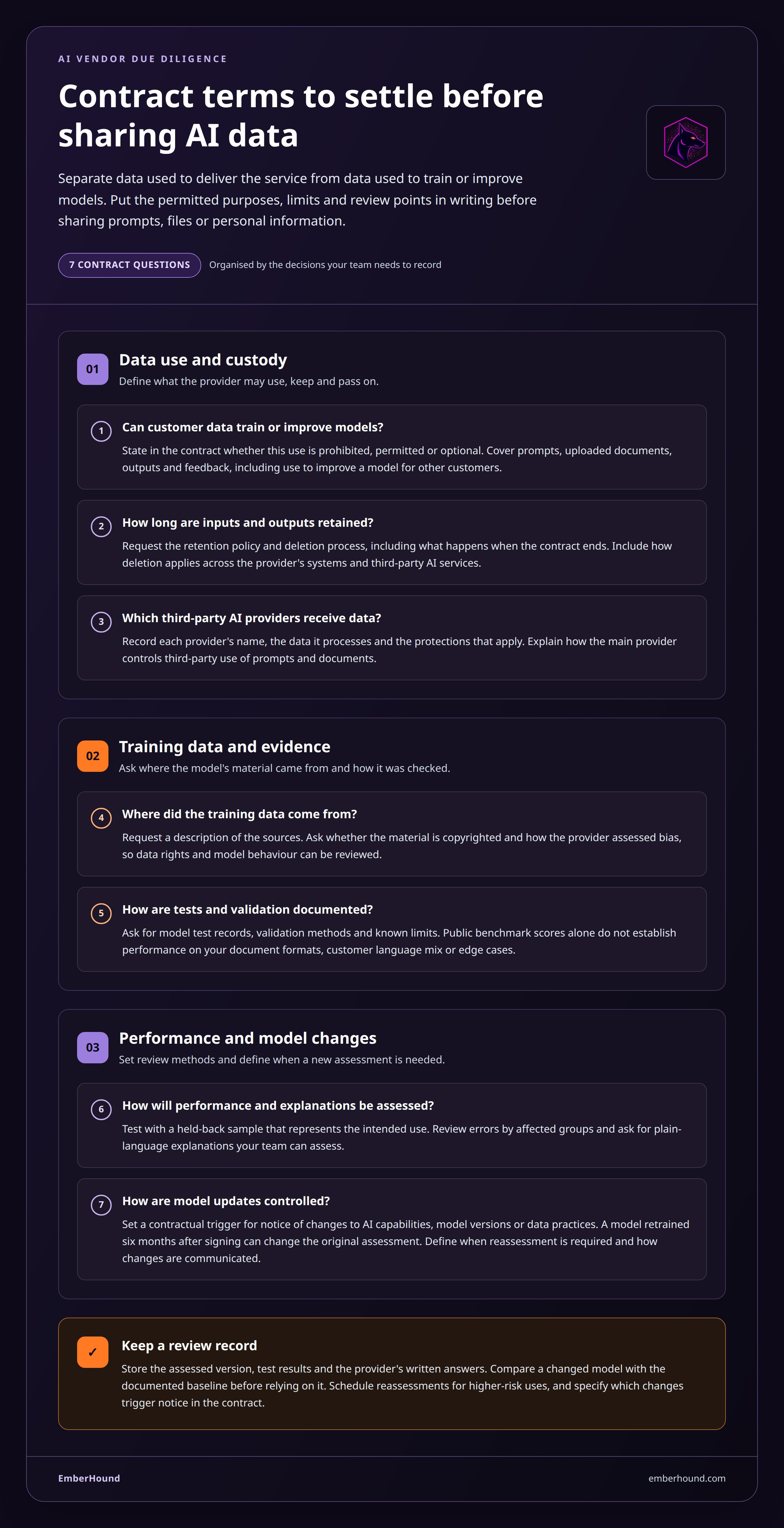
Agree the provider’s rules for customer data in the contract before sharing prompts, files or personal information. Your checklist should distinguish data needed to deliver the service from data used to train or improve models. Ask whether your information can be used to improve a model for other customers, and make the permitted purpose explicit in writing.
- Can the provider use our data to train or improve models? Require the contract to state whether this is prohibited, permitted or optional. Cover prompts, uploaded documents, outputs and feedback, so the restriction applies across each data type.
- How long does the provider retain input and output data? Ask for the retention policy and deletion process, including what happens when the contract ends. The terms should describe how deletion is handled across the provider's systems and any third-party AI services.
- Which third-party AI providers receive customer data? Request their names, the data they process and the protections that apply. If a third party handles prompts or documents, the contract should explain how the provider controls that use.
- Where did the model's training data come from? Ask the provider to describe its sources, address whether the material is copyrighted, and explain its bias assessment. These answers help identify where data rights or model behaviour need closer review.
- How are testing and validation documented? Ask for records of model tests, validation methods and known limits. Public benchmark scores alone cannot show how a system performs on your document formats, customer language mix or edge cases.
- How will performance and explanations be assessed? Test the system on a held-back sample that represents the intended use. Review errors by affected groups, and ask the provider to explain outputs in plain language that your team can assess.
- How are model updates controlled? Set a contractual trigger for disclosing changes to AI capabilities, model versions or data practices. A model retrained six months after signing can change the original assessment, so define when reassessment is required.
Keep the assessed version, test results and provider’s written answers in your records. If the provider changes the model, compare the new version with your documented baseline before relying on it. Schedule reassessments for higher-risk uses, and treat the review at signing as your baseline. The contract should define which changes trigger notice and how the provider will communicate them.
What is an AI vendor questionnaire?
An AI vendor questionnaire is a structured set of questions for a potential provider before you sign a contract. For UK GDPR, ask how the provider handles personal data, who determines its purposes, which subprocessors receive it and how long it is retained. Request evidence and documented answers, not general assurances.
The UK AI procurement questionnaire covers training-data sources, input and output handling, data protection, security, technical specifications and suitability for the intended use. Treat it as a starting checklist, then adapt questions to the information your proposed AI system will receive, such as staff records, customer messages or scanned identity documents.
- Who determines why personal data is processed? Establish whether your organisation or the provider decides each processing purpose. A provider using customer data to improve its own models determines that purpose and acts as a controller for that processing.
- What instructions govern processing? Where the provider acts as a processor, document the permitted purposes and instructions. Under the GDPR, processors may process personal data only on the controller's documented instructions, and controllers must use processors that provide sufficient guarantees.
- Which subprocessors are involved? Request their identities, roles and data access. The Data Protection Commission says processors need specific or general written authorisation before engaging a subprocessor. Record how changes to that list are communicated.
- How is data classified and minimised? Ask whether the system needs full records or selected fields. For example, replace names with reference numbers before sending support tickets, where the task does not require names.
- Where is data stored and accessed? Ask for the relevant storage and processing locations, including locations used by subprocessors. Set out any residency requirements in the contract and ask how remote access is controlled.
- What training data supports the model? Request the source categories, collection method and provenance records. Ask how the provider handles intellectual property rights in training material and defines ownership of generated outputs in writing.
- How are hostile inputs and tenant boundaries tested? Ask how the provider tests prompt injection, where malicious content tries to alter instructions, and whether one customer could retrieve another customer's data. Request test evidence for access separation and data leakage controls.
Record each answer beside the evidence supplied, the data category involved and the relevant contract term. That makes gaps visible before use. It also gives governance teams a basis for reviewing retention, access and data use as the system changes; a data discovery assessment can help map personal information before setting those controls.
AI incident response and contractual accountability
Agree incident obligations before the AI provider receives business data. The contract should specify the provider’s notification timeline, the information it will supply during an investigation and the contacts responsible for updates. A processor must notify the controller of a personal data breach without undue delay. A clear contractual timeline makes that obligation easier to manage in practice.
Compare vendors by mapping each charge to its billing unit, expected usage and overage terms. Include setup, support, storage and exit costs where relevant, then agree a spending ceiling and data export format before the pilot ends. This helps clarify how total cost and portability depend on usage, contract terms and the work required to move data.
- Review the SOC 2 report's scope and period. A report covers a defined scope and period against selected trust services criteria. Check whether it is Type I or Type II, and read testing exceptions before treating it as evidence for the service you will use.
- Identify complementary user entity controls. SOC 2 reports can assign controls to the customer as well as the provider. Record each customer-side action, such as restricting staff access, then assign an owner and review it alongside the provider's controls.
- Check subservice organisation treatment. Find out whether a report includes subservice organisations or excludes them. If excluded, identify which services sit outside the report's scope and how that affects your own assessment.
- Agree an incident response process. Specify who sends the first notice, what details it contains and how updates arrive. Include a route for escalating suspected exposure of prompts, uploaded files or generated outputs.
- Define data return and deletion at exit. Put the return process in the agreement before signing. State the export format, delivery method, deletion process and treatment of copies held by subcontractors.
- Set boundaries for intellectual property claims. Ask whether the provider will indemnify your organisation against third-party intellectual property claims arising from model outputs. Write the scope, exclusions and claim-handling process into the contract.
- Control shadow AI and pilot consumption. Set usage alerts and a hard spending ceiling before a pilot ends. Monitor approved tools and access routes so staff use does not shift into unreviewed AI services.
Keep the report, contract terms and incident contacts together in the vendor record. Review them when the service, scope or subservice organisations change. For a live incident, the response plan should specify who preserves relevant records, assesses affected data and communicates with the controller. Clear ownership and a usable export format reduce confusion during escalation or exit.
Is there an official AI vendor checklist?
Yes. The UK AI procurement questionnaire gives organisations a structured way to assess AI suppliers before procurement. It covers legal, operational and ethical risks, including training data, input and output handling, security, bias and human intervention. Use it as a baseline, then add checks for the system’s purpose, data and risk category.
A questionnaire captures only a point in time. Models, subprocessors and vendor arrangements can change, so assign an owner and review schedule. An assessment can become outdated within six months. Set review triggers for a material model update, a new use case, a security incident or a change in data access.
- Set reassessment frequency by risk category. Reassess critical-risk vendors quarterly, high-risk vendors semi-annually and medium-risk vendors annually. Record the category, review date, accountable owner and evidence considered.
- Refresh the questionnaire baseline annually. Update regulatory questions when the underlying regulation changes. Keep the previous version so procurement teams can identify which questions or supplier answers changed.
- Confirm what changed since the last review. Ask about model versions, subprocessors, data sources and intended uses. Compare answers with the previous assessment and reopen checks where the provider's practices or system capabilities have changed.
- Retest bias after material changes. Ask whether the provider tests for bias before launch and how often it retests. Review results for the groups affected by the process, especially after changes to training data, inputs or decision rules.
- Review customised workflows. Ask what systems and guardrails reduce risks when staff customise AI workflows. Check who can alter instructions and whether those changes receive review before use.
- Assign human oversight. For high-risk AI systems under the EU AI Act, deployers must follow instructions for use, assign human oversight within their organisation and monitor the system. If used in a workplace, affected employees and workers' representatives must be informed beforehand.
Use the UK questionnaire’s human-intervention questions to decide where people should review outputs or be able to override decisions. For example, a recruitment workflow could require a trained reviewer to assess flagged applications before a decision. Document who reviews the result, which inputs they see and how they record the action taken.
Keep monitoring practical. A risk owner can track scheduled reviews, provider change notices and unresolved findings in one register. If the provider changes its model between formal reviews, record the change and assess whether it affects the system’s purpose, data or oversight. Use the checklist as an ongoing procurement control, with regular reviews after signing.
Auditability of AI-driven actions
An AI tool needs records that let your team reconstruct what happened. Ask whether each report can link an output to its input, model version and timestamp. For a document summary, that means preserving the source file reference, generated summary and any human edits made before use.
Ask for explanations in plain language. A reviewer should be able to understand why an output was produced, which inputs influenced it and where uncertainty remains. Record who reviewed the result and what action followed. This gives an auditor a traceable sequence, rather than an isolated answer without context.
- Record inputs and outputs. Confirm which prompts, files and system instructions can be logged. A support team investigating an incorrect response needs the original prompt and output, not a later reconstruction from memory.
- Capture model and configuration changes. Include the model version and relevant settings in each record. Two reports may differ because the provider changed the model or configuration between requests.
- Keep human decisions visible. Record when a person accepted, edited or rejected an AI recommendation. For an application review, retain the recommendation and the reviewer's final decision with the reason for any override.
- Set access and retention rules. Limit log access to people with a defined review role. Set retention according to the audit purpose and applicable data protection requirements, since logs may themselves contain personal or confidential information.
- Test whether records support an investigation. Run a sample incident review before deployment. Ask a reviewer to trace a disputed output from its source input through the model response to the final action.
- Check logging obligations for covered systems. For high-risk AI systems, EU AI Act Article 19 requires providers to keep automatically generated logs for at least six months, subject to other applicable Union or national law.
A useful audit record supports a specific question: what information entered the AI tool, what did it return, and who acted on that result? Keep the report linked to the relevant case or transaction, with access controls that prevent unrelated staff from viewing sensitive inputs. If external-drive files may become AI inputs, review sensitive data on external drives to identify what needs scrutiny before use.
EmberHound
EmberHound helps you identify sensitive information before deciding what data an AI provider should receive. GDPR Data Discovery and PCI Card Data Discovery help locate personal and payment card data across your business. Combined GDPR + PCI Coverage addresses both data categories, while the DSAR Disclosure Pack supports subject access request handling.
Use data discovery when due diligence raises a practical question: which files, records or systems might contain information staff could send to an AI tool? Knowing where sensitive data sits helps your team decide what needs protection and which uses require closer review. It supports your assessment, but does not replace reviewing the provider’s contract, controls or audit evidence.
Make due diligence part of release control
Treat approval as a decision with an owner, conditions and a review point. Tie your AI vendor due diligence questions to the specific use case and record what could change the decision. When a team adds a data source or gives a system a new role, revisit the approval. This keeps the assessment connected to how the tool is used.
Assign someone to track changes and route them to security, privacy and operational owners. Together, they can decide whether existing controls remain suitable, whether use should pause or whether more evidence is needed. Set out that decision path before deployment, not after a concern arises.
A concise decision record also helps new team members understand why a system was approved and which assumptions mattered. Use it to make future reviews clearer and quicker.
With a clear owner and a workable review process, your team can make its next decision with greater confidence.
Frequently Asked Questions
How does AI vendor due diligence differ from standard IT vendor risk assessments?
AI reviews should examine model behaviour as well as the provider’s general security controls. A conventional software review may focus on access, availability and data handling; an AI review should also test how outputs vary with different inputs. For example, compare responses to representative and unusual customer requests. Record where errors could affect people or business decisions, then set review criteria for those outcomes.
Does the AI Act make the buyer responsible?
No. The EU AI Act distinguishes providers, who develop and place systems on the market under their own name, from deployers, who use systems under their authority. A buyer can become a provider by putting its own name on a high-risk system, substantially modifying it or changing its purpose so it becomes high-risk. Specified deployers have separate duties, including a fundamental rights impact assessment before use.
How can procurement teams prevent hidden cost overruns in consumption-based AI pricing?
Agree how usage will be measured before a pilot starts. Map the billed unit, such as requests or processed data, to a realistic workflow and expected volume. Include repeated requests, longer outputs and staff testing in your estimate. Set usage alerts and a spending ceiling, then compare actual consumption with the agreed limits before expanding access or moving the system into routine use.
Start with roles: who is the controller, who is the processor?
Assign roles separately for each data use. Your organisation may control processing for a service, while the vendor acts as a processor under your instructions. If the vendor uses customer data to train its own model, it determines the purpose of that processing and acts as a controller for that activity. Map each purpose to a role before signing, especially if one contract covers both service delivery and model improvement.
What IP indemnification protections should procurement demand from AI vendors?
Ask the vendor to cover third-party intellectual property claims arising from model outputs, and define the scope in the contract. Check whether the protection excludes claims linked to the vendor’s training-data choices. Specify who manages the claim, who controls the response and what remedies apply. Also define ownership and permitted use of generated outputs, so staff know what they can retain or reuse.
What questions should organisations ask AI vendors during due diligence?
A practical set of AI vendor due diligence questions starts with the intended use, data types and decisions the system may influence. Ask for evidence that its performance was tested on material like yours, including relevant languages and document formats. Then ask who reviews outputs, how errors are escalated and which changes trigger a fresh assessment. A focused scenario, such as processing a typical customer request, can reveal gaps that generic answers miss.
How should AI vendors explain data use, retention, training and deletion?
Ask for a data lifecycle account that separates prompts, uploaded files, outputs, feedback and service logs. For each category, establish its purpose, retention period and deletion process. Ask whether any derived data remains after deletion, and whether staff can request deletion of records held by subprocessors. The explanation should distinguish data used to deliver the service from data used for model development.
What AI security, access control and incident response checks should buyers make?
Include AI vendor due diligence questions about how user and administrator access is granted, reviewed and removed when roles change. Check whether access events can be linked to an individual and whether the vendor can provide relevant records during an investigation. Agree how suspected incidents are reported, what the first notice will include and how updates will be handled. Test the escalation route with a realistic scenario before relying on it.


