

A high-risk AI system needs more than a policy statement. Providers need evidence showing how they manage risks, govern data, log system activity and put human oversight into practice. That is the core answer to what evidence the EU AI Act requires.
Organising the records can feel like a second job, especially for a small team. Make each record useful: it should explain what the system does, where it is used, who is responsible and how safeguards work in practice.
This guide covers the evidence to organise, from AI inventories and public registration to technical documentation, logs and oversight records. It also explains how the requirements connect to day-to-day work and where sensitive-data discovery can support the wider process.
Key Takeaways
- Build evidence around the system's risk classification and the obligations that apply to its intended use.
- Keep the AI inventory, public registration details and technical records consistent as systems change.
- Use logs and oversight records to show how the system operates and how people can intervene.
- Assess the data and real-world context behind each system, including where personal information may be held.
- Use data discovery to identify sensitive information that may matter to wider privacy and compliance work.
Transparency and public registration of high-risk AI
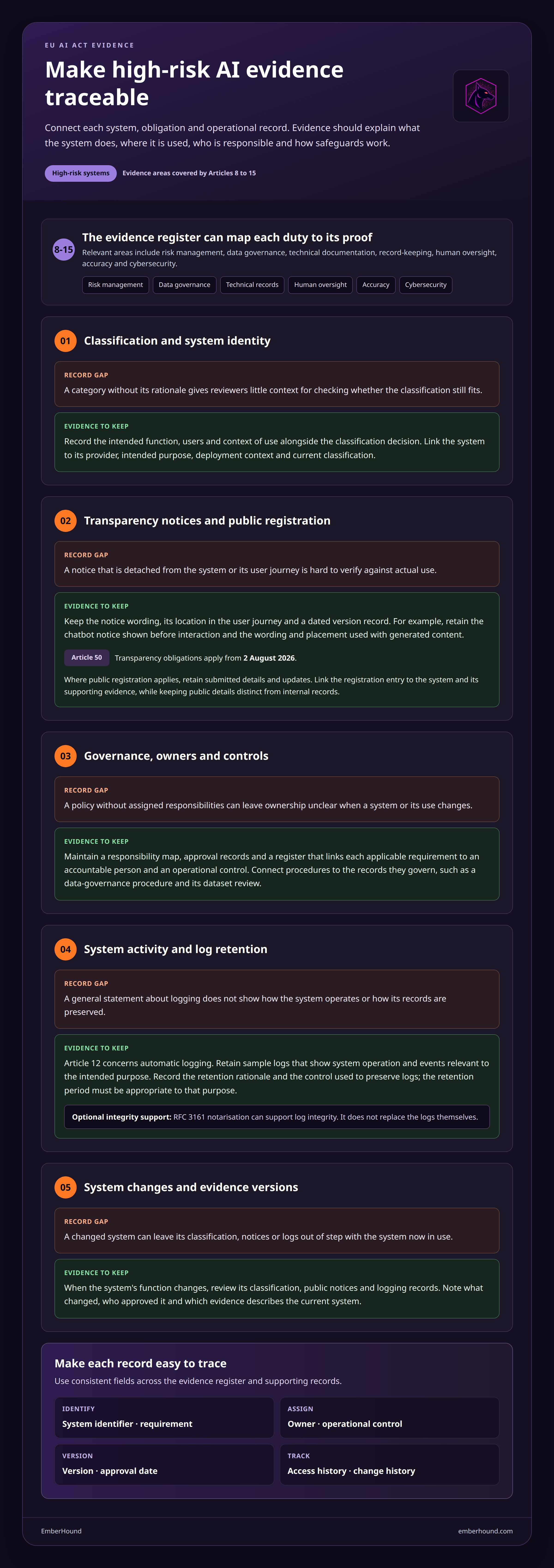
Evidence for AI Act transparency rules should show what people are told, where they see it and which AI system the notice covers. Article 50 transparency obligations apply from 2 August 2026. Keep the notice wording, its location in the user journey and a dated record of the version used. Teams asking what evidence for the EU AI Act they need can start by linking each notice to the system and its intended use.
The EU AI Act classifies AI systems by risk, distinguishing unacceptable, high and low risk. The strictest requirements apply to high-risk systems. Record the system’s intended function, users and context of use alongside your classification decision. This gives reviewers a clear rationale for the category and a basis for checking whether later changes affect it.
Public registration and internal inventory records serve different purposes. Where registration applies, keep the submitted details and any updates. Internally, link each system to its provider, intended purpose, deployment context and current classification. Keep the records connected so a registration entry can be traced to its system and supporting evidence. This also makes it clear which details are public and which belong in internal documentation.
For transparency, the evidence should match the way the AI system is used. Article 50 covers telling people when they are interacting with AI or with generated content. A practical record might include the notice shown before a user interacts with a chatbot, the wording attached to generated content, and evidence of where each notice appears. These records show how transparency is implemented; they do not replace assessment of which legal duties apply.
High-risk AI obligations sit across Articles 8 to 15. They cover risk management, data governance, technical documentation, record-keeping, human oversight, accuracy and cybersecurity. An evidence register can map each applicable obligation to the document, system record or operational control that supports it. Mark the owner and review date for each item, so gaps and outdated material are visible. This also helps answer what evidence for the EU AI Act a provider should retain for each requirement.
Article 12 concerns automatic logging. Keep sample logs that show the system’s operation and the events relevant to its intended purpose. The Act requires retention for a period appropriate to that purpose. Record the retention rationale and the control used to preserve logs. RFC 3161 notarisation is an optional way to support log integrity; it is not a replacement for the logs themselves.
Keep related evidence connected. If a high-risk system’s function changes, for example, review its classification, public-facing notices and logging records. Note what changed, who approved it and which evidence describes the system now in use. A clear trail helps reviewers see whether published information and internal records still match.
AI Act compliance guidance and codes of practice
Guidance helps providers interpret their obligations; governance turns them into records that can be retrieved and explained. A useful test is whether each record links a requirement to an accountable person and an operational control.
Governance and Compliance Evidence
Governance evidence shows who makes compliance decisions, owns each control and approves changes. A policy without assigned responsibilities can leave gaps when a system or its use changes.
Keep a responsibility map, approval records and a register linking each applicable requirement to its supporting evidence. For example, connect a data-governance procedure to the dataset review it governs, with an owner and review history. ISO/IEC 42001 is an international standard for Artificial Intelligence Management Systems. It can inform management-system design, but a standard or certificate does not by itself prove that every EU AI Act obligation is met.
Codes of practice and Commission guidance can help translate regulatory language into working controls. Treat each adopted or applicable instrument as a source for interpreting duties, then record which internal procedure addresses it. The European Commission published three instruments in July 2025 to support responsible development and deployment of general-purpose AI models. Those instruments concern that model category, so providers should map guidance to their own role and system.
Article 17 is associated with a presumption of conformity through a harmonised European quality-management standard. ISO 9001 may be used alongside an AI management system, as may ISO 27001 for information security and ISO 27701 for privacy. These standards support relevant management practices; they do not replace system-specific evidence or the technical documentation required by the Act.
Organise audit-ready evidence for retrieval. Give each item a clear system identifier, requirement, owner, version and approval date. Link the policy to the operational record and any review outcome. Reviewers should be able to trace a control from its stated purpose to an example of how it works. Keep access and change histories for records that may be updated.
Assess compliance software by the evidence it can organise and export. Check whether its records, access controls, retention settings and export formats fit your audit process. Assess platform pricing against your scope, data sources, users and retention needs, and review the costs before you commit. A dashboard or readiness score is not proof of legal conformity.
Compliance Deadlines
Compliance deadlines are the dates on which particular AI Act requirements begin to apply. The relevant date depends on the system category and provision, so relying on a single organisation-wide deadline can be misleading.
The Digital Omnibus moved the application date for high-risk AI obligations from 2 August 2026 to 2 December 2027. High-risk AI systems embedded in regulated products have an application date of 2 August 2028. Record the dates relevant to each system, its category and the evidence needed by then. A dated readiness plan can show owners, outstanding work and approval points.
Teams mapping sensitive information can scope a data discovery scan as part of that work.
AI inventories and assessment of use contexts
An AI inventory records each system’s purpose, provider and use context. It helps connect the system to evidence relevant to its actual function and provides an index to the supporting records.
Include the system name, intended purpose, users, affected groups, deployment setting and the decision it supports. Record whether it was developed in-house, adapted or supplied by another organisation. Add an owner and review history. For example, a recruitment tool that ranks applicants needs a different context record from one that drafts internal meeting notes.
Use context can change an assessment. A system’s output may affect people differently depending on who uses it, what decision follows and whether someone can challenge that decision. Record these factors alongside the intended purpose. If a team changes the system’s function, document the change and reassess whether the classification and supporting records still reflect its use.
A bias assessment needs evidence tied to the people and decisions affected. Record relevant population groups, test conditions, known limitations and how errors are handled. Keep test results linked to the version of the system they assess.
Technical evidence packs should make the system’s design and behaviour understandable to an assessor. Article 11 and Annex IV address technical documentation for high-risk AI systems. An organised pack can include a system description, intended purpose, data-governance material, risk assessment, test results and records of system changes. Identify the version each item covers, and retain approval or sign-off records where your process requires them.
An inventory or assessment summary is not a substitute for the technical documentation required by Article 11 or Annex IV. Treat the inventory as an index to the evidence, while the technical documentation explains the system and its compliance position. Keeping those records linked helps an assessor follow the trail from stated purpose to test result and output.
Conformity assessment is the process of assessing whether applicable requirements are met; evidence supports that assessment. The EU AI Act defines CE marking by reference to conformity requirements in Chapter III, Section 2, and other applicable EU harmonisation legislation. A notified body is defined in Article 3(22). Record the assessment route and supporting documents relevant to the system, then connect any CE marking records to that system’s technical file. A signed record should identify its approver and the version reviewed.
Deployer responsibilities and oversight
Deployers use AI systems in real settings, so their records should show how people oversee that use. To demonstrate responsible use of high-risk AI, document the system, its operating context and its human oversight processes. The precise evidence depends on the system’s function and the decisions it supports.
Article 14 of the EU AI Act concerns human oversight of high-risk AI systems. The evidence should show how oversight works in practice. Keep the oversight procedure, the role responsible for each action and records of relevant reviews together. For example, a record might show that an operator reviewed a flagged output and recorded the decision taken.
Art 14(4) addresses a human’s ability to disregard, reverse or stop an AI system’s output. A practical evidence trail can document how an operator accesses those controls, what prompts a review and how an intervention is recorded. Include an example from training or a controlled exercise, then retain operational records that show whether the process works during actual use.
A useful deployer record set can include:
- System and use context: identify the AI system, its purpose, the team using it and the decisions it informs.
- Oversight structure: record the responsible roles, escalation route and conditions for human review.
- Review records: document sampled outputs, concerns raised, decisions made and any follow-up action.
- Change history: note changes to the system or its local use, with the date and approver.
These items provide a practical framework for showing how deployers supervise a system, not a definitive statutory list of documents. Keep records proportionate to the system’s use, and link each entry to a named system and responsible role. Reviewers can then trace an output through to the human action taken.
Third-party AI still needs clear oversight within the deploying organisation. Keep the supplier’s system description and operating instructions with internal records of its use. Document who reviews outputs, how staff report unexpected behaviour and which role can pause use. If a caseworker spots an output that conflicts with source information, for example, the record should show the review, decision and escalation route.
When a system changes, review the oversight documentation against its current function and users. A new workflow can affect who sees an output or how it informs a decision. Record the review and any revised processes. This gives deployers a clear account of their oversight framework, including when human judgement can disregard, reverse or stop an output.
How does it all work in practice for providers of high-risk AI systems?
Start by checking whether any AI system supports a practice prohibited by Article 5 of the EU AI Act. The Act prohibits a short list of practices, including some systems that manipulate behaviour in ways likely to cause harm. A system’s stated purpose matters, but its actual function and use also need review.
The prohibitions numbered 1 to 8 became effective in February 2025. A further prohibition is due to come into effect in December 2026. These dates make a dated review useful: record when each system was assessed, what evidence informed the decision and who approved the outcome. Do not treat a high-risk classification as a reason to skip the prohibited-practices assessment.
For each system, describe its intended purpose, users, affected people and the action taken after an output. Then trace how it works in practice. A tool described as supporting staff decisions might still influence outcomes through rankings or recommendations. Record the workflow and the role of the output so the assessment reflects actual use.
Make the decision trail specific. Identify the system version, relevant function, use context and evidence reviewed. Record the conclusion, its rationale, the reviewer and the date. If the system changes, note what changed and whether it affects the original conclusion. This gives governance teams a clear route from the system’s purpose to decisions about its use.
For a possible prohibited practice, record the facts considered during the review. For example, document how the system interacts with people, what behaviour it seeks to influence and the potential harm considered. Keep relevant product descriptions, workflow materials and test records together. Distinguish observed behaviour from assumptions about what the system might do.
Transparency evidence can support this review by showing how an AI interaction or generated content is presented to people. Keep the relevant notice and the user journey where it appears. These records help explain the system’s deployment, but transparency measures do not settle whether its purpose or practices fall within Article 5.
Record a decision that can be revisited if the system, its users or its operating context changes. Link the assessment to the relevant inventory entry and assign an owner to review it. If the evidence raises concerns, document any decision to restrict or stop the relevant use, along with the action taken. This ties the assessment to operational outcomes.
Where an AI workflow involves sensitive information, teams can scope a data discovery scan to identify where that information is held.
EmberHound
EmberHound helps teams locate sensitive information relevant to their wider privacy and compliance work. Its GDPR Data Discovery and PII Data Discovery offerings help identify personal information across business data. These findings can inform records about data use, but they do not replace EU AI Act technical documentation or conformity assessment.
Use EmberHound when AI governance work raises questions about where personal information is stored. PCI Card Data Discovery and Combined GDPR + PCI Coverage support card-data discovery, while the DSAR Disclosure Pack helps with subject access request handling.
To discuss which data discovery option fits your needs, contact EmberHound.
Make evidence part of ongoing governance
Keep evidence connected to the AI system as its purpose, data and use change. Treat each change as a prompt to review relevant records, assign ownership and record the decision. This makes evidence part of normal governance.
Understanding what evidence the EU AI Act requires can also raise questions about personal information across your organisation. EmberHound’s GDPR Data Discovery and PCI Card Data Discovery help identify sensitive data, and Combined GDPR + PCI Coverage brings both discovery areas together. These tools support data visibility alongside AI governance, but do not replace legal assessment or technical documentation.
Choose the next step that fits the data question in front of your team. A clearer view of the information in your environment gives you a practical place to continue from. If you want to explore data discovery, start with EmberHound.
Record each decision when it is made.
Frequently Asked Questions
How are the penalties structured?
Penalties depend on the type of breach. The EU AI Act sets fines for prohibited practices, high-risk provider obligations and incorrect information, with different caps for each. High-risk provider breaches can attract a fine of up to 3% of total worldwide annual turnover where that exceeds the fixed cap. Prohibited-practice breaches can reach 7% of worldwide annual turnover. Lower, proportionate caps for SMEs extend to small mid-caps with up to 500 employees.
How has the Commission simplified the implementation of the AI Act?
The Digital Omnibus changed the application dates for some high-risk AI obligations, creating a later implementation timetable. It entered into force on 27 July 2026. High-risk obligations moved from 2 August 2026 to 2 December 2027, while high-risk systems embedded in regulated products have an application date of 2 August 2028. The Commission also published three instruments in July 2025 to support responsible development and deployment of general-purpose AI models.
What does the EU AI Act mean for AI deployers?
Deployers are organisations that use AI systems, so the Act makes their operating context central to compliance. They need to understand the system’s intended purpose and use it in line with its instructions. For high-risk systems, deployers should specify who monitors outputs and what that person can do when an output raises concerns. A caseworker using an AI recommendation, for example, needs a clear way to review it.
What does the EU AI Act mean for AI providers?
Providers develop AI systems or place them on the market, and the Act assigns duties according to system type and risk. For high-risk systems, providers need evidence addressing applicable requirements, including risk management, data governance, technical documentation, logging, oversight and cybersecurity. Identify who owns each obligation and link records to the relevant system version. A deployer that substantially changes a model may take on provider responsibilities.
What evidence shows the EU AI Act has entered into force and when do its rules apply?
The EU AI Act is Regulation (EU) 2024/1689, and it entered into force on 1 August 2024. That date does not mean every rule applied immediately. Application dates differ by provision and system category. For example, Article 50 transparency obligations apply from 2 August 2026. High-risk AI application dates include 2 December 2027 for stand-alone systems and 2 August 2028 for systems embedded in regulated products.
What are the EU AI Act’s risk categories and requirements for each?
The Act uses unacceptable, high and low risk categories. Prohibited practices fall into the unacceptable-risk tier and are barred under Article 5. High-risk systems face the Act’s most demanding requirements, covering matters such as risk management, data governance and human oversight. Lower-risk systems do not face that same set of high-risk obligations, although transparency duties can still apply. Classification depends on the system’s intended purpose and use.
What documentation and evidence must providers of high-risk AI systems maintain?
Providers need system-specific technical documentation and records that support the applicable high-risk obligations. Article 11 and Annex IV address technical documentation; Articles 8 to 15 cover requirements including risk management, data governance, logging, human oversight, accuracy and cybersecurity. A practical evidence pack can connect each requirement to the relevant system version, owner and supporting record. Keep change history with the file so reviewers can distinguish current evidence from superseded material.
What conformity assessments, CE marking and EU database registration does the AI Act require?
The conformity route depends on the AI system’s category and applicable product rules. The Act defines CE marking with reference to its conformity requirements and other relevant EU harmonisation legislation. It also defines a notified body as a conformity assessment body notified under the Regulation and relevant legislation. Where public registration applies, keep registration details and updates with the system records, linked to that system’s conformity documentation.


