

For UK organisations within the EU AI Act's scope, FRIA requirements apply to deployers of covered high-risk AI systems. Article 27 requires the assessment before deployment. It examines how an AI system could affect people's fundamental rights, including privacy, non-discrimination and access to essential services.
The rules can feel like another layer of paperwork, especially when you already have a DPIA. You can carry out the two assessments together, but an existing DPIA must be complemented by a FRIA to cover impacts beyond data protection, such as equality and access to justice.
This guide explains which organisations may need a FRIA, how to distinguish it from a DPIA and what information the assessment covers. It also sets out the resources available and the main phases, from scoping and risk identification to mitigation and documentation. The trigger is the system's risk classification and the organisation's role, not simply the fact that it uses AI. You'll get a clearer view of the work involved and where to begin.
Key Takeaways
- Assess your organisation's role and the AI system's use case to see whether the assessment duty may apply.
- A FRIA examines effects on fundamental rights beyond privacy. An existing DPIA may need additional analysis.
- Use the available assessment resources to organise evidence about the system, its purpose and the people it may affect.
- The process typically moves from scoping and risk identification to assessment, mitigation and documentation.
- Data discovery can help locate personal or payment card information relevant to your wider impact assessment work.
FRIA definition and purpose
A Fundamental Rights Impact Assessment, or FRIA, examines how a high-risk AI system could affect people's rights. Article 27 of the EU AI Act requires deployers of covered systems to conduct an assessment before deployment. It gives the organisation a structured way to identify possible harms and decide how to address them before the system enters use.
For UK organisations, the key question is whether the EU AI Act applies to their operations. The Act covers providers, deployers, distributors and importers operating within the European Union, regardless of where they are established. A UK organisation deploying a covered system in the EU may therefore have FRIA duties under the Act.
FRIA requirements focus on how a system is used in practice and how it affects people. For example, a hiring tool could affect access to employment if its decisions disadvantage a group of applicants. Assess who may be affected, how the system informs operational decisions and where those decisions could restrict rights or access to services.
The EU Charter of Fundamental Rights gives useful reference points for this analysis. Article 7 protects respect for private and family life, while Article 8 protects personal data. Article 21 concerns non-discrimination, and Article 47 covers the right to an effective remedy and a fair trial. These rights help frame questions about data protection, unequal treatment and whether people can challenge an outcome.
Link each possible impact to the system’s use. Consider whether an AI tool ranks applicants, supports eligibility decisions or informs access to an essential service. Explain how the tool influences decisions, who may be affected and what could happen if its output is inaccurate or discriminatory. This gives your organisation a basis for choosing proportionate measures.
A FRIA is not a one-off record to file away. A deployer must update it when relevant factors change or are no longer up to date. Changes to the system’s purpose, operating context or affected population can alter the impact analysis. Keep the assessment connected to operational decisions about the system rather than separate from them.
For personal-data questions, the UK GDPR data protection guide provides related context. A FRIA considers fundamental rights more broadly, so data protection is one part of the picture. The assessment should also consider discrimination, access to essential services and other rights affected by the specific use case.
Article 27 establishes the assessment duty, not a penalty amount. Any consequence must be assessed under the applicable enforcement provisions and the facts of the breach. A guessed figure would not answer what penalties apply to a particular failure.
Eligible organisations
Eligibility depends on the organisation's legal category and the AI system's use. The EU AI Act requires FRIAs from public-law bodies, private entities providing public services, and deployers of high-risk systems covered by Annex III points 5(b) and (c). These categories make the organisation's role and the system's purpose central to the assessment.
Public-sector organisations and private bodies delivering public services should consider whether their deployment falls within the relevant high-risk use cases. The Act covers a large subset of Annex III high-risk systems used by these deployers, except systems linked to critical infrastructure. A public service provider using AI to inform an operational decision should compare the use case with the Annex III categories.
Credit and insurance use cases have a specific place in the rules. Deployers using AI for creditworthiness evaluations, credit scoring, or life and health insurance risk assessment and pricing must perform a FRIA under Annex III entries 5(b) and (c). For example, a deployer using an AI system to assess a person's creditworthiness should identify that use, then assess its fundamental rights impact.
The wider high-risk classification also matters. The FRIA duty applies to high-risk systems outlined in Article 6(2), except systems intended for use in the area listed in Annex III point 2. Annex III includes use cases such as employment, credit scoring and law enforcement. That list helps organisations assess whether a system's intended purpose falls within a relevant category.
A UK organisation is not automatically outside the EU AI Act. The Act covers providers, deployers, distributors and importers operating within the European Union, regardless of where they are established. If your UK-based organisation deploys a covered system in the EU, assess the activity and your role rather than treating UK establishment as decisive.
For practical scoping, document your organisation’s role, the system’s intended use and the relevant Annex III category. Then identify whether the deployer is a public-law body, provides public services or uses AI for a specified credit or insurance purpose. This gives the implementation team a clear basis for deciding whether a FRIA is required and which deployment it covers.
FRIA and DPIA relationship
A Data Protection Impact Assessment (DPIA) examines processing likely to create high risks to people’s rights and freedoms under the GDPR. A Fundamental Rights Impact Assessment (FRIA) looks more broadly at how an AI system may affect fundamental rights. The assessments overlap when an AI system processes personal data, but their scope and purpose differ.
Article 27(4) of the EU AI Act allows a deployer to carry out a FRIA and a GDPR DPIA in one assessment. An existing DPIA must be complemented by a FRIA if it does not cover the required fundamental-rights analysis. Combining the work can reduce duplicated documentation, provided the assessment addresses both legal frameworks and their distinct questions.
The key difference is the range of rights examined. A DPIA focuses on risks linked to processing personal data. A FRIA also considers effects on equality, non-discrimination, freedom of expression and access to justice. For example, a system may process little personal data yet still affect someone’s ability to access a service or challenge a decision.
- DPIA: assesses risks to individuals from high-risk personal-data processing under the GDPR.
- FRIA: assesses wider fundamental-rights impacts associated with the AI system’s deployment.
- Combined assessment: may address both, if it clearly covers each assessment’s scope and findings.
Consider an AI system that ranks applications for a service. Its processing of personal data may require a DPIA if it is likely to create high risks to people’s rights and freedoms. The FRIA would also examine whether the system’s design or use could cause discrimination, limit access or make it harder to obtain an effective remedy.
Context matters. The same model can have different effects on rights depending on its purpose, the people affected and how staff use its output. A DPIA might identify risks from collecting or analysing personal information. A FRIA should also assess the consequences for affected people, including whether groups face unequal treatment or have a practical way to contest an outcome.
For a combined assessment, map each identified risk to the relevant right and framework. Record which findings relate to data protection and which concern wider rights. Then specify mitigation for each risk, linking each measure clearly to the harm it addresses. This helps teams see where the DPIA provides useful evidence and where further FRIA analysis is needed.
A shared document does not merge the legal tests. The GDPR’s DPIA threshold remains tied to processing likely to result in high risks to individuals’ rights and freedoms. Article 27(4) permits one assessment process, while the FRIA must still cover the AI system’s broader rights impact, particularly where privacy analysis leaves other affected groups or outcomes unexamined.
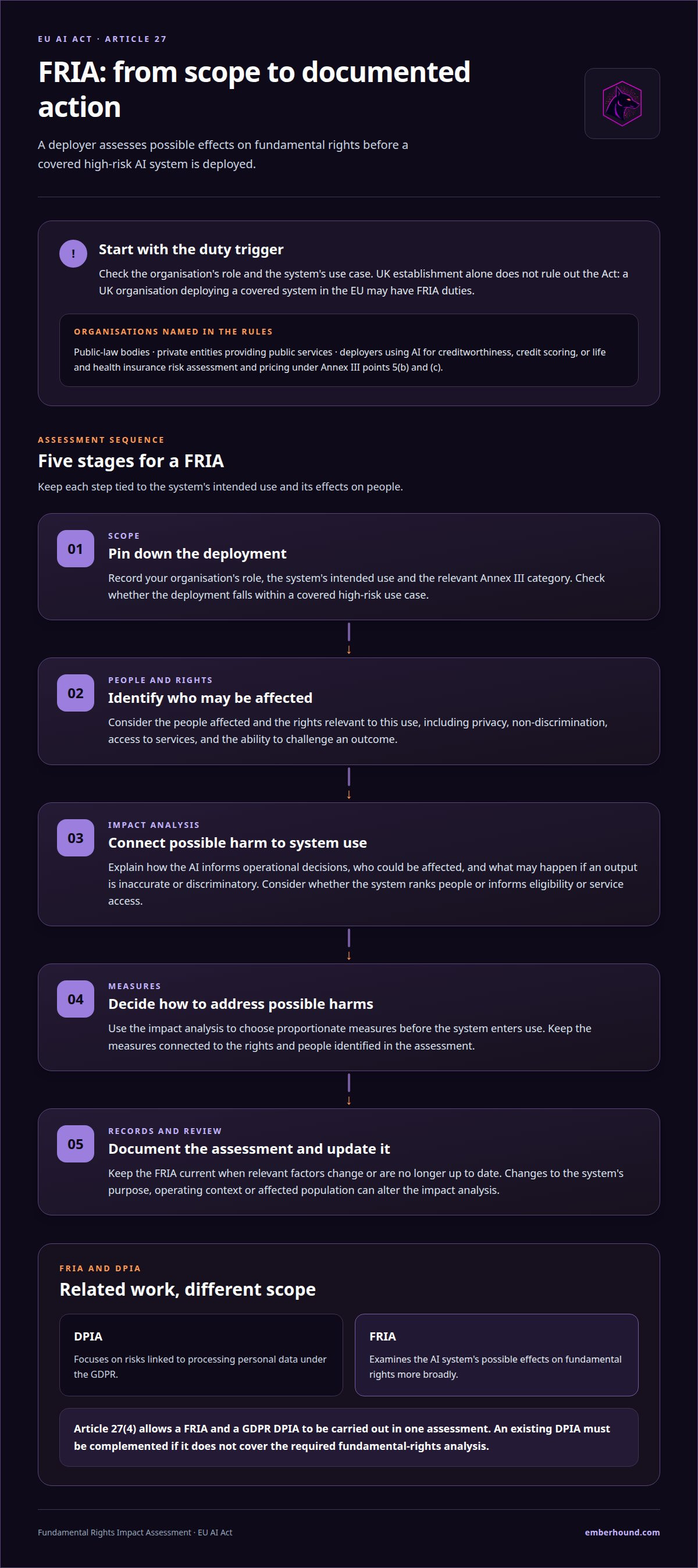
FRIA map and resources
A FRIA resource should help teams connect an AI system’s use to possible effects on fundamental rights. The European Commission released an EU AI Act Fundamental Rights Impact Assessment template in 2024. It gives deployers a structure for recording the system, affected people and potential impacts. Treat the template as a working document, not a substitute for analysing the actual deployment.
Article 27(5) sets out a further role for the AI Office: developing a FRIA questionnaire template and an automated compliance tool. The AI Office is also to publish a template for deployers to complete and submit to the market surveillance office with their FRIA results. These resources support the process; the assessment still needs evidence about the system’s intended use and operating context.
Use a template to organise the assessment around specific questions. For an AI system used in employment, record its purpose, the decisions it informs and the groups affected. Then link each possible risk to the relevant fundamental right. For example, a risk of discriminatory ranking calls for analysis of who may be disadvantaged and how the organisation could detect or reduce that effect.
Keep the documentation connected to implementation. The completed form should make clear which facts informed the analysis, which risks remain and which measures address them. If a measure changes how staff use the system, record that operational change alongside the risk it addresses. This helps the people responsible for deployment and later review use the assessment.
ISO/IEC 42005 is an AI impact assessment framework that complements FRIA requirements. It can inform an organisation’s wider approach to assessing artificial intelligence, while the FRIA remains focused on the EU AI Act’s fundamental-rights assessment. Keep the legal assessment’s purpose visible when using a broader framework, so general AI risk analysis does not displace rights-specific questions.
Some deployers must notify the competent market surveillance authority of their FRIA results, subject to limited exceptions. Make the results and supporting documentation clear enough to explain the assessment’s reasoning. Naming a risk without showing how it relates to the system’s use gives authorities little context for understanding the conclusion.
A FRIA Model guide is also available as a PDF with a file size of 1 MB. Use it alongside the Commission’s template when its structure helps organise evidence. For each resource, check that the final record still describes the actual system, the people affected and the measures selected. A template can prompt analysis, but it cannot supply deployment-specific facts or decide whether a risk is acceptable.
FRIA methodology and phases
A FRIA moves from the system’s intended use to documented risks and measures. Its phases help teams connect AI systems with their effects on individuals.
Information to include in a FRIA
A FRIA records what an AI system does, how people may be affected and which rights may be at risk. Describe the use case, the processes the system supports, how often and how long it is used, and who is likely to be affected. This gives the risk analysis a practical operational context.
For example, describe an AI system supporting recruitment decisions in terms of its role in the process and the applicants affected. Include relevant impacts, such as discrimination or limits on freedom of expression, where the use case raises them. Clear detail helps teams link each risk to appropriate mitigation.
FRIA completion and updates
A deployer must complete the FRIA before deploying a high-risk AI system. It must update the assessment when relevant factors change or are no longer up to date. Timing matters: an assessment based on an earlier system or operating context may miss current effects.
A change in purpose, process or affected population can alter the analysis. For example, extending an AI system from internal testing to decisions affecting service users changes who may be affected. Review the assessment against the current deployment before relying on its findings.
The methodology typically covers scoping, risk identification, risk assessment, mitigation and documentation. Each phase provides evidence for the next.
- Scoping: Describe the AI system’s use case and the processes it supports. Record how often and for how long it is used, then identify the people likely to be affected. A recruitment tool, for example, may influence applicant selection.
- Risk identification: Identify possible effects on fundamental rights linked to that use. Consider who could experience discrimination, lose access to a service or face restrictions on freedom of expression. Connect each concern to the system’s actual role.
- Risk assessment: Examine each identified impact in context. Consider how the system’s outputs affect decisions, which individuals may bear the consequences and whether existing controls address the risk. Explain the reasoning behind each assessment.
- Mitigation: Select measures that respond to the specific risks. A measure should identify the change, the risk it addresses and how it affects implementation. For example, a review step may be relevant where staff rely on AI outputs for consequential decisions.
- Documentation: Record the use case, affected people, identified risks, assessment and chosen measures. Keep the reasoning together so operational teams can understand what was assessed and what must change if the deployment changes.
Keep the phases connected. If the documentation reveals a new use or affected group, revisit scoping and risk identification before relying on the assessment.
EmberHound
EmberHound can support the data discovery work that informs an AI impact assessment. Its GDPR Data Discovery and PCI Card Data Discovery offerings help organisations identify sensitive information relevant to a wider review. Combined GDPR + PCI Coverage and a DSAR Disclosure Pack support related data discovery and access-request tasks.
Use these offerings when you need a clearer picture of personal or payment card data held across your organisation. That evidence can inform the data protection aspects of your assessment, while the FRIA must still address the system’s wider effects on fundamental rights.
Contact EmberHound to discuss your data discovery needs.
Put your assessment into action
Turn the assessment into decisions people can act on. Assign an owner to each mitigation measure, record the evidence supporting it and decide what changes would trigger a review. This gives operational teams a clear route from identified risk to action, rather than leaving findings in an unused document.
Use FRIA requirements to connect AI governance with existing data protection work. Where personal information is involved, keep relevant evidence accessible to the people responsible for reviewing the system. Clear records help teams understand why a decision was made and what needs attention if the system or its use changes.
You don’t need to solve every issue at once. Start with the highest-impact findings, assign responsibility and set a practical next step for each. A steady review process gives your team a clearer basis for decisions as AI use develops.
Make the next action clear, then build from there.
Frequently Asked Questions
What is a FRIA?
A FRIA, or Fundamental Rights Impact Assessment, examines how an AI system could affect people’s rights. It helps an organisation identify who may be affected and how the system’s use could shape their treatment. For example, a tool that ranks applicants could affect access to employment. The assessment records relevant risks and informs measures to address them before deployment.
Who Must Conduct FRIAs?
The deployer of a covered high-risk AI system must conduct the FRIA. This may be a public body using an AI system in its operations or a private organisation deploying one to provide a public service. A provider that builds a system is not automatically its deployer. The relevant role is the one the organisation performs in the system’s actual use.
What does FRIA stand for in the UK?
FRIA stands for Fundamental Rights Impact Assessment. It refers to the assessment under the EU AI Act, not to a separate UK institution. A UK organisation may still need to consider it if its role and AI deployment fall within the Act’s scope. The organisation’s location alone does not settle the question.
Which organisations must complete a FRIA?
Relevant categories include public-law bodies, private entities providing public services, and deployers using AI for creditworthiness or credit scoring, or for life and health insurance risk assessment and pricing. The system’s classification and intended use matter. For example, an organisation using AI to assess insurance risk should examine the applicable high-risk category and establish whether it is deploying the system.
How do you carry out a FRIA step by step?
Start by scoping the system: record its use case, the processes it supports, how often and how long it is used, and who is likely to be affected. Identify possible effects on rights, then assess each risk in the system’s operating context. Choose measures to address those risks and document your reasoning. For a recruitment tool, this could mean examining how its recommendations influence applicant selection and how potential discrimination is addressed.
How does a FRIA differ from a DPIA?
A DPIA focuses on risks to people arising from personal-data processing under the GDPR. A FRIA examines wider effects on fundamental rights, including equality, freedom of expression and access to justice. One assessment can cover both, but it must address both scopes. For instance, reviewing data handling alone may not establish whether an AI-supported decision limits someone’s ability to challenge an outcome.
What FRIA templates or guidance are available in the UK?
UK organisations can refer to the European Commission’s EU AI Act FRIA template, released in 2024, and the AI Office’s work under Article 27(5) on a questionnaire template and automated compliance tool. ISO/IEC 42005 is another AI impact assessment framework. These resources support assessment work, but the record still needs details about the specific system, deployment and people affected.


