

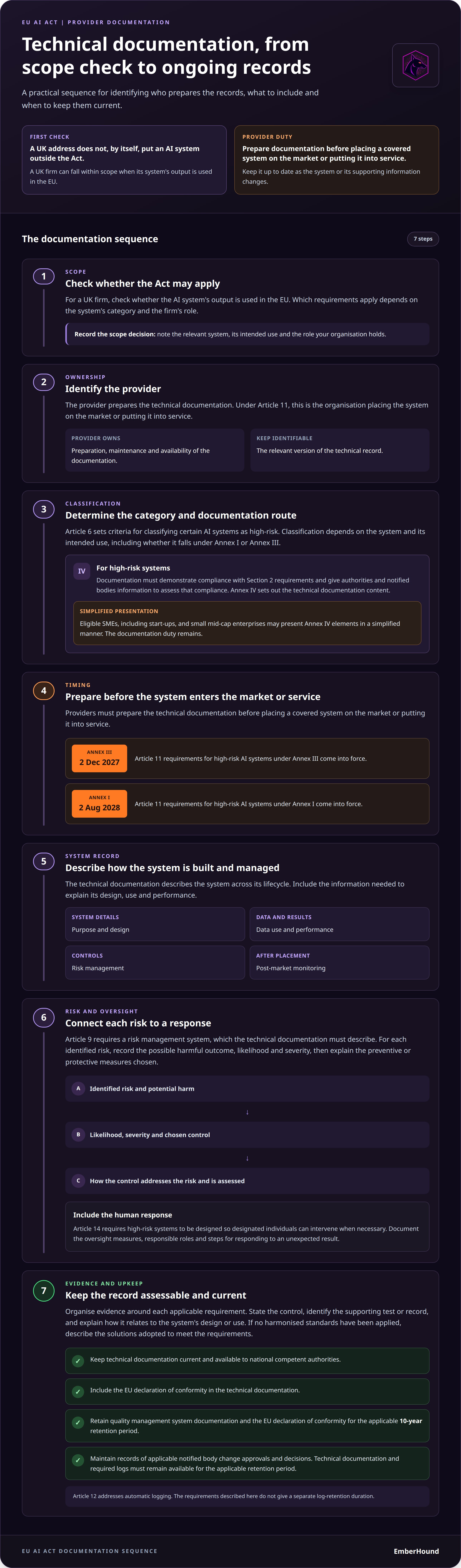
A UK address doesn’t put an AI system outside the EU AI Act. AI Act documentation requirements can apply to UK firms when their system’s output is used in the EU. Which requirements apply depends on the system’s category and the firm’s role. Providers of covered high-risk systems must prepare technical documentation before placing a system on the market or putting it into service, and keep it up to date.
The dates depend on the system's category. Requirements under Article 11 for high-risk AI systems under Annex I come into force on 2 August 2028. Eligible small and medium-sized enterprises, including start-ups, and small mid-cap enterprises may present Annex IV elements in a simplified manner.
The challenge is identifying the right documentation route and what the records need to demonstrate. This guide explains who must prepare technical documentation, when one set is required, and what to record about risk management, human oversight and data governance. It will help you understand which requirements apply to your system and what information your team needs to organise.
Key Takeaways
- Start by identifying your role and whether the AI system falls into a high-risk category. Those factors determine who prepares the technical documentation and which requirements apply.
- For certain high-risk AI systems linked to products covered by Union harmonisation legislation, one technical documentation set must bring together the AI Act and product-law information.
- Eligible SMEs, start-ups and small mid-cap enterprises may present Annex IV documentation elements in a simplified manner. Simplified does not mean skipping the required information.
- Keep records that explain how risks are managed, how people can oversee the system and interpret its outputs, and how relevant training data is governed.
- Use data discovery to locate sensitive personal or card data that may form part of your data governance work. A clear record of where that data sits can help inform the wider documentation process.
Who Must Prepare Technical Documentation and When?
The EU AI Act places technical documentation duties on providers of covered AI systems. For UK firms, its scope can depend on whether an AI system’s output is used in the EU.
Who Prepares Technical Documentation
The provider prepares the technical documentation for a covered AI system. Under Article 11, this means the organisation placing the system on the market or putting it into service. A UK firm can fall within the Act when its system’s output is used in the EU. Identify the provider role early: it determines who owns the documentation, maintains it and makes it available to authorities.
Preparation Timing and Retention
Providers must prepare technical documentation before placing a covered system on the market or putting it into service, then keep it up to date. Article 11 requirements for high-risk AI systems under Annex I come into force on 2 August 2028; those under Annex III come into force on 2 December 2027. Providers must retain quality management system documentation and the EU declaration of conformity for the applicable 10-year retention period. Technical documentation and required logs must remain available for the applicable retention period; Article 12 addresses automatic logging, but the requirements here do not give a separate log-retention duration.
High-Risk Systems and Annex IV
Article 6 sets the criteria for classifying certain AI systems as high-risk. The classification depends on the system and its intended use, including whether it falls under Annex I or Annex III. For high-risk systems, technical documentation must demonstrate compliance with Section 2 requirements and give authorities and notified bodies information to assess that compliance. Annex IV sets out technical documentation content. Eligible SMEs, including start-ups, and small mid-cap enterprises may present Annex IV elements in a simplified manner. Simplified presentation does not remove the documentation duty.
Provider Records and Documentation Duties
Provider records must show how the system is designed, tested and managed across its lifecycle. The technical documentation describes the system’s purpose, design, data use, performance, risk management and post-market monitoring. Articles 11, 56 and Annex IV are identified as sources of technical documentation requirements. Keep the relevant version identifiable, then update the documentation when the system or its supporting information changes. This gives reviewers a usable record of the system placed on the market.
- Keep the technical documentation current and available to national competent authorities.
- Retain quality management system documentation and the EU declaration of conformity for the applicable 10-year retention period.
- Maintain records of applicable notified body change approvals and decisions.
- Include the EU declaration of conformity in the technical documentation.
Risk management documentation
For high-risk AI systems, risk records must connect identified harms to the measures used to address them. They also help show how the system meets the EU AI Act’s applicable requirements.
Risk Assessment and Management Records
Article 9 requires a risk management system, and technical documentation must describe that system. Providers must establish, implement, document and maintain it under Articles 16 and 17. Record each identified risk alongside its potential harmful outcome, likelihood and severity. Then describe the preventive or protective measures chosen and how those measures address the risk.
For example, if an AI model supports a decision about access to a service, the record could describe the possible harm from an incorrect output. It should then explain the control used to reduce that risk and how the control is assessed. ISO 42001 Annex A controls can help plan risk treatment, but they are recommendations in this context, not a substitute for the Act’s requirements.
Human Oversight and Cybersecurity Information
Risk documentation should explain how people can intervene when the system’s operation creates a concern. Article 14 requires high-risk AI systems to be designed so designated individuals can intervene when necessary. Describe the oversight measures, the responsible roles and the steps available to respond to an unexpected result. Clear records help connect a stated risk to a practical human response.
Include cybersecurity information in the technical account of the system’s risks and controls. Describe the measures used to meet relevant requirements and link them to the risks they address. Make the intended purpose of AI models clear, as the relevance of a control depends on how the system is meant to be used. A general security statement is not evidence that a specific risk has been addressed.
Evidence of High-Risk AI Compliance
Technical documentation must demonstrate compliance with the requirements in Chapter III, Section 2, and give national competent authorities and notified bodies information to assess that compliance. Organise evidence around each applicable requirement: state the control, identify the supporting test or record, and explain how the evidence relates to the system’s design or use. When no harmonised standards have been applied, describe the solutions adopted to meet those requirements.
Article 43 requires the applicable conformity assessment before a high-risk system enters the market. That conformity assessment checks compliance with safety, transparency, data governance and technical requirements. The provider carries out the relevant assessment, draws up an EU declaration of conformity and attaches the CE marking to the system. Risk records should therefore match the system version assessed, so reviewers can trace the evidence to the system being placed on the market.
When Is a Single Set of Technical Documentation Required, and Who Can Use a Simplified Form?
The EU AI Act permits a single technical documentation set for certain high-risk AI systems associated with regulated products. It must cover the information required by both the Act and the applicable product legislation.
Single Documentation Sets for Product-Related AI
A single set is required when a high-risk AI system relates to a product covered by Union harmonisation legislation listed in Section A of Annex I, and the product is placed on the market or put into service. This brings the AI and product evidence together. The documentation must include information required by the applicable product legislation as well as by the AI Act.
Annex IV sets out the technical documentation required for high-risk AI systems. Describe the system’s intended purpose, design and interactions with hardware, software or other AI systems. Cover data use, testing, performance, risk management and post-market monitoring. Identify the system version and the product it supports, so the records clearly relate to the correct item.
If an AI system uses tools or takes actions, describe each interaction and its limits. For example, explain what information a connected tool receives and what actions the system can initiate. Testing records can show how it responds when a tool returns unexpected information or an action fails. This helps reviewers assess the system’s design and intended operation.
Quality management system documentation should support the organisation’s control of its technical records. Providers must retain the documentation concerning the quality management system referred to in Article 17 for the applicable 10-year retention period. Keep product and AI evidence organised around the relevant regulatory route. When a model or intended purpose changes, link the updated records to the affected system version.
UK Businesses Placing AI on the EU Market
The EU AI Act can apply to UK businesses that place covered AI systems on the EU market. It also applies to third-country deployers when a system’s output is used in the EU. Obligations depend on the firm’s role and the system’s use, so identify both before assembling the relevant documentation.
A UK provider should establish whether its system is high-risk and whether it relates to a product listed in Section A of Annex I. Then bring together the AI documentation and information required by the applicable product legislation. SMEs, including start-ups, and small mid-cap enterprises may present Annex IV elements in a simplified manner. This affects how those elements are presented, not the need to address the applicable requirements.
Human oversight and interpretable outputs
For high-risk AI systems, providers must document human oversight measures and how deployers can interpret outputs. Article 13 and Article 14 set the relevant documentation duties.
Human Oversight Measures
Human oversight documentation describes how designated people can intervene when necessary. Article 14 requires high-risk systems to be designed to allow that intervention. Record who is responsible, what decisions they can make and how they can respond to an unexpected output. The documentation should connect each oversight measure to the system’s intended purpose and identified risks.
Describe the practical controls, which may include human-in-the-loop decision-making, an emergency override, operating guidelines and user training. Explain when a person should review an output and what action they can take. For example, if a system supports a consequential decision, the records should explain how the responsible person can challenge or override its recommendation.
Oversight also continues after deployment. Under Article 26, deployers must monitor system operations and provide feedback to providers. Providers’ post-market monitoring plan under Article 72 should explain how performance is monitored. The post-market performance evaluation description must include the monitoring plan referred to in Article 72(3). These records connect oversight arrangements with ongoing risk management.
User Guidance and Interpretable Outputs
User guidance explains the system’s capabilities, limits and intended purpose in terms that support its safe operation. Article 13(3), point (d), addresses technical measures that help deployers interpret outputs. Document what those measures do, which users need them and how they relate to the system’s purpose. A clear account helps users understand when an output needs further review.
Instructions should cover operating steps and system limitations. Include relevant user training and guidance on responding to outputs that seem unreliable or fall outside expected use. Testing and validation records can show how performance was assessed, including accuracy and robustness metrics where applicable. Link the results to the version tested, so users and reviewers can identify the evidence that applies.
Transparency notices and instructions for use serve related but distinct purposes. The documented information should explain how the system works for its intended users and what its outputs mean. Article 50 transparency obligations apply from 2 August 2026. For AI systems placed on the market before those obligations apply, Article 50(2) compliance is due by 2 December 2026.
Keep the guidance consistent with changes to the AI system. If a new version changes its purpose, output format or user interaction, review the instructions and oversight measures. Article 73 also provides for applicable serious-incident reporting obligations. Records of incidents and resulting actions can inform later monitoring and updates to user guidance.
Data governance and documentation
For relevant high-risk AI systems, data governance documentation must show how datasets support the system’s intended purpose. Article 10 focuses on dataset quality and the way training data is selected and prepared.
Record whether datasets are relevant, representative, complete and as error-free as possible. These are qualities providers must address under Article 10. Explain how the data relates to the system’s intended use and which groups or conditions it represents. If a dataset has known gaps, document them and describe the measures used to address their effect on system performance.
For relevant systems, document the provenance, scope and main characteristics of training datasets. Include how data was acquired and selected, the labelling procedures used, and the methods applied to clean it. For example, if records were excluded during selection, document the method and rationale. This gives reviewers a traceable account of how source material shaped the model.
Data governance continues through testing and validation. Technical documentation must describe those procedures and include metrics for accuracy, robustness and compliance with Chapter III, Section 2 requirements. Keep dated and signed test logs and reports from responsible persons. Where no harmonised standards have been applied, provide a detailed description of the solutions adopted to meet the relevant requirements.
Link the evidence to the correct dataset and system version. Changes to data selection, labelling or cleaning can affect test results and system performance. Record each change, its rationale and the relevant validation evidence. This gives providers a usable record for oversight and post-market monitoring throughout the AI system’s lifecycle.
General-purpose AI models have separate documentation duties. Under Article 53(1)(a), providers must document training and testing processes and evaluation results. Annex XI sets minimum technical documentation content for those models. Annex XII sets minimum information and documentation content for providers intending to integrate them. Article 53(1)(b) requires specified information to be made available to those integrating the model.
Keep data records connected to the wider compliance file. The EU AI Act requires a copy of the EU declaration of conformity in technical documentation, while Article 10 data evidence supports assessment of data governance requirements. For a general-purpose model, its training summary and copyright policy also form part of the provider’s duties under Article 53. Separate model-level records from evidence about a particular high-risk system.
Map sensitive information across your organisation with GDPR data discovery.
EmberHound
EmberHound supports data discovery that can inform an AI system’s data governance records. GDPR Data Discovery identifies sensitive information, while PCI Card Data Discovery focuses on card data. Combined GDPR + PCI Coverage addresses both frameworks.
These services help teams locate relevant information, but they don’t prepare EU AI Act technical documentation or replace legal compliance advice. A DSAR Disclosure Pack supports subject access request disclosures, a related task for organisations handling personal data.
If data discovery is your next task, contact EmberHound.
Make the next review easier to manage
Keep a decision trail alongside the technical records. Note why each change was made, who approved it and which evidence informed the decision. This context can help the team understand how the documentation has developed over time.
AI Act documentation requirements are easier to manage when each change decision has a clear owner and rationale. Consistent records also give colleagues a useful starting point when responsibilities change or a review begins.
Set a routine to check whether the documentation still reflects the system and the decisions made about it. Focus each review on unresolved gaps, so the next action is clear.
Give your team a clear record to work from as its AI governance develops.
FAQs
Do deployers need documentation too?
Yes. A deployer's records show how the system was used in a particular deployment. The provider's records describe how it was built. Link the deployment clearly to the provider's instructions and any operational feedback sent back. If a fundamental rights impact assessment is required, retain it with the deployment records. This separation helps teams identify which organisation holds each piece of evidence.
What technical documentation must high-risk AI systems have under the EU AI Act?
The technical file must enable reviewers to assess the system against the applicable requirements. Organise it so each item clearly identifies the system version and supporting evidence. For example, dated test reports should specify the version tested. If the provider has not applied harmonised standards, the file needs a detailed account of the solutions used to meet the relevant requirements.
What documentation duties apply to deployers of high-risk AI systems?
Deployers should keep records that make operational events traceable. If an output raises a concern, record the affected system, what happened and the feedback sent to the provider. Link any follow-up action to the event. This creates a useful account of the system's behaviour in context and distinguishes the deployer's operational records from the provider's design and testing evidence.
What conformity assessment and EU declaration of conformity documents are required?
Providers need the applicable conformity assessment evidence and an EU declaration of conformity for the high-risk system. Keep the declaration with the technical file and identify the system version it relates to. If notified body decisions or change approvals apply, retain them with the assessment evidence. This gives reviewers a clear route from the declaration to its supporting records.
What documentation requirements apply to general-purpose AI models and models with systemic risk?
General-purpose AI model providers must make specified information available to providers integrating their models, and make technical documentation available on request to the EU AI Office and national competent authorities. Models trained with cumulative compute exceeding 1025 FLOPs are considered to present systemic risk. The documentation exception for certain free and open-source models does not apply to models with systemic risk, so licence type alone does not settle the question.
How long must AI Act technical documentation and logs be retained?
Technical documentation and required logs must remain available for the applicable retention period. Quality management system documentation and the EU declaration of conformity must be retained for the applicable 10-year period.


