

The bigger data discovery platform may be the wrong fit for your team. BigID vs EmberHound is a practical comparison of what each tool scans, how it handles data, and what evidence it gives your team. A feature list alone can miss the details that matter when you need to assess a specific use case.
Choosing a tool takes more than comparing product descriptions. While software discovery platforms such as ToolVerraAI can help businesses navigate and compare digital tools, evaluating specialised compliance solutions requires a deeper look: you need to know which data sources are in scope, where scanning happens, what evidence your team can review, and how much time staff can give to running the process.
This article compares BigID with EmberHound's endpoint scanning, which processes data locally and does not exfiltrate raw files. It covers GDPR personal-data discovery, PCI card-data discovery, and combined coverage, as well as masked previews, salted fingerprints, and practical ways to assess fit. Where details about BigID need confirmation, the comparison identifies them as points to verify rather than making assumptions.
Key Takeaways
- List the data types, repositories, and endpoints your team needs to scan before comparing platforms.
- BigID vs EmberHound comes down to scope, scanning boundaries, evidence, and the operating model your team needs.
- Compare data coverage, processing location, evidence, add-ons, and pricing. Use current official information for BigID details.
- Use a four-step fit check: set the scope, define evidence needs, review processing boundaries, and compare how each tool will be run.
- Test a focused discovery question with EmberHound to assess its masked previews and salted fingerprints against your team's review needs.
BigID vs EmberHound: define the data discovery job before comparing tools
Data discovery locates and maps sensitive information across the data sources an organisation needs to understand. It can show a team where relevant records are held and what a scan identifies. Discovery results alone do not establish compliance. They need to be assessed against the organisation's obligations and procedures. Data Discovery on Wikipedia gives background on the wider term and related processes.
Define the job before comparing vendor names. Feature lists can combine discovery with classification, privacy workflows, or security services, although these address different needs. Discovery locates data. Classification assigns categories to it. Privacy workflows can support tasks such as responding to a data access request. Security services may cover other controls. Decide which capabilities your team needs for the work in scope.
For BigID vs EmberHound, begin with the records and repositories to be scanned. EmberHound's Discover track scans endpoints for sensitive data and processes scans locally. That gives endpoint-first teams a clear use case to assess. Before comparing any tool, list the environments you need covered. A broad product description does not establish that every source is in scope.
Which data discovery requirements belong in the comparison?
Write down the data types and repositories your team needs to locate. Separate endpoint files from other possible sources, such as mailboxes, shared drives, cloud services, or business applications. Treat each as a scope requirement, then record the reason for the scan:
- GDPR: identify the personal data your discovery work needs to find.
- PCI DSS: specify the card data and relevant locations in scope.
- Internal audit: state what evidence reviewers need and how they will use it.
These requirements can overlap, but they answer different questions. A personal-data search does not automatically cover a card-data requirement. A scan result may inform an audit, but it does not prove that every control or obligation has been met.
Who is comparing BigID with EmberHound?
Lean IT and compliance teams need to understand what a scan touches and what staff will do with its results. Evidence handling matters when the team needs to investigate findings without circulating raw file contents. EmberHound processes endpoint scans locally and does not exfiltrate raw files. Its evidence includes masked previews and salted SHA-256 fingerprints.
Teams with broader repositories, established privacy workflows, or several people involved in review and operation should add those requirements to the scope. They are not automatically needed for every use case. Start by answering these questions:
- Which data types and locations must be included?
- Who will review the findings, and what evidence do they need?
- How much staff time can the team give to running scans and reviewing results?
Once you have those answers, compare scanning boundaries and evidence against the work your team actually needs to do.
Compare BigID vs EmberHound by scanning boundaries and evidence
Separate what happens during a scan from what the team can review afterwards. Ask where processing takes place, what data leaves the endpoint, and what evidence the scan produces. These are different questions. For example, encryption details do not by themselves explain where scanning occurs or what a finding contains.
What does local endpoint scanning mean for EmberHound?
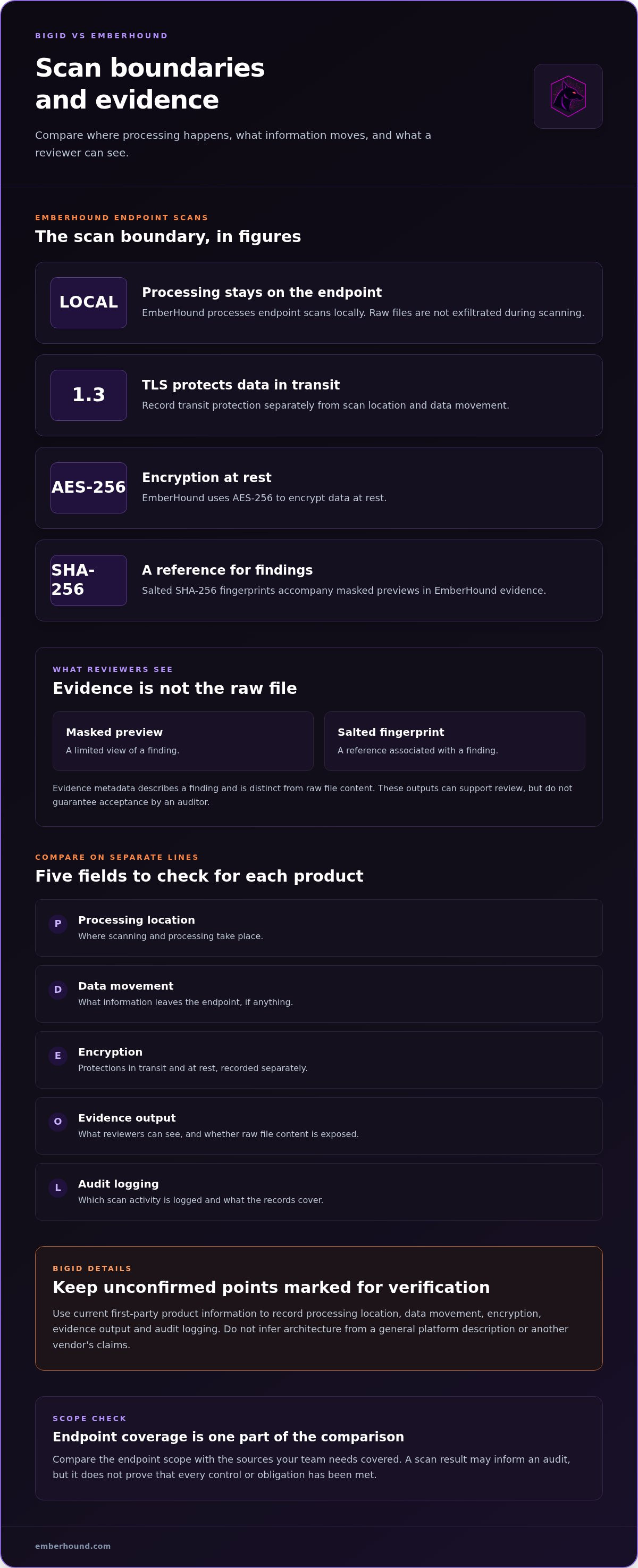
EmberHound processes endpoint scans locally. Raw files are not exfiltrated during scanning. This describes the processing boundary for endpoint scans; it does not mean that every repository in an organisation is covered. Compare the endpoint scope with the sources on your team's list.
For BigID, record the processing location, data movement, and evidence output from current first-party information. Keep any detail that the available documentation does not establish marked for verification. Do not infer a product's architecture from a general platform description or from another vendor's claims.
How should buyers compare security and evidence handling?
Use separate fields in your notes so one security detail does not stand in for a full account of data handling:
- Processing location: record where scanning and processing take place.
- Data movement: note what information leaves the endpoint, if anything.
- Encryption: record protections in transit and at rest separately.
- Evidence output: note what a reviewer can see and whether raw file content is exposed.
- Audit logging: record which scan activity is logged and what those records cover.
For EmberHound, TLS 1.3 protects data in transit, and AES-256 encrypts data at rest. Its evidence includes masked previews and salted SHA-256 fingerprints. A masked preview gives a limited view of a finding. A fingerprint provides a reference associated with it. Evidence metadata describes a finding; it is distinct from the raw file content itself. These outputs can support review, but their presence does not guarantee acceptance by an auditor.
EmberHound's audit logging covers data access and mutations. Keep this separate from evidence output: previews and fingerprints describe findings, while audit logs record relevant activity. For BigID, use current official product information to record the equivalent details before drawing a comparison.
For each product, note the source for every claim and distinguish documented behaviour from unanswered questions. This gives your team a clear basis for comparing processing boundaries and evidence handling.
If your team is assessing EmberHound's endpoint approach, a focused free scan can test a defined discovery question on an endpoint. Keep the test within the authorised scope and compare the resulting evidence with the criteria above.
BigID vs EmberHound feature comparison: map capabilities to your scope
A side-by-side table helps when each row maps to a requirement your team has already defined. A feature matters when it covers the data, location, or workflow you need. In the BigID column, use "verify" for details that need checking against current first-party documentation. An unverified detail is an information gap, not evidence that a product lacks the capability.
| Comparison area | BigID | EmberHound |
|---|---|---|
| Data scope | Verify current first-party documentation for personal-data discovery, card-data discovery, and combined coverage. | Supports GDPR personal-data discovery, PCI card-data discovery, and combined GDPR + PCI coverage. |
| Scanning location | Verify current first-party documentation for scanning locations and processing boundaries. | Scans endpoints, with processing performed locally. |
| Evidence | Verify current first-party documentation for evidence outputs and what reviewers can inspect. | Produces masked previews and salted SHA-256 fingerprints. |
| Add-ons and workflows | Verify current first-party documentation for DSAR support, OCR, mailbox, and external hard-drive scanning. | Includes a DSAR disclosure pack, OCR scanning, local mailbox scanning, and external hard-drive scanning. |
| Pricing model | Verify current first-party pricing and how quotes are scoped. | Uses a usage-based model, with a free-scan entry point and no mandatory contracts. |
Which data types and workflows should the table cover?
Keep the requirements distinct. Personal-data discovery relates to your GDPR use case; card-data discovery relates to your PCI scope. If both matter, list combined coverage as a separate requirement. The GDPR data discovery guide can help frame the personal-data row. For card data, specify the locations and records your PCI discovery needs to cover.
Record workflows and scanning options separately. A DSAR disclosure pack relates to a specific disclosure workflow. OCR, mailbox, and external hard-drive scanning are distinct capabilities, so include each when it is relevant to your use case. This makes it easier to see which requirements are covered and which still need assessment.
How should buyers read a feature comparison?
Use the same evidence standard for both columns. Mark a capability as documented only when a current source supports it. Use "verify" when the available information does not establish the detail. Keep vendor claims separate from your own test results, and do not count a roadmap item as a live capability. EmberHound's Protect track is on the roadmap and is not currently live.
Then connect each row to a decision. If your requirement is endpoint discovery with a defined evidence format, weigh those documented details against your team's operating needs. If your requirement involves more repositories or workflows, identify the specific rows that need further verification before comparing the tools. In BigID vs EmberHound, the table is useful when each feature answers a requirement your team has recorded.
Choose between BigID and EmberHound with a use-case fit check
A good fit depends on the work your team needs to do and can support. Apply the same test to both platforms: start with a specific discovery task and record what each product can demonstrate. This keeps broad product descriptions from deciding the outcome.
- Define scope. Name the data type and repository. For example, specify personal data or card data on staff endpoints.
- Set evidence needs. Decide what a reviewer must inspect and whether masked evidence suits your process.
- Check boundaries. Record where scanning and processing take place, and what data moves beyond the endpoint.
- Compare operating models. Consider who will run scans, review findings, and maintain the process alongside existing work.
When might EmberHound fit a lean team's requirements?
EmberHound fits use cases centred on local endpoint discovery for personal data or card data. Its evidence includes masked previews and salted fingerprints. Teams with a DSAR disclosure requirement can assess the DSAR disclosure pack against their workflow. Include OCR, local mailbox, and external hard-drive scanning in the evaluation when those sources are in scope.
These capabilities address specific use cases. If your requirements include other repositories or workflows, list them separately and compare the relevant documented capabilities. A broader scope may also change the operational work your team needs to plan for.
What should a fair product evaluation record?
Keep a short test record. Include the data types, repositories, and evidence requirements, along with who reviewed the result. Mark each item as documented, observed in a test, or still requiring current product documentation. This makes unknowns visible without treating them as product gaps. Use EmberHound's published security information when reviewing its security details.
Use a simple decision tree:
- If the task is endpoint-first and the documented scope matches, test that use case with EmberHound.
- If the task depends on other repositories or workflows, verify the relevant capabilities for both products before choosing.
- If the evidence or processing boundary does not meet your stated requirement, record why and assess another defined use case or product configuration.
For example, a lean team can test whether an endpoint discovery task produces evidence its reviewer can use. A larger team can apply the same method to each required source and workflow, then record the operational work involved. In BigID vs EmberHound, a bounded test gives the comparison a clear question and an observable result.
Assess EmberHound against BigID with a focused first scan
A focused test makes the comparison practical. Choose one device and write down a discovery question before scanning. For example: "Can this endpoint scan identify personal data in the files in scope?" For a card-data use case, ask: "Can the scan locate card data on this endpoint?" Keep the test within your organisation's authorised scope.
What can a first EmberHound scan help your team assess?
Use the scan to assess whether the endpoint approach suits your question and whether its evidence fits your review process. EmberHound processes scans locally on the endpoint, and raw files are not exfiltrated during scanning.
Review the locations identified and the evidence returned. EmberHound produces masked previews and salted SHA-256 fingerprints. Compare the findings with your discovery question and the scope of the scan. Record what the team can inspect, who will review it, and how the findings would be handled under your existing process.
To compare with BigID, use the same discovery question and evidence criteria wherever you can make a comparable assessment. Keep product claims separate from observations. Record BigID scanning-boundary or evidence details from current first-party information, and list any unresolved points as open questions.
What happens after you decide the fit is right?
Match the next step to your discovery requirement. EmberHound supports GDPR personal-data discovery, PCI card-data discovery, and combined GDPR + PCI coverage. Choose the path that matches the data and use case under review. EmberHound uses a usage-based pricing model, with a free-scan entry point and no mandatory contracts. See the EmberHound pricing model for pricing information.
Before expanding beyond the first test, record what it did and did not assess: the device, the discovery question, the locations in scope, and whether the evidence worked for your reviewers. This gives your team a basis for deciding whether to test another source or proceed with the relevant discovery coverage. In BigID vs EmberHound, a small, specific test answers a practical question without making claims about every requirement.
Turn the comparison into a clear next step
Before choosing a platform, agree on what a successful test needs to show. Set a clear question, identify who will review the result, and write down what would make the evidence useful. IT, compliance, and security colleagues can then assess the result against the same criteria.
Use BigID vs EmberHound to frame the decision around your team's workload. Keep unanswered requirements visible instead of filling gaps with assumptions. A short, documented test gives your team a practical basis for deciding what to assess next.
EmberHound's usage-based model includes a free-scan entry point and no mandatory contracts. Start with a defined use case and assess the results against your team's requirements.
Frequently Asked Questions
How much does BigID cost compared with EmberHound?
BigID has no public flat-rate price; its quote is scoped to factors such as data sources, applications, deployment type, and support needs. Third-party estimates may not match a quote for your requirements. EmberHound uses a usage-based model, with a free-scan entry point and no mandatory contracts. Compare the pricing basis with your expected data scope, then assess what each proposal includes before estimating the cost of running it.
Does data discovery software make an organisation GDPR compliant?
No. Discovery software can help locate personal data, but a scan alone cannot establish that an organisation meets its GDPR responsibilities. The result is one input for the people responsible for privacy and information governance. For example, a finding may prompt a team to review why the data is held, who can access it, and whether internal records or procedures need attention. Treat software output as evidence to assess, not as a compliance decision.
Can a data discovery tool replace a Data Protection Officer?
No. A data discovery tool scans for information; it cannot take the place of a Data Protection Officer's judgement, organisational oversight, or communication with colleagues. If your organisation has a DPO, use scan results as material for their review. A practical handover should state what was scanned, the purpose of the scan, and which findings need assessment, without circulating sensitive contents more widely than necessary.
What should we do after a scan finds sensitive data?
Route the result to people authorised to assess it. Check the file location and the type of data identified, then compare the finding with your internal access and retention processes. Record the decision and any follow-up action through your established process. Avoid copying raw contents into tickets or email. If the result may relate to a disclosure request or security incident, follow your organisation's relevant procedure and involve the responsible staff.
Do we need both GDPR and PCI card-data discovery?
Assess both if your discovery scope includes personal data and payment card data. The two requirements answer different questions, so do not assume that one scan purpose covers the other. For example, a team locating personal data for a privacy task should separately consider whether card data is also in scope. If both apply, compare combined coverage with the specific repositories and review needs involved.
Can a small IT team evaluate data discovery software without a long project?
Yes. A small team can begin with a bounded test, provided it has permission to scan the chosen device and a clear question to answer. Agree who will review the output and what would count as useful evidence before starting. Record the test scope and any unanswered product questions. EmberHound's free-scan entry point lets a team assess a real use case before considering a broader deployment.


