

Getting a fundamental rights impact assessment right starts with the system's context and the people it may affect. Under Article 27 of the EU AI Act, specified deployers must assess the fundamental rights impacts of covered high-risk AI systems before deployment. A fundamental rights impact assessment template helps organise that work around the intended use, affected groups, likely risks and planned safeguards.
The legal detail matters for UK organisations using AI systems within the EU AI Act’s scope. A GDPR data protection impact assessment (DPIA) focuses on data protection and privacy. It can support a FRIA only if it already covers the relevant obligations, so the two assessments may need to be linked without treating them as interchangeable.
This guide explains what a FRIA assesses, which sections to include, and how to identify affected people and groups. It also covers whom to consult, when to update the assessment, and how to connect it with a GDPR DPIA. You’ll find a practical structure for documenting the assessment and its safeguards.
Key Takeaways
- Structure the assessment around how the AI system will be used, who may be affected, and what safeguards will address identified risks.
- Map affected people and groups in the system's actual context of use, including those who may face greater barriers or harm.
- Plan stakeholder consultation so affected people can inform the assessment before deployment decisions are finalised.
- Set a review process for changes in the system, its use or the assessment findings.
- Use data discovery to identify personal information relevant to a GDPR DPIA or DSAR disclosure pack.
FRIA and GDPR DPIA differences and integration
- Set the scope of each assessment. A fundamental rights impact assessment (FRIA) examines how using a high-risk AI system may affect people’s fundamental rights. A GDPR data protection impact assessment (DPIA), governed by Article 35 of the GDPR, focuses primarily on data protection and privacy. For example, a recruitment system’s processing of applicant data may raise privacy concerns, while its use may also affect equal treatment or access to work. Record both questions where they apply.
- Decide whether both duties apply. Under the EU AI Act, certain deployers of covered high-risk systems must carry out a FRIA. Where personal data are processed, a GDPR DPIA is also necessary when required. A DPIA alone does not automatically meet the FRIA requirement. Check the assessment scope against the system’s intended use, the data involved, and the people affected.
- Map overlap before drafting. Place the DPIA beside the FRIA, then identify evidence that answers both assessments. Data categories, processing purposes and privacy risks may already be documented in the DPIA. Rights impacts may need additional analysis, such as how an AI-supported decision affects people subject to it. For practical work on locating personal information, use this GDPR data discovery guidance as part of the data-protection review.
- Cross-reference relevant DPIA material. Article 27(4) allows a deployer to use a DPIA to meet FRIA obligations only where the DPIA already covers them. The deployer may cross-reference relevant sections or include them in the FRIA. Keep each reference precise: name the DPIA section, state which FRIA point it supports, and record any gap that still needs analysis. This gives reviewers a clear route from evidence to assessment.
- Keep the two records connected through implementation. Assign responsibility for maintaining each assessment, and record how findings affect system use, human oversight, or safeguards. Information from providers can clarify the system’s intended purpose and operation, but deployers still need to assess their own context of use. If that context changes, review whether the DPIA and FRIA still accurately describe the deployment. The assessments can share evidence. Keep their conclusions and actions visible in each record.
FRIA requirements and mandatory assessment sections
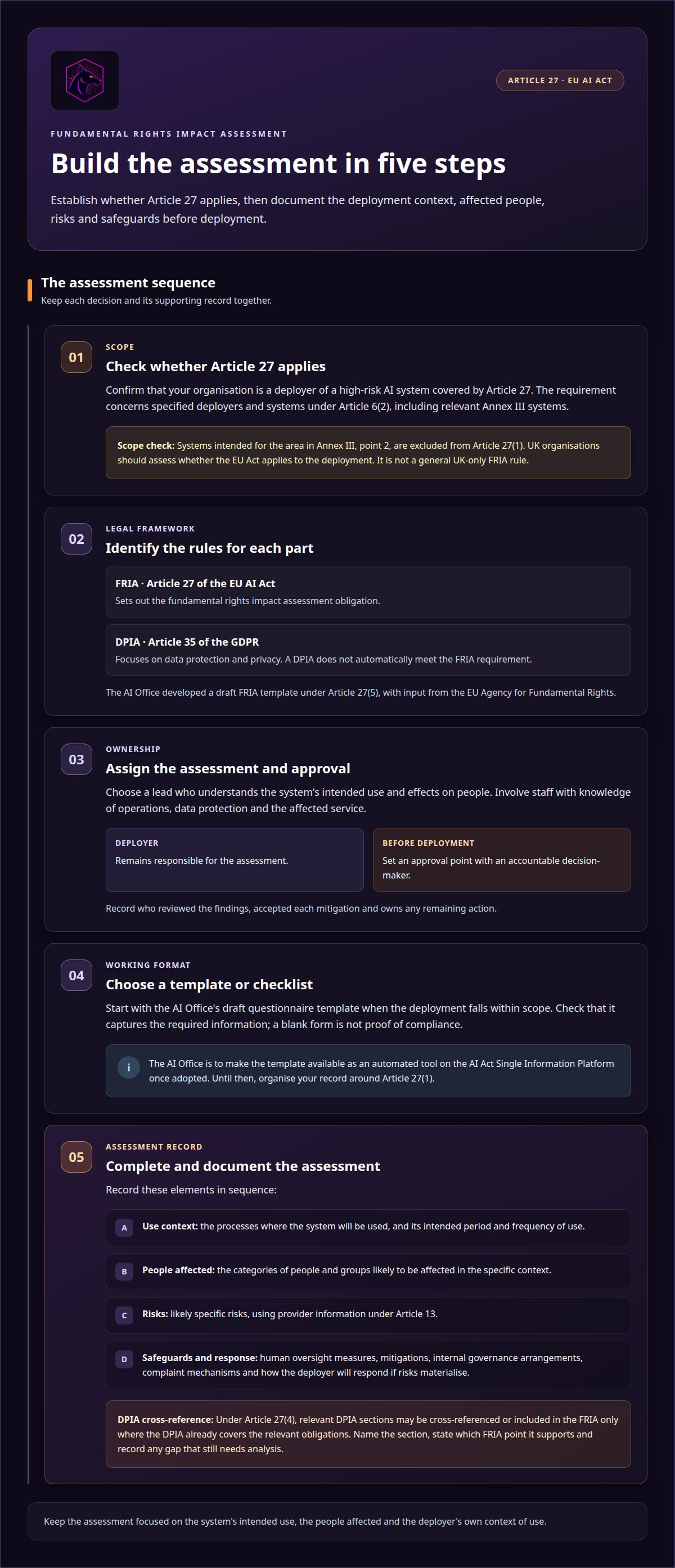
Use the steps below to establish whether Article 27 applies, then record the required assessment elements. The duty depends on the system, its intended use and the deployer’s circumstances.
-
Check whether an assessment is required
Check whether your organisation is a deployer of a high-risk AI system covered by Article 27 of the EU AI Act. The requirement concerns specified deployers and systems under Article 6(2), including relevant Annex III systems; systems intended for the area in Annex III, point 2, are excluded from Article 27(1). For UK organisations, assess whether the EU Act applies to the deployment. It is not a general UK-only FRIA rule.
-
Review applicable laws and guidance
Identify the legal framework for each part of the deployment. Article 27 of the EU AI Act sets out the FRIA obligation, while Article 35 of the GDPR governs DPIAs focused on data protection and privacy. The AI Office developed a draft FRIA template under Article 27(5), with input from the EU Agency for Fundamental Rights. Use that material when the EU Act applies, and account for relevant data-protection requirements.
-
Assign and approve the assessment
Assign the assessment to a lead who understands the system’s intended use and its effects on people. Involve staff with knowledge of operations, data protection, and the affected service. The deployer remains responsible. Set an internal approval point with an accountable decision-maker before deployment, and record who reviewed the findings, accepted each mitigation, and owns any remaining action.
-
Choose a template or checklist
Start with the AI Office’s draft questionnaire template for Article 27 when your deployment falls within scope. Check that it captures the required information rather than treating a blank form as proof of compliance. The AI Office is to make the template available as an automated tool on the AI Act Single Information Platform once adopted. Until then, organise your own record around Article 27(1).
- Complete and document the assessment in sequence. First describe the processes where the system will be used, its intended period and frequency of use. Next identify affected people and groups, then assess likely specific risks using provider information under Article 13. Record human oversight measures, mitigations, internal governance arrangements and complaint mechanisms for risks that materialise. Include how the deployer will respond. Where obligations are already met through a data protection impact assessment under Article 35 of Regulation (EU) 2016/679, EU AI Act deployers may cross-reference relevant sections or include them in the fundamental rights impact assessment.
Identifying affected people and vulnerable groups
- Map everyone touched by the system’s use. Article 27 of the EU Artificial Intelligence Act requires deployers to identify categories of natural persons and groups likely to be affected in the specific context. Include people directly assessed by the system and people affected by decisions based on its output. For a recruitment tool, map applicants whose applications it ranks, plus people responsible for reviewing those rankings. Record each group and how the system affects them.
- Trace the process from input to outcome. Follow the system through each stage of the service, from data collection to a decision or recommendation. A digital triage system, for example, may affect both someone whose information it analyses and someone whose access to an appointment depends on its output. Note where staff can change a result and where the output may shape later decisions. This process map can reveal indirect effects a list of users would miss.
- Examine how the same use may affect different groups. Assess whether the system’s design or operating context creates distinct risks for people in different circumstances. In a hiring process, consider whether application formats or scoring criteria could disadvantage applicants using assistive technology. In an automated service, examine whether people with limited digital access can complete the same process. Treat these as questions to investigate, not assumptions about an individual or group.
- Check the evidence behind each group assessment. Use the provider’s information about the system, its intended purpose, and its instructions for use. Compare it with the deployer’s actual process. A model tested on one type of input may behave differently when staff use it with another. Record which groups the evidence covers, what remains uncertain, and how that gap affects the assessment of AI risks in the deployment.
- Connect each affected group to a risk and response. For every group, describe the possible harm, how the system could contribute to it, and the safeguard intended to reduce it. A human review step may help address an incorrect recommendation, but specify who reviews it and what information they consider. Include a route for affected people to raise concerns. Use these records to identify where further consultation or monitoring is needed.
Stakeholder consultation
- Set the consultation purpose before inviting participants. Name the AI system, its intended use, and the decisions it may affect. For a recruitment tool, explain whether it ranks applications, recommends candidates, or supports interviews. Ask focused questions about effects people can describe from experience. This gives each discussion a clear purpose and keeps feedback tied to the system’s actual use.
Record which assessment questions consultation should inform. These might cover access, fairness, privacy, or the ability to challenge an outcome. Avoid broad questions about artificial intelligence that cannot guide a specific decision. A short purpose statement also helps participants understand how their input will be used.
- Invite people with direct experience of the system’s effects. Include people whose information the system processes and those affected by the decisions it supports. For a public service eligibility tool, that could include applicants, frontline staff, and people who help applicants complete forms. Include groups who may face barriers to using the service, such as people with limited digital access.
Use the affected-person categories already recorded in the assessment to shape invitations. Ask community organisations or staff who work directly with service users to help identify gaps. They may highlight whose experience the planned participant list misses. Don’t assume one representative can speak for everyone in a group.
- Choose a format people can use. Offer a meeting, interview, or written option, depending on the subject and participants. A group discussion may reveal different views about an AI system, while a confidential interview may suit people discussing a sensitive service. Explain the system in plain language before asking for feedback.
Give participants the information they need to respond, including what the system does and where human decisions remain. Use accessible formats and allow time for questions. If a digital form is the only option, it may exclude people who cannot use that format. Record the method chosen and any access limits.
- Ask questions that test the assessment’s assumptions. Present a specific scenario, such as an automated score affecting access to an appointment. Ask what could go wrong, who would notice, and how someone could challenge the result. Invite participants to identify harms the organisation may have overlooked. Keep the discussion open to evidence that differs from the team’s expectations.
Separate observed experience from predictions, then record both with context. For example, note whether a concern comes from a past service interaction or a possible future effect. This distinction helps the assessment team judge each comment against the system’s purpose, process, and safeguards.
- Document feedback and show how it affected decisions. Record who was consulted by role or group, the topics raised, and any changes made to the assessment. Protect personal details in consultation notes, especially where participants describe individual cases. If feedback does not lead to a change, document the reason and the evidence considered.
The Danish Institute for Human Rights has identified stakeholder engagement as an underdeveloped feature of the EU AI Act’s human rights impact assessment provisions. Treat consultation as input to the assessment, not a substitute for the deployer’s analysis. Revisit relevant feedback when the system’s use or effects change.
Timing and updates of impact assessments
Set the assessment timetable around the system’s deployment, legal scope, and any changes during use.
- Complete preparation before deployment. For covered high-risk AI systems, the FRIA must be completed before deployment. Start during preparation, while the deployer can still change the system’s purpose, workflow, or safeguards. For example, assess a recruitment system before staff rely on its candidate rankings. Keep the assessment aligned with the planned use, not a later account of how the system operates.
- Check which application date applies. The EU AI Act’s Article 27 FRIA requirement comes into force on 2 December 2027 for high-risk AI systems under Annex III. For high-risk AI systems under Annex I, it comes into force on 2 August 2028. The Article 27(1) requirement excludes systems intended for the area listed in point 2 of Annex III. Record the relevant category and date in the deployment plan.
- Set review triggers during use. Approval is not the end of the assessment. Review the assessment during use and refresh it when its assumptions or information may no longer reflect the system in practice. Relevant changes can include a new purpose, a different user group, altered processes, or new evidence about system performance. Assign an owner to log changes and decide whether they affect the original findings.
- Link each update to operational decisions. Compare the current deployment with the assessed context whenever a proposed change arises. If a service expands from staff recommendations to automated decisions, revisit the affected people, risks, and safeguards. Record what changed, who reviewed it, and which measures need revision. This creates a traceable link between system implementation and the assessment’s conclusions.
- Complete the required reporting step. After finalising the assessment, deployers must use the template to prepare it and notify the market surveillance authority of the results under Article 27(3) of the EU AI Act. Deployers may be exempt from notification in the situation referred to in Article 46(1). Record the submission and the version of the assessment used. Keep the notification process connected to the same review record as later updates.
Treat the assessment as a lifecycle control. EU AI Act Fundamental Rights Impact Assessments must be completed before deployment and updated throughout the AI system lifecycle. Keep the review process open after launch so new information can be considered against the original assessment, and make responsibility for revisiting it clear.
Many negative human rights impacts of AI systems emerge after deployment. Revisit the assessment while the system remains in use, preserve a clear account of decisions and revisions, and ensure it reflects the system’s current operation and potential effects on people.
EmberHound
EmberHound helps teams locate sensitive information that may be relevant to a GDPR DPIA or a data subject access request. Its GDPR Data Discovery can help identify personal data across business systems. For organisations managing payment card information as well, Combined GDPR + PCI Coverage brings both discovery needs into scope. A DSAR Disclosure Pack supports the preparation of information for subject access requests.
Use data discovery when you need a clearer record of where personal data is held and what may need review. It supports evidence-gathering for privacy work, including work on a FRIA and how an AI system affects people's rights.
Make your next assessment decision clear
Put rights-impact review on the agenda before the next AI procurement or renewal. This gives decision-makers time to account for the assessment before committing to a system or changing its use.
Keep the fundamental rights impact assessment template within the organisation’s governance process. Give project owners a clear point to raise questions before decisions are final, and allow for review when plans change.
Start with the upcoming decision that needs the clearest record.
Frequently Asked Questions
What is a Fundamental Rights Impact Assessment (FRIA)?
A FRIA documents how an AI system’s use may affect fundamental rights. Treat it as a decision record: state which deployment was assessed, who accepted the findings, and what conditions apply before use. For example, approval could depend on staff receiving instructions for handling disputed outputs. This makes the assessment useful to the team responsible for putting the system into operation.
What sections should a fundamental rights impact assessment template include?
Alongside the assessment’s core questions, add fields that keep the record useful after drafting. Include an evidence reference for each finding, a named action owner, the status of each measure, and a version history. For example, link a risk finding to the relevant internal policy or test record. These fields help reviewers distinguish an agreed safeguard from a proposed action that still needs work.
How should a FRIA assess risks to affected groups and vulnerable people?
Use specific scenarios to test whether the analysis reflects different ways people may encounter the system. Ask whether the same output could have different consequences depending on someone’s circumstances or access to support. For example, consider whether a person can correct an inaccurate record before it influences a later decision. Record the scenario, the evidence considered, and any unanswered concern, without assuming everyone in a group has the same experience.
How often should a fundamental rights impact assessment be reviewed and updated?
Review the assessment if an assessed element changes or its information is no longer current. Set internal review points around decisions that could alter deployment, such as a change request or governance review. Use scheduled checks alongside event-based review. Keep a dated record of each review, including when the assessment remains unchanged and why the existing analysis still applies.
How does a FRIA differ from a data protection impact assessment and an equality impact assessment?
A FRIA focuses on fundamental rights in an AI deployment. A GDPR DPIA centres on personal data processing, while an equality impact assessment examines equality effects in a policy or service. If a project needs all three, keep their conclusions distinct. A shared evidence pack can reduce duplicated collection, but map each piece of evidence to the question it answers. This prevents a privacy finding from being treated as an equality conclusion.


