

The longest feature list is not necessarily the best fit. A ground labs enterprise recon alternative for card data discovery should be assessed against the endpoints and data sources you need to scan, the evidence your team needs to review, and the security controls your workflow requires.
Product descriptions alone rarely answer the important questions. Does a scan cover the systems in scope? What evidence can your team inspect or retain? How does each tool handle sensitive files during processing? These questions matter for teams working to PCI DSS v4.0, where the full set of requirements has applied to assessments since 31 March 2025.
This article provides a practical way to compare Ground Labs Enterprise Recon with EmberHound Discover. We’ll look at documented scan scope, evidence outputs, and security controls, then consider where EmberHound’s local endpoint scanning, masked previews, and salted SHA-256 fingerprints may fit. You’ll also find a straightforward way to test EmberHound against a defined use case before deciding whether to switch or add another tool.
Key Takeaways
- Set your required scan locations and deployment conditions before comparing products.
- Check current product documentation for each tool’s scan scope, data handling, and evidence outputs. Record any unanswered questions for follow-up.
- Assess whether EmberHound Discover’s local endpoint scanning, masked previews, and salted SHA-256 fingerprints suit your review process.
- Use a written test scope with approved endpoints, card data types, and success criteria to compare results fairly.
- Use this framework to decide whether a ground labs enterprise recon alternative for card data discovery meets your documented requirements or leaves a gap.
Ground Labs Enterprise Recon alternatives for card data discovery: define the requirement first
Which documented capabilities must a card data discovery tool provide? Start there, not with a vendor feature list. Card data discovery means locating and mapping payment card data within the environments your organisation has defined as in scope. The work may involve finding data, producing evidence, and giving the right people a way to review findings. These are distinct outcomes. A product description that says a tool scans data does not, by itself, explain what it scans or how your team can use the results.
Before comparing products, write down your requirements for a ground labs enterprise recon alternative for card data discovery. Check Ground Labs Enterprise Recon’s documented capabilities against current vendor materials, including supported scan locations, deployment requirements, evidence outputs, and security controls. Treat anything you cannot confirm as an open question, not an assumed capability.
Turn the search for an alternative into a requirements list
List the assets and data types your test needs to cover. Be specific: note the approved endpoints, storage locations, and file types in scope, such as email files or local documents where relevant. Then define the outputs reviewers need, the access controls they expect, and the steps for triaging a finding. Include evidence formats your team can store and use in its existing review process.
Separate must-haves from preferences. If a required location is outside a tool’s confirmed scope, that may rule it out. A preferred dashboard layout may not. This distinction keeps the comparison focused on operational needs rather than feature counts.
Keep product claims and PCI DSS requirements separate
A scanning tool can help locate card data, but using one does not establish that your organisation meets PCI DSS. Check standards language against current PCI Security Standards Council materials. Use the Payment Card Industry Data Security Standard (PCI DSS) page as a general overview, not as a substitute for the current standard or official guidance.
Evaluation scope in plain English: We will test whether the tool can locate specified card data on approved systems and produce evidence our team can review under its documented process.
Keep that scope beside each vendor claim. For every requirement, record the supporting documentation, the test result, or the unanswered question. This gives your team a clear basis for comparing Enterprise Recon and EmberHound without confusing a product capability with a compliance outcome.
Compare Enterprise Recon and EmberHound by scan scope and data handling
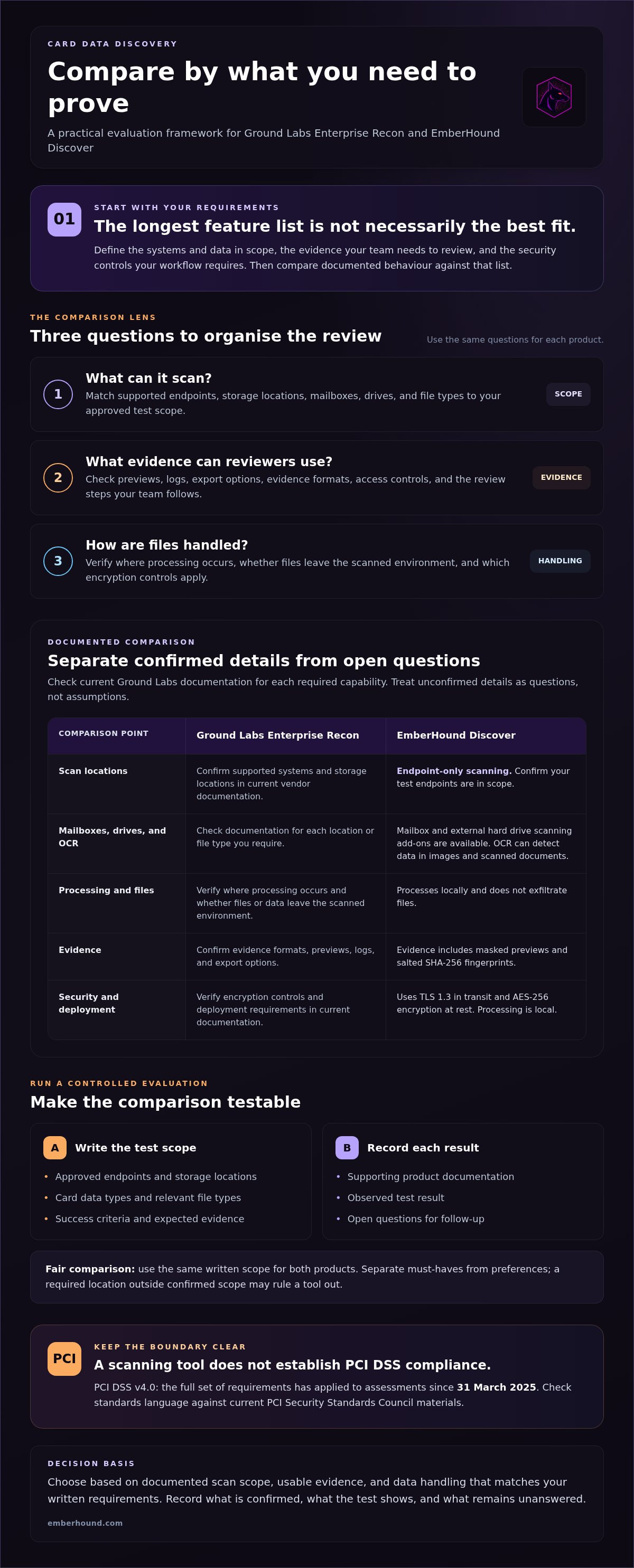
Compare documented behaviour, not assumptions. For Ground Labs Enterprise Recon, verify each point against current primary product documentation before relying on it. The table summarises what is documented for EmberHound Discover and what you should check for Ground Labs.
| Comparison point | Ground Labs Enterprise Recon | EmberHound Discover |
|---|---|---|
| Scan locations | Confirm supported systems and storage locations in current vendor documentation. | Endpoint-only scanning. Confirm that the endpoints in your test are in scope. |
| Mailbox, external drives, and OCR | Check product documentation for each required location or file type. | Mailbox and external hard drive scanning add-ons are available. OCR can detect data in images and scanned documents. Confirm which capabilities your use case requires. |
| Processing and file handling | Verify where processing occurs and whether files or data leave the scanned environment. | Processes locally and does not exfiltrate files. |
| Evidence | Confirm available evidence formats, previews, logs, and export options. | Evidence includes masked previews and salted SHA-256 fingerprints. |
| Security and deployment | Verify encryption controls and deployment requirements in current documentation. | Uses TLS 1.3 in transit and AES-256 encryption at rest. Processing is local. |
Check which systems and files each product can scan
Turn your requirements into testable questions. Can the tool scan the endpoint types you use? Does it cover the mailbox locations, external drives, or OCR needs in your written scope? EmberHound offers mailbox and external hard drive scanning add-ons, as well as OCR for images and scanned documents. Confirm which capabilities are included in the configuration you are evaluating, and check that each source is within the intended test scope. The PCI Security Standards Council is the official source for PCI DSS materials, while product documentation should answer what each tool can scan.
If a required source is outside a product’s confirmed scope, record the gap. Decide whether your team can cover it through an existing workflow or needs another tool. Don’t infer broader coverage from a product category or a general capability statement.
Compare processing, encryption, and evidence outputs
Local processing and no file exfiltration describe EmberHound Discover’s file-handling boundary. They do not, on their own, establish that it is safer for every environment. Assess the controls against your own policies. For Enterprise Recon, verify processing boundaries and encryption details directly in current vendor materials. Compare evidence formats only where documentation confirms them, then check whether reviewers can use those outputs in your existing process.
A controlled test can help resolve open questions. To assess an endpoint use case, you can configure a test scan for a defined use case before deciding whether EmberHound is a ground labs enterprise recon alternative for card data discovery.
Assess card data discovery evidence, review workflows, and PCI DSS fit
A scan result is useful only if your team can interpret it and record what happens next. Map each product output to a step in your process: who reviews a potential card data finding, how they validate it, where they record the decision, and who handles any follow-up. Ask Ground Labs to demonstrate its current review and evidence workflow. Confirm available outputs in its product documentation rather than assuming that a particular report, log, or export is included.
For EmberHound Discover, confirmed evidence includes masked previews and salted SHA-256 fingerprints. Masked previews let reviewers inspect evidence without displaying the full value in the preview. Check whether those outputs provide enough context for your team to validate a finding and record its disposition. Ask vendors to demonstrate their workflows with a representative, authorised test set, and check whether evidence can be shared with intended reviewers without exposing raw file content.
Test whether findings are usable by your team
Use the same review questions for each product. Can an analyst understand why an item was flagged? Can they record whether it is a confirmed finding or a false positive? Can the next reviewer follow the decision from the available evidence? For each answer, note what the product shows and what your team must record elsewhere. This will reveal workflow gaps that a feature list can miss.
Match discovery outputs to your PCI DSS work
Identify who uses the findings, such as security staff or the people responsible for PCI DSS assessment records, and define the decision each review supports. Check relevant references against the current standard and, where needed, a qualified adviser. The PCI DSS requirements published by the PCI Security Standards Council are the reference point for checking standards language. For broader scope context, consult your organisation’s PCI DSS card data scanning guidance alongside current source material.
Discovery evidence records what a scan found. It does not determine whether an organisation complies with PCI DSS. Treat product fit as a buyer assessment. A ground labs enterprise recon alternative for card data discovery should produce outputs your team can use within its documented review process, but the tool does not make the compliance decision for you.
Before choosing, write down the evidence each team needs and the record each reviewer must leave. Then test whether the product supplies that evidence, and verify any Ground Labs-specific workflow details directly with the vendor. This gives you a practical basis for comparing tools without treating an output as proof of compliance.
Use a controlled evaluation to decide whether an alternative fits
A defined test is more useful than a broad demo. Write down which approved endpoints and card data types are in scope, who owns the test systems, and what result would count as a pass. Set boundaries too: which files must stay untouched, who can access findings, and how test evidence will be handled.
Build a repeatable product evaluation
Choose a representative test set that your organisation is authorised to use. Record expected results before scanning, then note what each product detects, any false positives, the time reviewers spend checking results, and whether the evidence works in your process. Keep conditions consistent where vendor tools and internal policies permit. If setup, scan scope, or test data differs, record the difference so you don’t treat the results as directly equivalent.
Include the people who will operate the tool
Have IT run the setup and access checks. Ask compliance reviewers whether the findings and evidence support their established workflow. Record onboarding steps, required permissions, review effort, and any support arrangements each vendor confirms. Check pricing directly with each provider. EmberHound uses a usage-based model, with a free-scan entry point and no mandatory contracts. Review EmberHound’s security information as part of your assessment.
Use the same scorecard for each product. Keep it practical and tied to your written requirements:
- Coverage: Did the scan reach every approved endpoint and data type in scope?
- Review: Could the assigned analysts assess and record findings using the available outputs?
- Handling: Did processing and evidence handling meet your internal controls?
- Effort: What setup and review work did the team need to complete?
- Open questions: Which capabilities or terms still need written confirmation from the vendor?
For EmberHound Discover, assess the test against its confirmed endpoint-only scope and local processing. Check whether its masked previews and salted SHA-256 fingerprints support your team’s review needs. Don’t assume that a successful endpoint test proves coverage of other storage locations. The aim is to establish a clear fit or identify a gap before making a procurement decision.
A ground labs enterprise recon alternative for card data discovery should pass your documented test, not a generic feature checklist. If the result is mixed, decide whether the uncovered requirement can be handled through an approved existing workflow or whether it rules out the tool. Keep the scorecard and supporting vendor documentation together for the decision record.
Decide whether EmberHound is a suitable Ground Labs alternative
EmberHound Discover may fit when your documented requirement is endpoint-based card data discovery, local processing, and evidence that reviewers can assess without seeing full card values in previews. Its core scope is endpoint-only, with mailbox and external hard drive scanning add-ons and OCR capabilities also available. Confirm that the specific sources you need are supported in the configuration you are evaluating. Treat EmberHound as a candidate for a defined use case, not an assumed replacement for every function or scan location you may use today.
Check every must-have against product documentation and your evaluation results. If your scope includes mailboxes, external drives, OCR, or another location, confirm the relevant capability and configuration before deciding. The same applies to review steps, access controls, evidence retention, and any workflow your team relies on. A capability that remains undocumented is still an open requirement.
Use a fit checklist before switching
Proceed to a procurement decision only when the confirmed scan scope, evidence, and security controls meet your written requirements and the controlled evaluation supports that conclusion. Pause if an essential capability is undocumented or the tool fails a test criterion. Record each unresolved point, the vendor response, and who in your organisation must approve the decision. This helps prevent a gap from being mistaken for a feature.
Start with a defined EmberHound scan
Choose an authorised endpoint use case with known boundaries and success criteria. Review the EmberHound product demo if your team wants a walkthrough before testing. Then compare the scan result with your written requirements and decide whether Discover fits as a replacement for a specific workflow or as an additional tool. Keep any unverified location or process outside the decision until confirmed.
The practical answer to whether EmberHound is a ground labs enterprise recon alternative for card data discovery depends on evidence from your own test. If local endpoint scanning and masked evidence meet the defined need, continue the evaluation. If you need broader or different coverage, resolve that gap before changing tools.
Make the decision with evidence from your own test
Choose a card data discovery tool against written requirements, not feature counts. Confirm the scan locations you need, the evidence your team can review, and the security controls that fit your process. Check Ground Labs Enterprise Recon details against current vendor documentation, then compare them with results from a controlled evaluation.
EmberHound Discover may fit an endpoint-based use case. It processes data locally and does not exfiltrate files. Its evidence includes masked previews and salted SHA-256 fingerprints. TLS 1.3 protects data in transit, and AES-256 encrypts data at rest. These details give your team a clear basis for testing whether it is a ground labs enterprise recon alternative for card data discovery. They do not establish that it covers every location or workflow you require.
Start with an authorised test scope, record what the scan finds, and check whether the evidence supports your review process. Then decide whether EmberHound meets the documented need or whether a gap remains. A measured evaluation puts your team in control of the next step.
Set a clear scope, test the fit, and start your free scan.
Frequently Asked Questions
Can EmberHound replace Ground Labs Enterprise Recon for card data discovery?
EmberHound may fit an endpoint-based use case, but whether it can replace Ground Labs Enterprise Recon depends on your documented requirements. Discover scans endpoints locally and produces evidence that includes masked previews and salted SHA-256 fingerprints. Check that its confirmed scope, evidence, and controls meet your needs. If you require other scan locations or workflows, confirm support before making a change. A defined test can help assess fit.
What should I compare when choosing a card data discovery tool?
Compare documented scan locations and supported data types first. Then check processing boundaries, encryption, evidence outputs, access controls, deployment requirements, and how reviewers can handle findings. Ask how the tool fits your existing record-keeping process. For Ground Labs Enterprise Recon and any ground labs enterprise recon alternative for card data discovery, verify product claims against current vendor documentation. Mark details you cannot confirm as open questions, not assumed capabilities.
Does EmberHound send scanned files off the endpoint?
No. EmberHound Discover processes scans locally and does not exfiltrate files. Its documented security controls include TLS 1.3 in transit and AES-256 encryption at rest. If your organisation has specific requirements for data flows, retention, or access, check the relevant product and security documentation against those requirements. Include your own policies in the review before scanning approved endpoints that contain card data.
How can I test whether a card data discovery product fits our environment?
Define a controlled test before scanning. List the approved endpoints, card data types, and success criteria, then choose an authorised test set. Record detection results, false positives, reviewer effort, and whether the evidence supports your workflow. Run equivalent tests across products only where vendor terms and internal policies permit. Note differences in setup or scope, since they can limit a direct comparison.
Does using a card data scanning tool make an organisation PCI DSS compliant?
No. A scanning tool can help locate card data, but using one does not determine whether an organisation complies with PCI DSS. Review the current standard and map the tool’s outputs to your organisation’s assessment and record-keeping process. Keep discovery evidence distinct from a compliance determination, and consult a qualified adviser if you need help interpreting how requirements apply to your environment.
What evidence does EmberHound provide during data discovery?
EmberHound Discover provides masked previews and salted SHA-256 fingerprints as evidence. The previews mask data so reviewers can inspect a finding without seeing the full card value in the preview. Check whether these outputs give your team enough information to validate and record results. You should also confirm how evidence fits your internal review process before relying on it for a specific assessment workflow.
How is EmberHound priced compared with Ground Labs Enterprise Recon?
EmberHound uses a usage-based pricing model, with a free-scan entry point and no mandatory contracts. Confirm Ground Labs Enterprise Recon pricing directly with Ground Labs, as current prices and terms may depend on the offer. Compare expected usage, included features, support, and contract terms in each written quote. Avoid judging fit on price alone; check that each option meets your scan and evidence requirements.


