

Auditing sensitive files across your organisation shouldn't require provisioning dedicated servers or sitting through a protracted enterprise sales cycle. Finding a practical Netwrix alternative for sensitive data discovery usually begins the moment you realise your audit tool demands more maintenance than the compliance check itself.
You already know the frustration of bloated suites. You shouldn't have to buy unwanted directory monitors or push raw files across the network just to locate personal records. Lean IT teams need direct visibility across local workstations without creating fresh security risks during inspection.
This guide evaluates focused tools that cut infrastructure drag and satisfy strict GDPR and PCI DSS v4.0.1 standards. We compare the leading options across deployment speed, scan mechanics, and commercial flexibility so you can secure audit-ready evidence without multi-year contract lock-in.
Key Takeaways
- A focused Netwrix alternative for sensitive data discovery removes unwanted directory governance modules and heavy server maintenance.
- Local endpoint scanning keeps all processing on the workstation. Raw personal data never crosses your network during audit cycles.
- Pilot evaluations must verify detection across difficult repositories, including local mailboxes, connected external hard drives, and scanned PDFs via optical character recognition.
- Evidence reports should rely on salted SHA-256 fingerprints and masked data previews to satisfy compliance frameworks without creating secondary file stores.
Why IT teams seek a Netwrix alternative for sensitive data discovery
Traditional compliance vendors frequently conflate identity governance with file content discovery. When IT teams seek a Netwrix alternative for sensitive data discovery, the push usually stems from this mismatch. Active Directory auditing and permission analytics tell you who has access to a folder, but they cannot tell you if that folder holds unredacted national insurance numbers or payment records. Adding broad directory management suites complicates what should be a focused inspection task.
Enterprise platforms often package discovery alongside privileged access management and event log monitoring. This structure mirrors legacy Data Loss Prevention (DLP) software frameworks that require dedicated SQL databases, continuous schema updates, and separate console servers. Small security teams spend weeks configuring server permissions before scanning a single document. These multi-year contracts and heavy software packages lock budgets into capabilities that lean teams rarely use.
The cost of administrative bloat in enterprise governance
Managing server-heavy discovery tools pulls systems engineers away from core security initiatives. Every dedicated scanning server requires maintenance, patching, storage allocation, and service account monitoring. When software updates break underlying database connections, scheduled audits stall. Lean organisations waste hours troubleshooting infrastructure rather than resolving genuine data exposure risks.
Addressing the reality of modern endpoint sprawl
Hybrid work forces personal data onto local drives. Remote staff save spreadsheets to desktop folders, extract customer archives, and download sensitive attachments outside shared file shares. Centralised server scanners cannot inspect an offline laptop or a machine connected over an unstable home connection. Under UK regulations, unmanaged local files carry severe exposure penalties. You can review our detailed GDPR compliance guide to understand how unmonitored employee downloads create direct regulatory liabilities for your business.
Comparing architectures: centralised servers versus local endpoint scanning
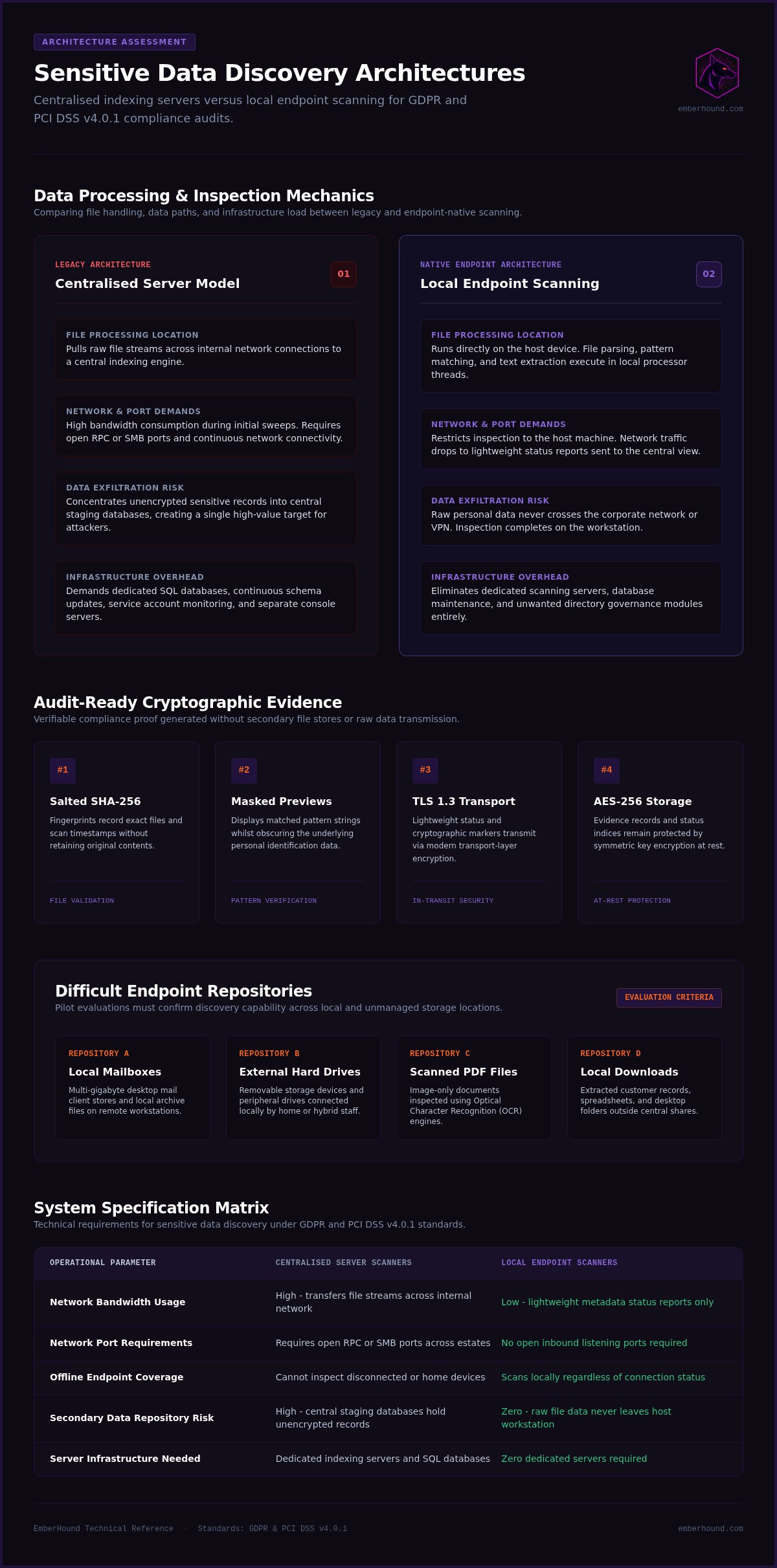
The core difference between traditional discovery tools and modern scanners sits in where processing occurs. Netwrix Data Classification uses an agentless deployment model that analyses files across your environment and collects indices on dedicated processing servers. This architecture requires continuous network connectivity and constant permission mapping across file shares.
Local endpoint scanning changes this pattern. The scanner runs directly on the device where files reside. It executes file parsing, pattern matching, and text extraction inside the local processor thread. The inspection process finishes on the machine. You eliminate the server farm entirely.
When assessing a Netwrix alternative for sensitive data discovery, compare the fundamental mechanics of both models:
- Centralised model: Pulls file streams over the internal network to a central indexing engine. This process creates high bandwidth consumption during initial sweeps and requires open RPC or SMB ports.
- Local endpoint model: Restricts all file opening and inspection to the host machine. Network traffic drops to lightweight status reports sent back to a central view.
Network impact and data exfiltration risks
Pulling full files across WAN or VPN connections strains remote infrastructure. A remote worker on a residential broadband link suffers degraded connection speeds while a central server pulls multi-gigabyte Outlook archives for indexing. More critically, concentrating unencrypted sensitive records into central staging databases creates fresh exfiltration risks. If an attacker breaches the central indexing server, they gain access to structured excerpts from across the entire corporate estate.
Cryptographic proof without exposing raw file content
Compliance auditors demand proof of inspection, not full copies of your data. Endpoint-native scanning satisfies regulatory mandates by generating cryptographically secure validation markers rather than archiving raw file contents.
EmberHound relies on salted SHA-256 fingerprints to record exactly which files were scanned and when. The system captures masked data previews, which show matched pattern strings with the actual personal data obscured. This audit trail is encrypted in transit using TLS 1.3 and stored with AES-256 encryption at rest. To see the exact implementation, read the EmberHound trust centre documentation. If you want to evaluate local scanning mechanics on your own devices, you can start a free trial scan across test machines in minutes.
Key selection criteria for sensitive data discovery tools
Selecting a viable Netwrix alternative for sensitive data discovery requires looking beyond marketing feature grids. Many enterprise suites focus heavily on Active Directory auditing while treating actual document parsing as an afterthought. A modern scanner must locate personal records wherever staff leave them, without requiring a team of administrators to write custom regular expressions.
Your team should evaluate potential solutions against three non-negotiable capabilities:
- Format resilience: The scanner must parse compressed archives, legacy office files, and plain text without crashing or timing out on large directories.
- Regulatory mapping: Pre-configured rule sets should match specific frameworks like UK GDPR, PCI DSS v4.0.1, and CIS Controls v8.1 directly out of the box.
- Actionable remediation evidence: The tool must deliver precise file paths and line matches so system owners can clean up exposures immediately.
Format flexibility across images, mailboxes, and drives
Sensitive data rarely stays inside structured databases. Employees download scanned identity cards, paste payment information into emails, and copy financial records onto portable media. A dependable alternative must inspect local mailbox files, such as PST and OST archives, right on the workstation.
Scanned identity documents present an even greater blind spot. Legacy text scrapers skip image-based PDFs entirely. Implementing OCR for data discovery solves this gap by extracting text directly from graphic files, payment receipts, and scanned intake forms. Your scanner must also automatically detect and crawl mounted external drives the moment an employee plugs them into a corporate machine.
Regulatory alignment and DSAR response readiness
Data Subject Access Requests (DSARs) carry a strict one-month statutory deadline under UK GDPR. Locating every instance of a customer's name, email, or telephone number across distributed laptops usually takes dozens of manual hours. A capable Netwrix alternative for sensitive data discovery turns this into a repeatable workflow.
Look for tools that compile findings into a dedicated DSAR disclosure pack. These reports give data protection officers the exact location of personal data, file creation dates, and surrounding context. Streamlined discovery eliminates the administrative panic of statutory deadlines and gives compliance teams the precise evidence required during formal regulatory inquiries.
How EmberHound delivers focused data discovery for lean teams
EmberHound is a targeted data discovery platform built for IT professionals who require rapid regulatory verification without enterprise infrastructure. Traditional suites depend on central indexing servers, but EmberHound executes scans directly on the endpoint. Raw files remain untouched on the local workstation. For organisations needing a practical Netwrix alternative for sensitive data discovery, this approach cuts deployment delays from months to minutes.
The four-step deployment and discovery workflow
Operation does not require database staging or service account configuration. The workflow follows four direct stages:
- Distribute: Deploy the standalone scanner to target machines using your existing endpoint management software.
- Scan: The engine inspects local storage, connected external hard drives, and mailbox archives using throttled system threads.
- Verify: Review detected findings through masked pattern previews. Salted SHA-256 hashes confirm file integrity without exposing private data.
- Export: Produce auditor-ready compliance records formatted for UK GDPR, PCI DSS v4.0.1, and CIS Controls v8.1 frameworks.
Commercial simplicity and flexible procurement
Enterprise platforms often hide their pricing behind mandatory discovery calls and annual licensing commitments. These vendors bundle identity analytics and active directory tools into contracts, forcing teams to purchase features they do not want.
EmberHound uses a transparent, usage-based model. You pay strictly for the scanning capacity your team actually inspects. You can evaluate the tiers directly on the EmberHound pricing page. Lean teams can execute an immediate GDPR assessment on high-risk departments before widening their scope to PCI Card Data Discovery. This flexibility establishes EmberHound as an efficient Netwrix alternative for sensitive data discovery without multi-year commitments.
Checklist for piloting an alternative data discovery tool
Piloting enterprise auditing software often turns into an accidental infrastructure project. Vendors ask you to configure dedicated Windows servers, create domain service accounts, and schedule calls with professional services. A modern Netwrix alternative for sensitive data discovery should validate its capabilities on your actual endpoints without these onboarding hurdles.
To run an independent pilot that returns clear answers quickly, structure your testing around four core verification steps:
- Target selection: Choose five to ten production machines representing mixed operating systems, including remote laptops that connect over residential Wi-Fi.
- Synthetic exposure testing: Plant controlled test files containing dummy credit card numbers and formatted national insurance identifiers across user desktop folders, local downloads, and compressed archives.
- Traffic auditing: Run a network packet capture while scanning to confirm that no raw document contents leave the local host.
- Evidence validation: Export generated finding summaries and ensure they provide clear file paths, matching rule IDs, and masked samples suitable for compliance sign-off.
Setting technical parameters for your pilot test
Benchmark system resource usage during deep inspection sweeps. A discovery engine must operate within predictable CPU and RAM boundaries so employees continue daily tasks without application lag. Track how long the tool takes to progress from the initial executable launch to populating your first finding dashboard. If a tool takes more than twenty minutes to configure and start scanning, it carries the same operational drag as legacy enterprise platforms.
Validating audit evidence and next steps
Once your pilot test concludes, review the exported records against your compliance obligations. Audit evidence must stand up to external scrutiny under UK GDPR, PCI DSS v4.0.1, and CIS Controls v8.1 frameworks without exposing sensitive personal identifiers to secondary breaches. You can review the EmberHound why us overview to see how endpoint-native inspection compares against server-bound architectures. For additional regulatory context regarding automated local inspection routines, examine our detailed GDPR compliance guide before finalising your internal compliance roadmap.
Modernise your endpoint discovery without enterprise overhead
Managing compliance audits shouldn't turn into an infrastructure burden. Lean teams need immediate answers, not six-month rollout plans. Choosing a focused Netwrix alternative for sensitive data discovery allows your team to locate personal records without provisioning dedicated servers or managing database dependencies.
Endpoint-only scanning protects data integrity with zero file exfiltration. By processing documents locally on the device, you eliminate network strain and avoid central storage risks. Salted SHA-256 fingerprints and masked previews provide audit-ready proof for UK GDPR and PCI DSS requirements. A flexible usage-based model means you pay strictly for the capacity you scan, without mandatory long-term contracts.
Take control of your endpoint visibility today. You can establish clear audit records across every remote laptop and desktop without architectural friction.
Frequently Asked Questions
Why do organisations replace Netwrix for sensitive data discovery?
Organisations replace Netwrix when administrative maintenance outweighs discovery results. Netwrix bundles broad directory auditing, user activity tracking, and access governance into enterprise contracts. IT teams looking strictly for a netwrix alternative for sensitive data discovery often want focused file inspection without dedicated server infrastructure, SQL maintenance, or protracted procurement cycles. Lightweight tools scan endpoints directly and generate audit proof without complex software tiers.
How does endpoint data discovery differ from Active Directory auditing?
Active Directory auditing tracks directory permissions and user logon events, whereas endpoint data discovery inspects actual file contents. Knowing which user has read access to a folder doesn't reveal what data sits inside those documents. Endpoint discovery parses spreadsheets, PDFs, and local mailboxes directly on employee workstations. It flags unredacted payment cards, national insurance numbers, and customer names that directory logs cannot see.
Does EmberHound exfiltrate raw files during the scanning process?
No, EmberHound never exfiltrates raw files or extracts document text off the machine. All scanning, string matching, and classification routines run locally on the endpoint processor. The software generates salted SHA-256 cryptographic fingerprints and masked data previews. Only these lightweight audit records transmit over TLS 1.3 to the reporting console. Your sensitive business documents remain protected at rest with AES-256 encryption and never leave the host system.
Can an alternative tool identify personal data within image files?
Yes, modern scanners identify personal data in graphic formats using Optical Character Recognition (OCR). Scanned receipts, identity document photos, and image-based PDFs frequently conceal sensitive records from standard text scrapers. EmberHound includes OCR Scanning to extract text from images directly on the machine. This allows lean security teams to pinpoint passports and payment card details hidden inside graphical files without moving images across corporate networks.
How does usage-based pricing compare to traditional software licensing?
Usage-based pricing charges organisations strictly for scanned capacity rather than forcing multi-year enterprise contracts. Traditional enterprise platforms bill on high-tier user brackets or annual company-wide commitments regardless of actual platform utilisation. By choosing a modern netwrix alternative for sensitive data discovery, teams start with a free scan entry point and scale inspections as their estate grows. This model removes upfront licensing hurdles and adapts directly to project-specific audit scopes.
What evidence does a discovery tool provide for GDPR compliance audits?
A compliant discovery tool produces structured findings records that verify file inspection without exposing personal data. EmberHound supplies salted SHA-256 cryptographic hashes for verified files alongside masked string samples. For formal regulatory inquiries, the platform compiles dedicated DSAR Disclosure Packs. These reports detail file paths, timestamps, and matched criteria. They give Data Protection Officers concrete evidence of compliance without generating secondary file exposures or duplicate document copies.
Is dedicated server hardware required to run lightweight discovery software?
No, lightweight discovery software operates without dedicated server hardware, database instances, or console virtual machines. Traditional enterprise discovery suites demand centralised index servers, dedicated SQL databases, and constant network bandwidth. Endpoint-native alternatives run directly within user workstation threads. System administrators distribute the scanning executable through standard device management tools, avoiding the delays, ongoing patching, and overhead associated with hosting on-premise compliance infrastructure.


