

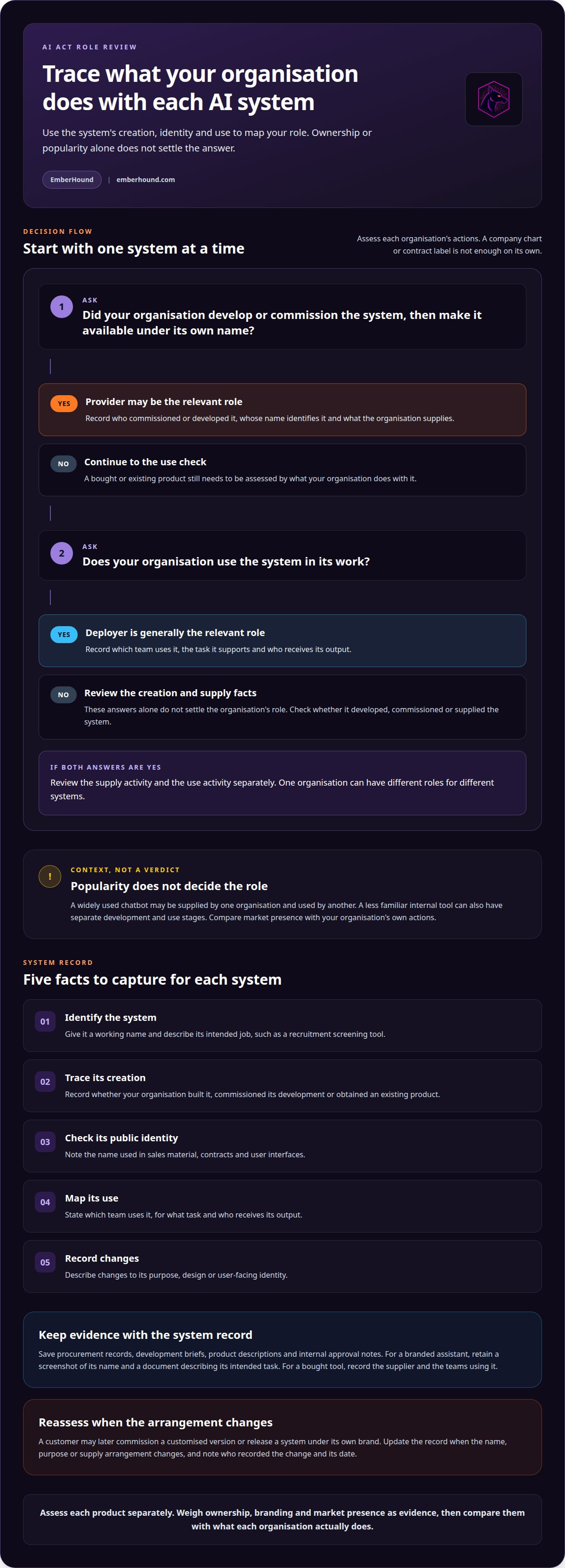
Ownership can point you towards an answer, but your organisation’s role depends on what it does with the AI system. To decide whether you are a deployer or a provider, start here: an organisation that develops or commissions a system and makes it available under its own name may be a provider; an organisation that uses a system in its work is generally a deployer. One organisation can have different roles for different systems.
Building, buying or branding an AI tool can affect your responsibilities. The harder cases arise when your organisation adapts a system or supplies it to others. Whether the system is already widely available adds context, but popularity alone does not settle its role.
This article explains how ownership and a system’s market position can help you assess your role. It also covers practical questions about who created the system, whose name it carries and how your organisation uses it. You’ll have a clearer starting point for deciding what to examine next.
Key Takeaways
- Assess your role by looking at who develops or supplies the AI system and how your organisation uses it.
- Business ownership can offer useful clues, but the system's name and route to market also matter.
- A system's market saturation provides context; it does not decide your role on its own.
- Separate the act of using an AI system from supplying one to others when assessing your responsibilities.
- According to the Bank of England, 80% of respondents reported having AI agents deployed.
Provider business and ownership details
Start with the organisation behind the AI system, not the person who first wrote its code. A business can own a company without owning every tool that company uses. For example, a UK retailer might buy a forecasting system from a software supplier and use it to plan stock. The retailer’s ownership of its shops does not, by itself, settle its role under the AI Act.
Separate corporate ownership from decisions about the system. Record which organisation developed it, which commissioned it, whose name appears on it and who uses it. A parent company might commission a customer service assistant while a subsidiary runs it. These are distinct facts that help map responsibility, but a company chart alone cannot classify every organisation’s role.
Use this practical review for each system:
- Identify the system. Give it a working name, such as "recruitment screening tool", and describe its intended job.
- Trace its creation. Record whether your organisation built it, commissioned its development, or obtained an existing product.
- Check the public identity. Note the name used in sales material, contracts and user interfaces.
- Map its use. State which team uses it, for what task, and who receives its output.
- Record changes. Describe any changes to its purpose, design or user-facing identity.
For example, Northstar Recruitment might buy a CV-ranking tool and use it to sort applications. Its staff set the role criteria and review the outputs. That is different from developing a ranking tool and supplying it to other employers under the Northstar name. The invoice label is useful evidence, but it does not replace a review of what each organisation actually does.
Business ownership becomes more relevant when a company puts its name on a system it commissioned or materially changes. Imagine a UK bank asking a technology firm to build a fraud-detection model. The bank should document who set the intended purpose, who made design decisions and whose name identifies the system. Calling the bank a “customer” in a contract cannot answer those questions by itself.
Market saturation adds context, but popularity does not determine the role. A widely used chatbot may still be supplied by one organisation and used by another. A less familiar internal tool may also have distinct development and use stages. Compare the system’s market presence with your own actions: did your business create or supply it, or does your team use it for its work?
According to the Bank of England, 80% of respondents reported having AI agents deployed. That figure shows why a business-wide inventory matters. A deployed agent may sit inside recruitment software, a support platform or a document workflow. Ask each team to name the product, vendor, business purpose and users. A central register makes gaps between procurement records and actual use easier to spot.
Keep evidence linked to each system. Save procurement records, development briefs, product descriptions and internal approval notes. For a branded assistant, retain a screenshot showing its name and the document describing its intended task. For a bought tool, record the supplier and the teams using it. Specific examples make your assessment easier to explain than a general claim about company ownership.
Review the assessment when the arrangement changes. A business might begin as a customer, then commission a customised version or release the system under its own brand. Update the system record and reassess each organisation’s activities. A new name, purpose or supply arrangement can change the facts behind the earlier assessment. Assign someone to record each change and its date.
The conclusion should be specific to each system. Your organisation may use one provider’s tool and develop another system for external users. Map each product separately, then compare the organisations’ actual actions. Ownership, branding and market presence are evidence to weigh, but none should stand alone as the answer.
Becoming provider
To answer “Am I a deployer or a provider?”, examine how your organisation turns an AI idea into something others can use. Product decisions can involve teams with different priorities: sales may promise a feature, engineering may select a model, and operations may decide how customers access it. Set a clear decision process before those choices blur together.
Consider a fictional firm, Lumen Works, planning an AI assistant for accountancy practices. Its leaders should define the product boundary first. Does the offer include the AI system itself, or a service that uses another organisation’s system? Write down what customers receive, what the interface does and which functions sit outside the offer. This gives teams a shared basis for their review.
Use this sequence before release:
- Set the product owner. Name the person accountable for the system description and internal approvals.
- Define the intended use. Describe the task, users, inputs and expected outputs in plain language.
- Assign design decisions. Record who approves model choice, feature changes and customer-facing claims.
- Prepare customer information. Explain the system's purpose, limits and operating conditions in the material customers receive.
- Set release gates. Require sign-off from product, technical and commercial owners before launch.
For Lumen Works, the product description should match the assistant customers receive. If sales describes automatic invoice approval, engineering must establish whether the feature exists and how it works. A mismatch can confuse customers and weaken the organisation’s assessment. Have the product owner review proposed claims before they appear in a demonstration or contract.
Build an internal responsibility map around decisions, not job titles. A machine-learning engineer may recommend a model while a product lead approves its use. The security team may set access controls, and customer operations may write support guidance. A simple approval record can show who made each decision and what information they used, helping new staff understand how the product reached its current form.
Customer materials need the same discipline. A service description, onboarding screen and support guide should describe the system’s purpose consistently. If a tool drafts replies for human review, explain that workflow plainly. Avoid implying that the system makes final decisions when staff retain that task. Review the materials with the teams responsible for product behaviour and customer support.
Supplier agreements can support this process. Define how the supplier communicates technical changes, who receives notices and how each change reaches the product owner. Request clear descriptions of updates that affect system functions. Set an internal route for assessing those updates before they reach customers. This gives the business a workable process for keeping its product description accurate.
A release gate should cover the complete customer experience. Review the product description, demonstration, onboarding steps and support instructions together, and confirm that they all describe the same intended use. Keep the approval record with the release materials. A named owner can then resolve questions about how a feature works or what the system is designed to do.
Assess provider status against the organisation’s actual role in the system. A contract title or internal job description cannot replace that assessment. If you’re still asking, “Am I a deployer or a provider?”, use the product boundary and decision map to identify what your organisation controls. This turns an abstract label into a review grounded in the product and its delivery.
Provider planning should also consider whether a commercial relationship could make the organisation overly dependent on one source of work. Contractors who rely on a steady stream of calls from one company may find it harder to build their own customer base and brand. Treat this as a strategic risk when deciding what the organisation offers, how it presents that offer and which customer relationships it wants to develop. Make the relationship’s limits visible in internal planning rather than assuming regular work automatically builds an independent business.
Before committing to a delivery model, identify what would remain under the organisation’s control if the flow of work changed. Consider whether it can develop its own service description, customer communications and reputation alongside work received through a commercial partner. Set review points for leaders to revisit the balance, and assign someone to raise concerns if reliance grows. These checks help decision-makers weigh the opportunity of regular work against the risk to customer-base and brand growth.
Service provider
“Service provider” describes a business relationship. “Provider” in an AI Act assessment concerns an organisation’s role in relation to an AI system. The terms can overlap, but one does not automatically establish the other. A UK software consultancy might host a client’s AI tool, configure access or maintain its integration. Assess those activities separately from who develops or supplies the system.
Start by defining the service in practical terms. Does the firm provide cloud access, technical support, integration work or a finished AI product? For example, a consultancy could connect a client’s existing chatbot to its booking system. The client may use the chatbot in its operations while the consultancy supplies integration work. Assess each organisation’s role in relation to the system and its activities.
Build a service map before drawing conclusions. Name each party and describe its contribution:
- Customer: identifies the business task and decides how staff use the system.
- AI supplier: develops or makes the system available to customers.
- Service firm: provides hosting, configuration, support or integration around the system.
- End user: works with the system or acts on its output.
A single business can have more than one role. Take fictional Harbour Advice, a firm that uses a third-party assistant to draft internal replies, then sells a separate AI-supported customer service package to retailers. Its internal use and external service need separate assessments. The word “service” on a proposal settles neither one.
For each contract, record what the service firm controls. Does it select the AI system, set its intended task, change its functions or decide who can access it? A firm that simply maintains a connection may have a different role from one that commissions a bespoke system and supplies it under its own name. Keep the contract, technical specification and customer-facing description together.
Use a change log to track changes to the service. A client may first ask a provider to install a standard tool, then request custom outputs for staff decisions. Record the request, who approved it and what changed. If a managed service introduces a different system or purpose, reopen the assessment. A short, dated entry can show why the organisation’s role stayed the same or changed.
Cross-border services need a separate jurisdiction review. According to the UK Government, under the proposed AI Act, providers in third countries could be covered if they place AI services on the EU Single Market or their systems produce outputs used in the EU. A UK consultancy serving a French retailer should record where the system is supplied and where its outputs are used. The UK Government statement concerns the proposed Act, so distinguish it from any UK-specific rule in your assessment.
Ask the service firm for concrete operational details, not a broad assurance. Request the system name, its intended task, any changes made, the organisations with access and the location of relevant users. Then compare those details with your own records. If a retailer uses an AI assistant through a service partner, the retailer should document its use while the partner documents its own supply and technical work.
Keep responsibilities visible in the contract. Identify who manages system changes, who tells the customer about them and who maintains the system description. Avoid relying on a clause that assigns every AI Act role to one party without describing its actual work. A clear division of tasks gives both organisations evidence for their assessments.
For UK businesses, the practical test is the work performed, not the service label. Map the AI system, the customer relationship and the service firm’s actions. If the same company uses one system and supplies another, assess them separately. This gives procurement and technical teams a useful basis for their next review.
Completing the AAA service provider request form does not guarantee acceptance as an affiliated service provider. AAA Northeast independent service providers are expected to offer members courteous service, quick response times and experienced technicians. AAA contractors may have to meet strict service standards and response times, adding pressure to staff and resources. AAA offers service providers free training in customer service and technical skills. AAA may negotiate lower rates for its members, which can leave towing businesses earning less per call than their standard cash-call rates.
Make your next step clear
If you’re still asking, “Am I a deployer or a provider?”, turn the assessment into a decision your organisation can explain. Prepare a short brief for the people responsible for product, procurement and governance. State the decision, the evidence behind it and any point needing further review. Agree who will approve the position and how it will be shared with the teams working with the system.
If your wider work includes identifying personal or payment card data, EmberHound provides GDPR Data Discovery, PCI Card Data Discovery and Combined GDPR + PCI Coverage. These services help identify sensitive information. They do not determine your AI Act role, so keep that workstream separate from your role assessment.
Make the next review part of your organisation’s normal governance process. A recorded decision gives colleagues a shared starting point when the product or its use changes. With a clear owner and practical brief, your team can move forward with purpose.


