

Using an AI system for work can make your organisation a deployer, even if another business built it. Under Article 3(4) of the EU AI Act, a deployer is a person or organisation that uses an AI system under its authority, except for personal, non-professional use. That is the core of the EU AI Act deployer definition.
The label depends on what your organisation actually does, not simply what a contract calls it. A UK organisation may also fall within the Act if it is established or located in the EU, or if the system’s output is used in the EU.
This guide explains how to determine whether your organisation is a deployer, how that role differs from being a provider, and when changes to an AI system or its purpose can bring provider obligations. It also covers what deployers should consider when using high-risk AI systems, helping you identify where your role begins and what to assess next.
Key Takeaways
- You may be a deployer when your organisation uses an AI system under its authority for professional purposes, even if another organisation built it.
- Your role depends on what you do in practice. A contract label alone does not decide whether you are a provider, deployer or both.
- Rebranding a high-risk system, substantially changing it or changing its purpose can bring provider obligations.
- Using a high-risk system brings duties around following its instructions, human oversight and monitoring for risks.
- A UK organisation may fall within the Act when it is established or located in the EU, or when its system's output is used in the EU.
When deployers may assume provider obligations
A UK organisation can fall within the EU AI Act if it is established or located in the EU, or if an AI system’s output is used in the EU. This can matter even when the organisation operates from Britain. Personal, non-professional use is excluded from the deployer definition, but using an AI system for work under your organisation’s authority can bring regulatory obligations.
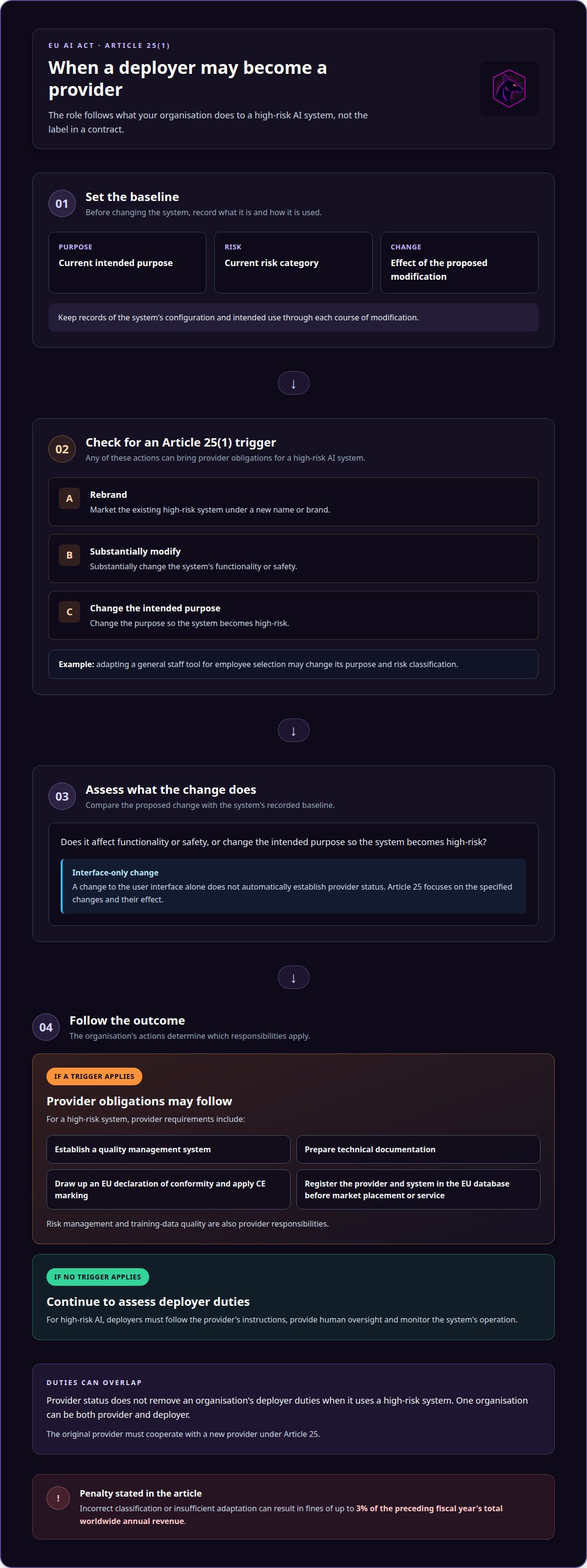
Article 25(1) sets out when a deployer can become a provider of a high-risk AI system. This can happen if the deployer markets the system under a new name or brand, substantially modifies its functionality or safety, or changes its intended purpose so it becomes high-risk. For example, a company that rebrands a high-risk recruitment system may take on provider responsibilities. The role follows the organisation's actions, not simply the label in a contract.
Provider status brings duties beyond those attached to deployment. Before making a change, identify the system's current intended purpose, its risk category and the effect of the proposed modification. Then assess whether the change affects functionality or safety, or makes the system high-risk. A change to a user interface alone does not automatically establish provider status; Article 25 focuses on the specified changes and their effect. Keep records of the system's configuration and intended use through each course of modification.
Deployers retain their own duties when using high-risk AI systems. Assess each system individually, follow the provider's instructions, use relevant and sufficiently representative input data, and provide human oversight. Monitor the system's operation. If its use may pose a risk to health, safety or fundamental rights, Article 26 requires the deployer to suspend use and notify the provider, distributor and relevant market surveillance authority without undue delay. Serious incidents must also be reported under Article 73.
Staff need a suitable level of AI literacy under Article 4. Article 50 sets transparency obligations for providers and deployers of certain systems. Deployers of emotion recognition or biometric categorisation systems must inform the people subject to them. The EU AI Act's Article 50 Guidelines, published on 20 July 2026, give further guidance on transparency obligations. Where personal data is involved, existing GDPR compliance processes can help organise related checks.
What penalties can deployers face? Incorrect classification or insufficient adaptation can result in fines of up to 3% of the preceding fiscal year's total worldwide annual revenue. The relevant obligations depend on the system's risk and the organisation's role.
Zooming in on AI #4: Deployers & Providers in EU AI Act
Article 3(3) defines a provider as a person or organisation that develops an AI system or general-purpose AI model, has one developed, then places it on the market or puts it into service under its own name or trademark. The definition covers the organisation responsible for that market-facing role, even if another party did the technical development. A company can therefore be a provider without writing the system's code.
A deployer may become a provider under Article 25(1) through particular actions. Rebranding an existing high-risk system is one trigger. So is substantially changing its functionality or safety. A deployer can also cross the line by changing the system's intended purpose so it becomes high-risk. For example, adapting a general staff tool for employee selection may change its purpose and risk classification. The new role follows what the organisation does in practice.
These changes can create a transition in responsibilities. Before making a change, identify the system's current intended purpose, its risk category and the effect of the proposed modification. Then assess whether the change affects functionality or safety, or makes the system high-risk. A change to a user interface alone does not automatically establish provider status; Article 25 focuses on the specified changes and their effect. Keep records of the system's configuration and intended use through each course of modification.
Once an organisation qualifies as a provider, it must meet the requirements that apply to the system. For a high-risk system, these include establishing a quality management system, preparing technical documentation, drawing up an EU declaration of conformity and applying CE marking. The provider must also register itself and the system in the EU database before placing it on the market or putting it into service. Risk management and training-data quality are provider responsibilities.
The original provider must cooperate with a new provider under Article 25. That cooperation matters when the new party needs information to meet its obligations. Provider and deployer roles can also sit with one organisation at the same time: a business may supply a system under its own brand, then use it under its authority. Contract wording cannot settle the classification. The organisation's development, marketing, modification and use of the system determine which responsibilities apply.
EU AI Act definition of a deployer
The EU AI Act deployer definition centres on who uses an AI system and whose authority governs that use. Article 3(4) covers a natural or legal person, public authority, agency or other body using an AI system under its authority. It excludes personal, non-professional use. A company can qualify when it puts another party’s system to work, even if it did not develop the system.
The phrase “under its authority” refers to how the system is used in practice. For example, an employer might use a third-party tool to screen job applications. The employer decides to use it in recruitment and deploys it within that process. The software supplier may have developed the tool, but the employer uses it under its authority. The system’s intended purpose and actual use help determine the organisation’s role.
Article 3(4) includes individuals and organisations, so the definition is not limited to companies. A public authority using an AI system for its work can be a deployer too. A body that commissions a system for its own use may also fall within the definition if it uses the system under its authority. The contractual description alone does not settle the role; the actual arrangements matter.
To assess a particular use, identify the organisation directing the system’s deployment, then record the task it performs. For example, employees using an AI model to rank applicants indicate a recruitment purpose. A supplier’s involvement in implementation does not, by itself, make the supplier the deployer of the employer’s use. The facts of each arrangement determine the applicable role.
- Who uses it? Name the person, company, public authority or other body operating the AI system.
- Under whose authority? Identify who decides that the system is used for a professional task.
- For what purpose? Record the task, such as screening job applications.
- Is it personal use? The Article 3(4) definition excepts personal, non-professional use.
For UK organisations, territorial scope is a separate part of the assessment. The EU AI Act can apply if an organisation is established or located in the EU, or if its AI system’s output is used in the EU. A UK business whose system produces outputs used in the EU should consider this connection when assessing whether deployer obligations apply.
Applying the EU AI Act deployer definition means mapping each AI system to the organisation directing its use. Document the system’s purpose, the responsible team and whether employees use it for work. This record helps distinguish operational deployment from personal use and supports a focused assessment of which AI Act duties apply.
The AI Act’s risk-based rules for AI developers and deployers
The EU AI Act links duties to an AI system’s risk and the organisation’s role. High-risk systems are those that pose significant risks to health, safety or fundamental rights. Credit scoring, employee selection, employee monitoring and individual profiling are listed as typical high-risk uses. Assess each system individually. The same tool may need a different assessment if its intended purpose or use changes.
For a high-risk system, start with the provider’s instructions. Deployers must use the system according to them and supply relevant, sufficiently representative input data. Human oversight can help keep the use of a high-risk system under review. Monitoring should identify operational risks and serious incidents. If use may put health, safety or fundamental rights at risk, deployers should respond promptly and consider suspending use and notifying relevant parties.
Staff responsibilities matter too. Article 4 requires deployers to ensure a suitable level of AI literacy for staff and others operating or using the system on their behalf. In practice, employees responsible for reviewing outputs need enough knowledge to understand the system’s role and identify when its results require scrutiny. Training should reflect the system’s purpose and the decisions it supports.
Documentation supports those operational processes. Keep the provider’s instructions, the system’s intended purpose, the data used and monitoring records together. For a high-risk system used by a public authority, or by a deployer acting on its behalf, Article 49(3) requires registration of the authority, the system and its purpose in the relevant EU database. That registration duty is specific to this public-sector use.
Impact assessments can connect AI governance with existing data protection work. Where applicable, deployers must use information supplied under Article 13 to help carry out a data protection impact assessment under Article 35 of the GDPR or Article 27 of Directive (EU) 2016/680. If an individual requests an explanation of AI’s role in a decision with a legal or similarly significant adverse impact, Article 86 applies to certain decisions.
Timing matters for UK organisations whose systems fall within the Act’s scope. Companies deploying high-risk AI systems in the European Union are told to prepare for the obligations by 2 August 2027. Keep system records current as use changes, since a new purpose can affect the risk assessment and the duties that apply.
How does the EU AI Act distinguish a deployer from a provider, importer or distributor?
The EU AI Act assigns roles according to what each organisation does with an AI system. A deployer uses it under its authority. A provider develops a system, has it developed, or places it on the market or puts it into service under its name or trademark, as defined by Article 3(3). A provider can be responsible for a high-risk system even if another organisation built it.
Importers and distributors have different roles in the supply chain. An importer brings an AI system from outside the EU into EU territory. A distributor makes an AI system available within the EU. These roles concern the system’s movement or supply; deployment concerns its use. For example, an organisation that imports a system and then uses it for its own recruitment may have both importer and deployer responsibilities.
One organisation can hold more than one role. A UK business that imports an AI system into the EU, makes it available to customers and uses it internally could act as importer, distributor and deployer in different activities. If it also places the system on the market under its own name, provider status may apply. Assess each activity separately: one label for the whole organisation can obscure distinct duties.
Contract terms do not determine the classification. The factual circumstances do. Map the AI system’s journey: who develops or commissions it, who brings it into the EU, who supplies it and who uses it under their authority. Then record which legal entity performs each activity. This separates a supplier’s role from a customer’s operational use, even when both parties support the same system.
Provider duties can be extensive for high-risk systems. Providers must establish a quality management system, prepare technical documentation, draw up an EU declaration of conformity and apply CE marking. Importers should ensure that technical documentation has been prepared and the declaration is present. Distributors should ensure declarations are present before supplying systems and cooperate with authorities as required. Deployers have separate duties related to use.
Role changes also matter. Under Article 25(1), a deployer can become a provider by rebranding a high-risk system, substantially modifying it, or changing its intended purpose so it becomes high-risk. The original provider must cooperate with the new provider. A contract that keeps calling the organisation a deployer does not remove provider responsibilities when its actions meet those conditions.
Use the role map to identify where sensitive information enters or leaves an AI workflow. Explore GDPR data discovery options
EmberHound
EmberHound helps organisations discover sensitive information that may be processed through business systems, including AI workflows. GDPR Data Discovery can help identify personal data across your environment, while PCI Card Data Discovery focuses on payment card data.
If both data types matter, Combined GDPR + PCI Coverage brings those discovery needs together. For subject access requests, the DSAR Disclosure Pack supports preparation of relevant disclosure information. These tools support data discovery and disclosure tasks; they do not determine whether your organisation is a deployer or replace your EU AI Act assessment.
If you need visibility into personal or payment card data, contact EmberHound to discuss your requirements.
Make your next AI review count
The EU AI Act’s deployer definition gives your team a starting point. Keep a current record of the systems in use, the teams responsible for them and any changes to their purpose. Review it when a new tool or workflow enters the organisation. Clear ownership gives your next assessment a useful factual starting point.
Data discovery can help when you need to locate personal or payment card data across business systems. EmberHound provides GDPR Data Discovery, PCI Card Data Discovery and Combined GDPR + PCI Coverage. These services focus on finding sensitive information, not determining your AI Act role.
Choose the discovery coverage that matches the data you need to identify, then take the next step at a pace that suits your team.
A clear view of your data gives your team a practical foundation for its next review.
Frequently Asked Questions
When are you a deployer?
You are a deployer when you use an AI system for professional purposes under your organisation’s authority. For example, a recruitment team using an external tool to rank applications deploys it in its hiring process. The supplier may operate the software, but your organisation determines how it is used. Personal, non-professional use is excluded. A UK organisation may also fall within scope if system outputs are used in the EU.
Which roles exist under the Act?
The EU AI Act names providers, deployers, importers, distributors, product manufacturers and authorised representatives as operators. Their roles depend on their activities. A provider places a system on the market or puts it into service under its name; a distributor makes it available in the EU. One organisation can hold several roles. For example, a business could import a system and then use it internally, requiring separate role assessments for each activity.
What is the definition of a deployer under the EU AI Act?
Article 3(4) defines a deployer as a natural or legal person, public authority, agency or other body using an AI system under its authority, except for personal, non-professional use. The test focuses on the use, not the organisation’s size or whether it built the system. A small business using an AI model to sort customer enquiries for work can qualify, even if staff access it through a supplier’s service.
What are the main obligations of deployers under the EU AI Act?
Obligations depend on the system and its use. Deployers must ensure suitable AI literacy for staff and people operating systems on their behalf. For high-risk systems, they must follow provider instructions, use relevant and sufficiently representative input data, and monitor operation. A practical starting point is to assign an owner to each system and record its purpose, users and provider instructions. This helps teams identify which duties apply.
What additional duties apply to deployers of high-risk AI systems?
High-risk system deployers must ensure human oversight and monitor the system during operation. If use may pose a risk to health, safety or fundamental rights, they must suspend use and notify the provider, distributor and relevant market surveillance authority without undue delay. Serious incidents must be reported to the relevant provider, importer, distributor and authority. These duties make a clear escalation route important before staff begin using the system.
When must deployers conduct a fundamental rights impact assessment under the EU AI Act?
Deployers must conduct a fundamental rights impact assessment before deploying a high-risk AI system. The assessment should consider the system’s intended use and the people whose rights may be affected. Where the deployment also involves personal data, deployers may need to consider a separate data protection impact assessment. Where applicable, information supplied under Article 13 of the AI Act helps with that assessment under Article 35 of the GDPR.
What are deployers required to do when using high-risk AI systems in the workplace or public services?
In a workplace, an employer using high-risk AI for employee selection should follow the provider’s instructions, provide human oversight and monitor system operation. Staff need suitable AI literacy to work with the system. A public authority, or a deployer acting on its behalf, must register itself, the system and its purpose in the relevant EU database under Article 49(3). These requirements apply alongside duties triggered by the system’s specific use.
What record-keeping, human oversight and monitoring duties apply to AI system deployers?
Deployers should keep operational records that show how a system is used, who oversees it and what risks monitoring identifies. For high-risk systems, human oversight is required, and deployers must monitor operation for risks or serious incidents. A useful internal record can link the provider’s instructions to the responsible team and escalation route. If a risk arises, staff need to know who can suspend use and make any required notifications.


