

Being based outside the EU doesn’t put an AI business beyond the Act. The EU AI Act’s extraterritorial reach can affect Australian organisations that place AI systems or general-purpose AI models on the EU market, or whose systems produce outputs used in the EU. The rules can apply even when an organisation’s development and operations are entirely outside the EU.
That boundary can be easy to miss. An Australian provider, deployer, importer or distributor may have different responsibilities depending on its role and how the system is used. A business with no EU market connection and no outputs used in the EU will typically fall outside the Act’s scope.
This guide explains when the Act can reach Australian organisations and how its recitals clarify the boundary. It also covers how obligations vary by role, when risk classification matters, and what an EU connection means for UK firms reviewing their AI supply chains.
Key Takeaways
- Assess whether your organisation has an EU market connection or whether people in the EU use outputs from its AI systems.
- Separate provider, deployer, importer and distributor roles to identify which duties may apply to your organisation.
- Check whether a system is high-risk, as this can affect documentation duties and whether a third-country provider needs an EU authorised representative.
- Read the Act's recitals alongside its articles to understand how its scope can reach systems operated outside the EU.
- UK-based providers can still fall within scope when they place AI systems on the EU market or their systems' outputs are used there.
Extra-territorial application of the AI Act: how will it impact UK organisations?
Article 2 sets the EU AI Act's territorial scope. It can cover organisations outside the EU when their market activity or AI outputs connect them to the Union.
Territorial scope compared with the GDPR
The Act's territorial scope describes when its rules apply to providers and deployers based outside the EU. Like the GDPR, it can reach organisations located elsewhere through their connection to the EU market. The comparison matters because a UK company's place of establishment alone doesn't settle whether either regulation applies. The EU GDPR also uses extraterritorial principles tied to EU market activity; see the EmberHound GDPR territorial rules.
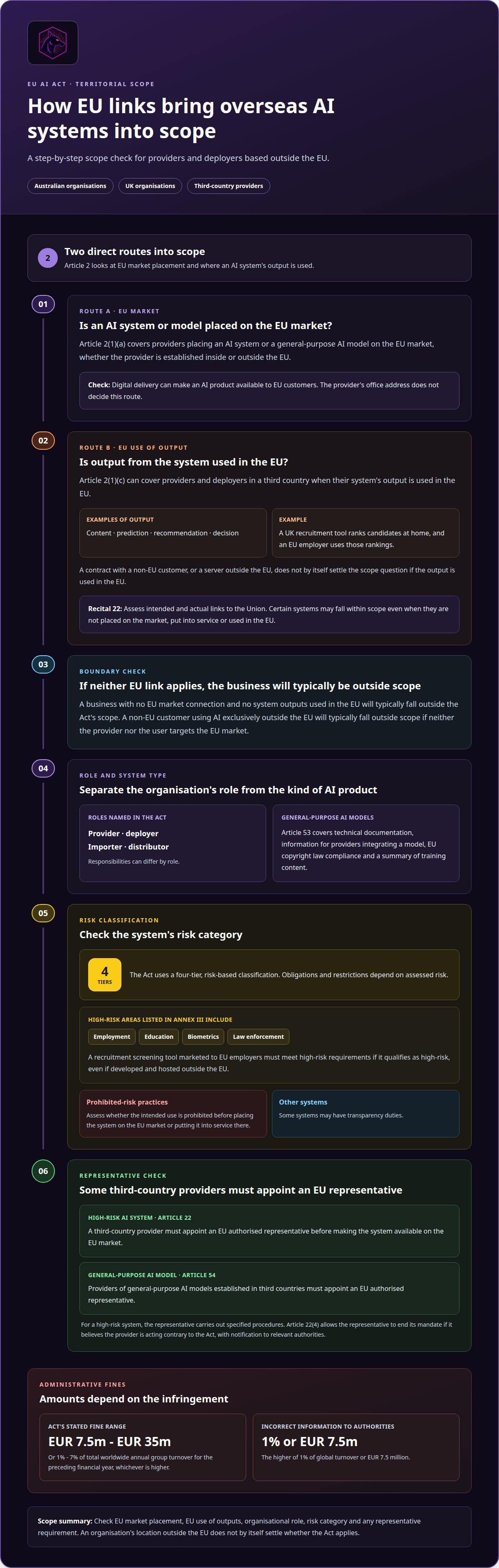
Article 2 identifies two direct routes into scope. Under Article 2(1)(a), providers placing AI systems or general-purpose AI models on the EU market are covered, whether established inside or outside the EU. Under Article 2(1)(c), the Act covers providers and deployers located in a third country when their system's output is used in the EU. EUR-Lex sets out the market-placement rule for providers.
For a UK provider, an output may be content, a prediction, a recommendation or a decision produced by a system. For example, a UK firm might host a recruitment tool at home while an EU employer uses its candidate rankings. Developing and hosting the tool outside the EU does not remove that connection. If the tool qualifies as high-risk AI, the provider may need to meet the Act’s high-risk requirements.
That output test also matters when a service is sold to a customer outside the EU. If the customer uses the system's output in the EU, the location of the contract or server does not alone resolve the scope question. Recital 22 describes circumstances where certain systems may fall within scope even when they are not placed on the market, put into service or used in the EU. Assess the system's intended and actual links to the Union.
By contrast, a non-EU customer using AI exclusively outside the EU will typically fall outside scope if neither the provider nor the user targets the EU market. For UK businesses, this makes market targeting and where outputs are used important checks. The four-tier risk classification matters once scope is established: the Act links obligations and restrictions to assessed risk, including high-risk uses listed in Annex III.
Penalties and enforcement against foreign companies
Penalties are administrative fines for breaches of the Act, and the applicable amount depends on the infringement. The Act provides fines from EUR 7.5 million to EUR 35 million, or 1%-7% of total worldwide annual group turnover for the preceding financial year, whichever is higher than the stated fixed fine. Incorrect information supplied to competent authorities can attract the higher of 1% of global turnover or EUR 7.5 million.
Enforcement has practical routes across borders. Article 22 requires a third-country provider of a high-risk AI system to appoint an EU authorised representative before making the system available on the EU market. The representative carries out specified procedures for the provider. Article 22(4) allows that representative to end its mandate if it believes the provider is acting contrary to the Act, and requires notification to relevant authorities. A foreign company's location does not erase these duties where the Act applies.
Third-country providers placing AI systems on the EU market
A provider based in Australia or the UK can fall within the EU AI Act when it places an AI system or general-purpose AI model on the Union market. EUR-Lex states that this applies whether the provider is established in the EU or a third country. The EU AI Act’s extraterritorial reach depends on the product’s connection to the EU market, not the provider’s office address. Digital delivery can also make an AI product available to EU customers.
Article 2(1)(a) covers providers placing AI systems or general-purpose AI models on the EU market. Article 2(1)(c) also covers providers and deployers located in a third country when their system's output is used in the EU. That can include a prediction, recommendation or decision generated abroad and then relied on by an EU organisation. A contract with a non-EU customer does not settle the question if the output is used inside the Union.
General-purpose AI models have a distinct status under the Act, with obligations for their providers. Article 53 sets out duties covering technical documentation, information for providers that integrate the model into AI systems, compliance with EU copyright law and a summary of training content. Article 54 requires providers of general-purpose AI models established in third countries to appoint an EU authorised representative. Providers should assess the model's intended market and its role in downstream systems.
Risk classification determines which provisions apply to an AI system. The Act uses a four-tier, risk-based classification, with restrictions and obligations linked to assessed risk. Annex III identifies areas where systems may be high-risk, including employment, education, biometrics, essential services and law enforcement. For example, an Australian recruitment provider marketing a screening tool to EU employers must meet high-risk requirements if the tool qualifies as high-risk, even when it is developed and hosted outside the EU.
Some practices fall into the prohibited-risk category. Before placing a system on the EU market or putting it into service there, providers must assess whether its intended use is prohibited. Other systems may have transparency duties. Free and open-source AI systems are generally excepted unless their use makes them prohibited or high-risk, or triggers transparency obligations. Open-source status alone therefore does not settle every scope question.
For a third-country provider, the useful distinction is between the model and each AI system built with it. Record where each is placed, who makes it available, and where its output is used. Then classify the system by purpose and risk. The EU AI Act's extraterritorial reach makes that market and use review relevant to providers operating outside the Union. If a third-country provider supplies a high-risk system, Article 22 requires an EU authorised representative before the system is made available on the EU market.
Obligations for providers, deployers, importers and distributors
The Act assigns obligations according to role, system risk and connection to the EU. Identify each organisation’s part in placing, supplying or using the AI system.
Providers and deployers within scope
Providers develop or place AI systems on the market; deployers use them under their authority. This distinction matters because duties depend on who supplies the system and who puts it to work.
Article 2 covers providers and deployers established or located in a third country when their system's output is used in the EU. A UK developer supplying a decision tool to a European business may therefore need to assess provider obligations, while the customer assesses its deployer role. Record each party's purpose and actions.
For high-risk AI systems, providers must retain system documentation for at least 10 years after the system is placed on the market. Article 53 also sets obligations for general-purpose AI model providers, including technical documentation and information for AI system providers. The duties vary by role and system category.
Non-EU deployers and users
A non-EU deployer is an organisation outside the Union that uses an AI system under its authority. Article 2(1)(c) brings third-country deployers within scope when the system's output is used in the EU, so the user's location alone does not settle applicability.
For example, an Australian business might use an AI service outside the EU, then send its recommendations to an EU team for decisions. Map where the output is used, who relies on it and the system’s purpose. This helps distinguish use confined overseas from a workflow with an EU connection.
Providers and deployers should document the hand-off. Record who selects the system, configures its use and acts on its output. These details help establish each party’s role and which Act provisions are relevant. Where personal data is involved, the AI Act does not replace GDPR obligations.
Authorised representatives, importers and distributors
Third-country providers of high-risk AI systems must appoint an EU authorised representative before making systems available on the EU market. Article 54 also requires providers of general-purpose AI models established outside the EU to appoint one. The Act does not set a general representative appointment duty for deployers.
Article 22 requires the representative to keep specified conformity and technical documents available to competent authorities for ten years. Providers should make the mandate and document responsibilities clear before market placement. This gives authorities an EU-based contact for the provider's relevant procedures.
Importers and distributors outside the EU should assess whether their activities connect to an AI system being placed on the EU market or put into service there. Their supply-chain role affects which provisions apply. Record the system’s provider, intended purpose, EU destination and any changes made before supply. This role-based review helps distinguish their responsibilities from those of providers and deployers.
AI Act recitals and extraterritorial application
Recitals 22 and 106 address different cross-border questions under the EU AI Act. Recital 22 describes circumstances where an AI system may fall within scope even when it is not placed on the EU market, put into service or used there. Recital 106 addresses copyright duties for providers of general-purpose AI models. For a global supplier, both recitals can inform an assessment of where a system operates and how its model was trained.
Use Recital 22 when the provider, customer and system appear to sit outside the EU. It signals that those locations alone may not settle whether the Act applies. Map the system's purpose, the organisations involved and where its outputs are used. Then compare those facts with Article 2's scope. For example, a provider should examine whether an EU organisation relies on a system output, even if development and hosting occur elsewhere.
This distinction matters for systems built into cross-border services. An Australian business could provide an AI-enabled service to a customer outside the EU, whose own operations extend into the Union. The relevant assessment is not simply where the model runs. Identify the output's users and destination, then assess whether the circumstances described in Recital 22 are relevant. The recital points to possible scope; the organisation still needs to examine its actual arrangement.
Recital 106 addresses a separate issue: providers of general-purpose AI models must comply with EU copyright law regardless of where model training takes place. Moving training activity outside the EU therefore does not remove that stated copyright requirement. A provider should map its training process and the model's route to the EU market. This is distinct from asking whether an AI system's output is used in the Union.
Article 53 adds concrete duties for general-purpose AI model providers. These include technical documentation, information for providers integrating the model into AI systems, EU copyright compliance and a summary of training content. Recital 106 helps explain why training location is not the deciding factor for copyright compliance. A model provider should therefore assess copyright matters alongside market placement, rather than treating them as one territorial test.
For firms supplying models and downstream systems, keep those assessments separate. A model may be offered to an AI system provider, which then places a product on the EU market. Record the model provider, the system provider, the intended purpose and the EU-facing activity for each stage. Apply Recital 22 to possible scope beyond direct EU placement, and Recital 106 to the model provider's copyright position. Those two checks address distinct routes under the Act.
Does the EU AI Act apply to UK-based AI providers after Brexit?
Yes. A UK provider can be subject to the EU AI Act after Brexit if it places an AI system or general-purpose AI model on the EU market, or if its system’s output is used there. The EU AI Act’s extraterritorial reach depends on these EU connections, not the provider’s UK address. A British contract or hosting arrangement does not, by itself, remove that connection.
For example, a UK supplier might provide a decision tool to an EU customer, which then uses its recommendations in a European workflow. The provider should assess the system’s intended purpose and its own role, then identify any risk-based duties. Annex III includes employment as an area where systems may be classified as high-risk.
The EU AI Act's extraterritorial reach also matters to UK firms supplying general-purpose AI models. Article 54 requires providers of such models established in third countries to appoint an EU authorised representative. Article 53 sets out related duties, including technical documentation, information for AI system providers, EU copyright compliance and a summary of training content.
For high-risk AI systems, Article 22 requires a third-country provider to appoint an EU authorised representative before making the system available on the EU market. The representative accepts a written mandate to carry out specified procedures and obligations. This can apply when a system is built and hosted in Britain but made available in the EU.
Review each product and route to market separately. Record whether the UK firm acts as a provider, deployer, importer or distributor, and identify where its outputs are used. Then classify the system according to its intended purpose and risk. A tool used exclusively outside the EU, with neither provider nor user targeting the EU market, will typically fall outside the Act’s scope.
The Act's phased application began on 2 February 2025. Most key provisions are in effect by 2 August 2026, while nearly complete full implementation is scheduled for August 2027. UK firms should map their EU-facing launches and existing uses against those dates and the provisions relevant to each role. Assess GDPR duties separately where AI processes personal data.
EmberHound: GDPR Data Discovery
EmberHound provides GDPR Data Discovery to help organisations identify sensitive information across their data estate. If your AI systems process personal data, knowing where that information is held can help you assess the data involved in those workflows.
Use GDPR Data Discovery when you need visibility into personal information held across business systems. For subject access request handling, the DSAR Disclosure Pack supports the preparation of disclosure material. These tools support data discovery and request handling; they do not determine whether an AI system falls within the EU AI Act or provide legal compliance advice.
To map personal data across your organisation, contact EmberHound or visit emberhound.com.
Turn the scope review into a clear data picture
Understanding the EU AI Act’s extraterritorial reach starts with knowing what data your AI workflows use. Map the systems involved, the personal information they process and where that information is held. This gives your team a practical basis for reviewing data handling alongside a separate assessment of the Act’s scope.
For UK organisations, the next step is to make that data visible across relevant business systems. EmberHound's GDPR Data Discovery helps identify sensitive information. PCI Card Data Discovery and Combined GDPR + PCI Coverage support card data discovery alongside GDPR data discovery.
Use the findings to inform internal reviews and subject access request handling. EmberHound's DSAR Disclosure Pack can support the preparation of disclosure material. These offerings support data discovery and disclosure workflows, not legal interpretation of the AI Act.
Set a review date with your privacy and IT teams, then assign owners to any data sources that need follow-up.
Frequently Asked Questions
How Does This Affect Non-EU Providers?
Non-EU providers may need to meet the Act’s requirements when they supply AI systems or models to the EU market, or when their system’s output is used there. For example, an Australian supplier should include EU customer routes and API access in its product review. It should also record whether each system is high-risk, as that classification can trigger additional requirements, including an EU authorised representative for certain providers.
Okay, but What if the Non-EU Company Is a User Rather than a Service Provider?
A non-EU user can fall within scope if it uses an AI system whose output is used in the EU. For example, an Australian company might use an AI tool to prepare recommendations for its European office. Map where staff act on the recommendations, not just where the user account or server is based. If the use and outputs remain outside the EU, and neither party targets its market, the company will typically fall outside scope.
What do I need to know?
Start by identifying the AI system, its intended purpose and your organisation’s role. Then map who receives its output and where they use it. Assess whether its purpose could put the system in a high-risk area, such as employment or essential services, or raise a prohibited-practice or transparency issue. Record the model separately from any product built with it, as their providers may have different obligations.
What do businesses need to do?
Build an AI inventory linking each system to its provider, business owner, purpose and EU-facing activity. Record where outputs go, including any onward use by customers or group companies. Classify each system by its intended use, then assign an owner to relevant documentation and market-access decisions. Before a planned EU launch, resolve the provider’s representative and conformity duties before making a covered system available.
What if I operate entirely outside the EU?
Operating outside the EU does not, by itself, settle the question. A business with no EU-targeted market activity and no AI output used in the EU will typically fall outside the Act’s scope. For example, an Australian firm serving only Australian users may have no direct EU link. Check indirect workflows too: an overseas customer could pass the system’s output to an EU team, changing the scope assessment.
When do I need to comply?
The Act's phased application began on 2 February 2025. Most key provisions are in effect by 2 August 2026, while nearly complete full implementation is scheduled for August 2027. For a business, the relevant date depends on the provision and activity involved. Map launch dates and existing system use against those milestones, then prioritise duties that already apply to your systems and role.
When does the EU AI Act apply to companies outside the EU?
The Act can apply when a company outside the EU places an AI system or general-purpose AI model on the EU market, or when its system’s output is used in the EU. For instance, a provider might develop and host a tool abroad while an EU customer relies on its results. The customer’s role, the system’s purpose and its EU destination help establish which duties apply.
What does Article 2 of the EU AI Act say about territorial scope?
Article 2 sets out who and what the Act covers, including certain providers and deployers established or located outside the EU. Its provisions address market placement and systems whose output is used in the Union. Apply the article to the actual service chain: identify who supplies the system, who deploys it, and where the output is used. Recital 22 also describes limited circumstances involving systems without direct EU use or placement.


