

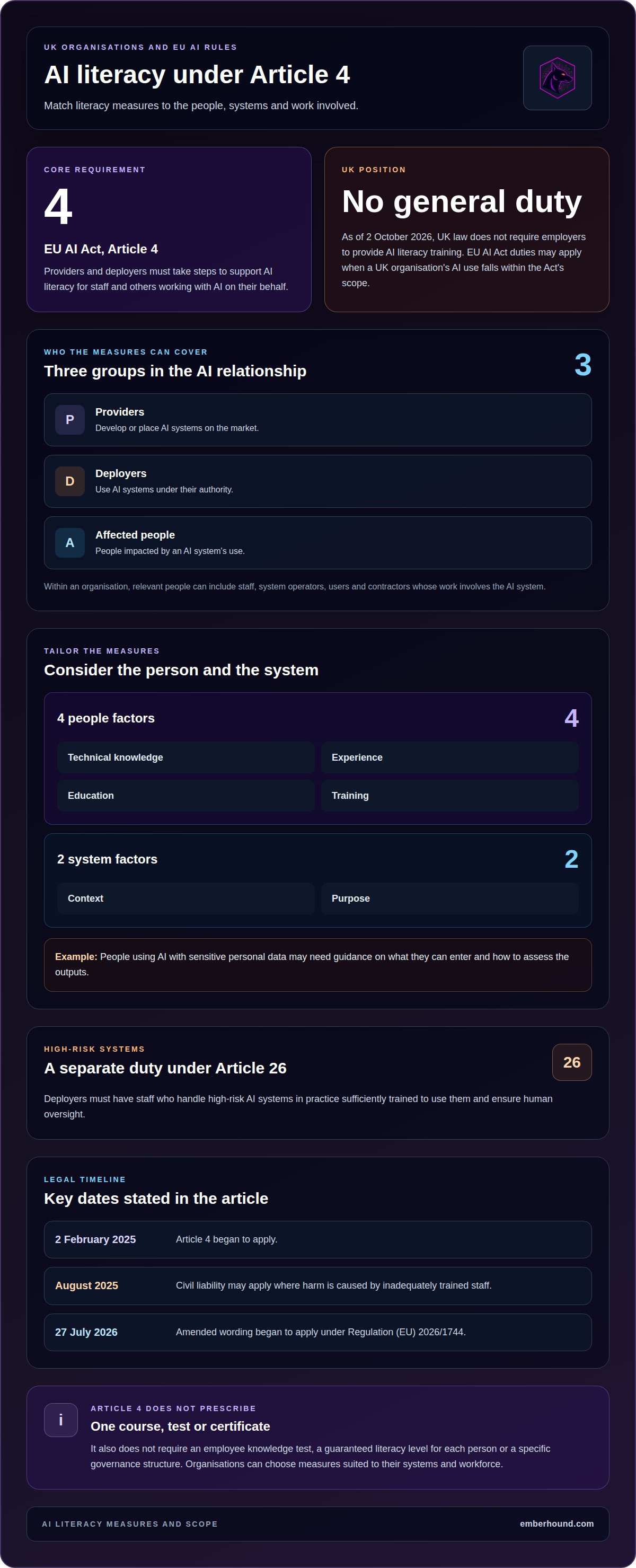
As of 2 October 2026, UK law does not require employers to provide AI literacy training. But ai literacy training requirements can still apply to UK organisations under Article 4 of the EU AI Act if their AI systems fall within its scope. That duty requires providers and deployers to take steps to ensure staff and other people working with AI on their behalf have sufficient AI literacy.
The distinction matters. A UK-only operation and a business whose AI use falls within the EU AI Act’s scope may face different obligations. The Act does not prescribe one standard course or certificate for everyone.
This guide explains when EU rules may apply to UK businesses, what staff training should cover and how to record the steps you take. It also shows how to tailor training to the AI systems people use, their roles and the risks involved, with training content suited to each context.
Key Takeaways
- As of 2 October 2026, UK law does not require employers to provide AI literacy training, but the EU AI Act may apply to UK businesses whose AI systems fall within its scope.
- Article 4 calls for steps to support staff and others working with AI on an organisation's behalf. The right approach depends on their roles and the systems they use.
- A prescribed course, test or certificate is not required under Article 4. Keep clear internal records of training and other literacy measures.
- Match training to the AI systems in use and their risks, with more focused guidance for roles that handle sensitive personal data or high-risk systems.
- EmberHound's GDPR and PCI data discovery offerings can help businesses identify sensitive information that may be involved in AI use.
Is an AI training mandatory for article 4 of the AI Act or are other AI literacy initiatives also allowed?
Article 4 of the EU AI Act requires providers and deployers to take measures supporting AI literacy. It does not prescribe a single course, test or certificate.
People who need AI literacy
AI literacy should reach staff and others who deal with an organisation’s AI systems on its behalf. This includes people who operate or use systems, as well as contractors whose work involves them. The relevant groups depend on each system’s purpose and the tasks people perform. A staff member using an AI tool to support recruitment needs different knowledge from someone maintaining the system.
AI literacy measures for system users
AI literacy measures are activities that help people understand and use AI systems appropriately in their work. They can include general awareness training, role-based instruction and practical guidance. Article 4 asks organisations to consider people's technical knowledge, experience, education and training, alongside each system's context and purpose. A single measure for every team may miss the risks attached to particular uses.
Article 4 has applied since 2 February 2025. Its amended wording has applied since 27 July 2026 under Regulation (EU) 2026/1744. Measures can combine organisation-wide awareness with targeted sessions for groups whose work carries greater risk. The European Commission advises that asking staff only to read a system's instructions for use may be ineffective training.
For example, staff using AI to handle sensitive personal data may need guidance on what information they can enter and how to assess outputs. Contractors involved in operating a system should also understand its purpose and limits. The European Commission and EU Member States support providers’ and deployers’ literacy efforts, including through voluntary codes of conduct and practical examples.
Article 4 does not require organisations to test employees' knowledge, guarantee a particular literacy level for each person or establish a specific governance structure. Organisations can choose measures suited to their systems and workforce. For AI workflows involving personal data, GDPR data handling guidance can help frame the wider privacy context.
Deployers of high-risk AI systems have an additional duty under Article 26: staff handling those systems in practice must be sufficiently trained to use them and ensure human oversight. The Act sets no specific fines for failing to ensure AI literacy. However, organisations may face civil liability from August 2025 where harm is caused by inadequately trained staff.
Definition of AI literacy under the EU AI Act
The EU AI Act defines AI literacy as the skills, knowledge and understanding that enable providers, deployers and affected people to make informed decisions about AI systems. The definition is about decisions people make around AI, not just familiarity with technical terms. For a business, this means considering what people need to understand to use or oversee each system in its actual setting.
“Informed decisions” is the practical test. Someone using an AI system should understand enough about its purpose and outputs to decide how to use them at work. For example, a team member reviewing an AI-generated summary needs to know that it requires human judgement. The relevant understanding depends on the system and the person’s responsibilities.
The definition covers three groups. Providers develop or place AI systems on the market; deployers use them under their authority; affected people are those impacted by an AI system’s use. These roles can span different organisations. A supplier may provide a system, while a UK employer deploys it for a business task, affecting workers or customers through its results.
AI literacy is about more than teaching staff how to use a particular interface. People need knowledge that supports sound decisions about using a system. For instance, a manager deciding whether to rely on an AI-generated recommendation needs context about the system’s purpose and the limits relevant to that decision. A technical specialist may need different knowledge to manage the system’s operation.
The European Commission’s approach recognises that literacy measures should reflect people’s technical knowledge, experience, education and training, as well as the AI system’s context and purpose. These factors help distinguish useful learning from generic content staff cannot apply. A role using AI to process sensitive personal data may call for more focused instruction than occasional use of a low-impact drafting tool.
The EU AI Act applies across sectors, so its definition is relevant to organisations using AI in different kinds of work. It does not set one literacy level for every person or system. Instead, providers and deployers need to consider what knowledge will help relevant people make informed decisions in their circumstances. This assessment can also distinguish general awareness from specialist understanding for particular tasks.
For AI workflows involving personal information, identifying where that information sits can inform the context staff need to understand. Explore GDPR data discovery as one way to map that data within your organisation.
Training records, certificates and assessment
Article 4 leaves organisations room to choose how they support AI literacy. Records can show which measures they took and how those measures fit their AI systems.
Training records and certificates
Training records document the coverage, delivery and timing of an organisation's AI literacy measures. The European Commission says Article 4 does not require a certificate. It also says organisations may keep internal records of training or other guidance initiatives. A practical record can name the audience, subject, delivery date and person responsible. Keep related materials with it, such as a session outline or guidance note.
Assessing organisational AI literacy
Assessing organisational AI literacy means reviewing whether people have the understanding their AI-related duties need. Article 4 does not require an employee knowledge test or a particular literacy level. An organisation can still review roles, systems and existing guidance to identify gaps. For example, a team using AI outputs in customer decisions may need different support from staff with no direct system access.
There is no prescribed assessment framework under Article 4. The European Commission says organisations do not need to test employees' AI knowledge or establish a specific governance structure. That does not remove the need to choose measures thoughtfully. A simple internal review can map which teams provide or deploy AI, who interacts with each system, and what guidance those groups already receive.
The Commission’s suggested steps begin with understanding AI and how it is used within the organisation. Next, consider whether the organisation provides or deploys the systems. Then assess the risks associated with them and tailor literacy measures to staff and use contexts. For example, a group using AI to process personal data may need guidance focused on its actual work.
Article 4 has applied since 2 February 2025. Records can help explain how the organisation's measures developed over time, particularly when systems or staff responsibilities change. An updated record might note a new AI use, the affected teams, and the guidance added in response. This creates a clearer account of decisions than a certificate alone, which may not show who received relevant instruction or what it covered.
Keep records proportionate to the measures in place. For a short briefing, note its topic, intended audience and delivery date. For role-based training, add the system or task covered and the guidance provided. These are practical record-keeping choices, not a format prescribed by the EU AI Act. You can use your existing training records process, provided it captures what measures were taken and when.
Contextual training based on deployed systems and risks
AI literacy measures should reflect the systems an organisation provides or deploys and the risks attached to their use. Article 4 calls for relevant knowledge to match each person’s work and the system’s context and purpose. A general introduction can establish shared understanding, while role-specific guidance addresses decisions staff make around particular systems.
Start with the use case. A deployer using AI to rank job applications needs to understand how staff should interpret the system’s output and where human judgement remains necessary. A provider developing an AI system needs measures suited to the people involved in its development and operation. The same course is unlikely to address both groups’ responsibilities equally well.
Next, consider each staff member’s technical knowledge, experience, education and training. These factors show what a person already understands and where instruction could fill a gap. A technical team member may need detail about system operation. A colleague using the system’s results may need practical guidance on appropriate use, relevant limitations and when to seek human review.
The European Commission’s suggested steps offer providers and deployers a practical way to scope their measures. They include understanding AI and its organisational uses, considering whether the organisation provides or deploys AI, assessing system risks, and tailoring literacy actions to staff and use contexts. This is a planning approach, not a prescribed course or assessment framework.
Risk should shape the depth of guidance. People in HR or using AI to process sensitive personal data may need focused training. For example, staff using an AI tool to sort applications need guidance on how its output fits into recruitment decisions. A broad awareness session might explain the system’s purpose, while role-based instruction addresses its use in that decision process.
Deployers of high-risk AI systems have a specific additional obligation under Article 26(2). They must assign human oversight to people with the necessary competence, training, authority and support. That requirement connects training directly to the oversight task. Staff need to understand the system well enough to perform their assigned role, and have the authority and support that role requires.
Review your measures when an AI system’s purpose, use or affected groups change. A tool introduced for drafting internal text might later be used to process personal data, changing what staff need to understand. Providers and deployers can then adjust guidance for the people involved, rather than relying on instructions describing an earlier use. This keeps literacy measures tied to how the system operates and the risks involved.
UK legal requirements for AI literacy training
As of 2 October 2026, UK legislation does not require employers to provide AI literacy training. A review of legislation from 2023 to 2026 found 11 Acts and 6 instruments mentioning artificial intelligence, but none imposed that training duty. For UK businesses, AI literacy training requirements therefore depend on whether another legal regime applies or the work creates separate training duties.
The EU AI Act can apply to organisations inside and outside the European Union. Its scope includes AI systems placed on the Union market, used in the Union, or used in ways that affect people located there. A UK business using a system in the EU, or whose use affects people there, should assess whether Article 4 applies. The relevant question is where and how the system is used, not simply where the business is based.
Article 4 requires providers and deployers within scope to take measures supporting AI literacy. The duty has applied since 2 February 2025. Supervision and enforcement of Article 4 apply from 2 August 2026, with national market surveillance authorities responsible for enforcement. EU Member States are responsible for relevant national arrangements. A UK organisation should assess its AI activity before treating domestic rules as the only obligations that matter.
Separate UK duties may still be relevant. Section 2(2)(c) of the Health and Safety at Work etc. Act 1974 requires employers to provide training necessary to ensure employee health and safety at work, so far as reasonably practicable. If AI use creates a workplace safety risk, employers should consider suitable training under that duty. It does not create a general AI literacy requirement. For example, staff using AI equipment in a safety-sensitive process may need instruction related to the risks of that work.
There can also be consequences when staff use AI without suitable knowledge. Organisations may face civil liability from August 2025 where harm is caused by inadequately trained staff. That is a potential liability issue, not a separate statutory AI training rule. In financial services, the Financial Conduct Authority and Prudential Regulation Authority have warned that the senior manager regime could lead to personal sanctions if firms fail to address AI risks. These sector-specific concerns can shape an organisation’s training decisions.
The practical takeaway is to separate the legal questions. First, assess whether the EU AI Act applies to the system and its use. Then consider UK duties related to the work, such as health and safety obligations or sector-specific accountability. Document your reasoning and connect staff measures to the actual systems and risks. This lets you assess AI literacy training requirements alongside the obligations that apply to your organisation’s activities.
EmberHound
EmberHound helps businesses locate sensitive information that may be involved in AI use. Its GDPR Data Discovery, PCI Card Data Discovery and Combined GDPR + PCI Coverage can help identify where relevant personal or card data is held. The DSAR Disclosure Pack supports subject access request handling. These tools can help you understand the data your systems and teams work with, but they do not replace role-based AI literacy measures or legal advice. Consider data discovery when you need visibility of sensitive information across your organisation, including information relevant to AI workflows. Contact EmberHound to discuss your data discovery needs.
Make AI literacy part of system change
AI use rarely stays fixed. Teams adopt new tools, change workflows and find new uses for existing systems. Build a review point into those changes. When a system or process changes, identify who will use it and whether their guidance still fits. This makes literacy part of managing AI in practice, rather than a course detached from daily work.
Your approach to AI literacy training requirements should evolve with the work. New data flows, new users or a changed decision process can alter what people need to understand. Give someone responsibility for spotting these changes and updating staff guidance and data reviews. This keeps the programme connected to how systems are actually used.
When AI workflows involve personal or payment data, visibility of that information can help teams decide what to address next. Start by understanding the data footprint, then connect it to the people and decisions around each system. Make the next step manageable by focusing on one workflow and its users.
Clear ownership and regular reviews can help your approach keep pace as AI use changes.
Frequently Asked Questions
Is AI literacy training a legal requirement in the UK?
There is no general UK law requiring employers to provide AI literacy training. The position may differ if the EU AI Act applies to a UK organisation’s AI activity. For example, a business using a system in the EU should assess whether it falls within the Act’s scope. Separate duties may also matter when AI use raises workplace safety risks or sector-specific accountability concerns.
What does "AI literacy" mean?
Under the EU AI Act, AI literacy means having the skills, knowledge and understanding to make informed decisions about AI systems. In practice, a staff member might need to know when an AI-generated answer requires human review before it is sent to a customer. The knowledge required depends on the person’s role and the system’s use. It does not necessarily mean learning how to build AI models.
Can’t I just rely on the providers of the AI systems?
Information from the provider can help, but relying only on a system’s instructions may leave staff without practical guidance for their work. A recruitment team, for example, needs to understand how the organisation expects them to use an AI-generated ranking. The provider’s manual may explain system functions, while internal guidance covers responsibilities, decision-making and escalation. These are different needs, so consider both.
Is there effectively an actual obligation to measure the level of the knowledge of employees?
No. Article 4 does not require providers or deployers to test employees or guarantee a defined level of knowledge for each person. An organisation can still review whether its measures fit the work. For example, a manager might identify teams using AI outputs in customer decisions, then check whether existing guidance covers those tasks. That review informs training choices; it is not a mandated examination.
Should managers and developers get different training?
Yes. Learning should reflect the decisions and tasks involved in each role. A manager approving AI-supported decisions may need guidance on appropriate reliance, escalation and accountability. A developer may need to understand system behaviour, intended use and risks arising during development. A shared introduction can give both groups common terms, while role-specific material explains what each person needs to do in practice.
What about specific sector guidance?
Sector context can add duties beyond general AI literacy measures. Sector rules can affect who needs guidance and what it should cover.
What does AI literacy mean under UK law?
UK legislation does not set a general AI literacy training duty for employers. The defined term in this guide comes from the EU AI Act, where it concerns the understanding needed to make informed decisions about AI systems. UK organisations should distinguish that EU definition from domestic duties that may apply to particular work. For example, health and safety training may be relevant where AI use creates workplace risks.
Do UK employers have a legal duty to provide AI literacy training?
There is no general UK statutory duty to provide AI literacy training. Employers still need to consider duties connected to the work itself. Section 2(2)(c) of the Health and Safety at Work etc. Act 1974 requires necessary health and safety training, so far as reasonably practicable. If an AI-supported process creates a workplace safety risk, training may be relevant to meeting that separate obligation.


