

High-risk AI is only part of the compliance picture. Some EU AI Act duties apply regardless of risk tier, while specific deployer requirements depend on the system’s classification and how you use it. An EU AI Act deployer obligations checklist should start by establishing whether the Act applies, your role and the system’s risk category.
For UK organisations, the Act can apply when an AI system’s output is used in the EU. AI literacy duties have applied since 2 February 2025, regardless of risk tier. High-risk systems bring further responsibilities, including human oversight, monitoring and records.
The rules can feel like a lot to manage, especially for a small team. A clear sequence makes the work practical. This guide explains how to scope your AI use and address applicable impact assessments, human oversight, monitoring and compliance evidence.
Use these checks to identify what applies to your organisation, then focus on the duties relevant to each system. You’ll see where deployer responsibilities begin and what evidence can help demonstrate how you handle them.
Key Takeaways
- Start by mapping each AI system, its intended use and your role. The Act can apply to UK organisations when a system's output is used in the EU.
- Classify each system before assigning duties. High-risk use triggers specific deployer requirements, while other risk categories have different obligations.
- Check whether your organisation must complete a fundamental rights impact assessment before using a relevant high-risk system.
- Set human oversight roles with the competence and authority to intervene, and define how staff will monitor system operation and respond to risk.
- Keep the records needed to show how each system is used, monitored and governed. High-risk system logs must be retained for at least six months.
Do deployer duties apply to all AI or only high-risk ones?
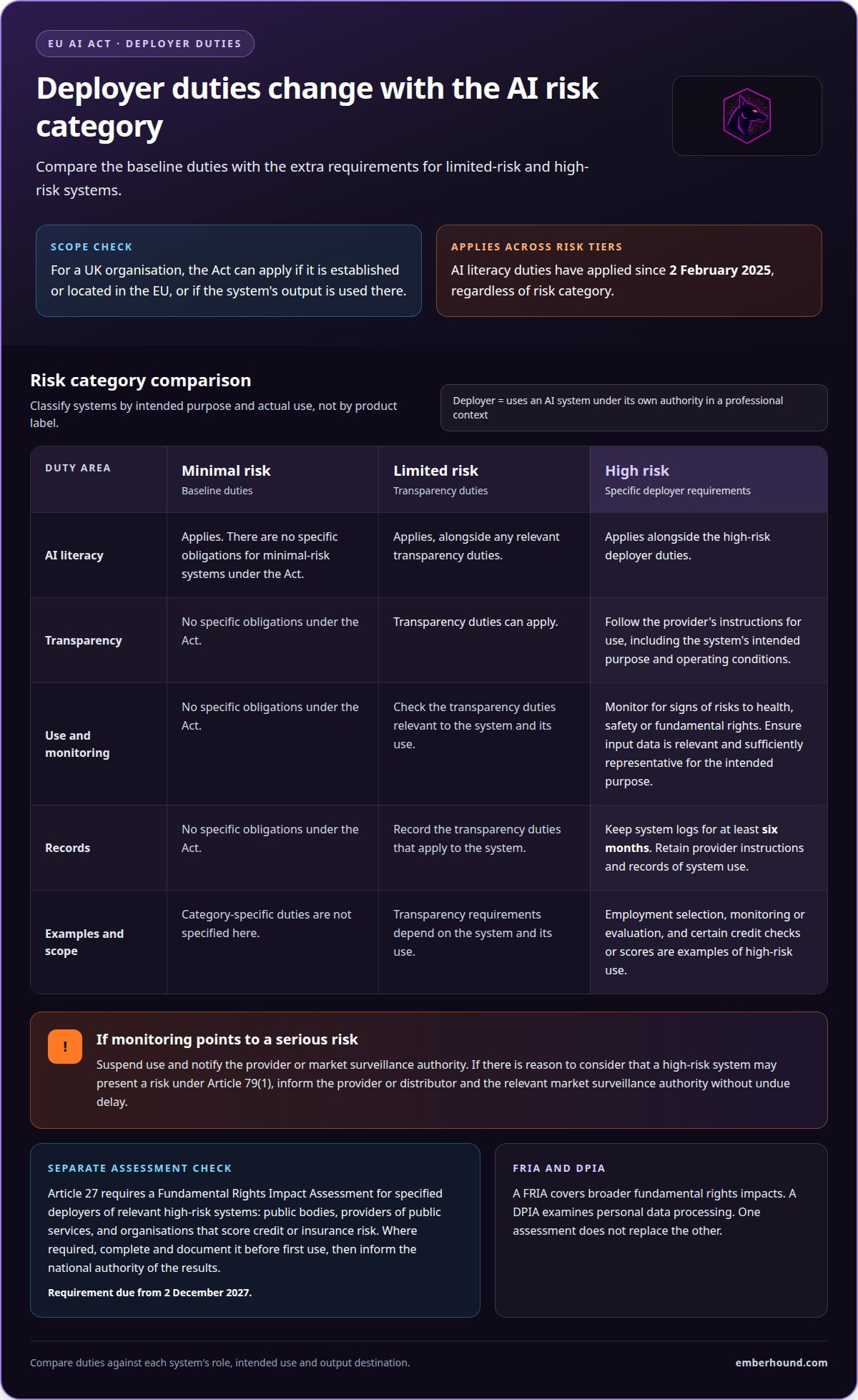
No. The EU AI Act sets different duties according to an AI system's risk category and the organisation's role. Minimal-risk systems have no specific obligations under the Act, but providers and deployers still have AI literacy duties. Limited-risk systems can carry transparency duties. High-risk systems trigger specific deployer requirements under Article 26 of Regulation (EU) 2024/1689.
For a UK organisation, the Act can apply if it is established or located in the EU, or if the system’s output is used there. A deployer uses an AI system under its own authority in a professional context. A provider develops a system, has one developed, or places it on the market under its own name. Use an EU AI Act deployer obligations checklist to map each system, its users, purpose and output destination.
Classify the system by its intended purpose and use, not its product label. The Act identifies systems used to select, monitor or evaluate employees as high-risk. Certain systems used for credit checks or credit scores are also high-risk. For example, an employer using AI to rank job applicants must assess the system against the relevant high-risk requirements, even if a supplier built it. Use the EU AI Act deployer obligations checklist to record the classification rationale and the duties that follow.
- Record the system and your role. Name its purpose, provider and where its output is used, because these details determine whether the Act applies and which operator duties are relevant.
- Assess the intended use against high-risk categories. Employment selection and certain credit assessments are examples, so test the actual workflow rather than relying on a general product description.
- Follow the provider's instructions for use. Article 26 requires deployers of high-risk systems to use them according to those instructions, which set the system's intended purpose and operating conditions.
- Monitor operation for risk. Article 26 requires monitoring for indications of risks to health, safety or fundamental rights, and deployers must ensure input data is relevant and sufficiently representative for the intended purpose.
Retain the provider’s instructions and records showing how the system was used. High-risk deployers must keep system logs for at least six months. Instructions guide operation; logs help establish what happened and when.
If you have reason to consider that a high-risk system may present a risk under Article 79(1), suspend its use and inform the provider or distributor and the relevant market surveillance authority without undue delay. If monitoring identifies a serious risk, suspend use and notify the provider or market surveillance authority. A system that fails to operate as intended needs prompt review; where the failure indicates a serious risk, follow the suspension and notification duties.
Finally, check whether your organisation has changed the system's role. Under Article 25, rebranding a high-risk system, substantially modifying it or changing its intended purpose so it becomes high-risk can make the organisation its provider. That shift changes the applicable obligations.
Fundamental rights impact assessments
A Fundamental Rights Impact Assessment (FRIA) is a separate EU AI Act duty from a GDPR Data Protection Impact Assessment (DPIA). Article 27 applies to deployers that are public bodies, provide public services, or score credit or insurance risk. Where required, complete and document the FRIA before first use of the relevant high-risk system, then inform the national authority of its results. The requirement is due from 2 December 2027.
Scope matters. The specified FRIA requirement exempts systems in Annex III, point 2, concerning critical infrastructure. A private organisation should therefore assess its role and activity, the system’s Annex III use case, and whether it provides a public service or scores credit or insurance risk. Record why the requirement applies or does not apply. This gives the assessment a clear basis when the system’s purpose or operating context changes.
- Identify the affected people and rights. Describe who may be affected by the system and how its decisions could affect their rights, because Article 27 focuses the assessment on fundamental rights impacts.
- Document the system’s intended use. Record its purpose, operating context and expected users, because a change from internal support to public-service decisions may affect the FRIA analysis.
- Set out the likely impacts and safeguards. Explain the risks identified and the measures planned to address them, because the FRIA must be documented and maintained.
- Inform the national authority of the results. Keep a record of what was communicated and when, because notification is part of the applicable Article 27 duty.
Run a DPIA separately where data processing is likely to result in high risk to people’s rights and freedoms under Article 35 of Regulation (EU) 2016/679. For processing by competent authorities for law enforcement purposes, Article 27 of Directive (EU) 2016/680 is relevant. Use provider information about the AI system to support a required DPIA. A DPIA examines personal data processing; an FRIA addresses the system’s broader effects on fundamental rights. One assessment does not replace the other.
Screen for prohibited practices as a distinct step. Article 5 prohibitions have applied since 2 February 2025. If a planned use falls within a prohibited practice, an FRIA or DPIA does not make that use permissible. Record the screening outcome, the intended purpose examined and any changes made to the workflow.
Where personal data forms part of the workflow, a separate review of personal data in your GDPR processes can help address that data-discovery task. Keep its findings distinct from the FRIA and DPIA records.
Human oversight and continuous monitoring
For high-risk AI, human oversight must have practical authority. Article 26(2) requires deployers to arrange oversight by people with suitable competence, training, authority and support. The duty for Annex III high-risk systems applies from 2 December 2027. Naming an employee as a reviewer is not enough if they cannot question an output or intervene.
Build the oversight process around the system’s actual decisions. Assign a trained person to review outputs that could affect an individual, such as a recruitment ranking. Give that person time, access to relevant information and authority to override the system or stop its operation. Document who acts, what triggers a review and how interventions are recorded.
- Set clear intervention points. Define when a person must review an output, such as before an AI-supported decision affects access to a service.
- Make intervention workable. Confirm that staff can override a recommendation or shut down the system, rather than merely approve its output.
- Train for system limits. Explain the intended purpose and known risks so reviewers can recognise unsuitable results.
- Record oversight actions. Keep the reason for a review, the decision made and any follow-up, so documentation reflects how oversight worked in practice.
Monitoring continues after deployment. Article 26 requires deployers to monitor high-risk system operation for indications of risks to health, safety or fundamental rights. Set a review process for unexpected outputs, repeated staff overrides and changes in the data or workflow. For example, a rise in disputed recommendations may signal that the system’s operation needs investigation.
If monitoring gives you reason to consider that use may present a risk under Article 79(1), suspend use and inform the provider or distributor and relevant market surveillance authority without undue delay. If you detect a serious risk, suspend use and notify the provider or market surveillance authority. Record the incident, the decision to suspend and the notifications sent.
Workplace use has a separate communication step. Under Article 26(7), before putting an Annex III high-risk system into use at work, deployers must inform affected workers and their representatives. This duty applies from 2 December 2027. For an AI system used to support employee evaluation, give that information before use begins, not after staff experience its effects.
Human editorial review also needs a defined purpose. Checking AI-generated text before publication can improve editorial control, but it does not replace assigned oversight for a high-risk system. Article 50 transparency duties apply from 2 August 2026, including relevant duties for deployers. Assess whether people need to be informed at their first interaction or exposure, and review any claimed exception against the specific use. Law-enforcement or legally authorised uses require particular care.
Compliance evidence and obligations registers
An obligations register turns each AI system into a record your team can maintain. For every system, capture its intended purpose, provider, deployer role, risk classification, applicable duties, owner and review date. Link to provider instructions, training records, impact assessments, incident records and monitoring evidence. This structure helps staff trace each duty to the system and the evidence supporting it.
Keep evidence current. Record when a system entered operation, changes to its purpose, who approved those changes and where its outputs inform decisions. For high-risk systems, retain required logs for at least six months. The register should point to these records, not suggest that every AI output must be logged.
- Record the classification and rationale. A written basis helps explain why a system was treated as high-risk or assigned another category.
- Link each duty to an owner. Named responsibility makes it clear who maintains monitoring, training and transparency records.
- Track incidents and actions. Keep the event, suspension decision and notifications together so the response can be followed later.
- Review records after a change. A new purpose, workflow or system modification can alter the applicable duties and risk assessment.
Dates depend on the system and obligation. Prohibited-practice and AI literacy duties have applied since 2 February 2025; Article 50 transparency duties apply from 2 August 2026. Articles 26 and 27 duties for Annex III systems apply from 2 December 2027. Relevant duties for AI embedded in Annex I regulated products apply from 2 August 2028, while high-risk deployments intended for public authorities have a 2 August 2030 date. Record the date relevant to each system, rather than using one deadline for the whole register.
Penalties also depend on the breach. Most operator breaches, including deployer duties, can attract a maximum fine of 3% of worldwide annual turnover; breaches of Article 5 prohibitions can reach 7%. Supplying incorrect, incomplete or misleading information to authorities carries a lower tier of up to 1%. These are EU AI Act penalty limits, not a prediction of the fine for a particular case.
Maintain separate records for other applicable laws. AI-related data processing may also engage the GDPR, national laws under the ePrivacy Directive, the EU Data Act and relevant cybersecurity laws. Keep GDPR accountability documentation and any required data protection impact assessment with the relevant processing records. An EU AI Act register supports compliance evidence; it does not replace these separate obligations.
Use the register to prepare for review before an inspector requests evidence. The EU AI Act does not prescribe one technical implementation, so records should reflect the system, its purpose and the duties that apply. Check that each entry points to current evidence, including provider instructions, monitoring records and required impact assessments.
EU AI Act deployer obligations
Article 26 sets the core duties for deployers of high-risk AI systems. They must follow providers' instructions, monitor system operation and arrange human oversight. They must also ensure input data is relevant and sufficiently representative for the system's intended purpose. The timing of deployer duties depends on the system and applicable requirements.
Turn requirements into assigned controls. Give a named role responsibility for oversight and another for incident escalation. Link each control to provider instructions, training records and technical documentation. For example, a team using AI to support a decision about a person needs a defined route to review the output and intervene. Governance works only when staff know who acts and what evidence to retain.
- Use the system within its intended purpose. Record the provider's instructions and the workflow in which the system operates.
- Review operation for risk. Set a monitoring process that can identify concerns affecting health, safety or fundamental rights.
- Keep input data suitable. Document how the data used in operation relates to the system's intended purpose.
- Prepare a serious-risk response. Define how staff suspend use and notify the provider or market surveillance authority when required.
If a deployer has reason to consider that use may present a risk under Article 79(1), it must suspend use and inform the provider or distributor and relevant market surveillance authority without undue delay. When a serious risk is detected, the deployer must suspend use and notify the provider or market surveillance authority. A response record should show the concern, action taken and notifications sent.
Public bodies, organisations providing public services and deployers scoring credit or insurance risk have an additional Article 27 question: whether a Fundamental Rights Impact Assessment is required. Where applicable, complete and document it before first use, then inform the national authority of its results. The listed Article 27 requirement is due on 2 December 2027. The assessment requirement exempts systems in Annex III, point 2, concerning critical infrastructure. Public-authority deployers of Annex III systems also have an EU database registration requirement; it does not generally apply to private enterprise deployers.
Keep the dates distinct. AI literacy and prohibited-practice duties have applied since 2 February 2025. Article 50 transparency duties apply from 2 August 2026. Annex III obligations under Articles 26 and 27 apply from 2 December 2027. A date register should connect each system to its use case and applicable duty, rather than treating one August deadline as universal.
EmberHound
EmberHound helps organisations identify sensitive data that may sit within their wider AI and data governance work. GDPR Data Discovery and PII Data Discovery can help locate personal information; PCI Card Data Discovery and Combined GDPR + PCI Coverage address payment card data. The DSAR Disclosure Pack supports subject access request handling.
Use data discovery when you need clearer visibility of personal or card data connected to your processing activities. It can support records and investigations, but it does not replace an EU AI Act risk classification, impact assessment or legal review. Keep these responsibilities distinct.
Contact EmberHound to discuss the data discovery work relevant to your organisation.
Make compliance part of daily operations
Treat an EU AI Act deployer obligations checklist as a working control, not a document to complete once and file away. Give each entry an owner and a review trigger, such as a change to the system’s purpose or workflow. This makes it easier to revisit decisions as your organisation changes how it uses AI.
A useful next step is to map where personal or payment card data sits in processes connected to AI. Clear data visibility can help teams understand what information enters those workflows and where related records may need attention. Keep this work separate from legal interpretation of the Act.
EmberHound’s data discovery tools can support this visibility work. Choose the next step that fits your organisation’s data needs and existing governance process.
Build the routine around real system changes so your governance keeps pace with the work.
Frequently Asked Questions
Who has to run this checklist?
The team responsible for AI governance should coordinate the process, with input from the people who select and use systems. Procurement can identify purchased tools; department leads can flag AI features built into existing software. For example, include a recruitment platform’s ranking function even if staff see it as just one feature of a larger product. Assign an owner to bring these records together and keep them current.
Do I need a checklist if none of my systems are high-risk?
Yes. A checklist can capture low-risk tools and help identify when their use changes. A writing assistant used for internal drafts may have a different purpose from one whose generated text informs decisions about individuals. Record the use case, users and affected people for each tool. This gives your team a basis for reviewing the classification if it adds a new workflow or audience.
Do all enterprise deployers need to register in the EU AI database?
No. The requirement applies specifically to public-authority deployers of Annex III high-risk systems; private enterprise deployers generally do not register solely because they use AI. Organisational size does not determine the answer. Record whether the deploying body is a public authority and which system and use case are in scope. This separates a registration question from other duties attached to a system.
Is a checklist enough to demonstrate compliance?
No. Treat each checklist entry as an index to evidence, not evidence in itself. If a control says a team reviewed an AI-supported decision, retain a dated review record identifying the case and action taken. Keep evidence somewhere with access controls and an assigned owner. A reviewer should be able to trace a stated control to records showing it is in operation.
Who counts as a deployer under the EU AI Act?
A deployer uses an AI system under its own authority in a professional context. A useful practical test is to consider who decides where and how the system is used. A supplier may provide the software, while an organisation sets the workflow and puts it into use. Contract labels alone do not settle the role; the organisation’s actual activity matters.
What is the EU AI Act deployer compliance checklist for high-risk AI?
Build the checklist around each system’s real workflow. Identify who can approve its use, who receives outputs and what happens when a result is challenged. Test the escalation route with a sample case before launch, then record the outcome and any changes. This adds an operational check to the legal review and can reveal gaps that a policy document alone may miss.
When must deployers conduct human oversight and monitor AI system performance?
Plan oversight before the system enters operational use, then keep it active throughout. Set review triggers that match the workflow, such as a user challenge, a material process change or an unexpected result. After changing the system’s purpose or user group, reassess whether the existing oversight route still works. Avoid setting a fixed review frequency when the system’s risks call for a different approach.
What are deployers' duties for input data, logging and record keeping?
For input data, record its source and how staff assess its suitability for the system’s purpose. For logs, ensure relevant events can be linked to the system and its period of operation. Record who owns each item and how it can be retrieved. Where personal data is involved, connect these materials to the organisation’s applicable data protection records.


