

The Annex III high-risk categories cover eight areas of AI use under the EU AI Act, including biometrics, employment, education, essential services, law enforcement, migration and border control, justice and democratic processes, and certain critical infrastructure. An AI system used in a listed area may be high-risk, but the specific purpose and the Article 6(3) exception matter.
The hard part is applying the list to a real use case. An AI system that performs a narrow procedural task may qualify for the Article 6(3)(a) exception, provided it meets the relevant conditions; profiling individuals rules out that exception. A category match alone is not the whole assessment.
This guide explains what Annex III covers, how to interpret its high-risk areas and what criterion (a) means in context. It also outlines how European Commission guidance and delegated acts may affect interpretation and the list.
Key Takeaways
- Annex III groups high-risk AI uses across eight areas. Start with the system's intended purpose and the specific use, not its label alone.
- Article 6(3)(a) may exempt a narrow procedural task from high-risk status if the relevant conditions are met. Profiling individuals rules out this exception.
- Commission guidance can help explain how the rules apply to use cases, while Article 7 provides for delegated acts to amend the list.
- Biometric systems have specific conditions under Annex III, including whether their use is permitted under relevant EU or national law.
- Separate the AI Act classification question from data discovery: GDPR Data Discovery and PCI Card Data Discovery address identifying sensitive information in business data.
European Commission guidance and delegated acts
European Commission guidance explains how providers should apply EU AI Act classification rules to practical cases. Delegated acts can amend Annex III under Article 7. One helps interpret the framework; the other can change the listed categories. Keep those functions separate when tracking regulatory updates.
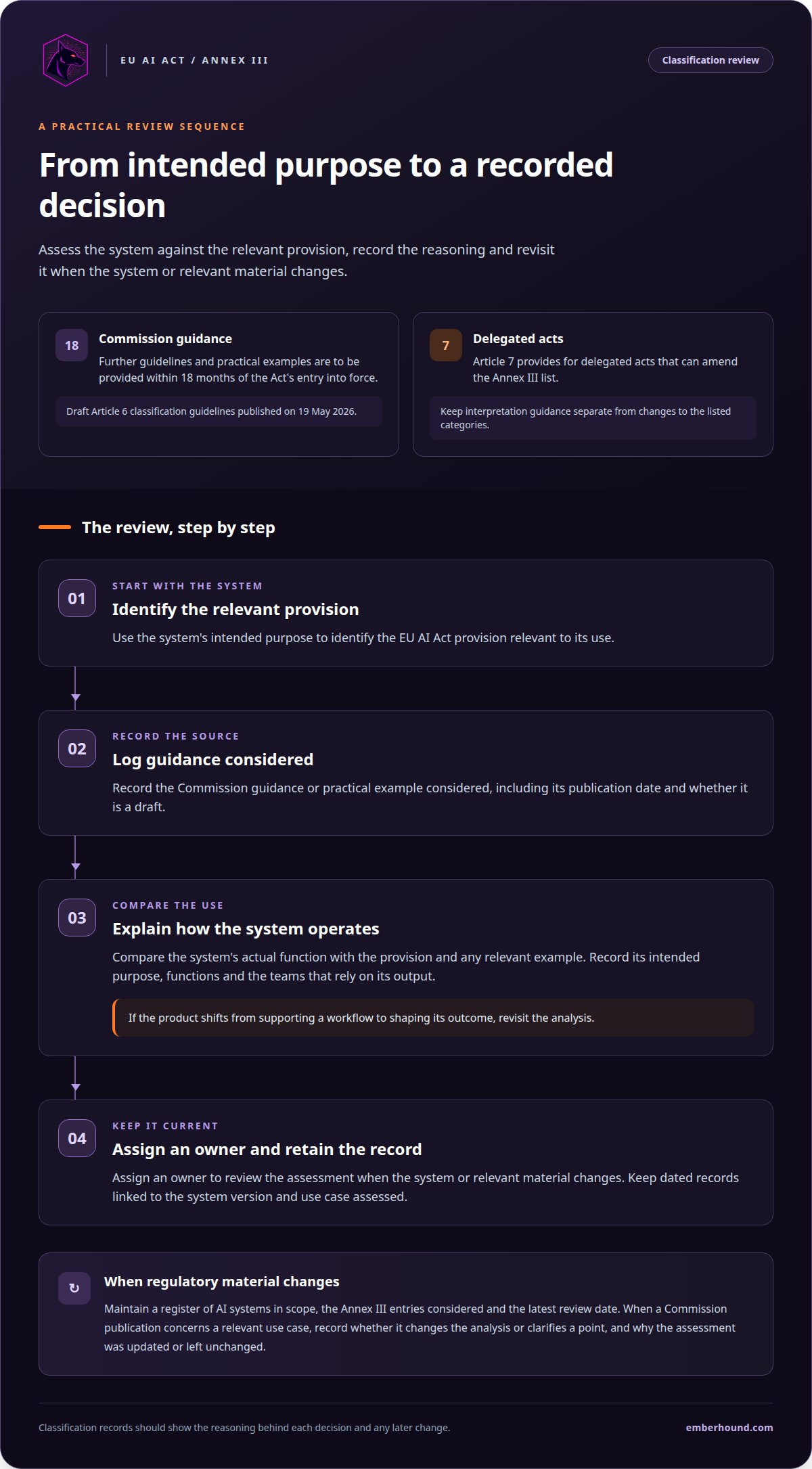
The Commission is to provide further guidelines and practical examples within 18 months of the Act's entry into force. It published draft Article 6 classification guidelines on 19 May 2026. The draft can help frame questions about a system's intended purpose and operation. Use its examples as interpretation aids, then compare the system against the Act's wording.
A useful internal record links each classification decision to the system version and use case assessed. Note the intended purpose, relevant functions and teams that rely on the output. If a product shifts from supporting a workflow to shaping its outcome, revisit the analysis. Keep dated records so teams can trace the reasoning behind each decision.
For a practical review, organise the work into clear steps:
- Identify the EU AI Act provision relevant to the system's intended purpose.
- Record the Commission guidance or practical example considered, including its publication date and draft status.
- Explain how the system's actual function compares with the provision and example.
- Assign an owner to review the assessment when the system or relevant material changes.
This approach makes the difference between an interpretive aid and a change to the legal text visible in the record. A draft guideline may help explain a classification question, while a delegated act under Article 7 can amend Annex III itself. Track each separately, so an interpretation update does not get mistaken for a change to the list.
Providers can make monitoring more specific by maintaining a register of AI systems in scope, the Annex III entries considered and the latest review date. When a European Commission publication concerns a relevant use case, assess whether it changes the analysis or clarifies a point. Record why you updated the assessment or kept it as it was.
For separate data-protection context around personal information, the GDPR guide explains the data discovery perspective. Keep that work distinct from monitoring European Commission publications and changes made through delegated acts.
Predictions of hazard classification for Annex III purposes can use (Q)SARs or other evidence. If a prediction informs a classification review, record the method, evidence and assumptions behind it. Note any limitations that could affect how it applies to the particular system or use case. This makes the reasoning easier to examine later without treating a prediction as a complete account of the system.
Keep the evidence trail connected to the classification decision. Identify the hazard question addressed, explain how the evidence relates to the intended purpose and note where other evidence supports or differs from the prediction. If you revisit the assessment, retain the earlier reasoning alongside the updated analysis. This helps reviewers see whether a changed conclusion reflects new evidence, a different interpretation of the use case or a change to the system.
The eight Annex III high-risk areas
Annex III of Regulation (EU) 2024/1689 lists eight areas where certain AI uses are classified as high-risk under Article 6(2). The intended purpose matters: a system must match a listed use, not merely operate in the same sector.
- Biometrics covers specified biometric identification and categorisation systems. Examples include remote biometric identification in publicly accessible spaces and categorisation that infers sensitive characteristics. Annex III applies only insofar as the use is permitted under relevant EU or national law.
- Critical infrastructure covers AI used as a safety component in managing or operating specified infrastructure. This includes critical digital infrastructure, road traffic, and water, gas, heating or electricity supplies. General operational-efficiency analytics are not automatically within this category.
- Education and vocational training covers AI that affects access, assessment or monitoring in education. Examples include systems that determine admission to educational institutions, evaluate learning outcomes or monitor exam candidates for prohibited behaviour.
- Employment and worker management covers AI used in decisions about work and employment relationships. The listed uses include recruitment and selection, task allocation, monitoring or evaluating workers, and decisions about promotion or termination.
- Essential private and public services covers AI that affects access to services or benefits. Examples include assessing a natural person's creditworthiness, pricing life or health insurance, assessing eligibility for public benefits, and allocating emergency services such as police or ambulance response.
- Law enforcement covers specified AI uses by law-enforcement authorities. These include assessing a person's risk of offending or re-offending, evaluating evidence reliability, profiling people during criminal investigations, and analysing crime patterns.
- Migration, asylum and border control covers AI used in decisions or checks concerning third-country nationals. Examples include assessing asylum applications, verifying travel documents, supporting border checks, and assessing irregular-migration or security risks.
- Administration of justice and democratic processes covers AI that assists judicial authorities or affects elections. A system may help a court research or interpret facts and law for a specific case, or be intended to influence voting behaviour or election outcomes.
For an assessment, identify the system’s purpose, users and role in the decision. Then match its functions to the specific Annex III use, including any stated limits. A database label or broad description such as "AI for education" does not establish the category on its own.
These categories concern AI classification. For a separate view of personal information held across your organisation, explore data discovery options.
Annex III criterion (a)
Article 6(3)(a) describes a narrow procedural task as one possible basis for treating an Annex III system differently. The phrase points to a bounded administrative operation, rather than an assessment of a person's circumstances. The task's limits matter: what information enters, what operation the system performs and what result it returns.
Consider a system that sorts incoming applications by receipt date or flags duplicate reference numbers. These operations organise a process. A system that ranks applicants or recommends who should receive a benefit performs a different function. The examples help distinguish procedural handling from substantive assessment, but the exact design and use determine how the provision applies.
To analyse the task, describe its boundaries in operational terms:
- State the input, such as a reference number, timestamp or document status.
- Describe the operation, such as sorting records or flagging repeated identifiers.
- Identify the output and the next step in the workflow.
- Record whether the output evaluates a person or shapes the assessment of their case.
Product labels can obscure this distinction. Calling software a "case-management assistant" does not show whether it only organises records or evaluates them. Map each function separately: a single system might sort incoming records and produce an individual score. The first function may be procedural; the second needs its own analysis against the relevant Annex III use.
Tie the criterion to the task, not just its surrounding industry. In an employment workflow, sorting applications by arrival time differs from ranking candidates. In public-service administration, routing a form to a team differs from recommending whether an applicant qualifies. The sector tells you where to look; the operation explains what the system does there.
Useful evidence includes workflow diagrams, interface descriptions and sample outputs. These can show whether staff receive an organised record or an AI-generated judgement about a person. Product documentation should describe each function in plain language, especially when an interface combines administrative actions with analytical features.
Review the analysis when a feature changes. A system that once sorted records might later add prioritisation based on applicant characteristics, changing the task under examination. Separating functions in product specifications and deployment records makes it easier to spot when a procedural operation has expanded into a decision-support function.
For chemical substances, a separate Annex III distinction applies under REACH; it should not be confused with the procedural-task analysis here. Under Article 12(1)(a) of REACH, a substance meeting either or both Annex III criteria requires a full Annex VII data set. Both conditions of Annex III criterion (b) must be fulfilled: the substance must have dispersive or diffuse uses and be predicted to meet classification conditions for a human health or environmental hazard.
Annex III criterion (b)(ii) refers to predicted classification for any human health or environmental hazard class under Annex I of the CLP Regulation. ECHA’s Annex III Inventory presumes that a listed substance meets criterion b(ii), meaning it is predicted to be hazardous. Under Article 12(1)(b) of REACH, substances meeting neither Annex III criterion need only provide the physicochemical information in Annex VII. These provisions concern substance information requirements, not the AI-related procedural task discussed here.
Annex III high-risk use-case categories
Annex III and Annex I are separate routes for identifying high-risk AI systems under the EU AI Act. Annex III focuses on specified AI uses in listed domains. Article 6(1) and Annex I cover AI systems used as safety components in products governed by EU safety legislation.
The key distinction is the system’s relationship to a product and its safety function. For the Annex I route, establish whether the AI system is intended to act as a safety component in a product covered by the relevant EU legislation. For Annex III, examine whether its intended use matches a listed use case.
Use this sequence to frame the classification:
- Describe the AI system's intended purpose and the function it performs.
- For the product-safety route, identify the product and its relevant EU safety legislation.
- Establish whether the AI system is intended as a safety component of that product.
- Separately compare the system's intended use with the specific entries in Annex III.
The product's use of AI does not, by itself, establish the Annex I route. The relevant question is whether the AI system has the safety-component role described by Article 6(1). An AI feature that supports a product in another way needs analysis against the applicable classification route, rather than an assumption based on the product's sector.
A system connected to a regulated product and used in a listed context may raise questions under both routes. Keep each route’s analysis distinct. Record the system’s purpose, its relationship to the product and the Annex III entry considered. This helps prevent a product classification from being mistaken for a use-case classification, or vice versa.
For example, an AI system intended to act as a safety component in a product covered by EU safety legislation should be assessed through Article 6(1) and Annex I. A stand-alone AI system used for a purpose named in Annex III should be assessed through Article 6(2) and that Annex. These examples show the two routes; the system's intended purpose and function determine which analysis applies.
Link the evidence for each route to the relevant facts. Product specifications can describe a safety function and the product it supports. System documentation can explain the intended use and how it matches an Annex III entry. If either description changes, revisit the relevant route and record the reason for updating the classification.
Which Annex III high-risk categories apply to biometrics?
Biometric identification uses physical, physiological or behavioural characteristics to identify a person. Biometric categorisation uses biometric data to sort people by inferred characteristics, such as race or religious belief. Annex III covers specified uses of both, subject to whether the use is permitted under relevant EU or national law.
Remote biometric identification compares biometric data with a reference database to establish a person’s identity from a distance. Annex III includes real-time and post-event remote biometric identification in publicly accessible spaces. Timing and setting matter: identify whether the system operates as people pass through a public place or analyses recorded material later.
Biometric categorisation is a separate use. Annex III includes systems that infer sensitive characteristics, such as political opinion, religious belief, race or sexual orientation. For example, a system that assigns people to categories based on facial images needs assessment of its intended purpose and inferred attributes. The focus is the use case, not simply the presence of a camera.
Law enforcement requires particular care. Article 5 prohibits real-time remote biometric identification of people in publicly accessible spaces by law enforcement. Annex III’s biometric category applies only insofar as the use is permitted under relevant EU or national law. A system’s appearance in Annex III does not authorise a use that Article 5 prohibits.
Separate the following questions during classification:
- What does the system do? Distinguish identity matching from categorisation by inferred traits.
- Where does it operate? Establish whether the location is publicly accessible, as Annex III specifies.
- When does identification happen? Record whether the system identifies people in real time or processes recorded material afterwards.
- Who uses it, and under what legal basis? Identify whether law enforcement is involved and whether applicable law permits the use.
Map the answers to the specific Annex III purpose. A workplace access system that checks an employee’s identity raises a different use-case question from software that infers sensitive traits from facial images. This comparison helps identify which function needs assessment; it does not determine classification without considering the full purpose and legal context.
For real-time identification by law enforcement in a publicly accessible space, Article 5’s prohibition is the immediate issue. For permitted biometric uses, Article 6(2) makes an Annex III purpose relevant to high-risk classification, subject to the Article 6(3) exception. Keep the use, location and timing together in the assessment.
EmberHound
EmberHound helps organisations identify sensitive information in business data. Its data discovery tools support a separate but related task: understanding where personal or payment-card data is held. They do not classify AI systems under Annex III or replace a legal assessment.
If an AI use case involves personal information, GDPR Data Discovery can help locate it. PCI Card Data Discovery focuses on payment-card data, while Combined GDPR + PCI Coverage addresses both. For subject access request handling, the DSAR Disclosure Pack supports preparation of disclosure material.
Use these services when you need visibility into sensitive data connected with your wider AI governance work. For help identifying data across your systems, contact EmberHound.
Turn the classification into a clear next step
Use the assessment to guide internal planning. Give relevant teams a shared view of the AI system’s purpose, its place in the workflow and the decisions that depend on it. This clarifies ownership as a project moves from design into operation.
Keep AI classification and data discovery as distinct workstreams. Annex III high-risk categories frame the classification question. EmberHound’s GDPR Data Discovery, PCI Card Data Discovery and Combined GDPR + PCI Coverage address the separate task of locating sensitive information in business data.
Choose the next action that fits your work: clarify how the AI system is used, or build visibility into the personal or payment-card data connected with its processes. A focused next step gives the right teams something specific to work on.
Frequently Asked Questions
What is Annex III in the EU AI Act?
Annex III is the EU AI Act’s list of specified AI uses assessed through the use-case pathway. It helps providers determine whether a system’s intended purpose falls within a listed domain. For example, a recruitment tool may need assessment against the employment entry, while software used for unrelated workplace administration may require a different analysis. Classification depends on the system’s function and context.
Can an Annex III system be excluded from high-risk status?
Yes. Article 6(3) allows an Annex III system to be treated as non-high-risk if it meets a specified task condition and does not pose significant risk to health, safety or fundamental rights. Profiling individuals rules out the exception. If relying on it, the provider must document its assessment before market placement or putting the system into service. Article 49(2) also requires database registration.
What obligations apply to high-risk systems?
Providers must meet the requirements in Articles 8-15, including lifecycle risk management under Article 9, data governance under Article 10, technical documentation under Article 11, and human oversight under Article 14. Article 15 covers accuracy and robustness. Article 43 requires conformity assessment, and Article 71 covers EU database registration. Deployers also have obligations under Articles 16-27, including using the system as intended and maintaining operational oversight.


