

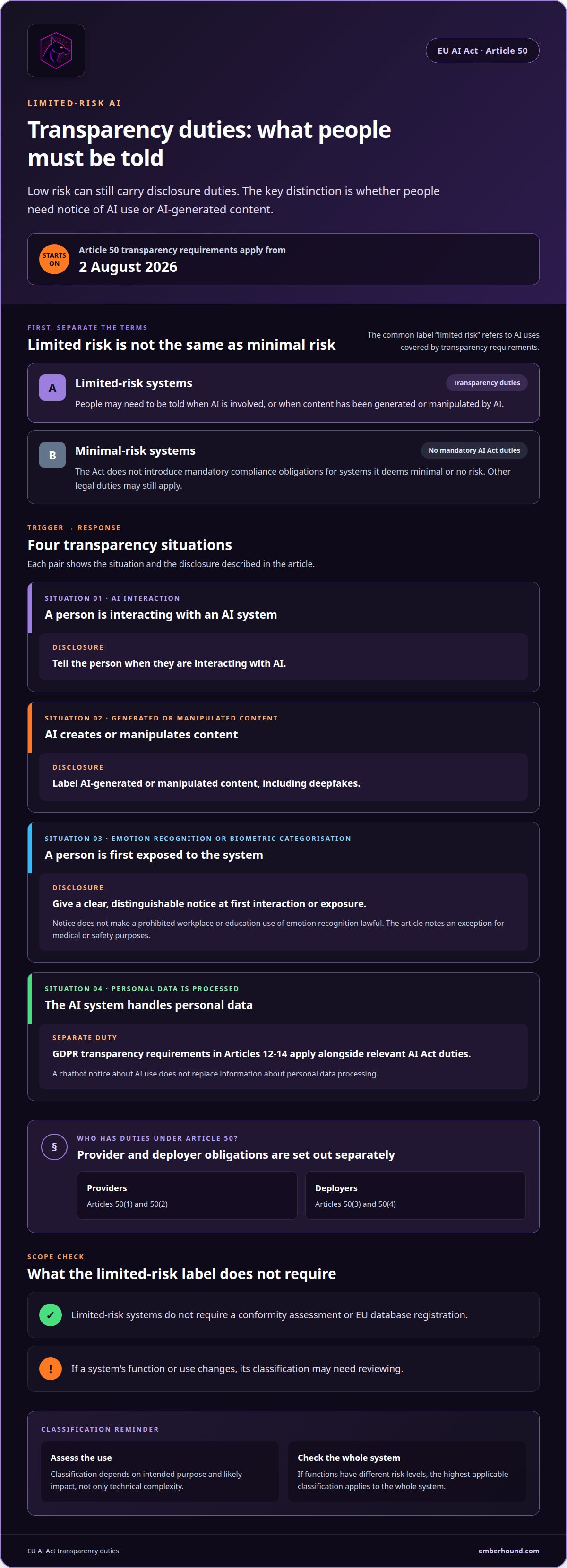
Low risk does not mean no transparency duty. Under the EU AI Act, limited risk AI systems have transparency requirements under Article 50, which apply from 2 August 2026. People may need to be told when they're interacting with AI, and AI-generated or manipulated content such as deepfakes must be labelled.
It's easy to confuse this category with systems that pose minimal risk, or to assume the EU rules replace GDPR. They don't: when personal data is processed, GDPR transparency requirements in Articles 12-14 apply alongside the AI Act.
This guide explains how the EU AI Act separates risk categories, what transparency means for chatbots, emotion recognition and generated content, and how GDPR fits in. You’ll also see what the rules mean for organisations in the UK, so you can identify which obligations may apply to your AI use.
Key Takeaways
- Classify each AI use against the EU Act's prohibited, high-risk, transparency and minimal-risk categories before deciding which duties apply.
- Use Annex III to identify high-risk application areas, and account for the Act's rules when an AI system has functions at different risk levels.
- Distinguish limited-risk systems, which have specific transparency duties, from minimal-risk systems, which have no mandatory compliance obligations under the Act.
- For UK organisations, keep the EU AI Act's categories separate from UK-specific rules when assessing which requirements apply.
What are the risk categories under the EU AI Act?
The EU AI Act, Regulation (EU) 2024/1689, groups AI systems by the risks they create. Its framework distinguishes prohibited practices, high-risk systems, systems with transparency duties and minimal-risk uses. These categories depend on an AI system's intended purpose and likely impact, not simply its technical complexity. A basic tool can face stricter obligations if its use affects education, recruitment, credit or critical infrastructure. Classification starts with what the system does, who operates it and who may be affected.
Prohibited practices sit at the highest end of the risk scale. For example, the Act prohibits systems that use social scoring or predictive policing. It also prohibits emotion recognition in workplaces and educational institutions, except when used for medical or safety purposes. These restrictions concern how a system is used and its purpose, not just its design. A business cannot make a prohibited use acceptable simply because the software also has permitted functions.
High-risk systems are permitted, but must meet specific requirements. Annex III of the EU AI Act identifies high-risk application areas, including recruitment, credit scoring and predicting educational grades. The Act also covers AI used in medical devices, as a toy safety component, or in critical infrastructure management. These examples show why context matters: an AI tool used to rank job applicants has a different regulatory profile from one sorting routine office files.
Classification must reflect the system’s full intended use. If a system performs functions at different risk levels, the highest applicable classification applies to the whole system. Assess it before it enters the EU market, then review the assessment when the system changes. A new function, setting or purpose can alter the relevant risks. For instance, adding applicant ranking to a recruitment tool changes the questions its operator must consider.
Some systems fall into the transparency category, which has disclosure obligations. Their principal obligations concern disclosure, so people can recognise when AI is involved. Users may need to be made aware when they are interacting with AI. AI-generated or manipulated content, including deepfakes, must be labelled. These requirements sit within Article 50. Providers have duties under Articles 50(1) and 50(2), while deployers have duties under Articles 50(3) and 50(4).
Emotion recognition and biometric categorisation also require clear notices. People exposed to these systems must be told about them in a clear, distinguishable notice at their first interaction or exposure. For example, someone facing a camera-based emotion recognition system needs to receive notice when first exposed to it. That disclosure does not make a prohibited workplace use lawful. The system’s purpose and setting still determine whether it may be used.
Minimal-risk AI sits outside the Act’s specific mandatory compliance obligations. A basic spam filter is a practical example of a routine tool with limited consequences for people. The Act does not introduce rules for systems deemed to pose minimal or no risk. That does not remove other legal duties that may apply. It means the AI Act’s risk classification does not, by itself, impose the requirements attached to high-risk or transparency systems.
One system can raise separate questions under different laws. When an AI system processes personal data, GDPR transparency requirements in Articles 12-14 apply alongside relevant AI Act duties. A chatbot notice about AI use does not replace information about personal data processing. Organisations need to consider both what the AI system does and what data it handles. The GDPR transparency requirements provide a separate point of reference for the data-protection side.
Biometric categorisation is also subject to transparency duties: under the EU AI Act, people affected by its use must be informed. This gives people notice when these systems are involved. It does not, by itself, make every system high-risk or prohibited; classification still depends on the system’s purpose and likely impact.
Separately, under the EU Artificial Intelligence Act, AI systems referred to in Annex III are considered high-risk in addition to systems covered by paragraph 1. The EU AI Act’s high-risk systems include systems used in medical devices, as toy safety components, in critical infrastructure management, recruitment, credit scoring and educational grade prediction. These examples show how an application can determine the obligations that apply. Minimal-risk uses remain at the lower end of the framework.
What about low-risk AI systems?
Some AI uses call for transparency, while lower-impact systems may face fewer mandatory requirements. This distinction affects what providers and deployers must do, and whether an assessment or registration is required.
Defining limited-risk AI systems
Limited-risk AI systems is a common description for AI uses covered by the EU AI Act's transparency requirements. Their defining feature is the need to inform people about AI use or AI-generated material, rather than meet the full high-risk requirements. For organisations, that distinction shapes the compliance work: identify the system's purpose, then establish whether Article 50 applies.
Article 50 transparency requirements apply from 2 August 2026. Deployers must meet the requirements in Articles 50(3) and 50 (4). Limited-risk systems do not require conformity assessment or EU database registration. These points can help scope the technical work, but they do not remove other legal duties. If a system's function or use changes, its classification may need reviewing.
Examples including games and spam filters
Video games and spam filters are examples commonly associated with low or minimal risk. A game might use AI to shape a non-player character’s behaviour, while a spam filter sorts incoming messages into folders. In each case, the practical question is what the system does and whether it triggers a specific transparency duty.
A familiar example does not determine the legal classification. A game that adds a function affecting access to education, recruitment or credit needs a fresh assessment of its purpose and impact. A spam filter that only organises email has a different use case. Record the system’s intended purpose and actual operation; its label alone cannot establish its risk level.
Commission guidance and practical examples
European Commission guidance on Article 6 helps explain how to assess whether an AI system is high-risk. It matters because a tool described as low risk may still fall into a high-risk area through its particular purpose. The Commission's approach should be read with the Act's categories, not as a substitute for examining the system's use.
Use practical examples to test the boundaries. A spam filter used only to sort routine messages has a different purpose from software that ranks job applicants. A video game’s character behaviour differs from an AI tool that predicts educational grades. Ask what decision the system supports, who is affected and whether fundamental rights could be affected. Document the answers and reassess when the system’s function changes.
UK rules and legal categorisation
For UK organisations, “limited risk” describes a category in the EU AI Act framework. It does not, by itself, determine which UK obligations apply. Separate the EU classification question from the rules relevant to the organisation’s UK activities, then consider whether the system is also used in an EU-facing context.
This distinction matters for a UK provider placing an AI system on the European market, or a deployer using one in an EU operation. The EU Act's transparency requirements apply from 2 August 2026, but that date does not create a general UK commencement date. Scope depends on the legal framework and the system's use. Map those factors before deciding which notices, records or technical changes are relevant.
Where personal data is involved, assess the data handling separately from AI risk classification. A system may sit outside the Act's high-risk requirements yet still process personal information. Keep its purpose, data use and transparency measures documented together. If you need to locate personal information across business data, review your data discovery requirements.
Transparency duties are not the same as prohibition. The AI Act’s transparency requirements cover cases where people need to be informed about AI use; for example, chatbot users should be told when they are interacting with a machine. The European Commission will review and potentially amend the list of limited-risk AI systems every four years, so organisations should monitor changes rather than treat current examples as permanent.
The wider framework also distinguishes prohibited practices: Article 5 contains the complete list, and prohibited AI practices can attract a maximum fine of €35 million or a fine of up to 7% of an organisation's total worldwide annual turnover. Separately, the European Commission and the AI Board declared the General-Purpose Code of Practice adequate on 1 August 2025.
Does the UK have a legal category or rules for limited-risk AI systems?
For UK organisations, distinguish the EU AI Act's risk labels from requirements that apply to UK activities. Some limited-risk AI transparency rules apply in the UK from early 2025. That does not establish that UK law uses the same categories or duties as the EU Act. The practical question is which legal framework applies to each system, its operator and its use.
The EU AI Act is Regulation (EU) 2024/1689. Its limited-risk category describes certain uses with transparency requirements. Treat that label as part of the EU framework, not as a universal legal classification. A UK team should record where an AI system is supplied and used, and whether its activities connect with the EU market. Those facts help direct the legal assessment.
Start with the system’s purpose. A chatbot that tells users they are interacting with AI raises a different transparency question from a spam filter sorting messages. Then identify the people affected and the data processed. For example, a UK business using an AI chatbot for customers should consider the notice shown to each user and how the system handles personal data. The product label alone answers neither question.
Next, distinguish UK obligations from EU AI Act obligations in your internal records. A useful record names the system, its provider, the organisation deploying it, its purpose and where it operates. Add the applicable transparency measures and the reasoning behind the classification. If the system later adds a purpose, such as ranking job applicants, review the assessment. A change in use can alter the relevant risk questions.
Keep GDPR separate in that assessment. Where personal data is processed, GDPR transparency requirements in Articles 12-14 apply alongside relevant EU AI Act obligations. A notice that explains a chatbot is artificial intelligence does not itself explain how personal data is used. For a UK operation, document the data-processing purpose and the information given to people. These checks address a different issue from assigning an AI risk category.
Do not assume a system has no duties because a team calls it low risk. A video game using AI for character behaviour may raise different issues from a tool that predicts educational grades, an example of high-risk use under the EU Act. For UK teams serving users in more than one jurisdiction, record the system’s functions and how it is used in each setting. This makes differences visible before deployment.
Timing also needs careful treatment. The EU AI Act's Article 50 transparency requirements for limited-risk systems apply from 2 August 2026. The UK position that some limited-risk transparency rules apply by early 2025 does not make that EU date a UK commencement date. Keep each date tied to its relevant framework. A calendar entry should identify the rule, the affected system and the organisation responsible for acting.
Review the classification when the system’s operation changes, not only when you buy a new tool. A customer-service chatbot might later generate images or assess customer applications. Those functions raise different transparency and risk questions. Record the change, affected users and notices, then reassess the system’s purpose. This gives UK teams a clear basis for distinguishing an EU AI Act requirement from a UK-specific obligation.
For a UK organisation, avoid treating “limited risk” as a complete compliance decision. Map the system’s purpose, affected people, personal-data use and operating locations. Then identify the legal framework relevant to each use and keep the supporting records together. This separates the EU category from the UK question without assuming that one label settles every duty.
EmberHound
EmberHound helps organisations locate personal data that may matter when assessing data protection alongside AI transparency duties. Its GDPR data discovery platform can help identify personal data across business devices, while its DSAR Disclosure Pack supports subject access request handling.
Use these tools when an AI system processes personal data and you need a clearer view of where it is held. Data discovery supports the evidence-gathering part of your work; it does not classify an AI system or replace legal advice. For payment card data, PCI Card Data Discovery is also available, with Combined GDPR + PCI Coverage for organisations working across both areas.
If you need to locate personal data or prepare for a subject access request, contact EmberHound to discuss your requirements.
Make your next review practical
For limited-risk AI systems, connect each system’s stated purpose with the personal data it handles. This gives privacy and technology teams a shared starting point for reviewing data use alongside transparency measures.
Keep the record useful after the initial assessment. When a system gains a new function or moves to a different setting, note what changed and whether its data use changed too. Linking AI records with data records helps teams spot where a fresh review may be needed.
EmberHound’s data discovery tools can help locate sensitive information across business devices. Use them as part of your data-mapping work, while leaving AI classification and legal decisions to the people responsible for those areas.
Start with a clear view of the data. Your next review can then focus on the decisions that matter.
Frequently Asked Questions
When do these obligations apply?
The relevant duty applies when a system’s use falls within an EU AI Act transparency case and your organisation has the corresponding provider or deployer role. Trace the user journey: does someone encounter an AI interaction or generated content during onboarding, support or publication? Assign an owner to each user-facing point. This helps ensure notices appear where people will see them, rather than in a separate document they may never read.
How do you classify an AI system step by step?
Build a record for each system version and deployment context. Note the features in use, who operates them and which decisions or content they affect. Compare the record with the relevant EU AI Act categories, then document the reason for the chosen classification and who approved it. Keep it with product-change documentation. This gives the team a clear starting point when a feature, audience or deployment setting changes.
What are limited-risk AI systems under the EU AI Act?
The term describes certain AI uses for which transparency duties apply under the EU AI Act. It is a legal label for specific obligations, not a general rating of a product’s safety or quality. When procuring a system, ask which feature and deployment the classification covers. A supplier’s broad description may not match how your organisation configures or uses the system.
Which AI systems are classified as limited risk under the EU AI Act?
Article 50 identifies disclosure cases involving direct AI interaction, emotion recognition, biometric categorisation and AI-generated or manipulated content. Whether a particular feature falls within a case depends on its actual function and use. For example, assess a generative feature separately from other functions in the same product. This avoids relying on a single product label to decide whether limited-risk AI systems have relevant transparency duties.
When do the EU AI Act transparency rules for limited-risk AI take effect?
The transparency rules take effect on 2 August 2026. For implementation planning, turn that date into a system-level task: identify the affected product features, assign an owner and schedule review of user-facing notices before the applicable date. Keep the evidence with the relevant system record. This makes it easier to see which deployments have been reviewed and where work remains.
How can organisations assess and comply with limited-risk AI requirements?
Set a repeatable review process. Give a named owner responsibility for recording system changes, checking whether they affect a disclosure and maintaining the relevant notice text. Test the notice in the actual interface or content flow, including on a small screen if users access it there. When personal data is involved, coordinate the review with those responsible for data protection information. Keep decisions and updates in one accessible record.


