

A chatbot may have transparency duties under the EU AI Act, while a spam filter is a common minimal-risk AI example. The Act’s lowest category covers systems that do not fall into the unacceptable-, high- or limited-risk groups. It creates no specific AI Act obligations for these systems, although laws such as the GDPR still apply.
That distinction matters. “Low risk” is often used informally, but the Act distinguishes minimal risk from limited risk. Chatbots are an example of limited-risk AI, for which transparency requirements can apply.
This article explains the four risk levels, gives practical minimal-risk examples, and shows how a system’s purpose can affect its classification. It also explains how minimal-risk AI fits into wider governance, so you can assess what a system does before assigning it a category.
Key Takeaways
- Classify an AI system by what it is used to do and the context in which it operates.
- Inventory-management algorithms and predictive-maintenance tools are examples of systems that may sit in the lowest risk category.
- Reassess a system if its purpose or use changes, as that can affect its risk category.
- Keep AI Act classification separate from data protection duties that may still apply to the information a system processes.
- Use an AI inventory as a starting point for governance, then review each system’s purpose and potential effects on people.
What about low-risk AI systems?
Minimal-risk AI systems sit at the lowest level of the EU AI Act’s four-part risk classification. They are systems that do not fall into the unacceptable-, high- or limited-risk categories. The Act creates no specific obligations for this category, although other laws, including the GDPR and consumer protection rules, may still apply.
The European Union states that the EU AI Act entered into force on 1 August 2024. For UK organisations, the Act’s categories apply to systems within its scope; they do not replace UK data-protection or sector-specific requirements. Treat EU classification and UK obligations as separate questions.
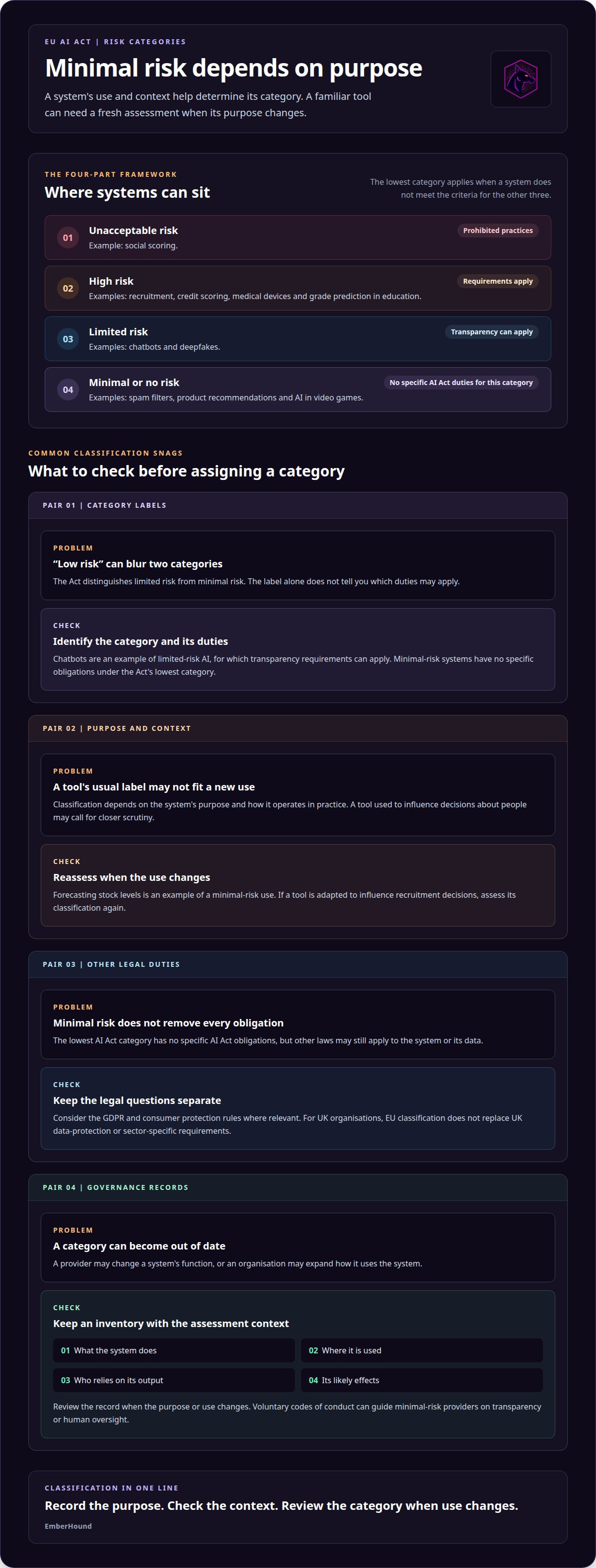
The risk-based framework sorts AI systems by their intended purpose and potential effects. Prohibited practices, such as social scoring, sit at the highest end. High-risk examples include AI used in medical devices, recruitment, credit scoring and grade prediction in education. Chatbots and deepfakes are limited-risk examples, for which transparency obligations can apply. Systems outside these categories fall into the minimal- or no-risk category.
Examples of minimal-risk AI systems include spam filters, product recommendation engines and AI used in video games. Inventory algorithms that forecast stock levels and predictive-maintenance tools that flag machinery parts for replacement are other examples. Classification depends on the system’s purpose and how it operates in practice.
Medical and HR contexts need closer scrutiny. AI systems used for medical purposes or in HR departments fall into the high-risk category. Examples include software that helps assess job applicants and AI used in medical devices. A familiar tool can therefore face different obligations when used to make decisions about people.
High-risk AI systems must meet requirements covering risk management, human oversight, robustness, accuracy, data quality, cybersecurity, documentation, record-keeping and transparency. Providers must maintain a Risk Management System and a Quality Management System. These processes help identify potential harm and explain how risks will be addressed. Deployers need enough information about the system to use it as intended.
Testing is part of that control framework. High-risk systems must be tested throughout development and before they are placed on the market or put into service. Reassess the classification when the system’s purpose or use changes. A tool used for routine stock planning may need a different assessment if adapted to influence recruitment decisions. Article 95 also encourages providers of minimal-risk systems to adopt voluntary codes of conduct. These can set out practices for transparency or human oversight, even when the lowest risk category carries no specific AI Act obligations.
AI governance and risk categorisation
Governance starts with a clear record of each AI system, its purpose and its likely effects. The EU AI Act uses this information to place systems in a risk category.
The EU’s four risk categories
The EU AI Act assigns systems to four categories: unacceptable, high, limited and minimal or no risk. Classification matters because each category brings a different level of control, from prohibited practices to no specific AI Act obligations. The lowest category is the default when a system does not meet the criteria for the other three.
Under Regulation (EU) 2024/1689, risk means the combination of the probability of harm and its severity, following ISO Guide 51. Providers should assess intended purpose and the people affected, including potential effects on fundamental rights. A tool’s label alone cannot settle its category.
Start governance with an inventory of AI systems used or planned across the organisation. Record what each system does, where it is used and who relies on its output. Then compare its purpose with the Act’s categories and relevant lists. Some uses of AI in areas such as work or education may call for closer risk assessment. Some AI systems used in product-safety contexts may fall into the high-risk category.
Context can change the assessment. A chatbot answering general enquiries is used differently from a system that influences decisions about people. A law enforcement application can raise different concerns from an internal business process. Providers and deployers should keep the intended purpose in view when a system is adapted, trained or used in new processes.
Assessments for minimal-risk systems
Minimal-risk systems have no specific risk-assessment or conformity-assessment obligations under the EU AI Act. This applies to the Act’s AI-specific duties; other rules, such as the GDPR, can still apply when the system processes personal data.
A practical governance record can still capture the system’s purpose, data use and potential effects. This helps identify changes that may affect classification. If an Annex III system is assessed as not high-risk under Article 6(3), it still requires registration through a simplified process. That distinction matters: an assessment result does not automatically remove every procedural requirement.
Keep the inventory current if a provider changes a system’s function or an organisation expands its use. A classification made for one purpose may no longer fit after a change. Voluntary codes of conduct can guide minimal-risk providers on matters such as transparency and human oversight. They remain voluntary for this category, while the Act’s high-risk controls apply when a system meets the relevant criteria.
Difference between limited-risk and minimal-risk AI
The practical difference is the obligations attached to a system’s use. Minimal-risk AI has no specific duties under the Act’s lowest category, while limited-risk systems can have transparency requirements.
For minimal-risk systems, the transparency answer depends on what the system does. Article 50 covers certain uses, including AI interactions and synthetic content, so a low-risk label alone does not settle the question. From 2 August 2026, the relevant transparency obligations apply to covered systems.
Limited-risk examples include chatbots, deepfake video, AI avatars and voice sentiment analysis. A chatbot must make clear that a person is interacting with AI rather than a human. AI-generated or manipulated content must be identified as such. These measures tell users what they are seeing or who, or what, is responding.
Obligations depend on a system’s function, not on a general rule that every AI product must display the same notice. A spam filter, for example, may remain minimal risk when it sorts unwanted messages. A chatbot answering customer questions raises a different transparency issue because users interact with it directly. One organisation can therefore use systems in both categories.
For content tools, distinguish between ordinary output and deepfake material. Article 50 addresses identifying content generated or manipulated by AI when the system generates deepfakes. The transparency requirement is about helping people recognise the content’s nature. It does not turn every system that generates text or images into a limited-risk system by itself.
In practice, assess each system against its intended purpose and the specific Article 50 use. Record whether people interact directly with it, whether it recognises emotion, and whether it creates or manipulates content. A change in development or deployment can change the answer. For instance, adding a customer-facing conversational function may create a disclosure requirement that did not apply to an internal sorting tool.
This distinction matters for governance. If a covered system is classified as minimal risk, record the basis for that classification and separately assess any Article 50 transparency duty. If it is limited risk, identify the people who need to receive a notice and where they encounter the system. A clear assessment prevents the category label from obscuring a specific transparency obligation.
Art. 13 applies transparency obligations to all AI systems, including high-risk AI. Under Recital 132, notices about AI interactions should be tailored to the target group, taking account of users with disabilities where relevant. The European Commission adopted its Article 50 transparency guidelines on 20 July 2026.
Examples of minimal-risk AI
Useful examples include tools that support routine choices without deciding a person’s rights or access to important services. Classification depends on purpose and context, so a technical label alone is not enough. A recommendation engine, for instance, can help arrange content or products; its role matters more than the fact that it uses AI. When documenting minimal-risk AI examples, describe that role in plain terms.
Personalised news recommendations are one example. A system may select articles based on a reader’s interests or previous activity. An e-commerce recommender can suggest products based on browsing patterns. These tools help users find relevant options, but their function should be recorded clearly. If a system is used for a different purpose, assess that use separately. The software’s label does not settle its classification.
Navigation advice is another example: an AI system can compare routes and suggest a journey. Language recognition tools can identify spoken words or written language, such as when a device recognises a voice command. Describe the task precisely, such as recommending a route or recognising language. This helps distinguish routine assistance from uses that may affect individuals differently.
Video games can also use AI for ordinary entertainment functions. Non-player characters may respond to a player’s actions, while procedural generation can create game environments or levels. The game context explains the system’s purpose. If the same technology is repurposed for decisions affecting people outside the game, its original classification may no longer fit.
Use these examples as a guide, then assess each system in its own context. Review its intended purpose, the people affected and the decisions shaped by its output. A recommendation engine suggesting a news article has a different function from a tool that ranks people for an important opportunity. Assess the latter use separately against the Act’s risk categories.
Keep the boundaries clear. Language recognition is different from a system that infers sensitive traits from biometric data. Under the EU AI Act, biometric categorisation that infers characteristics such as political opinions, religion, race or sexual orientation is a prohibited practice. AI used to detect people’s emotional states in workplace or education situations is also identified as prohibited.
For a practical record, describe each system in plain terms: the input it uses, the output it produces and who relies on that output. A route planner might use location information to suggest a journey. A news recommender might use reading preferences to rank articles. This makes each system’s purpose clear and helps governance teams spot changes in use before relying on an old assessment. These minimal-risk AI examples are a useful reference, but actual purpose and context determine classification.
Are spam filters and AI-enabled video games considered minimal-risk AI?
Yes. Spam filters and AI-enhanced entertainment, including video games, can serve routine functions, though classification depends on intended use. Classification still depends on intended use. A filter sorting unwanted email serves a routine inbox-management purpose; game AI operates within an entertainment product. These uses provide context for assessing each system.
A spam filter may score incoming messages using features such as sender details or message content. The service can use that score to route suspected junk into a folder. Since the result affects how a person sees email, describe the filter’s role and the decisions it makes. If staff use its output to restrict account access or assess an individual, review the classification again.
For video games, ask what the AI contributes to the player’s experience. A system might adjust an opponent’s challenge to a player’s progress or select in-game events based on previous play. These are entertainment functions. The assessment should record the system’s purpose, its users and the effect of its output within the game.
Keep the classification tied to actual deployment. A game studio’s internal test tool may have a different purpose from the version released to players. Similarly, a spam filter used to sort inbox messages differs from one whose output informs a decision about an employee or customer. Record the function, the people affected and the process that uses the result.
A change in purpose can change the assessment. Review the new function and its potential effects when a system moves beyond its established setting.
In an organisation’s inventory, describe a spam filter by its message-routing task and a game system by the player-facing function it supports. Note any later use that changes who relies on the output. This creates a practical deployment record and gives teams a clear trigger for reassessment. Intended use remains central to classification.
EmberHound
EmberHound helps organisations locate sensitive information with GDPR Data Discovery and PCI Card Data Discovery. An AI system’s risk category answers one question; the data it processes raises another. Knowing where personal or payment card data is stored can help teams understand the information involved in their systems.
Use data discovery when you need visibility into personal information across business data or need a disclosure pack for a subject access request. Combined GDPR + PCI Coverage is available for organisations assessing both types of data. These services support data discovery tasks; they do not classify AI systems under the EU AI Act.
Contact EmberHound to discuss data discovery for your organisation.
Make the next review part of the process
Use minimal-risk AI examples as a starting point for your system inventory. Record each system’s purpose, the information it uses and the teams that rely on its output. This gives future reviews a clear reference point.
Build the review into routine change management. When a team adds a function, changes the data used or applies a tool to a different task, update its governance record. This keeps decisions tied to actual use rather than assumptions made during procurement.
Data visibility is a separate part of this work. If you need to locate personal or payment card information across business data, EmberHound provides data discovery tools. They support the information-handling side of governance, while your organisation remains responsible for assessing its AI systems.
A clear record gives your next review a practical starting point. Keep it current as your systems and processes change.
Frequently Asked Questions
What does this mean in practice?
In practice, treat classification as one part of an AI system’s governance record. Note who uses its output, which business process it supports and whether it handles personal data. For example, a team purchasing an automated tool can record its intended use before deployment, then revisit that record if staff apply it to a new task. A minimal-risk classification does not remove duties under other applicable laws.
What does minimal-risk AI mean under the EU AI Act?
Minimal-risk AI is the EU AI Act’s residual category for systems outside its unacceptable-, high- and limited-risk groups. The Act sets no specific obligations for systems in this category. That does not settle every compliance question: if a system processes personal data, consider data protection requirements separately. A low AI Act risk category describes a system’s position under that regulation, not its status under every law.
What are examples of minimal-risk AI systems?
Examples include a tool that forecasts stock levels for routine replenishment and software that estimates when factory equipment may need a replacement part. Their purpose is to support operational planning. Classification depends on the system’s actual role: a forecast used to organise maintenance differs from an output used to make decisions about individuals. Describe the use clearly before relying on an example as a guide.
How does minimal-risk AI differ from limited-risk, high-risk and prohibited AI?
The categories have different regulatory consequences. Prohibited AI practices cannot be used under the Act; high-risk systems face specific requirements; and some limited-risk systems have transparency duties. Minimal-risk systems have no specific AI Act obligations. For a team reviewing a software purchase, identify the system’s function first, then check whether that use falls within a restricted category or triggers a transparency requirement.
How does the EU AI Act define an AI system as minimal risk?
The Act treats a system as minimal or no risk when it falls outside the unacceptable-, high- and limited-risk categories. Classification depends on intended purpose and use, not the product’s marketing label. Assess which decisions its output supports and who may be affected. If the system’s function changes, reassess it against the new use rather than relying on its earlier classification.


