

The EU AI Act’s biometric categorisation rules do not ban every system that groups people by appearance. They prohibit systems that infer sensitive attributes, while other uses may be permitted.
It’s reasonable to assume that any use of biometric data triggers the same rules. The distinction matters: under Article 9(1) GDPR, biometric data is special category data when processed to uniquely identify a person. Categorisation and identification are different purposes, but an AI system can still be high risk even when it isn’t prohibited.
This guide explains which biometric categorisation uses the EU AI Act prohibits, which may be permitted, and when high-risk requirements apply. It also distinguishes the GDPR’s special category test from the AI Act’s rules and explains how penalties may overlap. The practical questions are what the system does, what it infers and whether it identifies someone. For UK businesses, these distinctions are a starting point for assessing regulatory exposure.
Key Takeaways
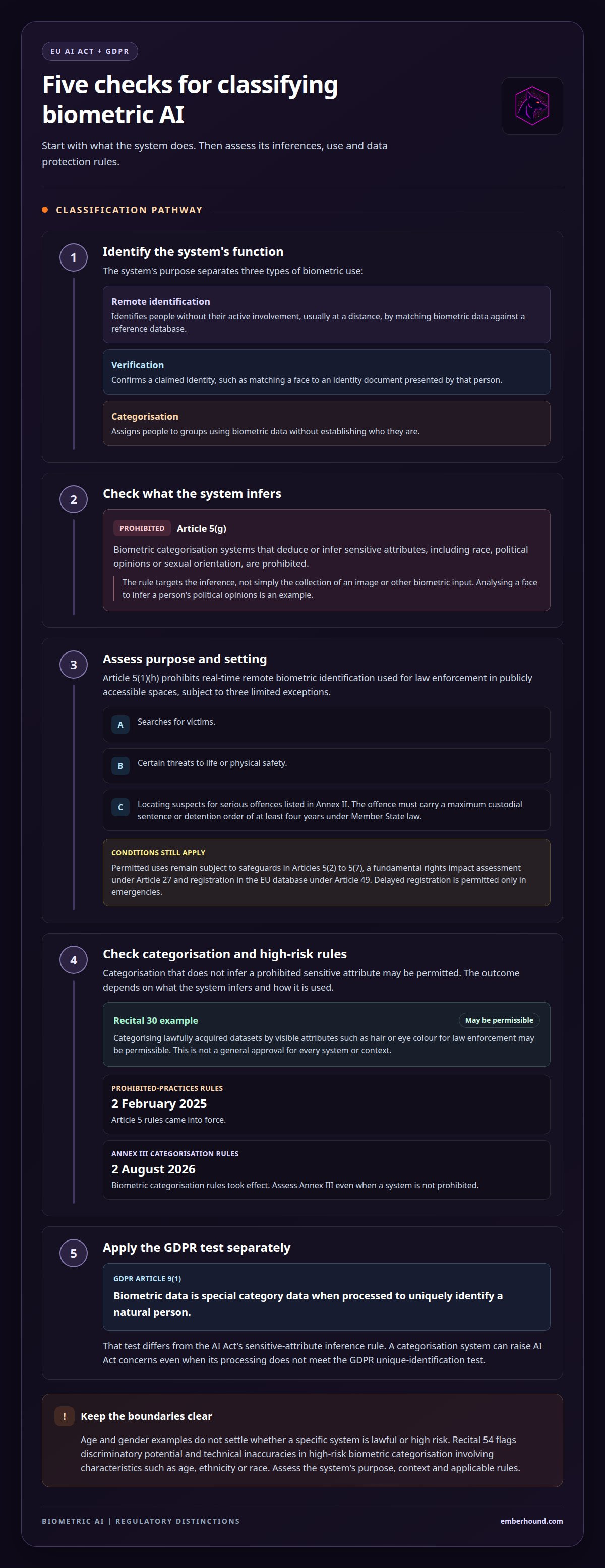
- Classify the system by whether it identifies a person remotely, verifies a claimed identity or groups people using biometric data.
- Separate prohibited inferences about sensitive attributes from categorisation uses that may be permitted.
- Check whether a biometric categorisation system falls under Annex III, even if it is not prohibited.
- Apply the GDPR special-category test by looking at whether biometric data is processed to uniquely identify someone.
- Assess AI Act and GDPR penalty exposure separately; each regime has its own rules and scope.
Remote biometric identification
Remote biometric identification means identifying people without their active involvement, usually at a distance, by matching biometric data against a reference database. Biometric categorisation instead assigns people to groups without establishing who they are.
Real-time Identification in Public Spaces
Real-time remote biometric identification uses live biometric data to identify people in publicly accessible spaces. For example, a camera system might compare passers-by’s faces with a database as they move through a station. The key test is whether the system searches for identity without each person’s active involvement. A system that groups people by an attribute without matching them to identities performs categorisation instead.
Restrictions on Real-time Identification
Article 5(1)(h) of the EU AI Act prohibits real-time remote biometric identification systems used for law enforcement. Article 5(1)(h)(i)-(iii) provides three limited exceptions. They cover searches for victims, certain threats to life or physical safety, and locating suspects for serious offences listed in Annex II. Those offences must carry a maximum custodial sentence or detention order of at least four years under Member State law.
Each permitted use remains subject to safeguards and conditions in Articles 5(2) to (7). It requires a fundamental rights impact assessment under Article 27 and registration in the EU database under Article 49. Delayed registration is permitted only in emergencies. The EU AI Act's restriction is without prejudice to GDPR Article 9 for biometric processing for purposes other than law enforcement.
Law Enforcement Use
Law enforcement use means processing biometric data for a law enforcement purpose, as defined in Article 3(46) of the EU AI Act. Remote identification seeks to establish a person's identity by comparison with a reference database. Categorisation instead assigns a person to a group based on biometric data. Law enforcement authorities must distinguish these functions when assessing a system's purpose.
The EU AI Act applies as lex specialis to Article 10 of the Law Enforcement Directive for restrictions on law enforcement biometric categorisation and real-time remote identification. The Council's text refers to a three-year maximum custodial sentence threshold for certain offences. It also refers to specific offences carrying a maximum custodial sentence of at least five years in the relevant Member State. These thresholds belong to the law enforcement provisions; they are not general permissions for business use.
Biometric verification is different again: its sole purpose is to confirm a claimed identity, such as matching a face to a presented identity document. The European Parliament text excludes systems limited to confirming one specific natural person's claimed identity from the specified high-risk biometric systems. For UK organisations, the AI Act's system classification and GDPR's processing rules need separate assessment. A GDPR data handling guide can help frame the latter review.
Which types of biometric categorisation systems are nevertheless allowed?
Biometric categorisation assigns people to groups using biometric data, such as physical or behavioural characteristics. The EU AI Act prohibits systems that infer sensitive attributes, but other categorisation may be permitted. The outcome depends on what the system infers and how it is used.
Under Article 5(g), biometric categorisation systems that deduce or infer sensitive attributes such as race, political opinions or sexual orientation are prohibited. The rule targets the inference, not simply the collection of an image or other biometric input. For example, a system that analyses a face to infer a person's political opinions falls within the prohibition.
Recital 30 distinguishes that practice from categorising lawfully acquired datasets by visible attributes such as hair or eye colour for law enforcement. Those categories may be permissible when used for that purpose. The boundary is the information inferred: sorting records by visible features differs from using biometric analysis to infer sensitive personal attributes. A permitted example under this recital is not a general approval for every system or context.
The EU AI Act's Annex III biometric categorisation rules took effect on 2 August 2026. Article 5's prohibited-practices rules came into force on 2 February 2025. A system therefore needs assessment against the provision relevant to its purpose and use, not just the date it was developed or acquired.
GDPR Article 9(1) treats biometric data as special category data when it is processed to uniquely identify a natural person. That test is distinct from whether an AI system infers a sensitive characteristic. The EU AI Act's prohibited list names race, political opinions and sexual orientation; the GDPR test turns on unique identification. A categorisation system can raise AI Act concerns even where its processing does not meet that GDPR test.
Age and gender illustrate why the distinction matters. The examples in the AI Act analysis treat age and gender as outside the sensitive or protected attributes covered by Article 9(1) GDPR. That does not settle whether a specific system is lawful or high risk. Its purpose, context and other applicable rules still matter. Recital 54 also flags the discriminatory potential and technical inaccuracies of high-risk biometric categorisation involving characteristics such as age, ethnicity or race.
The EU AI Act is EU legislation, not a UK AI statute. UK organisations still need to assess relevant UK data protection requirements when processing biometric personal data. The EU rules may also matter where an organisation's system or use falls within the Act's scope. For a separate review of personal data handling, explore data discovery options.
High-risk biometric AI use cases under Annex III
A high-risk biometric AI system is one listed in the EU AI Act's Annex III, subject to the Act's conditions. Point 1 of Annex III identifies three high-risk biometric use cases where relevant EU or national law permits their use. Point 1(b) specifically names biometric categorisation. A system's use must therefore be legally permitted before its high-risk classification becomes the next compliance question.
Biometric categorisation means assigning people to specific categories based on biometric data, subject to the Act's ancillary-service exception. Annex III point 1(b) makes this use case high risk when it is permitted by relevant law. That classification can apply even when the system does not make a prohibited inference about sensitive attributes. For example, a system categorising people by biometric characteristics may still need high-risk controls, depending on its purpose and legal context.
Biometric identification systems are also high risk unless they are prohibited under Article 5. The classification depends on the system's function and context, not simply its use of facial or other biometric data. A business assessing a system should identify its intended purpose, the people affected, and the applicable legal basis for its use. Those details help distinguish a high-risk use from a prohibited one.
Annex III classifications can also arise outside biometric categorisation. For example, an AI system collecting age and gender to assess risks posed by foreigners entering EU territory could qualify as high risk under point 7(b). The same data inputs may have a different classification in another context. Purpose matters: categorising individuals and assessing risks linked to entry into EU territory are distinct use cases.
High-risk classification brings obligations for different roles in the AI supply chain. Articles 16, 22, 23, 24 and 26 set out obligations for providers, authorised representatives, importers, distributors and deployers respectively. The organisation's role affects which requirements apply. A company deploying a system should establish whether it acts as a deployer or also takes on another role, such as provider.
Article 50 sets transparency obligations for providers and deployers. For high-risk biometric categorisation, Article 50(3) requires deployers to inform individuals exposed to the system. This means the deployment process must account for notice to affected people. The specific role and use determine which other obligations apply, so the system's documentation should describe its purpose and how it is used.
For UK businesses, an Annex III label classifies a system under the EU AI Act; it does not automatically mean the system is prohibited. Keep the tests separate: first establish whether the use is permitted under relevant law, then assess whether Annex III classifies it as high risk. A system may pass the first test and still need to meet high-risk requirements.
Administrative fines and penalties
An administrative fine is a financial penalty for breaching a legal regime. For biometric AI, assess the EU AI Act and GDPR separately. A prohibited AI practice, failure to meet high-risk requirements and unlawful personal data processing involve different legal tests. One project may raise several issues, so identify the conduct behind each potential breach.
The EU AI Act sets fines for breaches, including prohibited practices. A system that infers a sensitive attribute may raise a different issue from a permitted high-risk system that fails to meet its obligations. Record the system’s intended purpose, actual use and the organisation’s role. These details help identify the rule that may apply.
For small and medium-sized enterprises, including start-ups, the EU AI Act caps each fine at the lower of the specified percentage or amount. This cap does not mean every breach attracts the same penalty or that the highest cap applies in every case. The business category and the particular infringement both matter when assessing exposure.
Assess GDPR exposure separately. The key question is whether the processing of biometric data meets GDPR conditions, including whether the data is used to identify a person uniquely. For example, a facial categorisation tool may raise an AI Act issue if it infers a prohibited attribute, while its data processing needs its own GDPR analysis. Neither assessment automatically answers the other.
Do not treat the two regimes as interchangeable. An AI Act classification describes a system’s risk or prohibited status; the GDPR governs the processing of personal data. A high-risk label does not, by itself, establish that processing is lawful. Equally, a GDPR basis does not make a prohibited AI use permissible. Keep the legal grounds and evidence for each assessment distinct.
Start a practical review with three records: the system’s intended purpose, the categories it infers and the data processing it performs. Map each finding to the relevant AI Act or GDPR requirement. For example, record whether the system identifies people, categorises them or does both. Note the organisation’s role and the reasoning behind each use.
For UK organisations, the applicable rules depend on the relevant legal scope and processing. Do not treat a possible fine as one combined figure. Assess each alleged breach under its own regime, then establish whose conduct is in question and whether the SME cap applies to that fine. This gives decision-makers a clearer view of specific exposure without assuming that every issue leads to a penalty.
GDPR special category biometric data
Biometric data is personal data produced by processing physical, physiological or behavioural characteristics. Article 3(34) of the EU AI Act gives this definition. The Act does not define a separate category called "special-category biometric data". GDPR Article 4(14) defines biometric data separately, while Article 9(1) sets the test for special category status. For UK organisations, keep those definitions distinct when assessing a system.
Under Article 9(1) GDPR, biometric data is special category data only when processed to uniquely identify a natural person. A facial image is not automatically special category biometric data under this test. The purpose of processing matters. Comparing a face with a reference image to establish identity meets a different purpose from detecting a visible feature to sort images into groups.
The AI Act uses a related but separate test for prohibited categorisation. Article 5(g) prohibits AI systems that deduce or infer sensitive attributes, including race, political opinions or sexual orientation, from biometric data. That prohibition focuses on the system's inference. The GDPR test focuses on whether biometric data is processed for unique identification. A system can therefore raise an AI Act concern even when its categorisation purpose is not unique identification.
Consider a tool that analyses images of people entering a venue. If it groups images by visible characteristics, the GDPR special-category test depends on whether processing aims to identify individuals uniquely. If it infers race or political opinions, Article 5(g) becomes relevant regardless of that identification question. Record what the system receives, what it infers and how the result is used. Those steps clarify which legal test applies.
Article 9(2) GDPR provides conditions under which processing covered by Article 9(1) may proceed. Explicit consent is one condition; another applicable Article 9(2) condition may also be relevant. Consent alone does not resolve the AI Act question. For example, consent to facial identification would not make an Article 5(g) inference permissible. Assess the processing condition and the AI Act restriction separately.
Keep the assessment tied to the actual context. A system that detects faces in images may process biometric data, but the Article 9(1) question turns on whether it processes that data to uniquely identify natural persons. The AI Act question turns on what characteristics it infers. Document the system's purpose and outputs, then map each to the relevant provision. This distinction prevents a broad "biometric" label from obscuring the legal analysis.
EmberHound
EmberHound helps businesses locate personal data across their systems through GDPR Data Discovery and PII Data Discovery. This is useful when you need to understand what personal information your organisation holds alongside an assessment of an AI system's purpose and outputs. Data discovery supports visibility of information; it does not determine whether a biometric system is permitted under the AI Act.
If your team also handles payment data, EmberHound’s PCI card data discovery or combined GDPR and PCI coverage can help locate relevant records. A DSAR Disclosure Pack supports the preparation of information for subject access requests. Choose the capability that matches the data question you need to address.
Contact EmberHound to discuss data discovery for your organisation.
Make the next step operational
Turn your system assessment into a clear record of what happens in practice. Set out the system’s purpose, the data it uses and the decisions it supports, and assign an owner for each part. This gives your team a working reference when the system, its inputs or its use changes.
For biometric categorisation under the AI Act, keep the system assessment separate from the data inventory. Knowing where personal data is held can help your team understand which information is involved. EmberHound’s GDPR data discovery, PCI card data discovery and combined GDPR and PCI coverage help locate relevant data on company devices.
Data discovery supports information mapping. It does not determine whether an AI use is permitted or replace legal advice. Keep those decisions with the people responsible for assessing the system and the rules that apply.
A clear record gives your team a practical starting point for the next review.
Frequently Asked Questions
What exceptions apply to the AI Act ban on biometric categorisation?
There is no general exception that permits a prohibited biometric categorisation use. Recital 40 refers to specific opt-outs for Ireland concerning certain law-enforcement uses, not a general business exemption. The European Commission published prohibited-practices guidelines on 4 February 2025, but they are non-binding; authoritative interpretation rests with the Court of Justice of the EU. For an assessment, identify the precise system function and whether the use falls within a specific national provision.
What are the AI Act requirements for permitted biometric categorisation systems?
Test the system’s actual outputs rather than relying on its product label. Use representative test cases to check whether it infers attributes or produces categories beyond its stated function. Keep the test design, results and changes to system settings together. This gives the team a practical basis for reviewing the system after an update or a change in deployment context.
What penalties apply for prohibited biometric categorisation under the AI Act?
The applicable fine depends on the specific infringement, so do not assume a single maximum applies to every case. As a first step, preserve the system version, configuration, supplier materials and deployment records relevant to the suspected conduct. Then identify the decision-makers and the use in question. This creates a clear account of what happened and helps distinguish a configuration issue from an ongoing deployment practice.
Does the UK have rules on biometric categorisation AI?
The EU AI Act is not UK legislation. UK organisations must assess relevant UK data protection requirements when processing biometric personal data. The EU rules may also apply if their system or use falls within the Act’s scope.


