

A workplace emotion tool can cross a legal line even when it is presented as routine staff monitoring. Under Article 5(1)(f), the EU AI Act prohibits using AI to infer emotions in workplaces and educational institutions, except for medical or safety purposes.
That is the starting point for understanding emotion recognition in the workplace under the EU AI Act. The key question is whether a tool infers someone’s emotional state from biometric data, and whether a medical or safety exception applies. Calling a tool wellbeing, engagement or productivity software does not answer that question.
This guide explains how the Act defines emotion recognition systems, why the workplace rules also cover recruitment, and how inferring emotions differs from identifying expressions. It also covers governance, enforcement and data protection considerations. For UK organisations, first establish whether the EU AI Act applies to the activity and people involved. Then assess the tool’s purpose and inputs before using it.
Key Takeaways
- The Act prohibits workplace AI that infers people’s emotions, with exceptions for medical or safety purposes.
- Whether a system qualifies depends on what it infers and whether it uses biometric data.
- The workplace rules can apply to recruitment, so assess tools used during candidate selection as well as staff monitoring.
- Separate AI Act requirements and data protection rules may still apply when a system is outside the workplace prohibition.
- Breaches of prohibited-AI rules can lead to fines of up to 7% of global annual turnover.
EU AI Act prohibition on workplace emotion recognition
Article 5(1)(f) prohibits using AI to infer emotions in workplaces and educational institutions, except for medical or safety purposes. The EU AI Act rules on emotion recognition in the workplace form one of eight categories of prohibited AI practices.
Workplace ban and its exceptions
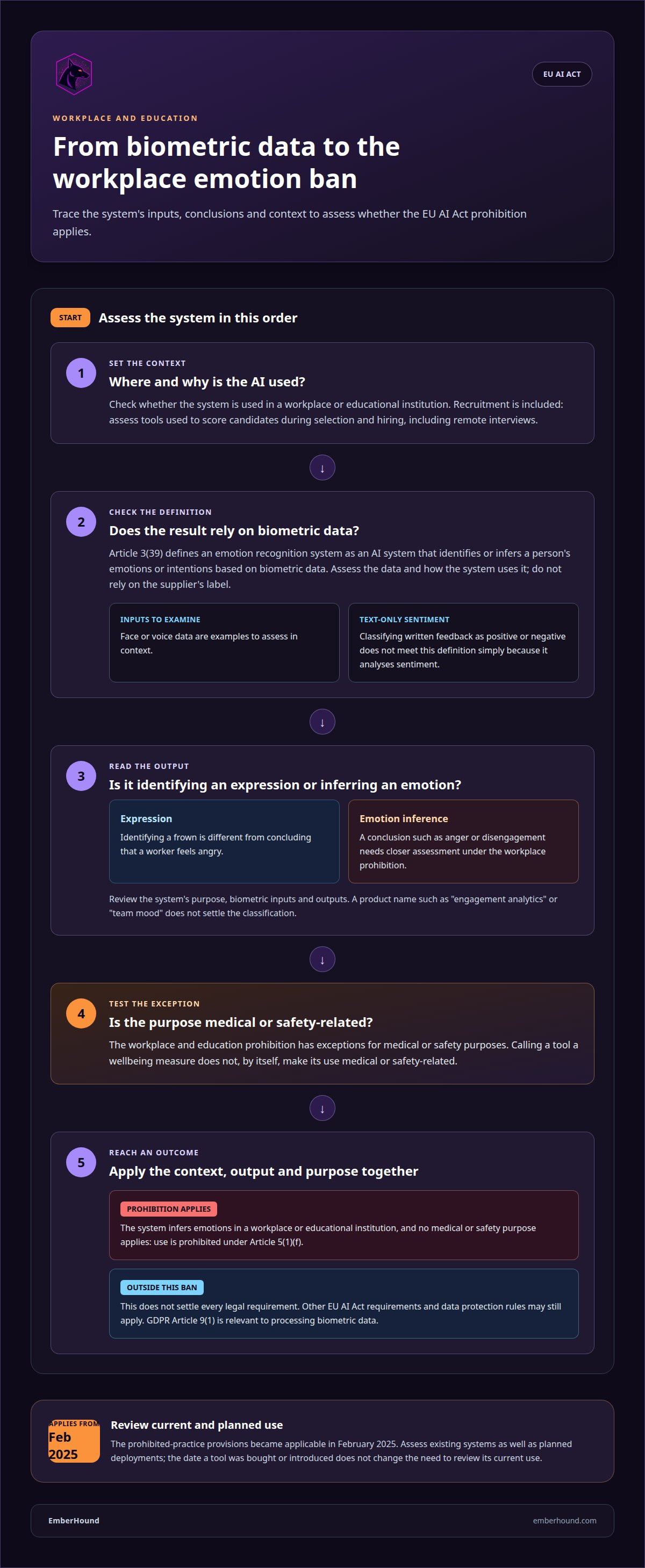
The prohibition covers AI that infers a person's emotional state in a workplace or educational setting. The medical and safety exceptions are narrow: describing a staff engagement tool as a wellbeing measure does not, by itself, make its use medical or safety-related.
The rule also covers recruitment. The European Commission's Guidelines state that the workplace prohibition applies to candidates during selection and hiring. Employers should therefore assess tools used to score applicants, including those used in remote interviews. Holding the interview online does not change whether the system is being used for recruitment.
Consider what the system concludes. Identifying a frown differs from inferring that a worker feels angry or disengaged. This distinction may affect whether the system falls within the prohibition, but a vendor's label cannot settle the question. Examine the system's purpose, biometric inputs and outputs. The EU AI Act rules on emotion recognition in the workplace depend on the inference made and the context in which it is used.
Timing of the ban
The provisions on prohibited AI practices became applicable in February 2025. The workplace ban is therefore relevant to existing systems as well as planned deployments. An organisation assessing a tool should consider its current use, not only the date it was bought or introduced.
For UK employers, the EU AI Act sets out this specific prohibition; it should not be treated as a complete statement of UK data-protection law. GDPR Article 9(1) addresses special categories of personal data and is relevant to processing biometric data, according to the European Union. These are distinct legal questions.
The education prohibition applies when a school or other educational institution uses AI to infer a pupil's emotions. For example, software that analyses facial data to infer frustration during lessons raises a different issue from a tool that simply records attendance. Whether a medical or safety exception applies still depends on the actual purpose.
When reviewing a system, distinguish identifying expressions from inferring emotions, then record its stated purpose and outputs. A tool that identifies a facial expression still needs careful assessment if it also draws conclusions about someone's emotional state. This gives employers a practical basis for deciding whether the prohibition applies.
EU AI Act definition of emotion recognition systems
Article 3(39) sets the test for an emotion recognition system. It must be an AI system that identifies or infers a natural person's emotions or intentions. The result must be based on that person's biometric data. Each part matters: the system, the inference or identification, the emotion or intention, and the biometric basis.
Recital 18 names examples of emotions and intentions covered by the definition. They include happiness, sadness, anger, surprise, disgust, embarrassment, excitement, shame, contempt, satisfaction and amusement. A system that analyses a worker's face to infer anger may fit the definition. The same question arises if biometric data is used to infer satisfaction or excitement.
Assess the system's actual purpose and outputs, not just its product name. A tool described as engagement analytics may still identify or infer emotions from biometric data. Check which data it processes, what conclusions it produces and how those conclusions are used. For example, a score labelled “team mood” warrants scrutiny if it draws on facial or voice data to infer workers' feelings.
The definition also covers intentions, which makes the output important beyond visible expressions. A system may classify a person's expression, or infer an internal state from biometric signals. Those activities are not automatically the same. The relevant question is whether the AI system identifies or infers an emotion or intention based on biometric data, as Article 3(39) states.
Text-based sentiment analysis is not emotion recognition under the Act. For example, software that classifies written feedback as positive or negative does not meet this definition simply because it analyses sentiment. The definition specifies a biometric basis. Review inputs and outputs together: a label such as “sentiment” cannot determine the classification on its own.
Article 3(34) defines biometric data, so it is relevant when deciding whether a system processes biometric data for emotion recognition. The definition must be applied to the data and system in question, rather than assumed from a vendor's description. A face image, voice sample or other input should be assessed in context, including how the AI system uses it to reach its result.
Earlier drafting proposals show why the final wording matters. European Parliament amendment 191 proposed including identification or inference of "thoughts" and "states of mind". An earlier European Commission version used "psychological states" in Article 3(34). The adopted definition instead focuses on emotions or intentions based on biometric data. Since prohibited-practice provisions became applicable in February 2025, this wording guides classification of relevant systems.
AI governance, due diligence and audits
For an AI system that can be used lawfully, governance should link its stated purpose to how staff actually use it. Record the system owner, the teams using it, the data involved and the decisions informed by its outputs. This gives reviewers a clear starting point if the tool, supplier or workplace process changes.
Annex III includes AI systems intended for emotion recognition among high-risk systems or use cases. Ask for documentation describing the system's intended purpose, inputs, outputs and limitations. Compare those details with the proposed workplace use. A product description focused on wellbeing may not explain whether managers receive individual scores.
Set an internal approval process before deployment, involving the people responsible for the technology and the workplace process. For a recruitment tool, for example, establish who can see its outputs and whether they inform candidate decisions. Record the decision and reasons for it. Reassess if the supplier changes the system or the employer adopts a new use.
Article 50(3) requires deployers to inform people affected by emotion recognition systems about their use, subject to an exception for certain law enforcement contexts. The notice should identify the system's role in the relevant process. For instance, a clear notice for a training exercise can explain when the system is active and who receives its results. Avoid relying only on general workplace technology wording.
Article 50 transparency obligations apply from 2 August 2026, subject to an exception. Plan the notice process around the actual deployment: identify affected groups, choose an accessible communication method and keep a copy of what they receive. Recital 132 calls for accessible transparency, with particular consideration for vulnerable groups, including people with disabilities.
An audit can test whether actual practice matches the approved use. Review a sample of system outputs, access records and notices. Check that the people receiving results match the documented audience. If a training system's results are meant to remain outside HR, for example, inspect sharing arrangements and access permissions. Record discrepancies and assign someone to resolve each one.
Use a change log to keep the assessment current. Record supplier updates, changes to data inputs, new user groups and shifts in how results affect workplace decisions. A periodic review can focus on changes since the previous assessment rather than repeating every earlier check. Good governance makes the system's purpose and operation traceable to those accountable for its use.
Administrative fines and enforcement
Enforcement may involve different parties, depending on the obligation and the request. This distinction matters when an organisation receives a formal request for information. Assign someone to coordinate the response, gather records from relevant teams and check that the account submitted matches the system's documented operation.
The EU AI Act provides separate penalties for certain operator and notified-body obligations. Non-compliance with specified obligations can incur a fine of up to 3% of worldwide annual turnover, or the stated monetary ceiling, whichever is higher. The applicable category depends on the obligation breached, so the conduct and the operator's role matter when assessing exposure.
Responses to authorities carry their own risk. Providing incorrect, incomplete or misleading information to a notified body or national competent authority can incur a fine of up to 1% of worldwide annual turnover, or the separate monetary ceiling, whichever is higher. Treat each request as a controlled process. Keep the request, evidence gathered, review notes and final response together.
A practical response starts with a clear record of how the system operates. Preserve supplier documents, its intended purpose, access arrangements and relevant changes. If an authority asks how a workplace tool was used, these records help distinguish the documented deployment from assumptions or informal descriptions. Keep the response factual and consistent across departments.
Arrange an internal review before sending information. The reviewer should compare the response with source records and identify gaps or conflicting accounts. For example, if procurement describes a tool as a training aid but HR records show its scores informed staff decisions, resolve the discrepancy before submission. Record who approved the response and which evidence supports it.
Enforcement work may also require coordination across legal, HR, IT and procurement teams. Give each team a defined role in locating records or explaining how the system is used. Avoid asking one person to reconstruct the full history from memory. A dated record of supplier changes, internal approvals and access decisions provides a reliable chronology.
After responding, track any follow-up request and the evidence supplied. Correct internal records if the review identifies an error, and document the change. The organisation still needs to meet the Act's obligations. Accurate records make its account easier to explain. Clear ownership and accurate records help prevent avoidable inconsistencies during enforcement.
Emotion recognition in workplaces and education
Workplace and education settings bring the EU AI Act's prohibition into decisions that affect people directly. Article 5(1)(f) covers emotion inference in both contexts, while Annex III includes emotion recognition systems among high-risk AI systems or use cases. The setting and the system's intended purpose both matter.
In employment, the rule extends beyond monitoring people at their desks. The European Commission's Guidelines say it applies to candidates during selection and hiring. A recruitment tool that infers a candidate's confidence from facial or voice data therefore raises the same prohibition question as staff monitoring. Moving an interview online does not change the purpose of the assessment.
Education raises similar concerns. Consider an AI system that analyses pupils' faces during a lesson and reports attention or frustration scores to a teacher. If it infers emotional states from biometric data, the educational context is covered. The prohibition has medical and safety exceptions, but describing routine classroom engagement tracking as student support does not make it either.
Training is a distinct use case. The European Commission's Guidelines state that emotion recognition systems may be used for training when results are not shared with HR and do not affect assessment, promotion or the work relationship. This boundary matters in workplace training: a practice tool used privately for learning differs from a system whose scores feed into personnel decisions.
Look closely at what the AI identifies. A facial expression, such as a smile, is an observable physical feature. Inferring happiness or motivation from that expression makes a claim about an internal state. The Act's wording distinguishes identifying expressions from inferring emotions. A vendor's label does not establish whether the system makes that inference.
Reliability is also relevant to how these systems are assessed. Recital 44 raises concerns about the scientific basis and reliability of AI systems that infer emotions. It notes that emotional expressions vary across cultures and situations, and within the same person. A raised voice or neutral face cannot establish the same emotional meaning for every pupil or worker.
The practical takeaway is to examine how the system is used. Identify who is assessed, what data the AI processes, what conclusions it produces and who receives the results. A system that identifies a facial characteristic may raise different questions from one that infers emotional states. Keep that distinction clear when making workplace and education decisions.
EmberHound
EmberHound helps organisations locate personal data through GDPR Data Discovery, PCI Card Data Discovery and Combined GDPR + PCI Coverage. If your review of an AI system raises questions about where personal information is stored, data discovery can help identify it. It does not determine whether an emotion recognition system is permitted under the EU AI Act; that assessment depends on the system's purpose and use.
For subject access requests, the DSAR Disclosure Pack supports preparing relevant data for disclosure. These tools can support data visibility alongside your AI governance work, without replacing a legal assessment of the Act's rules.
Contact EmberHound to discuss your data discovery needs.
Make the next AI decision accountable
Your next decision on emotion recognition in the workplace under the EU AI Act can shape how teams assess new tools. Set a clear approval point before a proposed system enters a recruitment, staff or education workflow. Involve the people responsible for the technology and the affected process early.
Tie the decision to the specific use, not a broad claim that a tool is safe or compliant. If its purpose changes, treat that as a new decision. A concise, clearly owned record gives colleagues a shared basis for discussing the system and its data.
If that review raises questions about the personal information held across your organisation, data discovery can help establish what information is present. Keep that task separate from deciding whether a particular AI use is lawful.
A clear decision process gives your team a practical place to start.
Frequently Asked Questions
What does the EU AI Act say about emotion recognition in the workplace?
Article 5(1)(f) prohibits using AI to infer emotions in workplaces, subject to medical or safety exceptions. For an employer, the key question is what the system actually does. A tool that scores staff engagement from facial or voice data needs assessment based on its inputs and outputs, even if its supplier describes it as a productivity or wellbeing feature.
Which workplace emotion recognition systems are prohibited under the EU AI Act?
Systems used in workplaces to infer people’s emotions from biometric data fall within the prohibition unless a medical or safety exception applies. Examples could include software that infers frustration from a worker’s face or confidence from a candidate’s voice. Assess the system’s function and intended use: a product name such as “mood analytics” does not determine whether it is prohibited.
What exceptions apply to the workplace emotion recognition ban, such as medical or safety purposes?
The Act’s workplace prohibition has exceptions for medical or safety purposes. The stated purpose must reflect the system’s actual use. For example, calling a staff engagement tool a safety measure does not establish that the exception applies. Record the task the system performs and how its outputs are used, then assess whether that use genuinely fits the exception.
How does the EU AI Act define emotion recognition and workplace use?
Article 3(39) defines an emotion recognition system as an AI system that identifies or infers natural persons’ emotions or intentions from biometric data. At work, consider a system that analyses voice samples and assigns a “confidence” score. Check whether it makes that inference from biometric data, and whether managers or recruitment staff use the score in decisions about people.
What penalties can employers face for using prohibited workplace emotion recognition?
Breaches of the EU AI Act’s prohibited-practice rules can attract a fine of up to 7% of global annual turnover. A GDPR fine may apply separately, and the combined amount could reach up to 11% of turnover. These are maximum figures, not automatic penalties. The exact consequences depend on the breach and the rules enforced in the particular case.
What should employers do to audit or remove workplace emotion recognition systems?
Start by listing workplace and recruitment tools that analyse facial, voice or other biometric data. For each system, record its purpose, outputs, users and role in decisions. Compare that use with the prohibition and its exceptions. If a use appears prohibited, stop it and arrange for the system to be removed or disabled. Record the assessment and resulting actions, including any change to the system’s purpose.


