

The hardest part of being an in-house DPO is often the position itself: you need to give independent advice while working inside the organisation whose decisions you assess. That tension shapes many of the challenges of being an in-house DPO. Limited time, budget or access to senior decision-makers can make it harder to give advice early enough for teams to act on it.
Evidence can be another pressure point. Personal data may be spread across endpoints, shared drives, mailboxes and other systems. If teams cannot say where it is held, the DPO may need more time to assess a proposed change, prepare for a subject access request or explain what has been reviewed. Clear responsibilities, access to decision-makers and a workable way to locate data make these tasks easier to organise.
This article looks at the structural and day-to-day pressures of the role, with practical ways to protect independence and improve support. It also explains how data discovery software can help locate personal data and produce masked evidence. The DPO's judgement and governance responsibilities remain with people.
Key Takeaways
- The challenges of being an in-house DPO often start with unclear authority. Keep the DPO's advisory role separate from the organisation's wider privacy responsibilities.
- Set a route for escalating concerns, assign privacy tasks to named owners and record decisions.
- Compare declared data records with the systems teams use to identify gaps in data visibility.
- Protect time for planned monitoring and staff advice, so urgent requests do not consume the whole role.
- Data discovery software can help locate personal data. EmberHound Discover scans endpoints and processes data locally; the DPO remains responsible for judgement and governance.
Challenges of being an in-house DPO start with a demanding, independent role
An in-house data protection officer (DPO) advises an organisation on its data protection obligations and monitors how it meets them. Unlike an external adviser, an in-house DPO works within the organisation and can see its processes and decisions up close. That access can make advice more informed. It can also make it harder to challenge colleagues or escalate concerns after a project is already under way.
UK GDPR requires an organisation to appoint a DPO if it is a public authority or body, if its core activities involve regular and systematic monitoring of individuals on a large scale, or if its core activities involve large-scale processing of special category data or personal data about criminal convictions and offences. The ICO's guidance on data protection officers sets out these criteria and the DPO's position. An organisation that appoints a DPO voluntarily must also meet the relevant DPO requirements.
What makes an in-house DPO different from an external adviser?
An internal DPO can speak directly with the teams handling personal data and learn how their systems and processes work in practice. This helps the DPO ask informed questions early. Familiarity can also bring pressure: colleagues may expect quick approval, or a senior manager may resist advice that delays a planned launch. UK GDPR requires the DPO to act independently, without instructions on how to perform their tasks. The DPO must report to the highest management level and must not be penalised for carrying out their duties.
A privacy lead is not automatically a DPO. The title alone does not make someone a formally appointed DPO. The organisation must designate the person to that statutory role and meet the applicable requirements, including independence and access to senior management. A privacy lead can still coordinate privacy work without holding the formal DPO role. For a general introduction to the role, see Data Protection Officer on Wikipedia.
Where does the DPO role end and organisational accountability begin?
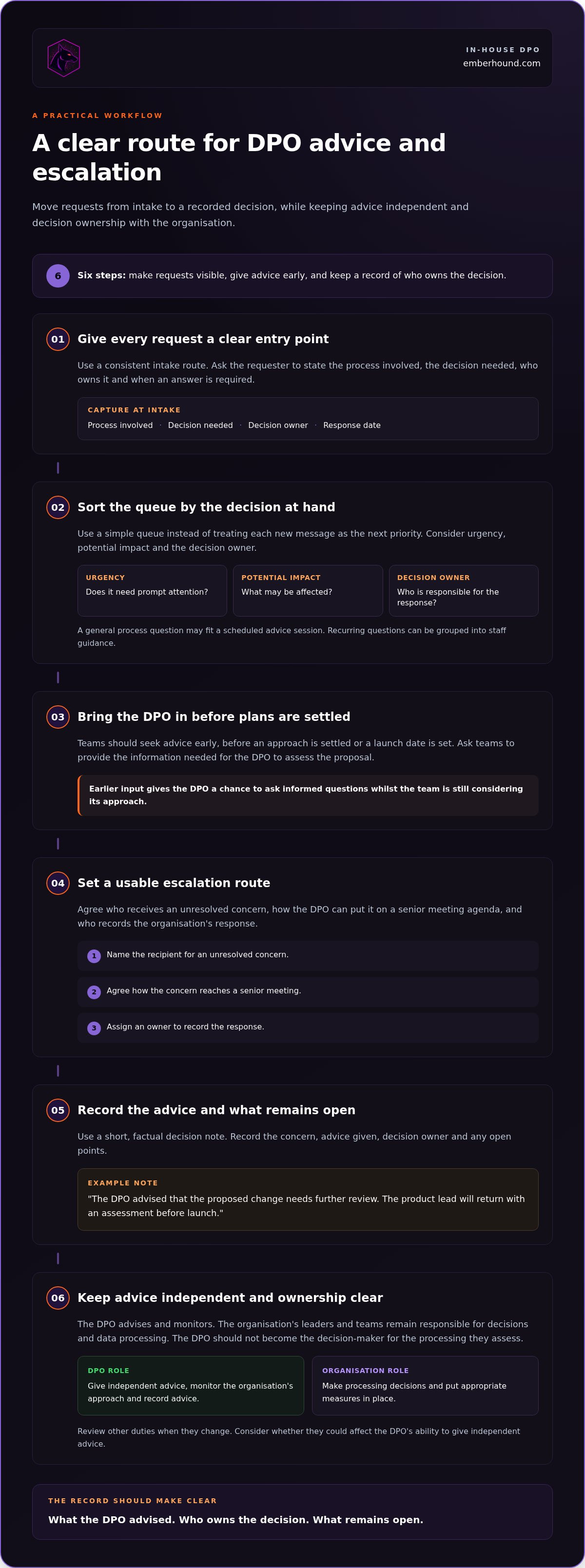
The DPO advises and monitors. The organisation's leaders and teams remain responsible for their decisions and data processing. This boundary matters: if the DPO is treated as the owner of every privacy task, teams may hand over decisions they need to make themselves.
For example, a product team proposes using customer data to personalise a new service. The DPO can ask how the data will be used, identify relevant risks and advise on safeguards or whether further assessment is needed. The team and its leaders must decide whether to proceed and put appropriate measures in place. The DPO can record their advice and monitor the organisation's approach, but should not become the decision-maker for the processing they assess.
That division can feel uncomfortable when delivery pressures are high. A clear route for raising concerns gives the DPO a way to make advice heard, while decision-makers retain ownership of their response. For wider context on UK data protection rules, read the GDPR guide.
Independence, influence, and workload create daily in-house DPO pressures
Privacy work is harder to manage when requests arrive through different channels and each is treated as urgent. A meeting request, supplier form and staff question can fill the day before planned review work begins. The pressure is sharper when the DPO is asked to comment only after a team has settled its approach or set a launch date.
A workable process gives requests a visible route and a clear next step. It also tells teams what information they need to provide before expecting advice. The International Association of Privacy Professionals discusses practical pressures in its article on challenges and solutions for DPOs.
How can an in-house DPO preserve independent advice?
Make escalation usable in practice. Agree who receives an unresolved concern, how the DPO can put it on a senior meeting agenda and how the organisation records its response. Without a route and a response owner, an issue can remain in email threads while a project moves ahead.
A short decision note can record the concern, the advice given, who owns the decision and what remains open. Keep the wording factual. For example: "The DPO advised that the proposed change needs further review. The product lead will return with an assessment before launch." This gives the discussion a clear next action without turning the note into a verdict on the project.
If the DPO has other duties, review whether they could affect the person's ability to give independent advice. The ICO's DPO guidance explains how organisations should consider potential conflicts. Review responsibilities when they change, rather than relying on an old job description.
Why do competing duties make the role harder?
Routine requests often arrive with little context. A consistent intake route can ask the requester to state the process involved, the decision needed, who owns it and when an answer is required. This lets the DPO clarify incomplete requests before spending time on analysis. It also gives the organisation a record of demand, which can help managers understand where capacity is going.
Use a simple queue rather than treating each new message as the next priority. Sort requests by urgency, potential impact and decision owner. A time-sensitive issue may need prompt attention; a general process question may fit a scheduled advice session. The DPO can group recurring questions into staff guidance, so the same issue does not need a fresh answer each time.
Protect time for planned work in the diary, then review the queue with a manager at agreed intervals. If requests repeatedly displace monitoring or staff support, raise the capacity issue with the people responsible for resourcing the role.
Data visibility and evidence are practical challenges for an in-house DPO
A DPO can give more specific advice when they understand the processing under review. If teams cannot say where personal data is held, which systems use it or who can access it, the DPO has to work with an incomplete picture. That makes it harder to assess a proposed change, prepare for a subject access request or check whether documented processing matches day-to-day practice.
Data discovery helps locate personal data in the endpoints being scanned. The results can guide follow-up questions and help teams compare actual locations with their records. Legal interpretation, risk decisions and compliance sign-off remain separate responsibilities.
Why is it hard to know where personal data is held?
Information can be spread across staff endpoints, shared folders, mailboxes and business systems. Working practices add to the challenge: a team may save a local copy for a project, or a process may change while its documentation stays the same. These are examples, not a claim that every organisation has the same gaps.
A simple comparison can show why declared records and actual locations need to be considered together:
| Declared records say | Unmapped locations may include |
|---|---|
| Customer details are held in the CRM. | Exports saved to staff endpoints or shared folders. |
| Recruitment records are held in an HR system. | CVs or interview notes kept in team mailboxes. |
| A process uses a named business application. | Copies created for a later task or retained in a separate workspace. |
The table is a prompt for investigation, not evidence that a particular location contains personal data. Compare records with the systems and locations teams use, then follow up with the relevant process owner. Before scanning, define the systems and endpoints in scope and use the organisation's data audit method to decide what needs examination.
What evidence can help a DPO explain a finding?
A useful discovery record should help a colleague understand what was found and where. It can note the relevant endpoint, the type of information identified and the context needed for follow-up. Keep the record proportionate: raw file content may contain personal data that does not need to be repeated in an initial finding.
EmberHound Discover scans endpoints and processes data locally. It can provide masked previews and salted SHA-256 fingerprints as evidence. A masked preview can help a reviewer understand a match without displaying the full content. A fingerprint records a file reference without including its raw content. Neither is, by itself, a legal conclusion or proof that an organisation meets its obligations.
The challenges of being an in-house DPO include turning technical findings into advice that decision-makers can act on. Discovery can point to material for review. The DPO and relevant teams still need to interpret the result, assess its significance and decide what action is appropriate.
Practical ways to make an in-house DPO role more manageable
Once responsibilities are clear, make privacy work part of the organisation's ordinary processes. This helps teams raise relevant questions while they can still act on the advice. These are practical working arrangements, not a statutory checklist.
- Map the points where privacy advice is needed. Include project planning, supplier onboarding, changes to existing services and new uses of personal data.
- Add privacy prompts to those workflows. Ask teams to record what is changing, what data is involved and when a decision is needed.
- Give teams reusable guidance. Provide short instructions for common tasks and a clear route for questions the guidance does not cover.
- Review where work gets stuck. Use recurring questions and delayed actions to identify processes that need clearer instructions or an earlier review point.
This approach brings privacy checks closer to the work itself. For example, a supplier onboarding form can prompt the team to describe the data involved before procurement reaches contract review. The DPO then has relevant context earlier, and the team can address routine questions through agreed guidance.
What support should an organisation provide its DPO?
Training should reflect the organisation's processes and the questions staff bring to the role. Short sessions can explain how to recognise a proposed change that needs privacy input and what information to include in a request. Refresh the material when processes change or the same point keeps causing confusion.
Practical tools matter too. Shared templates for project reviews, supplier checks and staff queries can reduce repeated drafting. For specific requirements such as website tracking compliance, platforms like Conzent can give teams a structured way to handle cookie consent without overburdening privacy staff. Keep templates simple, with prompts that help people explain the issue rather than tick boxes without context.
How can teams make DPO advice easier to act on?
Turn advice into a work item with a named owner, a clear action and a review point. A project record might state that the team will revise a privacy notice before release, then identify who will make that change. This keeps follow-up attached to the work rather than buried in meeting notes.
For supplier reviews, record the security information considered alongside the decision. EmberHound documents controls including local endpoint processing, TLS 1.3 in transit and AES-256 encryption at rest. Include relevant details in the organisation's review record.
How data discovery can support an in-house DPO without replacing the role
Data discovery gives a privacy team a starting point for work that might otherwise depend on staff knowing where information was saved. The DPO can use findings to direct questions to the relevant process owner and decide which areas need further review. That turns a broad request into defined follow-up work.
EmberHound Discover includes audit logging for data access and mutations. These records help teams review activity associated with discovery work. Use them alongside internal records and input from the relevant teams, so each finding has context and an owner who can assess what action is appropriate.
Which DPO tasks can data discovery support?
Discovery can help privacy teams prepare for reviews by identifying areas that need attention. For example, if a team is updating a process, relevant findings can inform questions about how personal data is used and who should review the change. The DPO can focus advice on the processing under discussion, while the responsible team supplies context and makes its decisions.
Discovery can also support operational preparation for a subject access request. A result can help the organisation identify material for human review. Staff still need to assess the request and decide what information to disclose. The tool supports that workflow; it does not make the disclosure decision or transfer responsibility from the organisation.
What should an in-house DPO understand about the platform's limits?
Discovery findings need to be interpreted in context. A result can inform a review, but it does not determine whether a processing activity is lawful or whether a risk should be accepted. The DPO's advice, the organisation's assessment and the decision owner's response remain distinct parts of the work.
EmberHound's documented controls include TLS 1.3 in transit and AES-256 encryption at rest. An organisation can consider these details as part of its own assessment of tools and processes. They do not settle the broader question of whether the organisation's use of data meets its requirements.
A free GDPR scan gives teams a starting point for data discovery. Review the results with people who understand the relevant processes and agree what to examine next.
Make the next step clear and manageable
The challenges of being an in-house DPO won't disappear through a single policy or tool. Make progress by turning privacy concerns into work with a clear owner, a decision point and a follow-up. Choose one process that needs better visibility, agree who will review the findings and set out how decisions will be recorded.
This gives the DPO a practical starting point and helps colleagues see what they need to do. Choose a focused first step, then use what you learn to decide where further review would help.
A GDPR scan can help teams examine where personal data may be held on endpoints. Scanning processes data locally, and masked previews with salted SHA-256 fingerprints can provide evidence for review without exposing raw file content. The organisation still needs to assess the findings.
With clear ownership and a manageable next action, the DPO can spend less time chasing basic information and more time giving advice teams can use.
Frequently Asked Questions
Is every organisation required to appoint an in-house DPO?
No. UK GDPR requires a DPO in specified circumstances, including when an organisation is a public authority or its core activities involve large-scale processing of certain personal data or regular, systematic monitoring of people. Size alone does not decide whether an appointment is required. An organisation can appoint a DPO voluntarily, but should understand that the formal role carries requirements around independence and access to senior management. These conditions shape the challenges of being an in-house DPO.
Can an in-house DPO have other responsibilities?
Yes, provided those responsibilities don't create a conflict of interest or prevent the DPO from carrying out their tasks. The ICO advises organisations to assess whether other duties involve deciding the purposes or means of processing personal data. For example, a role that sets how customer information is used may conflict with monitoring that processing. A job title alone doesn't settle the question. Review the person's actual decision-making powers and responsibilities.
Who should an in-house DPO report to?
A formally appointed DPO must report to the organisation's highest management level under UK GDPR. That does not necessarily mean every routine task must be managed by the chief executive. The practical arrangement should give the DPO a direct route to senior leaders when advice is disputed or a concern remains unresolved. The ICO's guidance on data protection officers explains this reporting requirement.
Can a DPO be dismissed for giving difficult advice?
No, a DPO must not be dismissed or penalised for performing their DPO tasks. This protects the role's independence when advice is unwelcome. It is not a blanket statement about every possible employment decision: the reason and circumstances still matter. If a dispute arises, keep a clear record of the advice and related events, and seek appropriate employment or legal advice. The ICO's DPO guidance sets out the protection.
What qualifications does a DPO need in the UK?
UK GDPR does not prescribe a particular degree, certificate or professional title for every DPO. The person needs expertise in data protection law and practice suited to the organisation's processing and the tasks involved. For example, a role covering complex data flows may call for knowledge of how those processes work as well as data protection requirements. Organisations should assess the person's experience and identify any training they need to carry out the role effectively.
Can a small organisation appoint an external DPO instead?
Yes. A DPO can be an external service provider working under a service contract. This can give a smaller organisation access to DPO support without employing someone in-house. The arrangement still needs to meet the role's requirements, including independence, access to relevant information and a route to senior management. The organisation remains responsible for making sure the appointed DPO can perform the tasks in practice, not merely naming a contact in a contract.
Is an in-house DPO personally responsible for GDPR compliance?
No. The DPO advises and monitors; responsibility for complying with UK GDPR remains with the organisation acting as controller or processor. For instance, a DPO may advise on a proposed retention period, but the relevant decision-maker must decide and arrange how the policy is put into practice. The DPO should be able to raise concerns independently. Their appointment does not transfer organisational accountability to one employee.


