

A UK company can be covered by the EU AI Act even without an EU office. If you’re asking, “Does the EU AI Act apply to my company?”, the key test is whether your AI system is used in the EU or its outputs influence decisions there. A website simply being accessible in Europe is not enough.
The Act’s cross-border reach can be easy to misjudge. Your role matters: providers, deployers, importers and distributors have different obligations, and a company that substantially modifies a high-risk system may be treated as its provider.
This guide explains when the Act covers a UK business, how it affects high-risk AI providers, and what penalties may apply for non-compliance. It also shows how to distinguish your responsibilities from those of other organisations in the AI supply chain, so you can focus on the requirements relevant to your business.
Key Takeaways
- Map your AI activities across the supply chain: provider, deployer, importer or distributor status can shape your obligations.
- High-risk classification can bring specific requirements for providers, including risk management and conformity assessment before market release.
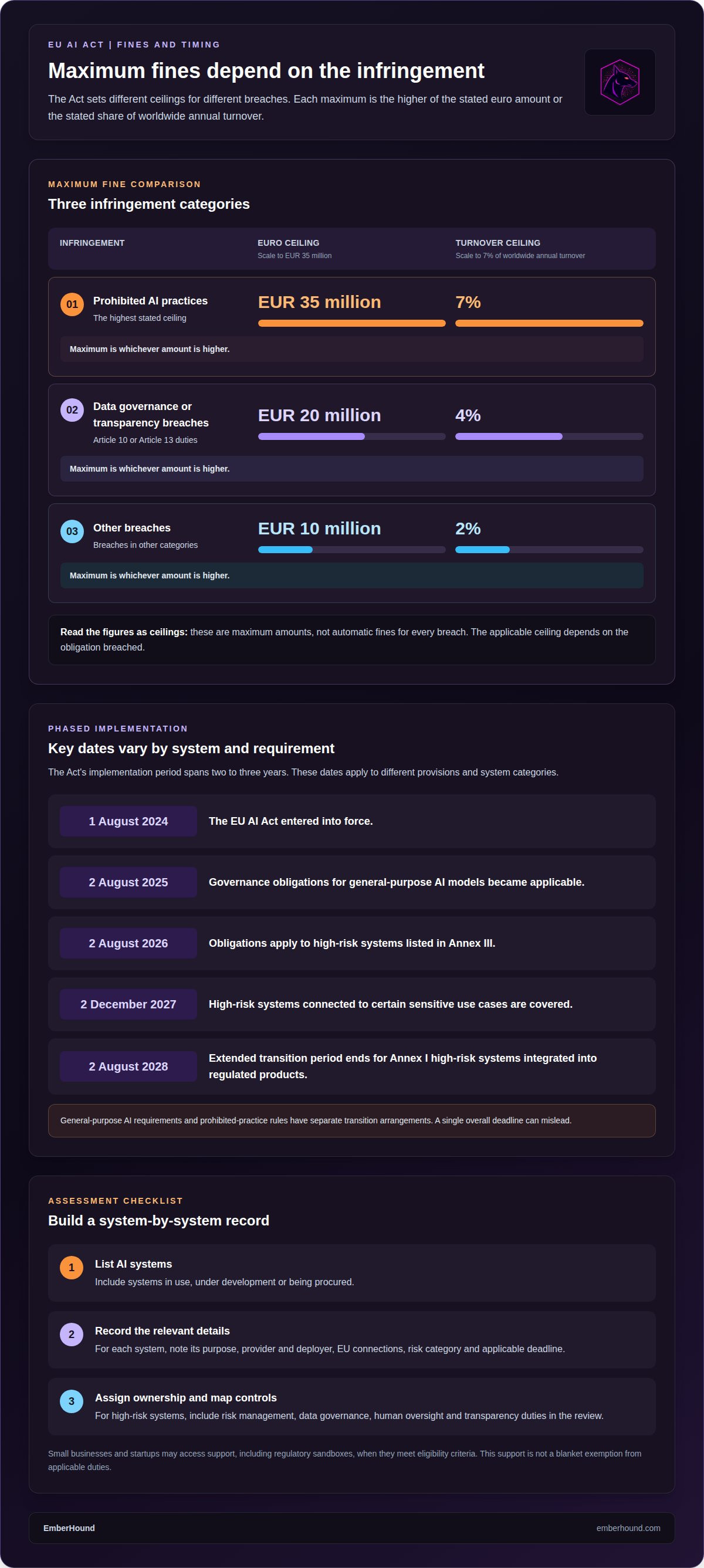
- Penalties depend on the type of infringement, with the highest ceiling reaching 7% of worldwide annual turnover.
- Build an inventory of AI systems and clarify who is responsible for each system before assessing the duties that apply.
- EmberHound's GDPR Data Discovery can help locate personal data relevant to your organisation's data governance work.
What are the penalties in case of non-compliance?
The EU AI Act sets maximum fines according to the infringement. Prohibited AI practices can attract a fine of up to EUR 35 million or 7% of worldwide annual turnover, whichever is higher. Breaches of data governance requirements under Article 10, or transparency and information duties under Article 13, can reach EUR 20 million or 4% of worldwide turnover, whichever is higher. Other breaches can reach EUR 10 million or 2% of worldwide turnover, whichever is higher.
The relevant ceiling depends on the obligation breached. A company using a prohibited system faces a different maximum from one failing to meet Article 13 transparency duties. These are maximum amounts, not automatic fines for every breach. The penalty figures are expressed in euros because that is how the Act sets them.
Deadlines also depend on the system category. The Act's implementation period spans two to three years, with provisions taking effect at different times. Obligations for high-risk systems listed in Annex III apply from 2 August 2026. High-risk systems connected to certain sensitive use cases are covered from 2 December 2027.
The timing for product-related high-risk systems depends on the applicable transition arrangements. Systems integrated into regulated products under Annex I have an extended transition period until 2 August 2028. General-purpose AI requirements and prohibited-practice rules have separate transition arrangements, so a single overall deadline can mislead.
Small businesses and startups may be able to access support, including regulatory sandboxes, when they meet eligibility criteria. That support is not a blanket exemption from applicable duties. Company size alone does not answer whether a system or activity falls within the Act.
Open-source status alone does not settle the compliance question. Assess the system’s intended purpose, how it is supplied or used, and your organisation’s role. Any relevant exception depends on the Act’s specific conditions.
To assess your position, create an inventory of AI systems in use, under development or being procured. Record each system’s purpose, provider and deployer, EU connections, risk category and applicable deadline. Assign an accountable owner, then map the required controls to the system. For high-risk systems, include risk management, data governance, human oversight and transparency duties in the review.
Article 69 provides for voluntary codes of conduct covering specific requirements for AI systems that are not classified as high-risk. A code can guide governance, but it does not replace a check of binding duties. Keep the assessment current as systems, uses or roles change.
Whether the EU AI Act applies to entities inside and outside the EU
The EU AI Act’s reach depends on where an AI system is supplied or used, and where its outputs matter. A company’s location alone does not settle the question.
Scope beyond EU and EEA borders
The Act can cover providers and deployers established outside the EU when their systems' outputs are intended for use in the EU. Article 2 sets out this scope, including its extraterritorial reach. A UK or Swiss company may therefore have obligations linked to EU use, even without an EU office. The regulation follows the system's EU connection, not simply the provider's address.
Organisations covered by the Act
The Act covers organisations that provide or deploy AI systems within its scope, including those established outside the EU. It also applies to general-purpose AI models placed on the EU market, regardless of where their providers are based. For example, an organisation outside Europe supplying a model for EU use may need to assess its role. The rules apply directly in EU Member States, without national transposition.
Application to UK businesses
A UK business may be covered when its AI system is used in the EU or its outputs influence decisions there. An EU office or subsidiary is not required. For example, a UK-developed system used by an EU organisation can bring its provider within scope. A UK organisation deploying an AI system for activity in the EU must also consider its obligations as a deployer.
Geography alone does not trigger the regulation. A UK website being accessible to people in Europe is not enough. The relevant question is whether EU users actually use the AI system or people in the EU rely on its outputs. Distinguish website availability from real system use: record where users interact with the system and where its recommendations or decisions have an effect.
The timeline is phased. The EU AI Act entered into force on 1 August 2024, while its provisions take effect at different times. Governance obligations for general-purpose AI models became applicable on 2 August 2025. That date matters to a UK organisation supplying such a model into the EU, even if its development team remains in Britain.
For each system, assess how it reaches the market and is used. Identify whether it is placed on the EU or EEA market, put into service there, or used to produce outputs for EU decisions. Then map the relevant organisation’s role and applicable start date. This gives a clearer scope assessment than relying only on the registered office or technical team’s location.
Does the EU AI Act Apply to UK Businesses?
For a UK company, the main territorial test is whether an AI system is used in the EU or its outputs influence decisions there. A UK address does not remove that connection. For example, a UK-developed recruitment tool used by an employer in France may bring the system within the Act’s scope. Obligations depend on the system’s use and the company’s role.
Consider what happens after the system produces an output. If an EU organisation relies on a UK system’s recommendation to rank applicants, assess creditworthiness or make another decision, that use can create an EU link. The same applies when a UK business supplies an AI application directly for use by people or organisations in the EU. Map the users, where the system is used and which decisions its outputs influence.
Website access alone is different. A UK company’s website being viewable in Germany or Spain does not, by itself, trigger the EU AI Act. The relevant issue is actual AI use by EU users or reliance on AI-generated outputs within the EU. A product page visible in Europe, for example, is not the same as an AI scoring tool used by an EU lender to assess applicants.
The Act also prohibits certain practices that create unacceptable risk. Article 5 prohibits specified AI-based practices, while government-run social scoring of the type used in China is an example of the kind of system the Act bans. A UK organisation must consider this if its system is intended for use in the EU. The system’s function and intended purpose matter more than its location of development.
Risk classification helps identify the obligations that may apply. The Act identifies four risk levels: unacceptable, high, limited, and minimal or no risk. A creditworthiness assessment can be high-risk, while a chatbot may trigger transparency duties in relevant cases. This distinction helps a UK company identify which applications need closer review and which requirements relate to their use.
Timing is also tied to the category. Obligations for high-risk systems listed in Annex III apply from 2 August 2026. That date does not make every AI application high-risk; classification still depends on the system and its purpose. Check each EU-linked application against its intended use and relevant start date, then record the result alongside the responsible organisation.
The UK’s domestic approach is separate. The UK Government’s 2023 White Paper set out a sector-led, principles-based approach to AI regulation. A UK business may therefore need to consider both its domestic regulatory context and the EU AI Act’s territorial scope. Treat these as separate questions: identify EU use first, then assess which framework applies to each activity.
How does it all work in practice for providers of high-risk AI systems?
The EU AI Act sets different duties according to system risk and each organisation’s role. For high-risk systems, providers need to link technical controls, documentation and governance to the system’s intended purpose.
The Act places AI systems in four risk levels: unacceptable, high, limited, and minimal or no risk. Prohibited systems fall into the unacceptable-risk category; high-risk systems face specific requirements, while limited-risk systems can trigger transparency duties. General-purpose AI models follow a separate framework, with different requirements for models with systemic risk. Generative AI tools may also have transparency duties, including in relevant cases involving AI-generated content.
Scoping systems with EU exposure
Scoping means identifying each AI system with an EU connection and tracing its use and outputs. Intended purpose and actual use help determine the applicable category and duties. Include systems in use, under development or being procured in your inventory. Record the model, provider, intended users, EU use case and decisions influenced by its outputs.
The Act defines an AI system as a machine-based system that infers from data how to generate outputs, such as predictions, decisions, recommendations or content. Those outputs can influence a physical or digital environment. This definition helps distinguish AI systems from ordinary software. Record the system’s function and how it produces outputs.
Identifying systems and companies in scope
Providers carry the heaviest duties, while deployers must use systems correctly and supervise them appropriately. A company that substantially modifies a high-risk AI system may be treated as its provider, changing which organisation holds provider obligations. Record who develops, supplies, modifies and uses each system, including where those roles belong to different companies.
High-risk systems include stand-alone applications listed in Annex III and certain product-related systems covered by EU legal acts listed in Annex I. Examples include recruitment and worker management, education, creditworthiness assessments and certain healthcare applications. The use case matters: a model’s general capabilities alone do not determine its classification.
For a high-risk system, establish governance around its full lifecycle. Article 9 requires a risk management system; Article 10 sets requirements for training, validation and testing datasets. Article 14 covers human oversight. Providers must also complete a conformity assessment before market release, and high-risk systems must be registered in an EU database.
Turn those duties into technical and contractual records. Keep an AI inventory or model repository with the intended purpose, risk assessment, dataset information, oversight arrangements and accountable teams. Contracts should clarify which party supplies system information and supports the required controls. Revisit the record when a system is substantially modified or its use changes. Obligations for Annex III systems apply from 2 August 2026; Annex I obligations start on 2 August 2027.
AI Act coverage of providers, users, importers and distributors
The EU AI Act assigns responsibilities according to each organisation’s role in the AI supply chain. A UK company may hold more than one role for the same system, so assess each activity separately. A developer that supplies a system, an EU business that imports it and an employer that uses it can have different duties. Contract labels are relevant, but so is what each organisation actually does.
Providers develop an AI system or place one on the market under their name. The Act places the heaviest obligations on providers, particularly for high-risk systems. A UK developer supplying a hiring tool for EU use should assess the system’s purpose, classification and intended users. Substantially modifying a high-risk system can also mean a company is treated as its provider.
Deployers use AI systems under their authority, such as an employer using software to support recruitment decisions. They must use the system correctly and supervise it appropriately. The Act also requires providers and deployers to take measures to ensure sufficient AI literacy among staff, including for systems outside the regulated risk categories. Teams using a tool need enough understanding to recognise its role and limitations.
Importers have a specific role in the EU supply chain. An EU or EEA-established company is an importer when it places on the market an AI system from a provider established outside the EU. For example, an EU company bringing a UK provider’s system onto that market may take the importer role. The UK provider’s location does not make it the importer.
Distributors are another supply-chain role to identify when a company makes an AI system available. A distributor should record which provider supplied the system and which customer receives it. The transaction’s details matter: an organisation that substantially changes the system or supplies it under its own name may need to reassess whether it is still only a distributor. Map actual conduct, not just contract headings.
Some deployers also have duties to carry out a fundamental rights impact assessment. This applies to certain deployers, so consider the organisation’s function and the system’s use. For example, a Member State public body using an AI system to make decisions about individuals should consider whether an assessment is required. Keep the assessment tied to the actual use case, affected people and decisions the system supports.
For each system, record the provider, deployer, importer and distributor, where those roles exist. Identify who controls development, makes the system available, modifies it and uses its outputs. This map clarifies who must act and where contracts need to describe responsibilities. AI literacy supports responsible use across roles, while proportionate governance helps maintain accountability without unnecessarily restricting innovation.
EmberHound
EmberHound helps you locate sensitive data that may sit alongside your AI systems. Its GDPR Data Discovery and PCI Card Data Discovery identify personal and payment card data in business files. Combined GDPR + PCI Coverage supports both discovery needs, while the DSAR Disclosure Pack supports subject access request handling.
This can help when you’re inventorying data sources connected to AI development or use. EmberHound can show where relevant information is held, but it does not determine your EU AI Act classification or replace legal advice. Use the findings as one input to your wider assessment of AI systems, roles and obligations.
Contact EmberHound to discuss data discovery for your organisation.
Make your next review count
Turn your scope assessment into a working record. Assign an owner to each AI system and document how its role, use and EU connection led to your decision. Review the record when a system changes, another organisation joins the supply chain, or its outputs begin to shape decisions in the EU. A concise, current record gives your team a clear basis for ongoing governance.
If you’re still asking whether the EU AI Act applies to your company, start by mapping the data behind the systems and decisions in scope. Knowing where sensitive information is held can help your team organise its wider review. Keep legal classification and data discovery as distinct workstreams, with clear ownership for each.
A clear record makes the next decision easier to manage. Take the next step with confidence.
Frequently Asked Questions
How can organisations apply it?
Organisations can put the EU AI Act into practice by assigning an owner to each AI system and recording its intended use. Link each system to the organisation’s role, risk category and relevant compliance date. For example, a team procuring recruitment software should record who supplies it, who uses it and which decisions it supports. Review the record whenever the system’s purpose or use changes.
Are UK deployers of third-party AI tools in scope of the EU AI Act?
Yes. A UK deployer can fall within scope when a tool is used in the EU or its outputs are intended to affect people or decisions there. Buying a third-party tool does not automatically make the UK company its provider. The deployer still needs to consider its own use and supervision duties. For example, assess where staff use the tool and where its recommendations are relied upon.
Can I voluntarily comply with the EU AI Act even if my system is not in scope?
Yes. An organisation can use the Act’s requirements as a voluntary governance reference for an out-of-scope system. Article 69 also provides for voluntary codes of conduct covering specific requirements for AI systems that are not high-risk. Voluntary adoption does not itself make the Act legally applicable to that system. Record which practices are voluntary and keep them distinct from duties that apply by law.
Is there a UK equivalent of the EU AI Act?
The UK has taken a sector-led, principles-based approach rather than introducing a single, overarching AI regulatory framework. The UK Government’s 2023 White Paper set out this approach, and the consultation outcome followed in February 2024. UK organisations may therefore need to consider existing rules relevant to their sector alongside the EU AI Act where their activities have an EU connection.
Which companies and AI systems are covered by the EU AI Act?
The Act can cover providers and deployers established inside or outside the EU when its territorial criteria are met. It applies to AI systems placed on the market or put into service in the EU or EEA, and to general-purpose AI models placed on the EU market. A system’s intended purpose and actual use help determine its risk category and the duties that follow.
Does the EU AI Act apply to UK companies serving customers in the EU?
It can apply, but serving an EU customer alone does not settle the question. Assess whether the customer uses the system in the EU or relies on its outputs there. A UK supplier whose AI output informs an EU organisation’s decision may have an EU-linked activity to assess. A website accessible to EU visitors, without actual AI use or reliance on outputs there, is insufficient by itself.
When does the EU AI Act apply, and what are the key compliance deadlines?
The Act entered into force on 1 August 2024, with requirements phased in by provision. General-purpose AI model obligations became applicable on 2 August 2025. Annex III high-risk obligations apply from 2 August 2026; Annex I high-risk requirements start on 2 August 2027. Certain sensitive high-risk uses have a 2 December 2027 date, while the extended transition for specified regulated products runs until 2 August 2028.
What obligations apply to providers, deployers, importers, and distributors of AI systems?
Providers carry the heaviest obligations, particularly for high-risk systems. Deployers must use systems correctly and supervise them appropriately. An EU or EEA-established company is an importer when it places an AI system from a non-EU provider on the market. Distributors should assess their role in making a system available; substantial modification may affect how that role is classified. Providers and deployers must also take appropriate measures to support staff AI literacy.


