

Academic research can fall outside the EU AI Act when an AI system or model is developed and put into service solely for scientific research and development, under Article 2(6). The EU AI Act exemptions also cover research, testing and development before a system is placed on the market or put into service, but not testing in real-world conditions under Article 2(8).
The boundary matters for UK firms. A research label alone does not settle the question, and an open-source licence does not create a blanket exemption. The Act can apply to UK providers and deployers when a system’s output is used in the EU.
This guide explains where research exclusions stop, when open-source components remain in scope, and how certain Annex III systems may avoid high-risk classification. It also covers the narrow exception for urgent, real-time remote biometric identification. You’ll get a clearer view of which exemption may fit your system and which obligations may still apply.
Key Takeaways
- An open-source licence does not automatically remove an AI system from the Act. Its use and regulatory category still matter.
- Some Annex III systems may not be classified as high-risk, depending on how they are used and the applicable conditions.
- Urgent real-time remote biometric identification has a narrow authorisation exception, with a strict deadline for requesting approval.
- Military, defence and national security uses depend on whether the activity falls within the Act's scope.
- Separate AI Act scoping from data protection work: data discovery can help identify personal and card data across business systems.
Conditions for excluding certain Annex III systems from high-risk classification
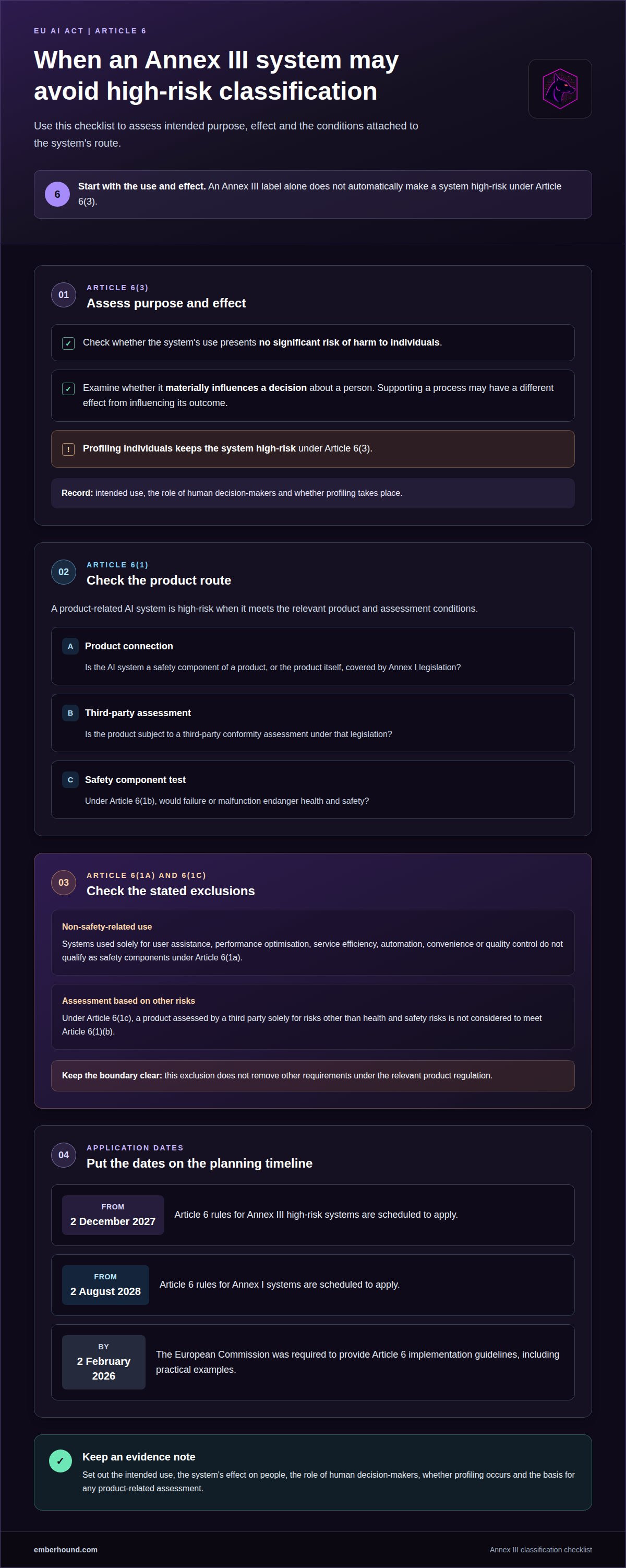
An Annex III label doesn’t automatically make an AI system high-risk. Under EU Article 6(3), some systems can be excluded if their use presents no significant risk of harm to individuals, including by not materially influencing a decision. The assessment turns on the system’s intended purpose and effect, not simply its technical design.
For education and employment, examine what the AI system does in practice. A tool that supports a process may have a different effect from one that materially influences decisions about a person. The exclusion is conditional: a system that profiles individuals remains high-risk under Article 6(3). Record the intended use, the role of human decision-makers and whether profiling takes place.
Product-related AI follows a separate route. Under Article 6(1), an AI system is high-risk when it is a safety component of a product, or is itself a product, covered by Annex I legislation and subject to third-party conformity assessment. Under EU Article 6(1b), a system qualifies as a safety component if its failure or malfunctioning would endanger health and safety. By contrast, under EU Article 6(1a), systems used solely for non-safety-related user assistance, performance optimisation, service efficiency, automation, convenience or quality control do not qualify as safety components.
There is a further boundary in EU Article 6(1c). A product subject to third-party conformity assessment solely because of risks other than health and safety risks is not considered to meet Article 6(1)(b). The basis for a conformity assessment can affect whether this exclusion applies. It doesn’t remove other requirements that may apply under the relevant product regulation.
Personal or non-professional AI use is treated differently from commercial deployment. An individual using an AI system in a personal capacity falls outside the Act’s scope for that activity; business use doesn’t become personal simply because one person operates the system. UK providers and deployers can be within scope when an AI system’s output is used in the EU. Article 2(1) also covers providers placing systems or AI models on the EU market, regardless of whether they are based in the EU or a third country.
Timing depends on the system’s route. The EU AI Act’s Article 6 rules for Annex III high-risk systems are scheduled to apply from 2 December 2027; for Annex I systems, they are scheduled to apply from 2 August 2028. The European Commission was required to provide Article 6 implementation guidelines, including practical examples, no later than 2 February 2026. These dates make classification and evidence of intended use a current planning task, even before those rules apply.
For UK teams mapping personal data alongside AI governance, the GDPR guide provides a related data-protection reference.
Exceptions for real-time remote biometric identification
The EU AI Act sets a narrow exception for real-time remote biometric identification. In a duly justified urgent case, use may begin before authorisation. The exception does not remove the authorisation obligation. The request must be made without undue delay and within 24 hours at the latest.
That short window affects the operational response. If your team relies on urgency, record why the case was urgent, when the system began operating and when authorisation was requested. These details show the sequence of events and help distinguish an urgent exception from a planned deployment that should have sought authorisation first.
“Real-time” matters. The exception concerns identification as the system operates, rather than later analysis of stored material. “Remote” describes identification without direct interaction between the system and the individual. For example, identifying people from a live camera feed raises a different issue from reviewing footage after an event. Both the system’s intended purpose and its actual use matter.
Urgency must be duly justified. Operational convenience alone does not establish urgency. The decision record should set out the specific circumstances and explain why waiting for authorisation was not viable. Tie the account to the deployment, rather than a broad purpose such as public safety. The exception applies to the urgent case; it should not become a standing route for routine use.
Consider fundamental rights before and during deployment. The impact on individuals depends on where identification occurs, who may be affected and how the result is used. Technical documentation can describe the system’s intended purpose, operating context and decision process. Make clear which system is involved, who approved its use internally and what prompted the urgent decision. These records support a focused review of the deployment.
The 24-hour deadline is a maximum, not a waiting period. If authorisation can be requested sooner, the urgency exception does not justify delay. Assign responsibility for submitting the request before any urgent deployment begins. Record the start time and submission time in a consistent format. A missed deadline cannot be repaired by describing the use as urgent after the event.
Keep this exception separate from other eu ai act exemptions. It concerns a specific use of real-time remote biometric identification; it does not exempt every AI system, every biometric use or every purpose AI model. The European Commission’s separate implementation work on high-risk classification does not replace this authorisation step. For the related personal-data work, map GDPR data exposure across the systems involved.
Exemptions for open-source components
An open-source licence does not remove every AI system from the EU AI Act. Article 2(12) excludes AI systems released under free and open-source licences, unless they are placed on the market or put into service as high-risk systems, prohibited systems under Article 5, or systems covered by Article 50. The system’s release terms matter, but so do its use and regulatory category.
Separate the component from the finished system. A freely licensed machine-learning library may qualify for the Article 2(12) exclusion on its own. If a provider integrates it into an AI system placed on the market as high-risk, the system remains subject to the relevant rules. The component’s licence does not decide the finished system’s classification.
Article 25(4) provides a narrower relief for providers of certain free and open-source tools, services, processes or components integrated into high-risk AI systems. It exempts those providers from the obligation to give written documentation to downstream providers. This is a documentation exemption, not a general release from every duty. The downstream provider’s assessment of the complete system still matters.
For a practical assessment, trace the software through its stages:
- Identify whether the released item is an AI system, an AI model, or a component used within a larger system.
- Record its free and open-source licence and how the code or model is distributed.
- Establish whether the complete system is placed on the European market or put into service.
- Assess whether the system falls within high-risk, prohibited-use or Article 50 categories.
General-purpose AI models require a separate check. The EU AI Act’s governance rules and obligations for general-purpose AI models became applicable on 2 August 2025. Article 53(1c) requires general-purpose AI model providers to put in place a policy to comply with the EU Copyright Directive. An open-source release does not, by itself, settle whether model-provider obligations apply.
That distinction answers a common question: open-source status may exclude a qualifying AI system under Article 2(12), but it does not create a blanket exemption for general-purpose AI models. Check the model’s role, provider status and applicable obligation separately from the licence of a downstream system.
A mistaken exemption claim does not change the system’s actual category. The consequences depend on the underlying conduct. Non-compliance with the EU AI Act’s prohibitions can result in a fine of up to €35 million or global annual turnover in the preceding year, whichever is higher. That penalty relates to prohibited practices, not automatically to every classification error.
Article 2(8) pre-deployment research and testing
Article 2(8) excludes research, testing and development activities before an AI system or model is placed on the market or put into service. The boundary is about the activity and its timing. It does not give a permanent exemption to a system that later reaches deployment. A team assessing a prototype should identify whether its work remains pre-market development or has moved into real-world use.
A virtual test environment is a clear example of pre-deployment work. Developers might use synthetic records to evaluate whether an AI system sorts documents as intended. They can record the test objective, model version, data source and results. Those details show what was tested and whether the activity involved a real operating setting. An explicit research label alone does not establish that every activity falls within Article 2(8).
Real-world testing is the key limit. Article 2(8) does not exclude testing in real-world conditions. For example, testing an AI system with live users in an operational workplace may cross that boundary, even if the team calls it a pilot. The setting, participants and system use help distinguish a controlled development test from real-world testing.
That boundary matters before market entry. A provider might test a recruitment tool with simulated applications in a development environment. If the same tool is then tested on live applicants as part of an actual hiring process, the activity has changed. Assess the new setting separately rather than carrying forward the earlier pre-deployment conclusion.
Article 2(8) also differs from the research exclusion in Article 2(6). Article 2(6) concerns AI systems and models developed and put into service solely for scientific research and development. Article 2(8) concerns research, testing and development before the system or model is placed on the market or put into service. A commercial development project can therefore involve Article 2(8) activities without being solely scientific research.
For an Annex III system, pre-deployment testing does not determine its eventual classification. During development, assess the intended purpose and likely use before market placement. Make the system’s stage clear in project records: prototype testing, real-world testing, and market or service deployment describe different circumstances. Reassess when the activity changes.
Real-world testing can trigger obligations under the EU AI Act’s regulatory-sandbox provisions in Articles 57-61. The existence of a sandbox route does not turn real-world testing into pre-deployment research under Article 2(8). Treat the testing setting as a separate scoping question, then assess which provisions apply to that activity.
A practical record can capture the test environment, whether real individuals or live operations are involved, the system’s status, and when its purpose changes. This helps explain why an activity was treated as development rather than deployment. It also provides a clear basis for reassessment before the system is placed on the market or put into service.
Does the EU AI Act apply to AI systems used only for military, defence or national security purposes?
Certain activities fall outside the EU AI Act’s scope, including some uses for military, defence or national security purposes. The purpose and context of use matter. A label attached to an AI system does not, by itself, establish that an activity is excluded.
Start with the specific activity. An AI system developed for military use might later be used for a civilian task. Assess that civilian use separately. For example, a model developed for defence research and later adapted to screen commercial job applications has moved into a different operating context. Its original development purpose cannot determine the status of every later use.
“Used only” sets a narrow boundary. If a system supports both national security work and ordinary commercial operations, analyse those functions separately. Identify who uses the system, what task it performs and where its output is applied. A defence contract alone does not explain whether the system’s other uses fall outside the Act.
Keep the purpose record specific. “Security” can describe activities ranging from protecting military operations to managing access to an office. These contexts are not interchangeable. Record the operational task, intended users and how the AI system affects that task. If the system is repurposed, reassess its scope against the new activity rather than relying on its earlier designation.
A practical scope review can map each use separately:
- Describe the activity the AI system supports, such as a defence operation or a civilian service.
- Identify whether the purpose is exclusively military, defence or national security.
- Separate any civilian or commercial use, including uses of shared models and outputs.
- Keep the purpose and deployment records together so changes can be assessed.
This approach also helps distinguish an AI model from the activity around it. The same machine-learning model may support different tasks in different settings. Its technical capabilities alone do not show whether each deployment is outside scope. The relevant question is how the system is used in the activity under review.
For UK organisations, the practical risk is treating an organisation-wide label as an exemption. A supplier may serve defence and civilian customers with the same system. Each use needs a clear account of its purpose and context. If a team cannot distinguish those uses in its records, it may be difficult to explain why a particular deployment falls outside the EU AI Act.
Tie each conclusion to the facts of the activity. A use that falls outside the Act does not automatically take related civilian deployments with it. Revisit the assessment when the intended purpose, users or operating context changes. This gives teams a clear basis for identifying which activities remain within the regulation’s scope.
EmberHound
EmberHound helps UK firms identify sensitive information on business devices. An AI Act exemption addresses regulatory scope; it does not show where personal or payment card data sits. GDPR Data Discovery and PCI Card Data Discovery can help locate that information, while Combined GDPR + PCI Coverage addresses both data types.
Turn to data discovery when your AI review raises questions about personal information stored across your organisation. If you need to gather information for a subject access request, the DSAR Disclosure Pack supports that task. These tools help with data visibility and disclosure, not the legal classification of an AI system.
Contact EmberHound to discuss your organisation’s data discovery needs.
Make your next review specific
Record each exemption decision against the system’s purpose, users and actual deployment. Revisit it when those facts change. This gives your team a clear basis for deciding whether an earlier assessment still applies.
EU AI Act exemptions do not replace work on personal or payment card data. Keep those data questions separate from AI system classification. EmberHound’s data discovery tools can help identify where relevant information sits, giving your organisation a clearer starting point for its data work.
If you need to locate personal or payment card data as part of a wider review, speak with EmberHound about data discovery.
A focused review is easier to maintain when each decision has a clear purpose and an owner. Take the next step with the information your team needs, and keep the assessment current as your systems change.
Frequently Asked Questions
Does the EU AI Act apply to AI systems built purely for academic research?
Pure scientific research and development can fall outside the Act when a system is developed and put into service solely for that purpose. For an academic project, distinguish the research purpose from later teaching, administration or commercial work. A change in users or operating context can change the scope analysis, so record project changes as they happen rather than relying on the system’s original research label.
What activities and systems are exempt from the EU AI Act?
Some research activity, qualifying open-source systems and certain uses outside the Act’s scope may be excluded. Treat these as separate routes, each with its own boundaries. A system could be excluded in one research setting while a related deployment has a different purpose. A useful scope record identifies the system, the activity under review and why that activity is treated as outside the relevant requirements.
Are research, testing and development of AI systems exempt under the EU AI Act?
Pre-deployment research, testing and development are excluded, but that exclusion does not cover real-world testing. A practical test record should identify the environment, participants, data used and whether the system affects an operational service. Keep separate records for simulated evaluation and live testing. This makes it easier to show when a project moved from development into a setting that needs a different assessment.
When are AI systems used for scientific research exempt from the EU AI Act?
The exclusion applies when a system is developed and put into service solely for scientific research and development. Document the research question, intended use and project scope. If the system later supports a separate university function, assess that use on its own. Keeping the research activity distinct from subsequent uses helps prevent a research exemption from being applied too broadly.
Are open-source AI models exempt from the EU AI Act, and what are the exceptions?
Open-source status can support an exclusion for qualifying systems, but it does not settle every obligation attached to a model or its later use. Record the licence, the component’s role and how the complete system is supplied or used. A provider integrating an open-source component should assess its own role separately from the original developer’s. This avoids treating the component’s release terms as a conclusion about the whole system.
Which AI systems are exempt from high-risk classification under the EU AI Act?
Some Annex III systems may qualify for exclusion if the relevant conditions are met; profiling remains a disqualifying factor. In practice, describe the task the system performs and how its output enters the decision process. A record should distinguish administrative support from a system that shapes an individual's outcome. That account gives reviewers a clearer basis for examining the system's actual function.
What conditions exempt an AI system from the EU AI Act's high-risk requirements?
For an Annex III system, the exclusion depends on whether its use presents a significant risk of harm and materially influences a decision; profiling prevents reliance on the exclusion. For product-related systems, assess the applicable product legislation and the reason for any third-party conformity assessment. Tie the evidence to the system’s intended purpose and actual function, so the classification rationale can be revisited if either changes.


