

Small businesses aren't exempt from the EU AI Act: its rules can apply to businesses in the UK as well as those in the EU. EU AI Act small business obligations depend on your role and the AI system's risk, and the Act's requirements are being phased in through August 2027.
The dates matter. Some requirements already apply; others depend on the AI system and how your business uses it. Company size can affect certain provisions, but it does not remove the need to identify which rules apply.
This checklist explains how to assess whether the Act covers your business, distinguish provider duties from deployer duties, and identify requirements for prohibited, high-risk and other AI uses. It also sets out key transition dates, including what is already in force and what comes next. You’ll get a clearer view of what to prioritise, without treating every AI tool as if it carries the same obligations.
Key Takeaways
- Assess where your business places or uses AI in the EU. The Act can apply to UK businesses too, and company size alone does not create an exemption.
- Identify whether your business acts as a provider or deployer. Your role helps determine which duties apply to each AI system.
- Check what your AI system does and how it is used. The Act’s risk categories shape the requirements, with specific duties for high-risk systems.
- Review customer-facing AI and generated media. Article 50 transparency duties include telling people when they interact with a chatbot and marking certain AI-generated content.
- Use the phased dates to set priorities. Some rules already apply, while most obligations apply from August 2026 and high-risk requirements are phased in through August 2027.
Transparency duties for AI systems interacting with people
The EU AI Act can apply to a UK business when its activities fall within the Act's scope. Article 2 covers providers, deployers, importers and distributors, while Article 3 defines provider and deployer roles. Which EU AI Act obligations apply depends on the business's role and the system's risk category. A business using an AI system under its authority is generally a deployer, unless the use is personal and non-professional.
Start by listing each AI system. Record its purpose, supplier, users, whether it interacts with people and whether it generates content. This gives your assessment a practical starting point. For example, if your business uses a chatbot to answer customer questions, record how people interact with it and assess which transparency duties may apply. If your business develops or changes an AI system, assess whether provider responsibilities also apply.
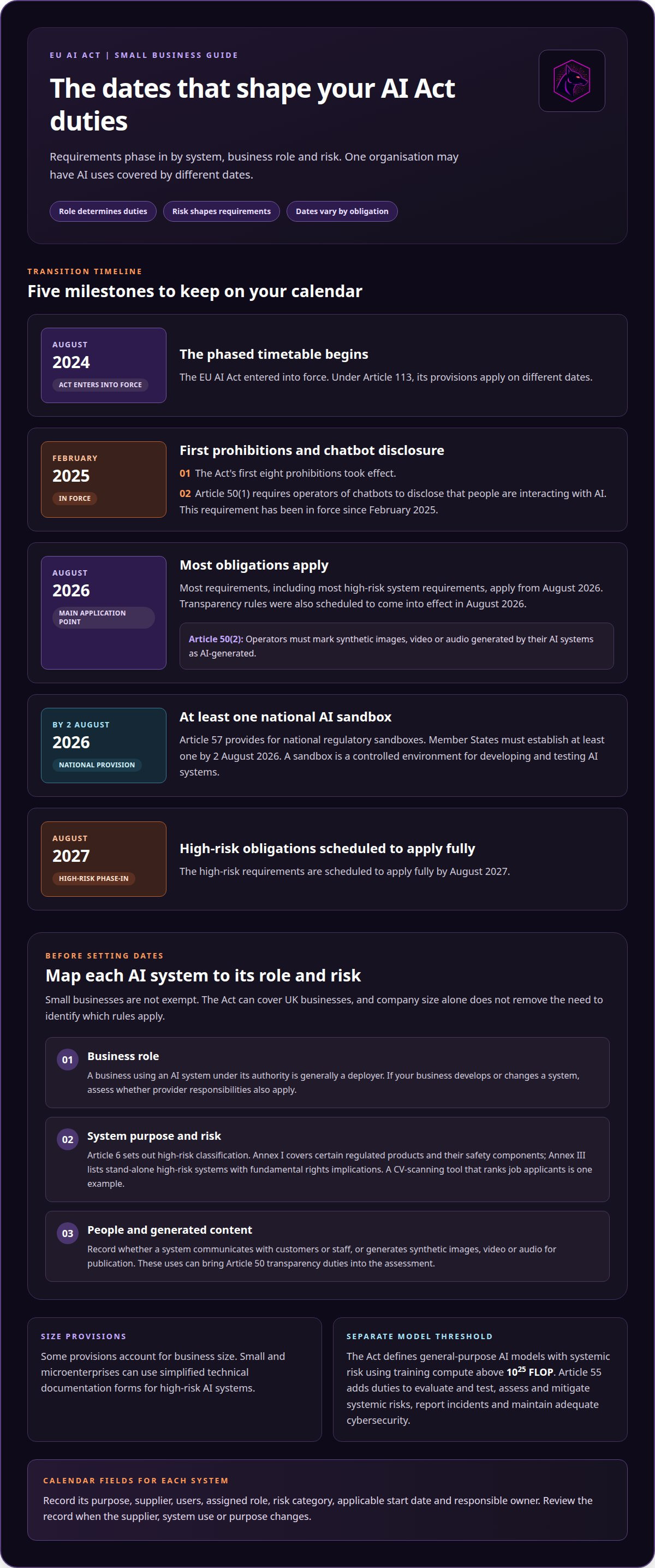
Article 50 sets transparency obligations for certain AI systems, including systems that are not high-risk. Under Article 50(1), operators of chatbots must disclose that people are interacting with AI; this requirement has been in force since February 2025. Under Article 50(2), operators must mark synthetic images, video or audio generated by their AI systems as AI-generated. A business publishing AI-generated audio, for example, should consider how the mark will remain clear when the content is shared.
For each system in the inventory, note whether it:
- Communicates directly with customers or staff, such as a chatbot.
- Generates synthetic images, video or audio for publication.
- Is supplied by the business or used under its authority.
- May fall into a high-risk category listed in Annex I or Annex III.
Risk classification needs a separate assessment. Article 6 sets out how to classify high-risk AI systems. Annex I covers systems that are safety components of certain regulated products, or are themselves such products. Annex III lists stand-alone high-risk systems with fundamental rights implications. A CV-scanning tool that ranks job applicants is one example of a high-risk use case. The system's purpose and context matter more than its label or supplier description.
High-risk provider duties include requirements for datasets used to train, validate and test systems under Article 10. Small and microenterprises can use simplified technical documentation forms for high-risk AI systems. Businesses using high-risk systems have separate duties, including human oversight, monitoring and following the system's instructions. Record the system's classification, assigned role and relevant duties together, so an assessment does not confuse provider responsibilities with deployer responsibilities.
General-purpose AI models have a separate threshold for systemic risk. The Act defines these models in Article 3(63); providers of general-purpose AI models have transparency obligations under Article 53. For models with systemic risk, Article 55 adds duties to evaluate and test the model, assess and mitigate systemic risks, report incidents and maintain adequate cybersecurity. The Act defines systemic-risk models using training compute above 10^25 FLOP. Most obligations, including most high-risk system requirements, apply from August 2026, so businesses should use their inventory to identify relevant systems before that date.
Implementation dates and compliance preparation
The EU AI Act applies in phases, so small businesses should map each duty to its start date. Key deadlines depend on the system and the business’s role.
Compliance deadlines and implementation dates
The Act entered into force in August 2024, with provisions applying on different dates under Article 113. Its first eight prohibitions took effect in February 2025. Transparency rules were scheduled to come into effect in August 2026, and most obligations, including most high-risk system requirements, apply from August 2026. High-risk obligations are scheduled to apply fully by August 2027. These dates matter because a single organisation may use systems covered by different requirements.
Build a governance calendar around each system’s role and risk assessment. Record the relevant date for each system, then assign an owner to track changes in its use, supplier or purpose. This ties preparation to the applicable obligation rather than one company-wide deadline.
SME and startup compliance checks
A compliance check matches each AI use to the business's role, risk and applicable date. SMEs and startups remain within the Act's scope, although some provisions account for their size. Article 4 addresses AI literacy, so identify which staff use AI and what knowledge their tasks require. Check whether a system's purpose has changed since purchase; a new use can affect its risk assessment.
Keep a record of each system, its intended use, responsible staff and applicable requirements. Review it when the supplier changes the system or your business adopts a new use. A clear record helps explain your organisation’s decisions to authorities.
Implementation and compliance resources
Article 96 requires the European Commission to develop practical implementation guidelines with particular attention to SME needs. Those guidelines can help translate obligations into internal processes. Article 57 also provides for national AI regulatory sandboxes, where businesses can develop and test AI systems in a controlled environment. Member States must establish at least one by 2 August 2026.
Use resources according to the task: guidelines for understanding requirements, and a sandbox for supervised testing. General-purpose AI models have separate provider duties under Articles 53 and 55, so model developers should account for those provisions in their implementation plans.
Proportionate compliance costs
The Act recognises that compliance effort and assessment fees should reflect business size. Under Article 62(2), competent authorities must consider SME needs and reduce conformity assessment fees in proportion to company size and market size. This affects fees for conformity assessment, not every internal cost of preparing for compliance.
Plan work by system and duty. A business using a low-risk tool may need a different assessment from a provider of high-risk AI. Separating tasks helps direct staff time towards the requirements that apply.
Penalties also account for SME circumstances. Under Article 99(6), an SME or startup pays the lower of the fixed fine or the turnover-based figure when calculating applicable fines. Authorities must consider SME interests and economic viability when setting penalties. Article 99 requires Member States to establish penalty rules. The Act also sets different maximums by infringement type, so accurate records of each system and decision matter when responding to an authority.
Risk-based obligations for AI developers and deployers
The EU AI Act uses risk to determine which requirements apply to an AI system. Your business’s role matters too: developers and suppliers may have provider duties, while businesses using systems under their authority may be deployers.
Risk-based classification tiers
The Act groups AI systems into four risk categories: prohibited, high, limited and minimal or no risk. Classification matters because the system's purpose and use determine the rules, not simply its technical label. Article 6 sets out how to identify high-risk systems, while Annex I and Annex III list relevant product types and use cases.
For example, a CV-scanning tool that ranks job applicants can be high-risk under Annex III. Systems classified as minimal or no risk generally face fewer specific regulatory duties. Document how each system’s intended purpose relates to its category before deciding which duties apply.
Risk categories and prohibited practices
Article 5 bans specified AI practices, including social scoring and certain forms of manipulation. The Act prohibits nine practices. A business should assess the system's actual use against those prohibitions before considering duties for lower-risk systems. If a system's function or context changes, reassess the use rather than relying on its original classification.
High-risk systems have specific requirements because their uses can affect safety or fundamental rights. Annex I covers AI that is a safety component of certain regulated products, or is itself such a product. Annex III lists stand-alone high-risk uses with fundamental rights implications. For a small business, this distinction determines whether high-risk system requirements need attention.
Limited-risk AI transparency requirements
Limited risk describes systems outside the high-risk classification, but the label does not settle every obligation. Assess separately whether a system falls under a specific transparency rule. This helps prevent teams from treating the risk category alone as a complete account of the system’s duties.
For a system used in customer communications or published outputs, record how people encounter it and what it produces. This context helps you assess whether a specific transparency requirement is relevant. Keep your reasoning with the system assessment so staff can revisit it if its purpose or use changes.
Role determines who carries each duty. Article 3 defines provider and deployer: a provider develops an AI system or has one developed and places it on the market or puts it into service under its name. A deployer uses an AI system under its authority for professional activity. Importers and distributors also fall within the Act's scope under Article 2, with obligations tied to their position in the supply chain.
Providers of high-risk systems face requirements concerning risk management, technical documentation and datasets. Article 10 sets requirements for data used to train, validate and test high-risk AI. Small and microenterprises dealing with high-risk systems can use simplified technical documentation forms. This changes the documentation format, not the system's risk category.
Deployers have operational duties for high-risk AI. They must use the system in line with its instructions, provide human oversight and monitor its operation. A business using an AI tool to support recruitment decisions should identify who oversees its use and how monitoring is carried out. These duties differ from a provider’s responsibilities for developing and documenting the system.
SME support, regulatory sandboxes and testing
The EU AI Act provides support for small and medium-sized enterprises, including regulatory sandboxes and certain tailored provisions. A sandbox can let an SME test an AI system in a controlled setting with competent authority involvement.
Under Article 57, each EU Member State must establish at least one national AI regulatory sandbox by 2 August 2026. The Act also requires Member States to give SMEs priority access. Article 57(9)(e) says sandboxes must support and accelerate Union market access, particularly for AI systems provided by SMEs or startups. Priority access does not remove the need to explain what the system does and what testing the business plans to conduct.
A sandbox is a supervised environment for developing, testing or validating AI systems under a defined plan. For example, a small developer could test how an AI model performs in a proposed use before wider deployment. Set out the system’s purpose, the planned test and the risks being examined. Authorities can then provide guidance through the sandbox process.
Sandbox participation has specific limits. Participants acting in good faith and following the agreed sandbox plan and competent authority guidance will not face administrative fines for infringements of the Act during their participation. This protection depends on meeting those conditions. It does not remove liability for damage to third parties caused by experimentation with an AI system. A testing plan should identify safeguards and clarify who oversees each test.
For an SME, a sandbox can help uncover practical issues before a system reaches its intended market or use. Testing may examine how the model behaves in the planned setting, whether the test data suits that purpose and what adjustments are needed. Record the test plan, authority guidance and resulting changes. These records help show how the system developed during the controlled process.
Sandbox access is one form of support, not a general waiver from the AI Act. The business still needs to identify its role and applicable duties outside the experiment. A provider developing a system remains responsible for its provider obligations; a business deploying a system still needs to use it appropriately. SMEs should treat sandbox participation as a bounded route for testing, with the plan and guidance setting its limits.
For a small business considering support options, ask whether supervised testing can answer a specific technical or operational question. A sandbox may suit a system that needs real-world evaluation under supervision. It may be less relevant if your business simply uses an established AI tool without developing or testing it. Either way, record the system’s purpose and testing decisions, and distinguish sandbox activity from routine use.
AI Act application and transition dates
The EU AI Act has separate transition dates for particular kinds of AI use. The practical task is to match each system to the timeline that applies to its function and product context.
Article 113 sets out different application timelines. One date to track is 2 December 2027, listed for high-risk AI use cases in certain sensitive areas. The schedule identifies this date as proposed. Keep it distinct from dates for other system types, and avoid treating one milestone as the deadline for every AI deployment.
A separate transition applies to high-risk AI systems embedded in regulated products. Those rules are scheduled to apply from 2 August 2028. This product-linked timeline matters to businesses placing or using AI that forms part of a regulated product. It calls for a different review from a stand-alone AI tool, because the system's connection to the product affects which transition date is relevant.
For an internal timeline, group systems by what they do and how they are supplied:
- Record whether the AI system is stand-alone or embedded in a regulated product.
- Identify whether its use falls within a sensitive high-risk area.
- Link each system to the relevant transition milestone in Article 113.
- Keep the reasoning with the system record so later changes can be assessed.
This approach helps prevent applying a transition date for one system type to another. For example, track an AI function embedded in a regulated product separately from a stand-alone system used for an internal business task. Describe what the AI actually does, not only the product name or supplier category.
Review the timeline when a system is adapted or introduced in a different context. A new product connection or use case may change which transition provision needs attention. Label proposed dates clearly in internal planning and distinguish them from dates already set out as applicable in the Act. This makes planning more precise without treating a proposal as an operative requirement.
The transition calendar should be specific to each system. Record its function, relationship to a product and relevant milestone, then update the record when those details change. This gives teams a clearer view of future requirements to plan for and avoids applying one date to every AI system.
EmberHound
EmberHound helps businesses locate sensitive information that may be relevant to their wider AI governance work. If an AI review raises questions about personal data across your systems, GDPR Data Discovery and PII Data Discovery can help identify where that information is held. PCI Card Data Discovery focuses on payment card data, while Combined GDPR + PCI Coverage addresses both areas. These tools support data visibility; they do not determine your AI Act role or risk category.
If a data subject access request involves information held across systems, the DSAR Disclosure Pack can support disclosure preparation. Consider data discovery when your AI assessment highlights a need to locate personal or card data. Start a free GDPR scan with EmberHound to see where personal data is held.
Make your next compliance decision concrete
Turn your AI review into a working record. For each system, note its purpose, your organisation’s role and the evidence behind its risk assessment. Assign an owner to revisit the record when the system or its use changes. This gives your team a practical basis for deciding what needs attention next.
Understanding small-business obligations under the EU AI Act also means knowing where relevant data is held. If your review raises questions about personal or payment card data, data discovery can help build that picture. It supports your assessment but does not determine an AI system’s legal classification.
Start a free GDPR scan with EmberHound to locate personal data and support your wider governance work.
Start with one system and a clear record. From there, your next decision becomes easier to manage.
Frequently Asked Questions
Does the EU AI Act apply to my small business?
The Act may apply to a UK small business if its AI activity has a connection to the EU market. For example, consider a UK firm whose AI service is made available to EU customers. Assess where the service is directed and how it is used, rather than relying only on the company’s registered location. A small headcount does not, by itself, determine whether the Act applies.
How can organisations apply it?
Build the assessment into everyday decisions about buying and using AI. Before adopting a tool, record its intended purpose, supplier, users and the business process it affects. Ask the internal owner to document why the tool is being introduced and who will review its operation. Revisit the record if the tool is adapted or used for a different task.
How do penalties work?
Penalties vary by infringement, and the maximum is not an automatic fine. Member States set enforcement rules under Article 99. For a practical example, a business responding to an authority should make sure its submitted information is accurate and supported by records. Keep correspondence and the evidence behind each response together, so the organisation can explain how it reached its position.
How has the Commission simplified the implementation of the AI Act?
The Commission is required by Article 96 to develop practical implementation guidelines that pay particular attention to SMEs. A small business can use such guidance to translate legal requirements into internal procedures, such as assigning responsibility for AI records or setting a review process. Keep guidance-based procedures distinct from binding duties, and track formal changes to the Act separately.
What is the EU AI Act?
The EU AI Act is the European Union’s regulation on artificial intelligence. It covers AI systems and, in some provisions, general-purpose AI models. Buying an AI-enabled product does not, by itself, describe every relevant activity: your organisation may also supply, distribute, import or use the technology. Those activities shape which parts of the regulation matter.
What does an EU AI Act compliance assessment for an SME involve?
An assessment should capture the business context for each AI use, not just the product name. Record the business process affected, the people who rely on the output and the supplier information used to understand the system. For example, note whether staff treat an AI result as advice or use it to make a decision. This context helps explain the assessment later.
How does the EU AI Act define an SME, and which obligations or exemptions depend on company size?
The Act uses the EU SME definition, which classifies businesses as micro, small or medium-sized using employee numbers and financial criteria. The relevant category can affect certain tailored provisions, including simplified documentation or quality-management arrangements. It does not create a general exemption from AI Act duties. When assessing your status, consider the applicable employee and financial tests, not turnover alone.
What must small businesses do when using high-risk AI systems, including human oversight, records and monitoring?
Set up a clear procedure for the people responsible for a high-risk system. Identify who reviews its output, what they should do if it appears unreliable and where monitoring records are kept. For instance, staff using a system to support decisions should understand the supplier’s instructions and how to escalate a concern. These practical controls make oversight part of daily use.


