

AI CCTV does not sit under one UK law. UK businesses using AI CCTV must comply with the Surveillance Camera Code of Practice, and the regulation of AI CCTV analytics can also involve data protection duties under the UK GDPR and Data Protection Act 2018.
The compliance question depends on what the system does with its footage. Detecting behaviour or flagging activity is different from using biometric data to identify someone. That distinction affects the lawful basis you need and whether a data protection impact assessment must be completed before processing starts.
This guide explains what AI CCTV analytics can detect, when face recognition triggers special-category data duties, and which safeguards may be needed. It also covers DPIAs and wider UK rules. A system's purpose, data and level of risk shape the work ahead.
Key Takeaways
- Define what your AI CCTV system detects and why. Its purpose affects which rules and safeguards apply.
- Check whether face recognition identifies people using biometric data. That can trigger special-category data duties.
- Assess the risk before processing starts. A DPIA is required when processing is likely to result in high risk.
- Review the full data trail, including alerts and movement histories, when setting retention and access controls.
- Consider less intrusive ways to meet the same security goal, and limit camera coverage to what is needed.
Behavioural and suspicious activity detection
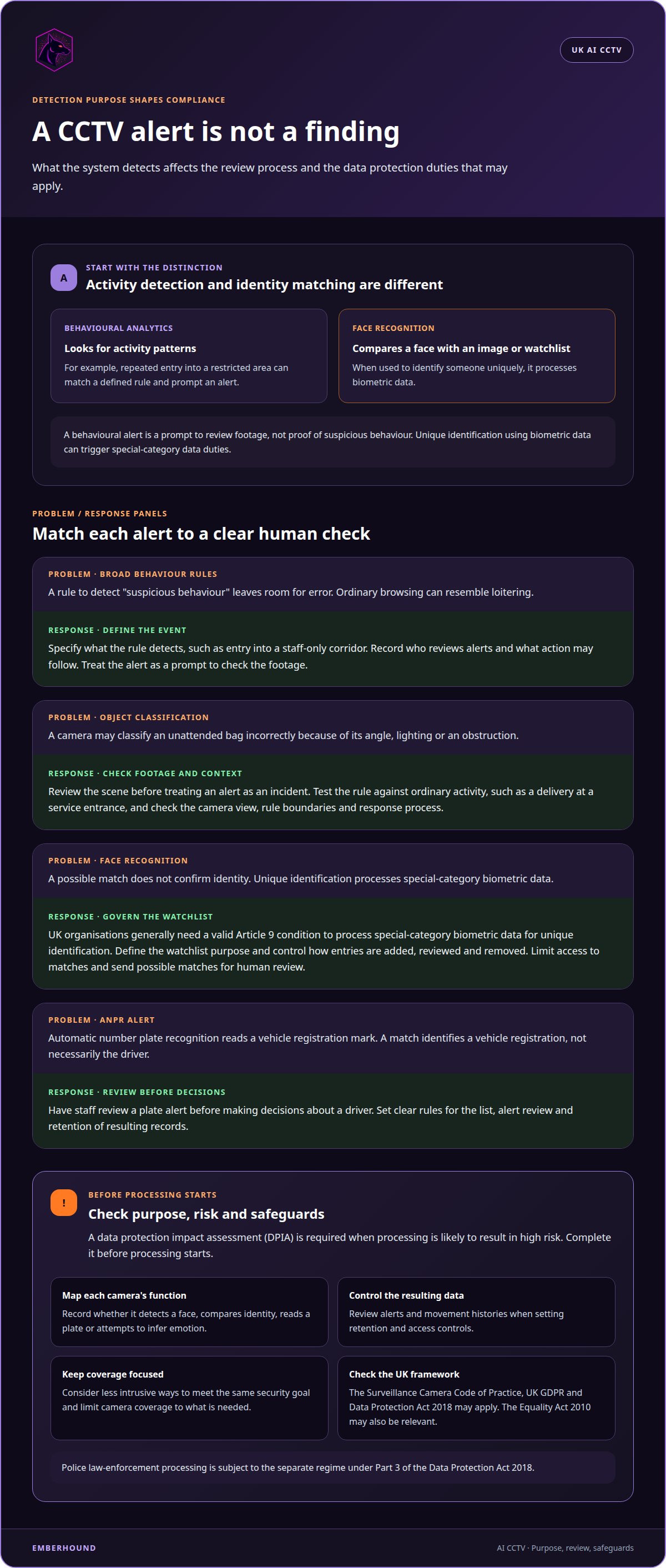
Behavioural analytics look for patterns in CCTV footage, such as repeated entry into a restricted area or someone waiting beside a closed shop entrance. The system compares movement with defined rules and generates an alert when activity matches a selected pattern. An alert is a prompt to review footage, not proof of suspicious behaviour. This matters in retail, where ordinary browsing can resemble loitering. Assessing AI CCTV analytics regulation starts with defining what each system detects.
Define the detection purpose before setting rules. An alert for someone entering a staff-only corridor identifies a specific place and event. A broad instruction to detect suspicious behaviour leaves more room for error and inconsistent decisions. Record what each rule detects, who reviews alerts and what action may follow. This helps staff respond consistently and keeps surveillance focused on its stated purpose. The scope of AI CCTV analytics regulation depends on how footage is processed and how the output is used.
Object detection and classification differ from behavioural analysis. A system may detect an object in a frame, then classify it as a bag, vehicle or parcel. For example, a retail camera might flag an unattended bag near an exit. The classification may be wrong because of the camera angle, lighting or an obstruction. Staff should review the footage and context before treating an alert as an incident.
Real-time video analytics can detect an event as it happens and send an alert for review. A rule might flag movement through a doorway after it has been marked as closed. The alert’s usefulness depends on the camera view, the rule’s boundaries and the response process. Test each rule against ordinary activity, such as a delivery at a service entrance, before relying on its output.
At a construction site, object detection may classify a hard hat or high-visibility vest as present or absent. This can direct attention to a possible safety issue, but camera coverage and image quality affect the result. A worker carrying a helmet may be classified differently from one wearing it. Define the event precisely, limit review to relevant areas and do not treat an automated classification as a final finding about an individual.
The legal framework still matters when analytics focus on conduct rather than identity. The Equality Act 2010 may be relevant to AI video-surveillance deployments. According to The National Archives, the Data (Use and Access) Act 2025 amended aspects of the UK data-protection framework and did not replace the UK GDPR or the Data Protection Act 2018. According to The National Archives, the Protection of Freedoms Act 2012 is relevant to the Surveillance Camera Code’s statutory duty for defined relevant authorities in the UK. Purpose and deployment context shape the assessment.
Face recognition and biometric watchlisting
Facial recognition compares a face captured by cameras with a reference image or watchlist. A match can trigger an alert for a human reviewer. The system’s purpose matters: checking whether a named person appears is different from detecting that people are present. Live facial recognition performs this comparison as people move through a camera’s field of view. In the UK, police law-enforcement processing is subject to the separate regime under Part 3 of the Data Protection Act 2018, according to The National Archives.
Facial recognition used to identify a person uniquely processes biometric data. UK organisations generally need a valid Article 9 condition to process special-category biometric data for unique identification. A watchlist therefore needs a defined purpose and a controlled process for adding, reviewing and removing entries. For example, a venue using a watchlist must consider whose images it contains, who can access matches and how staff respond to a possible match. An automated result is a lead for review, not confirmation of identity.
Workplace emotion recognition raises a separate issue. The European Commission’s explanation of the EU AI Act says that workplace emotion recognition is prohibited, subject to an exception for medical or safety reasons. This is an EU rule, not a single UK-wide AI law. Carefully assess any system that claims to infer anger or stress from facial expressions, including its intended use and where it operates. Facial identity matching and emotion inference are different functions and should not be confused.
Automatic number plate recognition (ANPR) reads vehicle registration marks from camera footage. It can compare a plate with a list and generate an alert when it matches. This identifies a vehicle registration, not necessarily the driver. For instance, a plate alert at a site entrance needs human review before staff make decisions about the driver. Set clear rules for the list, alert review and retention of resulting records.
Consequences for unlawful AI CCTV use depend on the processing and the applicable legal regime. Organisations may face regulatory enforcement or claims related to the processing; no single penalty applies to every case. Document the purpose, data used and decision process, especially where biometric identification or watchlists are involved.
Before deploying recognition, map each camera’s function separately. Record whether it detects a face, compares identity, reads a plate or attempts to infer emotion. Then limit access to the resulting alerts and ensure staff know when to pause and review a match. If you are also mapping where personal information sits across business systems, review your data discovery options.
Potential future compliance-monitoring capabilities
AI CCTV can monitor workplace conditions as well as site security. For example, a warehouse system might flag a blocked fire exit or an unexpected production-line stoppage. A camera could also detect whether workers appear to be wearing required protective equipment. These alerts can help teams focus on particular footage, but they still need a defined purpose, human review and a clear response process.
Employee monitoring needs clear boundaries. A system introduced to flag missing safety equipment has a different purpose from one used to assess individual productivity. Using a safety dashboard to assess productivity introduces a new purpose, which needs assessment for lawfulness, proportionality, access and employee information. Explain what the system monitors, who sees alerts and how decisions are made. A pattern in footage is not proof of an employee’s conduct.
Workplace safety monitoring should focus on a specific risk. A camera at a loading bay could flag entry into a vehicle movement zone, with coverage limited to the area needed to assess that risk. Review who can access footage and alerts, and whether less intrusive measures could achieve the same safety aim. A new use, such as measuring individual output, needs its own assessment.
AI Act rules create a clear contrast between the UK and EU. The UK has not adopted one single legislative framework regulating every use of artificial intelligence. The EU has introduced the EU AI Act. AI intended to monitor and evaluate workers’ performance and behaviour is listed as high-risk in Annex III, point 4 lit. b. The stated application date for those Annex III rules is 2 December 2027.
Continuous camera monitoring can also strain operators. Curtin University’s security operations centre operates 24/7 and had limited resources to monitor its expanding CCTV network. Alerts could help staff focus on selected events, but they do not remove the need to assess footage and manage false alerts. Set escalation rules so staff know which events need immediate attention and which require routine review.
Potential uses vary by industry: a factory might flag entry into a restricted production area, while a distribution centre might detect a blocked route. Each use needs its own purpose and access boundaries. Record what the system detects, who reviews the output and what action may follow. Make sure information given to employees reflects the actual monitoring. If the system’s role changes, assess the new purpose before relying on its alerts.
Biometric identification and GDPR requirements
Assess AI CCTV processing by its purpose and the type of data involved. Identifying people through biometric footage brings specific UK GDPR considerations.
Data Protection Act Requirements
The Data Protection Act 2018 works alongside the UK GDPR for relevant personal-data processing. It matters because camera footage can identify people, and analytics can derive information about their behaviour. Organisations need to understand what the platform processes, why it processes it, and who can access the results. According to The National Archives, law-enforcement processing in the UK is subject to a separate data-protection regime under Part 3 of the Data Protection Act 2018.
For a shop using cameras to detect repeat theft, distinguish ordinary footage review from biometric identification. Define the purpose before processing starts, then keep the system’s actual use within it. Restrict access to footage, alerts and derived information. Changing from detecting an incident to identifying named individuals needs a fresh assessment of the processing and its safeguards.
ICO Video Surveillance Guidance
The ICO’s video-surveillance guidance helps organisations assess surveillance against data protection principles. A camera’s purpose, coverage and use of facial recognition affect how personal data is processed. For example, a camera at a building entrance may capture visitors who are not under investigation. Consider whether that coverage is necessary for the stated purpose and how people will be informed.
Facial recognition adds a further question: does the system process biometric data to identify someone uniquely? UK organisations generally need a valid Article 9 condition for that processing. A proposed system should explain how a match is generated, who reviews it and what response follows. A match should not, by itself, become a final decision about an individual.
Lawful Bases for AI CCTV Analytics
A lawful basis is the UK GDPR ground an organisation identifies for processing personal data. Public and private organisations must link that basis to the actual purpose, rather than assume that installing cameras makes every later use lawful. A public-space security function and a private workplace system may have different purposes and decision-makers.
For private security monitoring, an organisation may assess legitimate interests; public bodies may assess public task where processing supports their functions. The chosen basis must fit the specific use. Biometric identification also requires a valid Article 9 condition, which is separate from the general lawful basis. For instance, a retailer considering a face-matching watchlist must assess both requirements before processing begins.
In practical terms, document the purpose, data involved, access controls and response to alerts. Keep footage and derived records within the stated use. If the system’s role changes, reassess the lawful basis and any biometric condition before applying it to individuals.
DPIAs and operational safeguards
A DPIA must be completed before processing likely to result in high risk begins. It helps assess how AI CCTV analytics regulation applies to the system’s purpose, data and likely effects on people. Signage, transparency and retention controls should reflect what the system actually does.
CCTV Signage Requirements
Signage tells people that CCTV is operating and directs them to further information. Place it where it can be seen before someone enters camera coverage, such as at a building entrance or car park gate. State the purpose in plain language, including whether AI video analysis is used. This gives people notice before footage is captured and distinguishes security monitoring from other uses.
Transparency About AI CCTV
Transparency means explaining how footage and analytics are used, who can access them and what action may follow. For example, a warehouse notice could say that cameras flag entry into a restricted vehicle area for safety review. Keep the explanation consistent with the software’s actual operation. If monitoring shifts from site safety to employee performance assessment, review the purpose and update the information given to people.
Footage Retention Rules
Retention controls determine how long footage and information derived from it remain available. Choose a period that fits the stated purpose, then apply deletion to the full data trail. Removing video alone may not be enough if identifiable movement histories, alerts or other derived information remain. A vehicle alert linked to an individual may still identify them after the original clip is deleted.
Document the assessment before deployment. Under the GDPR, a DPIA must be carried out before processing likely to result in high risk begins. Describe the purpose, people affected, data collected and operational response to alerts. Assess who can view footage, whether access is recorded and how errors can be challenged. This keeps the assessment grounded in the actual processing and system purpose.
Safeguards should address risks in the camera’s specific setting. France’s CNIL guidance on AI cameras at self-service checkouts recommends considering less intrusive alternatives, restricting camera coverage and adding safeguards against disproportionate consequences. A UK retailer could assess whether staff checks or narrower camera views meet the same purpose. This makes safeguards specific to the intended use.
Review controls whenever the system or its purpose changes. A new alert category, wider camera coverage or additional analysis can change the risks. Restrict access to staff with a defined role, and specify what action alerts can trigger. If footage is retained for an incident, record the reason and remove associated alerts or derived records when that reason ends. Review the controls to check that they reflect the system’s current operation.
EmberHound
EmberHound helps organisations find personal data across their business devices. If AI CCTV footage or related records form part of your data protection work, GDPR Data Discovery can help locate personal data for review. The DSAR Disclosure Pack supports the preparation of information for subject access requests.
These tools help you understand where relevant data is held and support your organisation’s handling of it. They do not assess whether a CCTV deployment has a lawful purpose or replace a DPIA. Those decisions depend on how your system is used and what processing it involves.
Contact EmberHound to discuss how data discovery could support your organisation’s work with personal information.
Make your next review count
As AI CCTV systems change, keep their documentation accurate about how they are actually used. A new alert, data source or use of footage can change what your organisation needs to assess. Treat each change as a prompt to review the system’s data and decision process. This gives your team a clear record of why the technology is used and what information it handles.
The UK’s AI CCTV analytics regulation sits alongside wider data protection work. EmberHound’s GDPR Data Discovery can help identify personal data. For organisations that also handle cardholder data, PCI Card Data Discovery and Combined GDPR + PCI Coverage support those discovery needs. These tools support data discovery; they do not determine whether a CCTV deployment is lawful.
Choose a practical next step for your data discovery work.
Clear records make the next review easier to manage.
Frequently Asked Questions
What Is AI CCTV?
AI CCTV uses software to analyse camera images and video for defined events or features. A system might classify an object as a vehicle, detect a door opening or compare a face with reference images. These functions produce different outputs: a vehicle classification describes an object, while face comparison may help identify a person. Start by naming the output the system generates, then assess how staff use it.
Does the Surveillance Camera Code Apply to Every Organisation?
The Code’s statutory duty applies to defined relevant authorities, not every organisation. Businesses using AI CCTV should still consider the Code when assessing how their cameras operate. For example, a private car park operator can use its principles to review camera placement, access to footage and each camera’s purpose. Whether the statutory duty applies depends on the operator’s legal status.
When Does CCTV Footage Become Personal Data?
Footage is personal data if someone can be identified from it, directly or with other information available to the organisation. A blurred face may still be identifiable from a uniform, vehicle registration or linked attendance record. An alert linked to a staff account can also identify someone, even if the clip only shows a person entering a room. Consider the video and associated records together.
Who Is Responsible for Compliance?
The organisation that decides why and how its CCTV analytics are used is generally responsible for those decisions. For example, a warehouse choosing to analyse vehicle movements should set the purpose and decide who can act on alerts. A software supplier may support the system, but the organisation’s own monitoring decisions remain central. Assign an internal owner for camera purposes, access permissions and changes to system use.
What UK laws regulate AI CCTV analytics and facial recognition?
The relevant framework can include the UK GDPR, the Data Protection Act 2018, the Data (Use and Access) Act 2025, the Equality Act 2010 and the Protection of Freedoms Act 2012. Which provisions matter depends on the system’s purpose and operator. For law-enforcement processing, Part 3 of the Data Protection Act 2018 provides a separate data-protection regime. The EU AI Act is an EU framework, not a single UK AI law.
How does UK GDPR apply to AI CCTV analytics?
UK GDPR applies when analytics process personal data, including footage or alerts linked to identifiable people. The organisation should identify a lawful basis for each use and explain it accurately to people. For example, analytics introduced to monitor staff activity need assessment against that purpose, even if the cameras were first installed for site security. A change in use calls for a fresh review.
When is a data protection impact assessment required for AI CCTV?
A DPIA is required before processing begins if it is likely to result in high risk. Assess the planned system as a whole, including who may be affected and how outputs could influence decisions. For example, a camera network creating alerts across a public entrance may need a different assessment from a single camera covering a controlled loading bay. Record the risks identified and the safeguards considered.
What equality and bias risks must UK organisations assess when using AI CCTV?
Assess whether the system or staff response could lead to unfair treatment of particular people. For example, test whether lighting, camera position or image quality affects how consistently a recognition system works in its intended setting. Review who is more likely to receive an alert and how it is checked before action is taken. A clear way to challenge an incorrect alert can help reveal problems in both the software and operating procedures.


