

The EU AI Act can apply to US companies that supply AI systems to organisations in the EU or make them available in the EU market. A US address alone doesn’t determine the answer. Your role in the AI supply chain matters too.
It’s easy to assume the rules only concern companies based in the EU. In practice, the key questions are how your AI system reaches or is used in the EU, and whether your business acts as its provider, deployer, importer or distributor. This article explains how those connections affect the rules that may apply.
You’ll learn how the Act’s risk categories shape obligations, how provider and deployer roles differ, and which application dates matter. This gives you a practical starting point for assessing your EU exposure and deciding what needs attention.
Key Takeaways
- A US company may fall within the Act’s scope through its AI tools’ connection to EU organisations or users. Assess where the system is supplied and used.
- Your role matters: provider, deployer, importer or distributor responsibilities can differ. Identify your position for each AI system.
- The system’s purpose and risk category shape which obligations may apply. Check how it is used, especially in sensitive areas.
- Application dates are phased. Match the relevant deadline to the type of AI system and the rules that apply to it.
- The need for an EU authorised representative depends on the company’s circumstances under the Act. The article explains what to consider before deciding.
EU AI Act territorial scope for US companies
A US company’s location does not, by itself, determine whether the EU AI Act is relevant. Start by assessing its activities connected to the EU, the AI system involved and the purpose for which that system is used.
Territorial reach for US businesses
The Act may apply to a US business that supplies an AI system to an EU-based organisation or makes it available in the EU market. For example, a US software supplier serving a French customer should assess how its product is supplied and used. Cross-border delivery can create a connection to EU requirements even if the company’s staff and systems remain in the United States.
US federal and state rules are separate from the EU framework. A US company serving customers on both sides of the Atlantic may need to assess each market’s rules independently. Its US compliance work does not, by itself, determine whether the EU Act applies.
Exceptions and exclusions
The Act distinguishes prohibited AI practices and high-risk systems from other applications. Applications that are neither prohibited nor classified as high-risk are largely outside those specific controls. Assess the system’s intended purpose and actual use, rather than relying on a broad product label.
For example, software that ranks job applicants raises different questions from a general text-generation feature. This comparison can help a US supplier identify where a closer risk assessment is needed. Falling outside one category does not determine whether other rules, including data protection requirements, apply.
AI system and EU market connection
Article 2 sets out the EU AI Act’s scope. To assess an EU connection, map where the system is supplied and where organisations use it. A tool supplied to an EU customer for a work-related decision presents a different situation from software used only within a US operation.
For a company serving EU customers, assess the AI Act and data protection rules separately. If the service processes personal data, the GDPR may also be relevant to that processing. For example, a US platform analysing EU customer records should document the data involved and the system’s purpose, then assess each framework against those facts.
AI Act provider and deployer roles
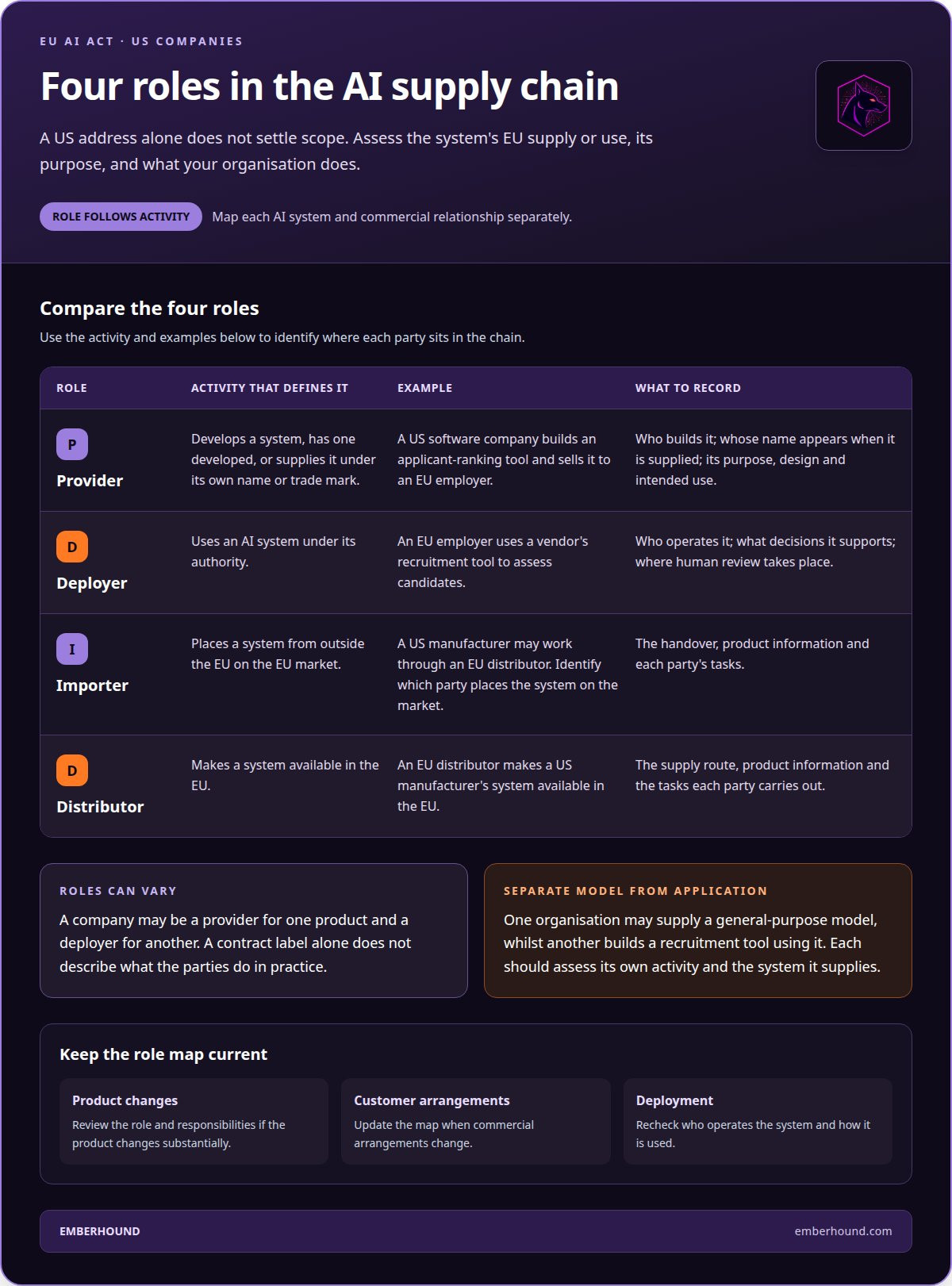
The EU AI Act can apply to US companies acting as providers, deployers, importers or distributors. A company’s role depends on what it does with a system, and it may hold different roles across products and commercial relationships. Map the activities for each AI system before deciding which obligations need attention.
A provider develops an AI system, has one developed, or supplies it under its own name or trade mark. For example, a US software company that builds an applicant-ranking tool and sells it to an EU employer may act as its provider. Assess the system’s purpose, design and intended use. If the product changes substantially, review the role and associated responsibilities again.
A deployer uses an AI system under its authority. An EU employer using a vendor’s recruitment tool to assess candidates may act as deployer, while the vendor may act as provider. The employer should record who uses the tool, what decisions it supports and where human review takes place. A contract label alone does not describe the operational relationship.
Importers and distributors have distinct positions in the supply chain. An importer places a system from outside the EU on the EU market; a distributor makes a system available there. A US manufacturer working through an EU distributor should document the handover, product information and each party’s tasks. Written arrangements should reflect what the parties do in practice.
General-purpose AI models need their own role assessment. A US company supplying a model should distinguish that activity from supplying a specific application built on it. For example, one organisation may provide a general-purpose model, while another builds a recruitment tool using it. Each organisation should assess its own activity and the system it supplies.
For each product, map the commercial chain and keep the record current:
- Development: record who builds the system and whose name appears when it is supplied.
- Use: identify the organisation operating the system and the task it performs.
- Supply route: record any importer or distributor and their part in making it available.
- Model and application: distinguish a general-purpose model from products built on it.
Review the map when the product, customer arrangement or deployment changes. A US business may supply one product as provider and use another as deployer. Tying roles to actual activities gives teams a clearer basis for assigning internal ownership and reviewing relevant obligations.
How does the EU AI Act define an AI system and an EU user or market connection?
The Act defines which activities and organisations fall within its scope. A US business should assess two separate questions: whether its product is an AI system, and whether its supply or use connects with the EU market. This distinction helps teams examine the technology and its route to customers without relying on a product name or company address alone.
Start with what the software does. An AI feature might analyse information and produce a score, recommendation or generated output. A fixed rule that returns a set result differs from software that uses a model to infer patterns. Describe the system’s inputs, operation and outputs in plain terms. A supplier’s marketing label alone does not determine how the product should be assessed.
Purpose adds context. The same technology can support different tasks, depending on how an organisation configures and uses it. For example, a tool that summarises customer messages serves a different function from one that ranks people for job applications. Record the system’s intended purpose and the customer’s actual use. This helps identify which features and decisions need closer review.
The EU connection also depends on the actual service arrangement. A US-hosted application used by an organisation in the EU can connect the supplier to that market, even if its developers and servers remain in the United States. A service sold directly, supplied through an EU distributor or included in a wider software package may each reach the market differently. Record the route and the organisations involved.
Use a scope record for each product:
- Function: describe what the software analyses and what it produces, such as a score or recommendation.
- Purpose: state the task the supplier designed it for and how the customer uses it.
- Users: identify the organisations operating the system and the people affected by its output.
- EU connection: record EU customers, deployments and distribution arrangements.
- Evidence: retain product descriptions and customer arrangements that support the assessment.
If a US company supplies a model that powers a separate application, record each component and the organisation responsible for it. The model and finished application may have different purposes and supply arrangements. Keep those details with the relevant product documentation. This gives the team a practical basis for reviewing the system, its EU market connection and any duties that may follow.
What are the EU AI Act compliance deadlines and phased application dates?
The EU AI Act entered into force on 1 August 2024, but its requirements apply in phases. US companies should match each system to its role and risk category, then track the relevant date. A single organisation may face different dates across its AI models and applications.
The first dates distinguish prohibited practices from duties for general-purpose AI providers. The Act’s prohibition on certain AI systems takes effect six months after entry into force. Governance obligations for general-purpose AI models apply 12 months after entry into force. The later transparency and high-risk system dates require separate planning.
- 1 August 2024: The EU AI Act entered into force.
- 2 August 2025: Governance rules and obligations for general-purpose AI models became applicable.
- August 2026: Transparency rules apply. The EU AI Office and Member State authorities are responsible for implementing, supervising and enforcing the Act from 2 August 2026.
- December 2026: The prohibition on real-time remote biometric identification for law enforcement in publicly accessible spaces takes effect.
- 2 December 2027: Rules for high-risk AI systems used in certain sensitive areas apply.
- 2 August 2028: Rules for high-risk AI systems embedded in regulated products apply.
These dates do not make every obligation relevant to every US company at once. For example, a provider of a general-purpose AI model should account for the obligations applicable since 2 August 2025. A company supplying a high-risk system for a sensitive area should assess the 2 December 2027 date, while a system embedded in a regulated product has a later date.
The EU AI Omnibus adds a further timing point. The European Commission adopted its legislative proposal on 19 November 2025. Political agreement followed on 7 May 2026, and the EU AI Omnibus Regulation entered into force on 27 July 2026. The Digital Omnibus may shift Annex III deadlines to December 2027, so businesses should distinguish that change from the dates attached to other system categories.
For planning, create a deadline record for each system. Note its category, purpose, whether it is a general-purpose model or part of a regulated product, and the date linked to its requirements. Then assign owners for technical documentation, transparency measures and oversight tasks. A US provider with several EU-facing products should track each one separately, rather than applying a single deadline across its portfolio.
When must a non-EU company appoint an EU authorised representative under the AI Act?
A US company should assess any authorised representative requirement alongside its AI Act role and system classification. The key question is whether the company’s activity and the system it supplies bring it within the Act’s representative provisions. A US address alone does not answer this. Start with the product, the organisation supplying it and its connection to the EU market.
Distinguish provider activity from deployment. A US business that develops an AI system and supplies it under its own name has a different role from an EU organisation that uses it. For example, a US software firm supplying an AI tool to a French employer should document who developed the tool, who supplies it and how the employer uses it. These facts help identify which requirements need assessment.
System classification is another factor. The EU AI Act distinguishes prohibited practices, high-risk systems and other applications. A US provider of a system intended to rank job applicants should examine whether it is high-risk before deciding whether representative arrangements are relevant. Both the product’s intended purpose and actual use matter. A general-purpose model and an application built on it may also need separate analysis.
Keep the decision grounded in evidence. For each EU-facing system, assemble the following records:
- Role: identify whether the US company develops or supplies the system, or uses it within its own operations.
- System: describe the tool’s purpose and how it produces or supports a decision.
- Market route: record whether an EU customer receives the system directly or through an EU distributor.
- Classification: document the risk category considered and the system’s intended use.
- Representative assessment: record why the company considers an appointment relevant to its role and system.
An EU distributor does not, by itself, establish that the US provider has met its own obligations. For example, a US company selling recruitment software through a distributor should keep its provider assessment separate from the distributor’s responsibilities. Contract terms can set out tasks between the parties, but the company still needs to map what each party does in practice.
If your US business has several AI products, assess each one separately. A general-purpose model, an applicant-ranking application and an internal tool can have different purposes and roles. Keep the representative assessment with the relevant product records, then review it when the system’s use, EU route or responsible organisation changes.
EmberHound: GDPR Data Discovery
EmberHound’s GDPR Data Discovery helps businesses locate personal data across their data. If AI systems use personal information, finding that data can help clarify what information is involved. This is a practical data discovery task, separate from assessing AI Act roles, risk categories or legal obligations.
Use GDPR Data Discovery when you need to find personal data across business systems. For payment card information, PCI Card Data Discovery focuses on card data. Combined GDPR + PCI Coverage supports discovery across both types of data, while the DSAR Disclosure Pack helps with subject access request handling.
These offerings help with data identification and disclosure work. They do not determine whether an AI system falls within the EU AI Act or replace a legal assessment. Contact EmberHound or visit emberhound.com to discuss your data discovery needs.
Make the assessment part of your operating process
If you’re asking, “Does the EU AI Act apply to US companies?”, turn the answer into a clear internal decision. Assign an owner to maintain the system inventory and record who is responsible for each AI product. Keep the assessment with product documentation, customer arrangements and operational change records.
Set a review point whenever a system gains a new purpose, reaches a new EU customer group or changes how it processes personal information. Such changes can affect the facts behind your assessment. A concise, maintained record gives legal, technical and product teams a shared reference for decisions.
Data discovery can help identify personal information held across business systems. EmberHound’s data discovery offerings support that task, making the information involved easier to locate. This work improves data visibility; it does not determine your AI Act status or replace legal advice.
Keep the process practical: assign ownership, document material changes and revisit the assessment when the product changes. A clear record gives your team a workable basis for its next decisions.
Take the next step at a pace that suits your team, with the relevant information in view.
Frequently Asked Questions
Does the EU AI Act Apply to US Companies?
Yes, the Act can apply when a US company supplies AI to an EU organisation or makes it available in the EU market. For example, a US company providing an AI feature to an EU client should assess the system and its role in the arrangement. The company’s location alone does not decide the question. Record which products serve EU customers and who uses them.
How can organisations apply it?
Organisations can assess the Act by linking each AI system to its intended purpose, risk category and responsible role. For example, a group using the same model in recruitment and customer support should assess those uses separately. The recruitment application may raise different issues from a support tool. Assign an internal owner to track each assessment and update it when the system’s purpose or deployment changes.
What is the EU AI Act?
The EU AI Act is a European Union regulation governing artificial intelligence systems and general-purpose AI models. It sets obligations according to system risk and the roles of the organisations involved. For example, its framework prohibits certain practices and sets requirements for high-risk systems. US suppliers serving EU customers may need to consider the Act alongside other rules governing their handling of personal data.
Why should you care?
You should pay attention if your organisation supplies or uses AI connected to the EU market, because the Act can create duties for businesses outside the EU. Those duties may affect product design, technical records and customer arrangements. For example, a US firm selling an AI recruitment tool to an EU employer needs to understand the system’s intended use and its own role before expanding the service.
What is the EU AI Act’s territorial scope for companies outside the EU?
The Act’s scope can extend to companies outside the EU when their AI systems are supplied to EU organisations or used in the EU market. A US business should examine its actual sales and deployment arrangements, including whether an EU customer uses its software through a wider service contract. An EU distributor may form part of that route, but the provider should assess its own activities and responsibilities too.
What fines and penalties can US companies face for violating the EU AI Act?
Maximum fines depend on the breach category. The Act sets penalties of up to 7% of annual global turnover for prohibited practices, up to 3% for high-risk non-compliance, and up to 1% for incorrect information. These are statutory maximums, not automatic fines. The relevant category and circumstances determine which ceiling applies. Companies should treat prohibited practices and high-risk duties as separate areas of exposure.
What steps must a US company take to comply with the EU AI Act?
Start by assigning an owner to each EU-facing AI product. Document its purpose, users, development history and the organisations involved in supplying or deploying it. Then connect that record to the applicable risk category and deadlines. For example, if a customer changes a tool from drafting support to applicant ranking, review its classification and update product records, contracts and internal responsibilities to reflect the new use.
How does the EU AI Act compare with US AI laws and regulations?
US federal and state rules are separate from the EU AI Act. A US company serving both markets should assess each market’s rules independently. US compliance does not determine whether the EU Act applies.


