

Brexit doesn’t settle the question. The practical test is: does the EU AI Act apply to UK companies when their AI systems reach the EU? A UK address alone won’t decide it. What matters is what the business does and where its AI system is placed on the market, put into service, or used.
It’s easy to assume that UK operations fall outside an EU regulation. The key is to identify the EU connection, then work out whether your company acts as a provider, a deployer, or both. You may also need to trace where the system’s outputs are used.
This guide explains the main routes into scope and the activities that may trigger them. It covers which business roles to examine, what to gather about your systems, customers, and outputs, and how to prepare a first-pass review. Data discovery can help locate sensitive data around AI use, but it cannot determine whether the Act applies or establish legal compliance.
Key Takeaways
- Ask: does the EU AI Act apply to UK companies? Check whether a system is placed on the EU market, put into service there, or produces outputs used in the EU.
- Map each system to your business role. Supplying an AI system and using one in your business can raise different scope questions.
- Compare UK-only use, EU deployment, and UK supply for EU use to identify possible EU connections.
- Gather a system list, customer and user locations, output destinations, and details of how each system is supplied or used.
- Record unanswered scope questions for qualified legal review. Data discovery can help locate sensitive data around AI use, but it cannot establish compliance.
Does the EU AI Act apply to UK companies? Start with the EU connection
UK incorporation does not settle the question. The answer to "Does the EU AI Act apply to UK companies?" depends on the activity and its connection to the EU. Regulation (EU) 2024/1689 considers whether an AI system is placed on the EU market or put into service there, and whether its output is used in the EU. A company’s registered address is only one part of the picture.
This is a first-pass explanation of territorial scope, not legal advice or a decision about a particular business. The Act’s wording and the role a company performs matter. A UK business developing an AI system for UK use, with no relevant EU activity or output use there, presents different facts from a business whose system serves EU users. Each case needs to be assessed on its facts.
What the EU AI Act's territorial scope means
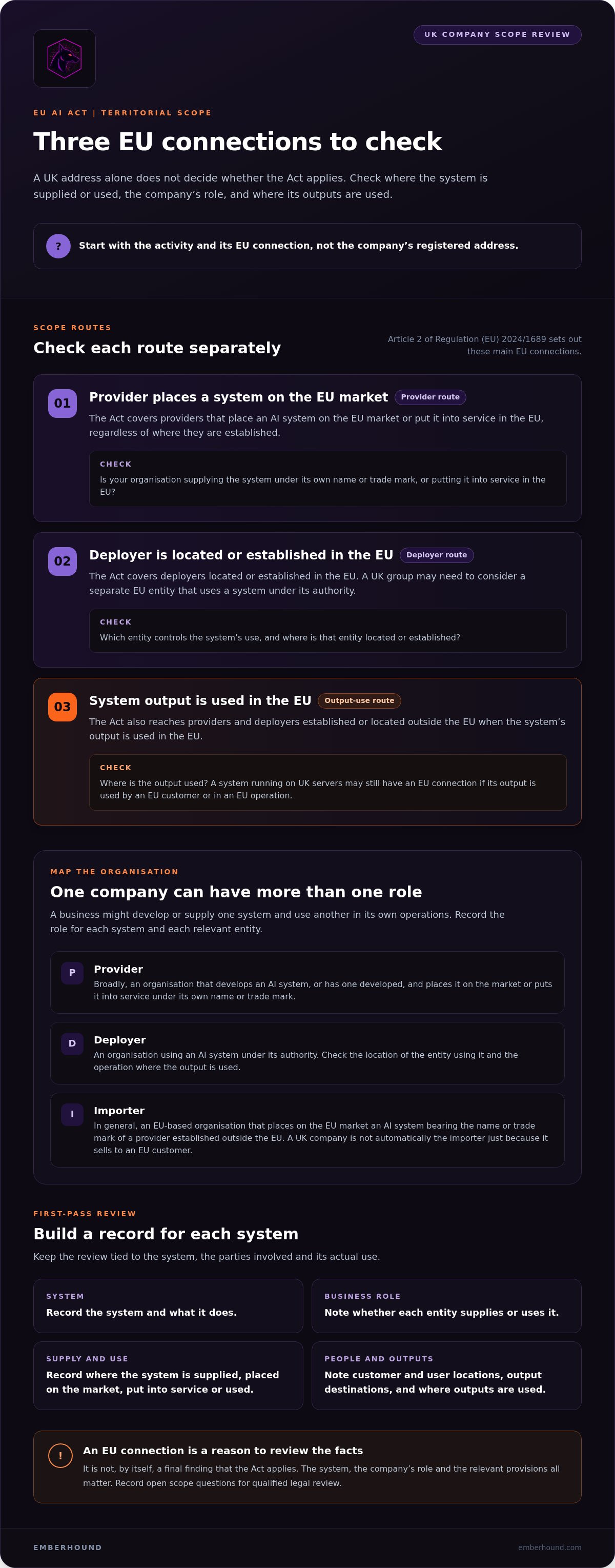
Article 2 sets out the main connections. It covers providers that place an AI system on the EU market or put it into service in the EU, regardless of where they are established. It also covers deployers located or established in the EU. A further rule reaches providers and deployers established or located outside the EU when their AI system’s output is used in the EU.
That last test matters for UK activity. A model can run on UK servers and still have an EU connection if its output is used by an EU customer or in an EU operation. The relevant question is where the output is used, not simply where the code was written or hosted. The Act does not automatically cover every UK company that uses AI. The system, the company’s role, and the destination of its output all need attention.
The EU Artificial Intelligence Act overview gives wider context on the regulation. For scope decisions, use Article 2 of Regulation (EU) 2024/1689 as the legal anchor, then consider how the facts fit its wording.
Why Brexit does not answer the question by itself
Brexit means a UK company is established outside the EU. It does not remove the Act’s stated reach over certain EU-facing activities. Identify where the system is supplied, who uses it, and where its outputs are used. A UK address alone cannot answer those questions.
For a UK business, the GDPR guide for UK businesses gives context on data-protection responsibilities, which should be considered separately from the EU AI Act’s territorial scope. A UK supplier might provide a fraud-scoring tool to a customer operating in the EU. If that customer uses the scores in its EU operations, the output-use rule may be relevant. That does not mean every UK supplier to an EU customer falls within scope. Review the system’s function, the parties’ roles, and the actual use of its output.
Keep the initial review concrete. Record the system, your role, the market where it is supplied or used, and where its outputs go. If the answers point to an EU connection, examine the applicable provisions with qualified legal support. Treat the connection as a reason for review, not as a final finding that the Act applies.
Which UK business activities can bring an AI system within scope?
Start with the work the company performs, not its head-office address. One organisation might develop a system, supply it to another business, and use a separate AI tool in its own operations. These activities can put it in different roles under the EU AI Act. The relevant duties depend on the role, the system, and the provisions that apply.
Keep two questions separate. Is the system being placed on the EU market or put into service there? Or is an organisation using the system in an EU-connected operation? Supplying a system and using one are different activities, even when the same company group does both.
Supplying, importing, or putting an AI system into service
A provider is broadly an organisation that develops an AI system, or has one developed, and places it on the market or puts it into service under its own name or trade mark. A UK developer supplying its own system for use by an organisation in an EU Member State should examine the provider rules and the details of that supply.
Importers have a separate role under the Act. In general, an importer is an EU-based organisation that places on the EU market an AI system bearing the name or trade mark of a provider established outside the EU. A UK company selling to an EU customer is not automatically the importer or within scope just because the customer is in the EU. The supply arrangement, system, and each party’s actual role matter. The role definitions and conditions are set out in Article 2 of Regulation (EU) 2024/1689 and the Act’s related provisions.
Using an AI system for activity connected with the EU
Use can create a different route into scope. A UK group may run an AI system from its UK operation while an EU subsidiary uses it under its authority. The subsidiary’s location and use may be relevant to the deployer rules. If the UK entity supplies the system to the subsidiary, its provider role may also need separate consideration. Group structure alone does not decide the answer.
Trace the system through the operation: who selected or supplied it, which entity controls its use, who receives its outputs, and where those outputs are used. For example, an EU subsidiary might use a UK-developed tool to rank applications for roles based in an EU Member State. The function and real-world use matter to the assessment, but the example alone cannot establish which obligations apply. For a focused explanation of the distinction, consult guidance on whether a business is an AI Act provider or deployer.
So, does the EU AI Act apply to UK companies? An activity map gives you a better starting point than the company’s UK address. Record each entity’s role and the system’s EU-facing use, then assess the relevant provisions against those facts.
If your review also needs a clearer picture of where sensitive data sits around AI use, EmberHound’s endpoint scanning can help locate and map that data. Explore endpoint data discovery as an information-gathering step. The scan’s findings do not determine whether the Act applies or establish legal compliance.
UK company scenarios: compare the EU links before deciding
Compare how the system enters the business and where it is used. The same UK company may have one AI tool used only by UK staff and another supplied to an EU customer. These examples are starting points for review, not legal conclusions.
| Scenario | Relevant actor and activity | Possible EU connection |
|---|---|---|
| UK-only use | UK organisation deploys a system in its UK operation. | Weaker apparent EU link if there is no EU market activity, EU deployment, or use of outputs in the EU. Check for indirect links before concluding. |
| EU deployment | An EU subsidiary or team uses a system in its operation. | Potentially in scope for the EU-based deployer. The group’s UK entity may have a separate role to assess. |
| UK supply for EU use | A UK business supplies or provides a system for use by an EU customer. | Potentially in scope if the relevant market or output-use test is met. The customer relationship alone does not decide the result. |
These distinctions matter because the Act’s territorial rules focus on specified actors and activities. The UK’s domestic approach to AI regulation is a separate question; the House of Commons Library research briefing on AI regulation provides context on the UK framework. A UK-based company still needs to assess EU-facing activity under the EU rules.
When the business and AI use are UK-only
A UK team may develop and use an internal system for UK operations, with no EU customers, users, deployment, or output use. That points to a weaker EU connection, not an automatic exemption. Before closing the review, check whether another group entity uses the system in the EU, whether outputs reach EU operations, and whether the system is supplied into an EU market.
When an EU customer, user, or operation is involved
Supplying a system to an EU organisation and having an EU subsidiary use one are distinct scenarios. In the first, examine the UK supplier’s role and how the system is made available. In the second, assess the subsidiary’s use and whether the UK entity has another role. An EU link raises a scope question; it does not prove that every obligation applies.
Contracts can help reveal how the parties describe supply, responsibility, and intended use. Contract labels do not replace the facts. Check what the system actually does, which entity operates it, where users are located, and where outputs are acted on. The legal outcome depends on those details and the applicable provisions.
So, does the EU AI Act apply to UK companies in each of these scenarios? The table can help prioritise a review, but it cannot settle a case. Record the possible EU link and the facts behind it, then seek qualified legal advice if the application remains uncertain.
How UK teams can make a first-pass EU AI Act scope review
A useful first-pass review records systems, roles, and EU connections. Keep it factual. It can show where legal interpretation is needed, but it does not replace that interpretation or decide whether a particular company has duties under the Act.
Record systems, business roles, and EU-facing activity
Work through the inventory in order. Assign an owner to each system and record what is known. If an answer is missing, mark it as unresolved instead of assuming there is no EU connection.
- List the AI systems. Include internally developed tools and third-party products used in business processes. Record the supplier, internal owner, and intended purpose for each.
- Map the company’s role. Note whether an entity develops or supplies a system, imports it, or uses it in its operations. A group may have different roles across different systems.
- Trace locations and outputs. Record where each system is supplied and used, who operates it, and where its outputs are intended to be used. Include EU subsidiaries, customers, and teams in the review.
- Collect supporting information. Keep system descriptions, supplier documentation, relevant contract terms, and internal decisions in a controlled record. Note the date and owner of each entry so the review can be updated when use changes.
- Log open questions. Record unclear roles, unknown output destinations, or uncertain customer use. These are questions for qualified legal review, not gaps to fill with assumptions.
Keep the scope review tied to evidence
Good records help a team explain what it assessed and which facts shaped its initial view. They do not turn a first-pass review into a legal conclusion. For preparation beyond territorial scope, use the article’s broader guidance on EU AI Act readiness alongside advice on your specific circumstances.
Data visibility can support information gathering. EmberHound Discover scans endpoints locally for sensitive data and produces audit-ready evidence. It can help show where sensitive data sits around AI use, but it does not identify every AI system or decide whether the EU AI Act applies.
Keep this work distinct from data-protection review. The EU AI Act scope question concerns the regulation’s rules for AI systems and the roles of the actors involved. Duties relating to personal data may apply independently under data-protection law, depending on the processing and the organisations involved. A GDPR data discovery guide can help frame the separate task of locating personal data.
Ask, “does the EU AI Act apply to UK companies?” once you have mapped the systems and activities. Take the documented facts and unresolved questions to qualified legal advisers for an assessment against the relevant provisions.
What UK companies should do next if an EU connection is possible
An EU link is a prompt to review the facts, not a reason to guess. Record the activity that may connect the system to the EU, the entities involved, and the information behind that view. Then ask a qualified legal adviser to assess whether the Act applies and which provisions are relevant. This is practical guidance, not a legal conclusion about your business.
For the question, “Does the EU AI Act apply to UK companies?”, a data scan cannot supply the legal answer. It can help with a separate task: locating sensitive data on endpoints around AI use. Keep those workstreams separate so technical findings are not mistaken for an assessment of legal scope.
Separate legal interpretation from technical data discovery
Give your legal adviser the documented facts about the system, its use, the business roles, and any possible EU connection. Ask for an assessment of those circumstances under the Act. The result depends on the specific system, actors, activity, and applicable provisions.
EmberHound Discover supports information gathering. It scans endpoints locally to find and map sensitive data. Files are not exfiltrated. Its evidence includes masked previews and salted SHA-256 fingerprints. Use these records to support data visibility work around AI use, and keep legal interpretation separate.
Start with a focused discovery step
Keep the technical task narrow. Identify endpoints relevant to the AI use under review, then use data discovery to build a clearer picture of where sensitive data sits. A scan does not identify every AI system or fulfil the Act’s requirements. Treat its output as one input to your internal records and legal review.
Security controls matter when planning this work. EmberHound’s trust and security information describes its controls, including TLS 1.3 in transit and AES-256 encryption at rest. Use scan findings alongside system descriptions, supplier material, contracts, and your record of scope questions. Keep each source distinct so a data finding is not mistaken for proof of a legal status.
Once you have the facts, record the possible EU trigger and the questions still open. Share that record with qualified legal advisers. Update it if the system’s purpose, users, supplier, or output destinations change. A new EU customer or subsidiary use may alter the facts behind the original review.
Data discovery can make sensitive data more visible to your team. Use the findings as supporting information, not as a compliance certificate. Legal advice is still needed to interpret your company’s obligations under the EU AI Act.
Make your next scope review easier to act on
Assign an owner to the scope review and set a point for follow-up. Record who is responsible for revisiting the assessment when the system, its business purpose, or its use changes. This gives your team a practical way to keep its conclusions tied to current operations.
Take unresolved questions and the supporting evidence to a qualified legal adviser. Ask directly: does the EU AI Act apply to UK companies in your specific circumstances? The answer depends on the facts and relevant provisions. Keep technical information gathering separate from legal interpretation, and don’t treat a data scan as a compliance certificate.
If mapping sensitive data around AI use is your next task, a focused scan can support that work. Use the findings as one input to your records, then follow through on the legal questions that remain open.
A clear next step is enough to move the review forward. Build from what you know, record what you don’t, and address each open question with the relevant evidence.
Frequently Asked Questions
Does Brexit mean the EU AI Act cannot apply to a UK company?
No. Brexit does not, by itself, prevent the EU AI Act from applying where its territorial conditions are met. A UK company’s registered location is one fact, not the whole assessment. A system supplied for EU use or producing outputs used in the EU may raise a scope question. Assess the system and activity; neither automatic coverage nor automatic exemption follows from UK incorporation alone.
Does the EU AI Act apply if a UK company uses an AI tool made by a US company?
The supplier’s US location does not decide the answer. Assess whether your UK business develops, supplies, or uses the tool, where staff use it, and whether its outputs feed an EU operation. A UK-only workflow may present different facts from a tool whose recommendations are used by an EU subsidiary. The outcome depends on the actors and use. Ask a qualified legal adviser to interpret your circumstances.
Does the EU AI Act replace the UK GDPR?
No. The UK GDPR and the EU AI Act are separate frameworks. The UK GDPR concerns processing of personal data within its scope, whilst the AI Act regulates specified AI-related activities and actors. A company may need to assess an AI system under the Act and separately review how it handles personal data, such as CVs used in recruitment. An AI Act scope review does not replace a data-protection assessment, or vice versa.
Can a UK company be affected when an AI system’s output is used in the EU?
Potentially. The Act includes a territorial rule for providers or deployers established or located outside the EU when output from their AI system is used in the EU. A UK-produced risk score used by an EU business could warrant review. The location of use alone does not establish that every condition is met or that every UK firm is covered. Check the current legislation and the system’s actual use before drawing a conclusion.
Does the EU AI Act apply to a UK company with an EU subsidiary?
An EU subsidiary makes the group structure relevant, but its existence alone does not determine each entity’s duties. Identify which company procures or supplies the system, which team operates it, and which legal entity uses its output. One group company might provide a tool whilst the subsidiary deploys it. Their positions may differ, so document the arrangements and seek advice based on the specific facts.
Do UK companies need to follow the EU AI Act if they sell only in the UK?
Selling only in the UK may point to no EU market connection, but sales territory does not tell the whole story. Check where staff, group entities, or customers use the system and whether outputs are used in EU operations. An apparently UK-only product can have EU-connected use through a wider business arrangement. Treat the sales description as one piece of evidence, then assess actual operations and the relevant provisions.
When should a UK company review whether the EU AI Act applies?
Review scope before launching a system, when a supplier or customer arrangement changes, and when outputs start supporting activity in the EU. Revisit the review if the system’s purpose, users, or deployment changes. Use the current text of Regulation (EU) 2024/1689 and verify application dates instead of relying on an old checklist. Record the change and assessment, then seek qualified advice if the scope remains unclear.


