

A UK address does not automatically put your AI use outside the EU AI Act’s scope. The Act can reach UK organisations that place AI systems on the EU market, put them into service there, or use systems whose outputs are used in the EU. It applies alongside data protection laws such as the GDPR, so one assessment does not replace the other.
The boundary can feel unclear, especially when a business uses a third-party tool rather than building AI itself. The deciding factors include where the system is supplied, where it is used and what it does. Some activities are excluded, while other uses face lighter or more specific requirements.
This guide explains how to assess the EU AI Act’s reach for a UK organisation, which exclusions matter and how its rules sit alongside data protection duties. It also outlines the Act’s risk-based approach, helping you identify the questions that should shape your next compliance steps.
Key Takeaways
- The Act can apply to UK organisations when they place AI systems on the EU market, put them into service there, or use outputs in the EU.
- According to the European Union, the EU AI Act entered into force on 1 August 2024. Military, certain research and development activities, and personal non-professional use have specific exclusions.
- Assess each AI use by its purpose and risk category. Some systems face requirements that depend on their role and how they are used.
- Open-source licensing alone does not settle whether the Act applies. The system’s use and whether specific provisions cover it also matter.
- The AI Act and data protection laws apply alongside each other. Map where personal data is held and used to identify the separate duties that may apply.
Military, research and personal-use exclusions
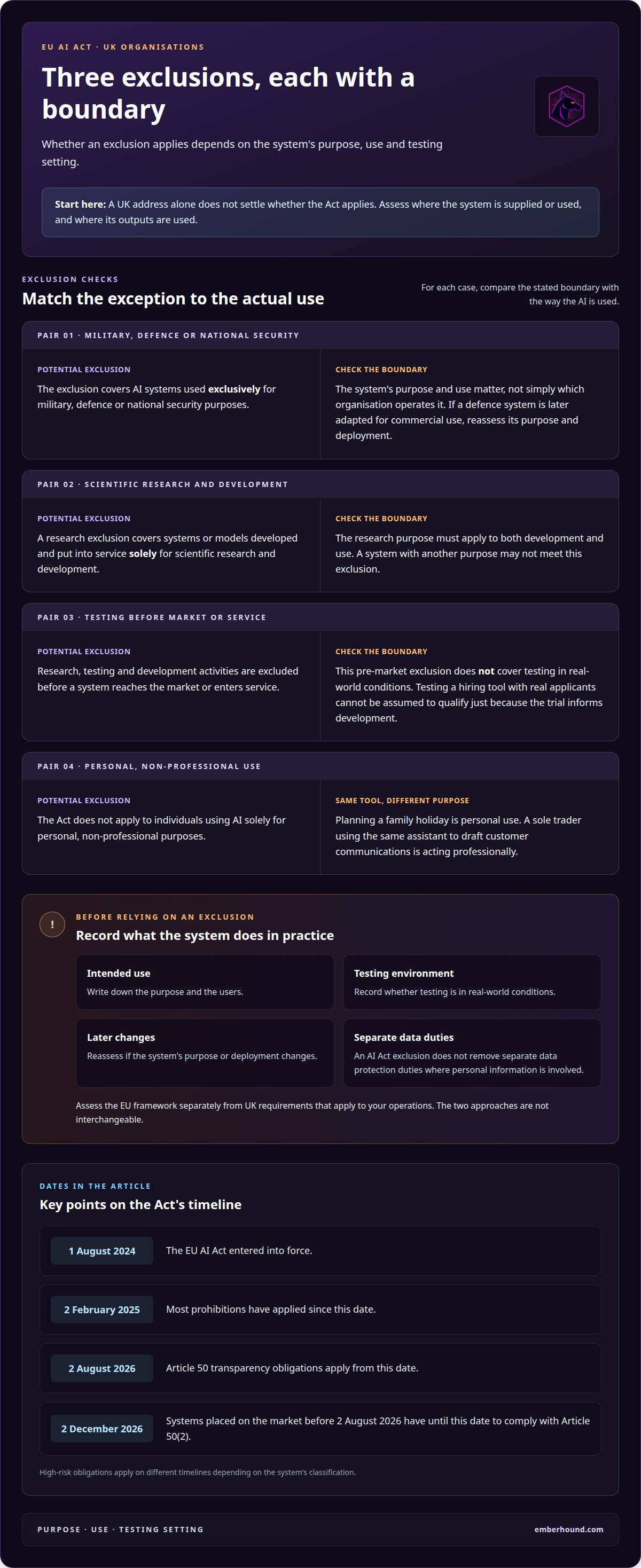
The military exclusion covers AI systems used exclusively for military, defence or national security purposes. According to the European Union, the EU AI Act entered into force on 1 August 2024. The exclusion turns on the system's purpose and use, not simply the organisation operating it.
A research exclusion covers AI systems or models developed and put into service solely for scientific research and development. Separately, research, testing and development activities are excluded before a system reaches the market or enters service. That pre-market exclusion does not cover testing in real-world conditions. For example, a company testing a hiring tool with real applicants cannot assume the research exclusion applies simply because the trial informs development.
The personal-use exclusion means the Act does not apply to individuals using AI solely for personal, non-professional purposes. Someone using an AI assistant to plan a family holiday is acting personally. A sole trader using the same tool to draft customer communications is acting professionally. The tool may be identical, but the user’s purpose changes the analysis.
These exclusions have boundaries. A system developed for defence but later adapted for commercial use needs a fresh assessment of its purpose and deployment. A laboratory prototype may fall within pre-market research activity, but real-world testing remains outside that exclusion. Before relying on an exception, record the intended use, users, testing environment and any later changes.
The EU AI Act sets harmonised rules for AI across the European Union. UK organisations should assess this EU framework separately from the UK requirements that apply to their operations. The two regulatory approaches are not interchangeable: relevant duties depend on where the organisation operates and how it uses AI.
For deadlines, the Act entered into force on 1 August 2024, and most prohibitions have applied since 2 February 2025. Article 50 transparency obligations apply from 2 August 2026, with systems placed on the market before that date having until 2 December 2026 to comply with Article 50(2). High-risk obligations apply on different timelines depending on the system’s classification.
Penalties depend on the type of breach and the obligation involved. The Act provides for administrative fines, so assess the conduct and requirement in question rather than assuming every breach carries the same consequence. The exclusions discussed here do not remove separate data protection duties where personal information is involved.
For a practical data-mapping step, identify where personal information appears in AI-related files and records. A GDPR data discovery guide explains how to approach that separate visibility task. Keep the resulting data map distinct from the decision about whether an AI use falls within an EU AI Act exclusion.
The EU AI Act's risk-based approach
The Act uses a four-tier risk framework to determine which requirements apply. Start by identifying the system’s purpose, role and users, then assess its risk category.
Prohibited AI systems
A prohibited AI system uses a practice that Article 5 bans, regardless of the system's risk classification. The rules address public-authority AI systems that evaluate or classify people's trustworthiness. They also address real-time remote biometric identification by law enforcement in publicly accessible spaces.
Assess how the system is actually used, not just its product description. A tool used to rank people may raise different questions from one used for a routine administrative task. Record the decision it supports, who is affected and which organisation uses it. This helps distinguish a prohibited practice from a system requiring a different risk assessment.
Transparency duties
Transparency duties require specified AI systems to disclose relevant information to people. Article 50 covers certain systems that interact with people, generate content or detect emotions. For example, an organisation deploying an AI assistant should determine whether users need to be told they are interacting with AI.
For generated content, identify what the system produces and how people encounter it. For emotion detection, document the system’s purpose and operating setting. These checks help teams identify interactions or outputs that may trigger disclosure duties. Record the decision alongside the system details, and revisit it when the use changes.
General-purpose AI model obligations
A general-purpose AI model is designed for use across a range of tasks. The Act sets additional requirements for providers when a model presents systemic risks. A model is presumed to present systemic risks when cumulative training compute exceeds 10^25 floating point operations (FLOPs).
A provider meeting that compute criterion must notify the European Commission without delay and no later than 2 weeks. The provider should identify the model, document its training compute and record the notification. This assessment concerns the model provider; an organisation using a third-party model should identify that provider and its own role in deploying the resulting system.
High-risk systems follow a separate set of controls. Providers must complete the applicable conformity assessment before placing a system on the market under Article 43. They must also prepare technical documentation under Annex IV and maintain a quality management system. These records describe how the system was designed and assessed.
Deployers have distinct duties. In certain cases, Article 26(11) requires them to inform people that they are subject to a high-risk AI system. For each system, record its intended use, provider, deployer and relevant obligations. This separates model-level checks from requirements tied to a particular system or deployment.
AI applications largely left unregulated
A free and open-source AI system is released under a free and open-source licence. The EU AI Act generally excludes these systems from its rules, subject to specific exceptions. The licence matters, but it does not settle the question by itself. The system’s status and use still need assessment.
The exclusion does not cover a system placed on the market or put into service as high-risk. It also does not cover systems within Article 5 or Article 50. For example, publishing model code under an open licence does not remove the Act's requirements if a resulting system falls within one of those categories.
Distinguish the model from the system built with it. A publicly released model may be adapted into a tool for recruitment, customer support or content creation. Assess the finished system’s intended purpose, who provides it and how it is put into service. A public code repository alone does not answer those questions.
For a practical review, record the licence, the system's intended use and how it reaches users. Then assess whether the system is placed on the market or put into service, and whether it falls under Article 5, Article 50 or a high-risk category. Keep evidence of design changes and deployment decisions. Revisit the assessment when a material change alters the system's purpose or operation.
Open access is not the same as unrestricted use under the Act. A developer may publish model weights or code, while another organisation integrates them into a product. That organisation’s role and deployment can affect whether the resulting system falls within the exception. Keep records of the original release and later adaptations separately.
“Largely unregulated” should therefore be read narrowly: the Act does not regulate every open-source release in the same way. This is not a blanket exemption for every system using open-source components. An organisation adopting a free model should assess its own system and use, rather than relying only on the model’s licence or the original developer’s description.
For example, a team might use an openly released text model to draft internal meeting summaries. It should still document the system’s purpose and deployment, then check the relevant Act categories. If the same model is adapted for a covered high-risk purpose, its original open-source release does not remove the resulting system from the Act’s rules.
Create a decision record for each deployment: name the model, describe the system, identify its provider and deployer, and note the relevant category checks. This makes it easier to reassess the system if a new use, integration or release changes how it operates.
Data protection and privacy laws
Data protection law governs how organisations handle information about identifiable people. The EU AI Act does not replace it. The Act applies alongside Regulation (EU) 2016/679, the General Data Protection Regulation (GDPR), and other privacy rules. A UK organisation using AI should assess the AI Act and each data-protection regime relevant to its processing separately.
The Act expressly leaves other data-protection rules in place. These include Regulation (EU) 2016/679, Regulation (EU) 2018/1725, Directive 2002/58/EC and Directive (EU) 2016/680. The last is the Data Protection Enforcement Directive. For example, an AI tool that analyses customer records may raise questions under both the AI Act and GDPR. Meeting one set of duties does not automatically meet the other.
Personal data means information linked to an identified or identifiable person. The AI Act defines it by reference to Article 4, point (1) of Regulation (EU) 2016/679. Names are obvious examples. An employee number or a combination of details may also identify someone. When assessing an AI system, map what information enters it, where it is stored and whether its outputs relate to individuals.
A data protection impact assessment is an assessment of how processing may affect people’s rights and freedoms. GDPR Article 35 provides for this assessment. For example, an organisation using AI to analyse applicants’ personal information should document the processing and consider its potential effects. Keep that assessment distinct from the AI Act’s own risk classification, even where the same system features in both reviews.
Article 22 of the GDPR concerns decisions based solely on automated processing, including profiling, that produce legal or similarly significant effects. The AI Act also includes a right to explanation in specified circumstances. Treat these as related but distinct questions: identify how the decision is made, what effect it has, and which rule applies to that processing.
Use a shared system inventory to connect AI and privacy reviews. For each tool, record its purpose, the personal data involved, the people affected and the decision or output it produces. Assign separate owners for AI Act and data protection checks. If a system starts using new data or supports a different decision, update both records before relying on the earlier assessment.
For a UK organisation, the practical question is which rules apply to each activity and where people are affected. Record the system’s users, data flows and deployment locations. For instance, a customer-support assistant handling identifiable messages needs a privacy review alongside its AI Act assessment. This approach reveals overlapping duties without treating either framework as a substitute for the other.
Does the EU AI Act apply to companies outside the EU?
Territorial scope describes the connection between an organisation’s AI activities and the European Union. A UK company can fall within the Act when it places an AI system on the EU market, puts one into service there, imports or distributes one there, or deploys a system whose output is used in the EU.
The organisation’s location alone does not settle the question. The Act covers EU-based deployers and certain product manufacturers that place products containing AI systems on the market. It also covers third-country deployers when an AI system’s output is used in the EU. A UK supplier serving only UK users should assess its activities separately from a supplier whose system reaches EU users.
Identify each role in the supply chain. The same organisation may have more than one role, depending on its activities.
- Provider: the organisation placing an AI system on the market or putting it into service. A UK company selling its own AI hiring tool in the EU should assess its provider role.
- Deployer: the organisation using an AI system under its authority. A UK firm using an AI tool to produce outputs for EU operations should examine where those outputs are used.
- Importer or distributor: an organisation bringing an AI system into the EU or distributing it there. A UK supplier involved in EU sales should map these steps.
- Product manufacturer: a manufacturer placing a product containing an AI system on the EU market. Record the product and the AI system together.
For a UK business, map the system’s route from supply to use. Record who provides it, who deploys it, where it is made available and where its outputs are used. For example, a UK provider may sell a decision-support tool to an EU organisation. The provider’s location does not remove the EU market connection.
An EU authorised representative is an EU-based representative appointed by a provider established outside the EU. Under Article 22, a non-EU provider must appoint one before making an AI system available on the EU market. This requirement concerns providers. It does not mean every UK deployer must appoint a representative.
Keep evidence for each system, including contracts, product documentation, sales territories, deployment records and the intended use of outputs. Link each record to the organisation’s role. If a UK customer later uses an AI system’s output in the EU, reassess the deployment in light of that use. A change in customer, territory or system purpose can alter the scope analysis.
Apply the same review to third-party tools. A UK organisation may deploy software supplied by an EU provider, or use a system whose outputs serve people in the EU. Record the supplier and actual deployment separately. This gives compliance teams a clear basis for deciding which obligations apply to each party.
EmberHound: GDPR Data Discovery
EmberHound’s GDPR Data Discovery helps organisations locate personal information across business data stores. Use it when your AI and privacy reviews need a clearer view of where personal data is held. That information can support internal assessments, but it does not determine whether an AI system falls within the EU AI Act or replace legal advice.
For access-request preparation, the DSAR Disclosure Pack supports the work of assembling information for a subject access request. Organisations handling payment card data can use PCI Card Data Discovery, or choose Combined GDPR + PCI Coverage when both data types need attention.
Contact EmberHound to discuss your data discovery needs.
Make your next review easier to act on
Turn your assessment into a working record. Assign an owner to each AI system, document its purpose and data flows, and note what would trigger a fresh review. A new customer, a changed use or a different source of personal data can alter the questions your team needs to answer.
Keep the EU AI Act scope and your data protection review connected, but track their decisions separately. This gives colleagues a clear starting point when a system changes or a new tool enters the business. A focused record is easier to maintain than a review rebuilt from scattered notes.
If personal information is difficult to locate across your organisation, EmberHound’s data discovery tools can support that part of the work. Start a free GDPR scan to see where personal data is held and keep your compliance process moving.
Clear ownership and an up-to-date record give your team a stronger basis for its next decision.
Frequently Asked Questions
How can organisations apply it?
Apply the Act by keeping a record for each AI system and reviewing it when its use changes. Name the business owner, supplier, intended users and business purpose. Record where the system is supplied and where its outputs are used. Then identify the relevant risk category and any duties attached to the organisation’s role. For example, a new feature that begins ranking job applicants should trigger a fresh assessment.
What is the EU AI Act?
The EU AI Act is Regulation 2024/1689, a European Union regulation laying down harmonised rules on artificial intelligence. It governs the placing on the market, putting into service and use of AI systems in the EU. It uses a cross-sectoral approach, so its rules can affect organisations across different industries. For a UK business, the practical relevance depends on its systems, activities and connections to the EU.
What is the scope of the EU AI Act?
The Act’s scope covers relevant AI lifecycle activities and uses connected with the EU market or people there. It can matter before a system reaches users, when it is put into service and during deployment. For a UK team, map the system from supplier to end user. Include AI embedded in a product and systems that produce outputs for use in the EU.
Which AI systems and organisations does the EU AI Act apply to?
Depending on their role and connection to the EU, the Act can apply to providers, deployers, importers, distributors and product manufacturers. It may also reach a UK organisation deploying a system when its output is used in the EU. For instance, a UK business supplying an AI-enabled product to an EU customer should identify who places the system on the market and who controls its use.
How does the EU AI Act classify high-risk AI systems?
The Act identifies high-risk systems through two routes. Article 6(2) and Annex III cover listed use cases, while Article 6(1) links certain AI systems to products covered by Union harmonisation legislation in Annex I. To classify a system, document its intended purpose, the product it forms part of and the applicable legislation. This helps distinguish a standalone use case from AI embedded in a regulated product.
What exemptions and exceptions are included in the EU AI Act?
Some activities and uses fall outside particular parts of the Act, but an exemption depends on the circumstances. For example, the open-source exception has limits where a system is high-risk or falls under Article 5 or Article 50. Military-only use, specified scientific research and personal, non-professional use also have exclusions. Record the specific purpose and deployment; a later commercial use may change the assessment.


