

A UK business can fall within the EU AI Act's reach when its AI system is used in the EU or its output is used there. The EU AI Act's prohibited practices list is set out in Article 5, which bans specified AI uses.
It’s understandable to want a clear line between a prohibited practice and a restricted one. Article 5 covers uses such as certain forms of behavioural manipulation, social scoring, untargeted facial-image scraping and emotion recognition in workplaces and educational institutions. Some prohibitions have defined exceptions, so the intended purpose and context of use matter.
This guide explains which practices Article 5 prohibits, where key exceptions apply and what the rules mean for policing, workplaces and education. It also distinguishes prohibited uses from AI applications that face other requirements, so you can focus on the systems and decisions that need closer scrutiny.
Key Takeaways
- Use Article 5 to identify AI practices that are prohibited, then distinguish them from uses subject to other requirements.
- Assess the system's intended purpose and how it is deployed: these details can affect whether a prohibition applies.
- Real-time remote biometric identification for law enforcement in publicly accessible spaces is prohibited, subject to narrow exceptions and controls.
- Check the setting and purpose of emotion recognition systems, particularly in workplaces and educational institutions.
- Review predictive policing tools carefully: assessing a person's risk solely from profiling, personality traits or behavioural characteristics is prohibited.
Real-time remote biometric identification for law enforcement
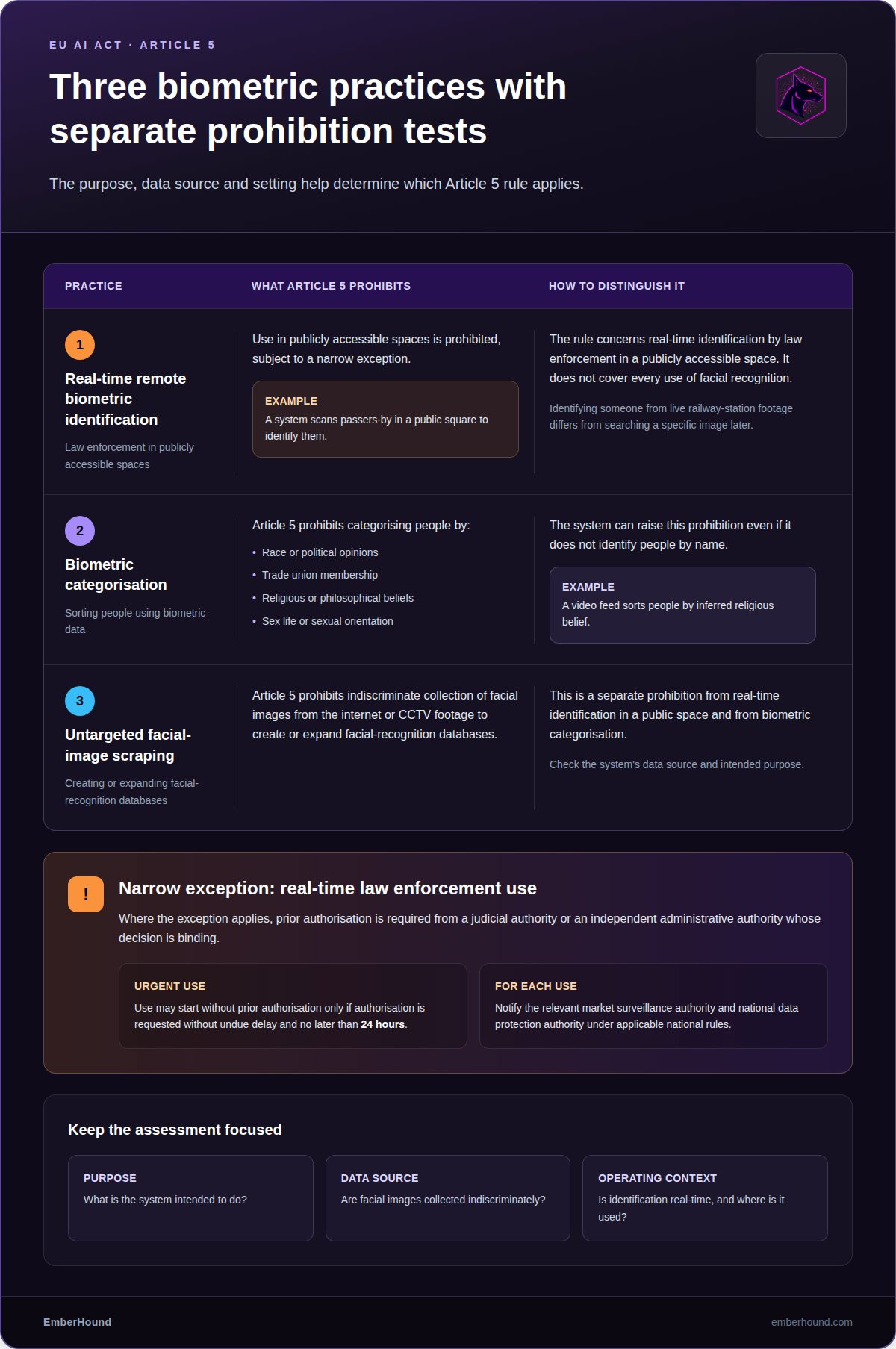
Real-time remote biometric identification compares a person’s biometric data with reference data to identify them remotely. Under Article 5 of the EU AI Act, law enforcement use in publicly accessible spaces is prohibited, subject to a narrow exception. For example, a system scanning passers-by in a public square to identify individuals falls within this rule.
The prohibition concerns real-time identification, not every use of facial recognition technology. The setting and purpose matter: the rule addresses law enforcement use in publicly accessible spaces. A system that identifies someone from live camera footage in a railway station differs from a tool used later to search a specific image. This distinction does not determine whether other laws apply.
Where the exception applies, prior authorisation is required from a judicial authority or an independent administrative authority whose decision is binding. An urgent use may start without prior authorisation only if authorisation is requested without undue delay and no later than 24 hours. Each use must also be notified to the relevant market surveillance authority and national data protection authority under applicable national rules.
Biometric categorisation classifies people using biometric data, including by inferring protected characteristics. Article 5 prohibits systems that categorise individuals by race, political opinions, trade union membership, religious or philosophical beliefs, sex life or sexual orientation. A system sorting people in a video feed by inferred religious belief would therefore raise this prohibition, even if it does not identify them by name.
Untargeted scraping of facial images to create recognition databases is prohibited by Article 5(1)(e) of the EU AI Act. The rule covers systems that create or expand facial-recognition databases by collecting facial images indiscriminately from the internet or CCTV footage. The Act also identifies the GDPR, EUDPR and LED as relevant data-protection laws; the GDPR guide explains the separate data-protection context.
Keep these rules distinct when assessing a proposed deployment. A facial recognition database built through untargeted scraping raises a separate prohibition from real-time identification in a public space. A biometric categorisation system that infers protected characteristics raises another. The system’s purpose, data source and operating context determine which Article 5 rule is relevant.
Articles 21 and 24 of the EU Charter of Fundamental Rights concern equality and the rights of the child. They are relevant when assessing effects on people who may face discrimination or require added protection. For a law enforcement proposal, record the intended purpose, whether identification is real-time, where it operates, and the authorisation and notification steps.
Exceptions to prohibitions on generating or manipulating material
Article 5(1a) covers AI systems designed to generate or manipulate specified material. Placing a system on the market or putting it into service is prohibited only when that activity is its intended purpose. A deployer’s use is prohibited only when they use the system for that purpose. The system’s design and the way it is used both matter.
Article 5(1b) defines a limit on what counts as manipulation for this prohibition. Editing material does not qualify if it neither increases exposure of depicted intimate parts nor changes the nature of depicted sexually explicit activities. For example, an edit that changes background lighting without either effect falls outside this specific definition. The exception is narrow: the stated effects are the test.
Subliminal manipulation uses techniques that operate below a person’s conscious awareness. Article 5(1)(a) prohibits AI systems using subliminal techniques or manipulative or deceptive methods when designed to distort behaviour and cause, or be likely to cause, significant harm. Recital 29 addresses the risk that subliminal manipulation can distort behaviour. A system’s method, design and likely effect all inform the assessment.
Exploiting vulnerabilities means targeting characteristics such as age, physical or mental disability, or socioeconomic status to distort behaviour. Article 5(1)(a) prohibits this where the distortion causes, or is likely to cause, significant harm. For example, an AI system designed to exploit an older person’s vulnerability to pressure them into harmful choices may meet this test. The characteristic alone does not establish the prohibition; the intended distortion and harm matter.
Social scoring means assessing people’s social behaviour or inferred personality traits to determine how they are treated. Article 5(1)(c) prohibits scoring that leads to detrimental treatment in unrelated social contexts, or treatment unjustified or disproportionate to the behaviour assessed. There is no general exception for social scoring. Credit scoring based on financial history may fall outside this prohibition when designed and used transparently, relevantly and proportionately.
Apply the rules in sequence: identify the material or behaviour at issue, establish the system’s intended purpose, then assess the deployer’s actual use. For Article 5(1a), distinguish placing or putting into service from deployment. For manipulation, test the method, targeted vulnerability and likely harm. This keeps a particular use distinct from untargeted scraping or law enforcement applications governed by other Article 5 rules.
If your review also needs a clearer picture of personal data held across your systems, review your data discovery options.
Emotion recognition in workplaces and education
Emotion recognition uses AI to infer a person’s emotions from their data. Article 5(1)(f) prohibits these systems in workplaces and educational institutions, subject to specific exceptions.
Workplace emotion recognition
Workplace emotion recognition is AI inference of a person’s emotions in an employment setting. Article 5(1)(f) prohibits systems designed for this purpose at work. For example, software that analyses an employee’s images to infer frustration or confidence falls within the rule’s scope. The system’s design and intended use matter, not simply the presence of a camera or other data source.
The prohibition covers emotion inference, not every employment decision supported by AI. A tool that organises work schedules without inferring emotions raises a different question. By contrast, a system designed to score staff as engaged or disengaged based on their expressions infers emotional states. Employers should distinguish this function from tools that process information without drawing conclusions about emotions.
The Act provides an exception for systems placed on the market for medical or safety reasons. The exception depends on the system’s purpose. A workplace system intended for a medical or safety reason may be treated differently from one used to assess morale or performance. Describing a staff-monitoring tool as a safety measure does not change its actual intended purpose.
High-risk employment and educational uses
High-risk employment AI is used for certain decisions about workers or job candidates. The EU AI Act classifies recruitment, candidate filtering and evaluation as high-risk uses. A CV-scanning tool that ranks applicants is one example. These systems face specific legal requirements, although the Act does not prohibit every use of AI in employment.
The high-risk category also covers AI used to allocate work, evaluate performance or conduct, decide promotions, or support termination decisions. An emotion recognition system used to score an employee’s mood may therefore raise two separate issues: the Article 5 prohibition and the rules for high-risk employment AI. Assess each function and decision separately.
Education requires the same careful distinction between emotion inference and other AI uses. Article 5(1)(f) addresses emotion recognition in educational institutions, with the medical or safety exception. For example, software designed to infer a pupil’s emotional state from images during lessons falls within the prohibition’s subject matter. The exception depends on the system’s purpose, not simply its location in a school.
For a practical review, record what the system infers, whose data it analyses, where it is used and what decision follows. Separate emotion inference from recruitment ranking or work allocation. That distinction helps identify whether Article 5(1)(f), high-risk employment requirements, or both are relevant to the particular use.
Predictive policing based on profiling
Predictive policing uses AI to assess or predict criminal conduct. Article 5(1)(d) prohibits predictions based solely on profiling, personality traits or behavioural characteristics.
Profiling-based crime prediction
Profiling-based crime prediction uses personal characteristics or behaviour to estimate whether someone may commit an offence. Article 5(1)(d) applies when that assessment relies solely on profiling, personality traits or behavioural characteristics. For example, a system that labels an individual as likely to offend based only on their behavioural profile falls within the prohibition.
The distinction depends on the basis for the prediction. A tool may process sensitive information or biometric data, but those data types alone do not define this specific prohibition. The assessment should identify what information drives the prediction, how the system uses it, and whether the prediction is based solely on profiling or personal traits.
Criminal-conduct prediction
Criminal-conduct prediction is an AI assessment of a person’s risk of committing an offence. Article 5(1)(d) prohibits a law enforcement system from making that assessment solely from profiling, personality traits or behavioural characteristics. A prediction that a named person will offend because of an inferred behavioural pattern is a clear example of the type of use covered.
Read the prohibition alongside wider concerns about predictions based on past criminal behaviour or other data that perpetuate bias or discrimination. Both the system’s purpose and the data behind its output matter. Review whether it predicts an individual’s conduct, which inputs support the prediction, and whether those inputs reproduce biased assumptions.
For a practical assessment, map the process from input to operational use. Identify whether the AI assesses an individual or a place, such as a public space, and whether its output concerns a person’s future conduct. Then record whether profiling, personality traits or behavioural characteristics are the sole basis for that prediction. This helps distinguish person-focused predictions from other policing analysis.
Articles 7 and 8 of the EU Charter of Fundamental Rights concern privacy and data protection. They are relevant when reviewing predictive policing systems that use personal information, including biometric data. Consider how the system’s purpose affects individuals, what data supports its assessment, and how law enforcement uses the result. A tool’s stated purpose should match its actual function.
The key question is how the prediction is produced, not simply whether a system is labelled predictive policing. An assessment based solely on profiling or personal traits falls within Article 5(1)(d). Separately, examine whether past criminal behaviour or other inputs may perpetuate bias or discrimination. Keep those findings distinct when documenting the system’s design and use.
EU AI Act Article 5 prohibited practices
Article 5 is the part of Regulation (EU) 2024/1689 that prohibits specified AI practices. Its rules focus on uses considered unacceptable under the Act, including practices that manipulate behaviour or threaten fundamental rights.
The eu ai act prohibited practices list covers distinct functions, not one general category of technology. It includes AI systems that use subliminal techniques or manipulative or deceptive methods to cause, or be likely to cause, significant harm. It also prohibits exploiting vulnerabilities, such as age, disability or socioeconomic status, to distort behaviour and cause significant harm.
Social scoring is prohibited when assessments of social behaviour or perceived personality traits lead to detrimental treatment in unrelated contexts, or treatment that is unjustified or disproportionate. The European Commission’s guidelines distinguish this from credit scoring based on financial history, which may fall outside the prohibition when designed and used transparently, relevantly and proportionately.
Other Article 5 rules cover biometric and policing uses. These include prohibited biometric categorisation based on protected characteristics, real-time remote biometric identification for law enforcement in publicly accessible spaces, and AI predictions of criminal conduct based solely on profiling, personality traits or behavioural characteristics. Each rule has its own scope and, in some cases, specific conditions or exceptions.
Article 5(1)(e) prohibits systems that create or expand facial-recognition databases through untargeted scraping of facial images from the internet or CCTV footage. Article 5(1)(f) prohibits emotion recognition in workplaces and educational institutions, except where systems are placed on the market for medical or safety reasons. The intended purpose and actual use help distinguish these cases.
The European Commission published guidelines on prohibited AI practices on 4 February 2025. They explain the Commission’s approach and aim to support consistent application across the EU. The guidelines are non-binding; authoritative interpretations of the AI Act are reserved for the Court of Justice of the European Union.
For a practical compliance review, identify each AI system’s intended purpose, inputs and outputs, then compare its actual use with the specific Article 5 rule. Record whether an exception applies and why. The Act also covers other EU law: Article 5 does not remove prohibitions that apply when a practice infringes separate EU rules.
Penalties depend on the applicable enforcement provisions and the nature of the infringement. Article 5 identifies prohibited practices; it does not set out a penalty figure in its list.
The key takeaway is to assess each system by what it does and how it is used. A facial system that identifies people, a tool that infers emotions, and software that ranks people require different Article 5 analyses.
EmberHound
EmberHound helps businesses locate sensitive information that may be held in systems used to develop or deploy AI. GDPR Data Discovery identifies personal information, while PCI Card Data Discovery finds payment card data. Combined GDPR + PCI Coverage addresses both data types, and the DSAR Disclosure Pack supports subject access request handling.
This is useful when an AI review raises questions about where personal or payment data is stored. Data discovery can help establish what information exists and where it is found. It does not determine whether an AI practice is prohibited under Article 5, so keep that legal assessment separate.
For help locating sensitive information across your business data, contact EmberHound.
Make your next AI review concrete
Turn your reading into a repeatable review process. Assign each AI system an owner, record its intended purpose, and note where its outputs are used. This provides a clear basis for revisiting the assessment when the system or its use changes.
Use the EU AI Act prohibited practices list as a prompt to examine each system’s function and context. Keep the reasoning with the system record, including which Article 5 rule you considered and whether an exception is relevant. This helps teams distinguish a documented assessment from an assumption based on a product label.
Set a review point whenever a system’s purpose, data inputs or deployment changes. A tool used for a new decision may raise different questions from those raised by its original use. Keep the assessment focused on actual functions and decisions, then refer legal interpretation to the appropriate internal specialist.
If the review raises questions about where personal information is held, data discovery can help establish what information your organisation holds.
Keep the assessment record with the system details for the next review.
Frequently Asked Questions
What Is the EU AI Act?
The EU AI Act is the European Union’s regulation on artificial intelligence. It sets rules for organisations involved in developing, supplying or using AI systems within its scope. For a UK organisation, map the system’s role in the supply chain, such as developer or deployer, alongside its connections to the EU. This helps identify which activities need assessment under the regulation.
What is prohibited AI?
Prohibited AI is a practice that falls within an express ban in the Act. The assessment concerns how a system is used, not merely the fact that it uses artificial intelligence. Start with the task the system performs, then record who uses its output and for what purpose. A clear description of use helps ensure that a product label does not substitute for an assessment.
What AI practices are prohibited under Article 5 of the EU AI Act?
Article 5 prohibits specific AI practices listed in the regulation. For a system review, record the function, intended purpose, users and deployment context, then match those details to the relevant Article 5 provision. This creates a traceable reason for the classification. If the use changes, revisit that reasoning; a new purpose can raise a different question from the one assessed originally.
When is biometric categorisation using sensitive data prohibited under the EU AI Act?
It is prohibited when biometric data is used to classify individuals by protected characteristics covered by Article 5. In reviewing a system, separate the biometric input from the inference it produces. For example, document whether a tool merely processes an image or assigns a person to a category based on an inferred characteristic. That distinction makes the system’s function clearer for assessment.
What restrictions apply to real-time remote biometric identification in public spaces?
Article 5 restricts law enforcement use of real-time remote biometric identification in publicly accessible spaces, with a narrow exception. For an applicable use, the process includes authorisation and notification requirements. A review should capture the setting, purpose, authorising body and notification route. This record helps distinguish a proposed deployment from an urgent use and shows which procedural conditions were considered.
Which manipulative or deceptive AI practices are prohibited by the EU AI Act?
The Act prohibits specified manipulative or deceptive methods when they are designed to distort behaviour and cause, or be likely to cause, significant harm. It also covers systems that exploit vulnerabilities for that purpose. When assessing a system, document the method, the people it targets and the foreseeable effect on their choices. A persuasive interface alone does not establish whether these legal conditions are met.
Are individual risk assessments and crime prediction prohibited under the EU AI Act?
Some law enforcement predictions about an individual’s risk of offending are prohibited, but the rule does not ban every individual risk assessment. The key question is whether the prediction relies solely on the specified personal characteristics. Record the system’s inputs and how they contribute to its output. A prediction about a location rather than a person raises a different assessment question.
When did the EU AI Act prohibitions take effect?
The Article 5 prohibitions took effect on 2 February 2025. This is the date to use when establishing whether a practice falls within the prohibitions’ application period. Keep it separate from the Act’s broader entry-into-force date, because the regulation’s provisions do not all share one commencement date. An internal system record can note the relevant date alongside the assessment and deployment history.


