

Classification sets the compliance burden. The EU AI Act defines four risk levels, and the category determines which rules apply. This guide explains EU AI Act risk levels in practical terms, including what high-risk providers must do and how exceptions and deadlines affect them.
For UK businesses, location alone does not determine whether the Act applies. It can cover third-country deployers when an AI system’s output is used in the EU. A system’s purpose and role can change its classification, and systems in sensitive areas may fall outside the high-risk category under specific conditions.
This guide explains how the four levels differ, what providers of high-risk systems need to prepare, and how the rules for general-purpose AI fit in. It also distinguishes deadlines for AI used in sensitive areas from those for AI built into regulated products.
Key Takeaways
- Use an AI inventory to identify systems in scope, record their intended purpose and role, then document the reason for each risk classification.
- Check whether Article 6 and Annex I or Annex III apply. The route into the high-risk category affects which obligations and deadline matter.
- High-risk providers need to plan for risk management, data quality, technical documentation, record-keeping, human oversight and conformity assessment.
- Some AI systems used in Annex III areas may qualify for an exception under Article 6(3), if they meet the specified conditions.
- Keep general-purpose AI and limited-risk transparency rules in view: their requirements follow separate pathways from the high-risk system rules.
How does it all work in practice for providers of high-risk AI systems?
The EU AI Act classifies systems across four risk levels, from minimal to unacceptable. Article 6 determines whether a system is high-risk through its intended purpose and its connection to regulated products or listed use areas.
Classifying high-risk AI systems
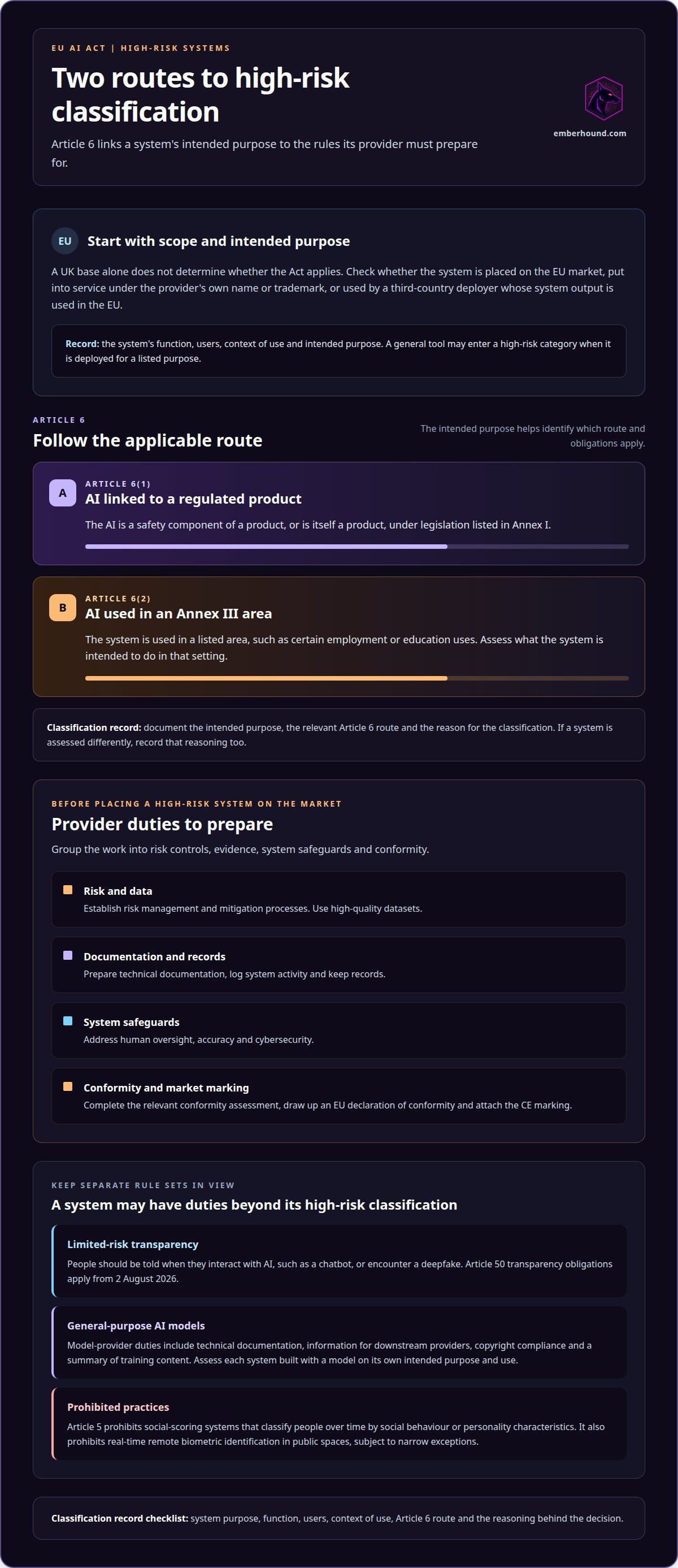
Article 6 sets two routes to high-risk classification. Article 6(1) covers AI that is a safety component of a product, or is itself a product, under legislation listed in Annex I. Article 6(2) covers systems in Annex III areas, such as certain uses in employment or education. The intended purpose matters because it helps identify the relevant route and obligations.
Start with the system’s function, users and context of use. A general tool can enter a high-risk category when deployed for a listed purpose. Record the classification reasoning, including the system’s intended purpose and the relevant Article 6 route. That record helps explain why the provider treated a system as high-risk or assessed it differently.
Obligations across AI risk categories
Before placing high-risk systems on the market, providers must establish risk management and mitigation processes. They must use high-quality datasets, log system activity, complete the relevant conformity assessment, draw up an EU declaration of conformity and attach the CE marking. Requirements also cover human oversight, accuracy, cybersecurity, technical documentation and record-keeping.
Limited-risk systems have transparency duties instead of the full high-risk framework. People should be told when they interact with AI, such as a chatbot, or encounter a deepfake. Article 50 transparency obligations apply from 2 August 2026. The difference matters: classify the system first, then match the duty to its risk category.
Applying the rules to UK businesses
The Act can apply to UK providers that place AI systems on the EU market or put them into service under their own name or trademark. It can also apply to third-country deployers when their system’s output is used in the EU. A UK base does not, by itself, take a business outside the Act’s scope.
For UK teams, the practical first step is to identify systems sold or used in the EU and document each system’s purpose, role and classification. Keep AI Act analysis distinct from personal-data obligations: the GDPR guide explains the separate rules governing personal data. This distinction helps teams map which framework applies to each issue.
General-purpose AI models have separate rules. A model presents systemic risk when cumulative training compute exceeds 1025 floating point operations. Its provider must notify the Commission without delay and no later than 2 weeks after meeting that threshold. The provider may argue that the model does not present systemic risk, and the Commission may identify systemic risk below the threshold.
General-purpose AI providers also have baseline duties covering technical documentation, information for downstream providers, copyright compliance and a summary of training content. These model-level duties differ from high-risk system duties. Providers should assess both their model obligations and the classification of any AI system built with the model.
Unacceptable-risk practices are prohibited under Article 5. The Act prohibits social-scoring systems that classify people over time based on social behaviour or personality characteristics. It also prohibits real-time remote biometric identification in public spaces, subject to narrow exceptions. These cases require a different response from compliance duties: determine whether the intended practice falls within a prohibition before assessing other categories.
What are the rules for General-Purpose AI models?
Spam filters and AI-enabled video games are examples of minimal-risk uses; the proposed Act treated voluntary codes of conduct as their main regulatory form. General-purpose AI models have separate provider obligations, with additional rules where a model presents systemic risk.
General-purpose AI models follow a separate compliance track from AI system risk classifications. A model’s category does not determine the risk level of every system built with it. Classify each application according to its intended purpose and use, including whether an employment use listed in Annex III makes it high-risk.
For example, an AI system used for employment screening needs its own assessment based on its purpose. Keep records at both levels: model-provider documentation and the classification of each application. Open-source models may avoid stricter duties when their licences permit access, use, modification and distribution of the model and its parameters, subject to stated exceptions.
Compliance deadlines for general-purpose AI
Article 50 transparency obligations apply from 2 August 2026. People should be informed when they interact with AI, such as a chatbot, or encounter deepfake content. These duties concern transparency, while GPAI model-provider obligations cover separate documentation and information requirements.
Providers of GPAI models placed on the EU market before 2 August 2025 must take the necessary steps to comply with the Act by 2 August 2027. That date gives providers of earlier models a defined compliance deadline. Track it separately from deadlines for high-risk systems, since the model and its applications can trigger different obligations.
Baseline GPAI duties include technical documentation, information for downstream providers, a copyright-compliance policy and a summary of training content. A compliance plan should assign responsibility for each item to the model provider, then assess whether an application also falls under Annex III or product rules.
Systemic-risk rules for general-purpose AI
Systemic risk is an additional classification for GPAI models, not a fifth risk level for every AI system. A model meets the compute criterion when cumulative training compute exceeds 1025 floating point operations. Its provider must notify the Commission without delay and no later than 2 weeks after meeting that criterion.
A provider may argue that a model meeting the compute threshold does not present systemic risk. The Commission may also decide that a model presents systemic risk below the threshold. Compute screening does not end the review. Record the training-compute assessment, notification timing and any arguments about the model’s risk.
Where AI governance also involves personal data, consider your organisation’s data footprint as a separate part of the work.
Exceptions to Annex III high-risk classification
An Annex III use does not always mean an AI system is high-risk. Article 6(3) sets conditions for excluding certain systems, so classification depends on the system’s purpose and characteristics, not its sector label alone.
How the Article 6(3) exception works
Apply Article 6(3) to the specific AI system and its intended use. It provides conditions under which a system in an Annex III area is not classified as high-risk. The exception is conditional: being used in employment, education or another listed area does not, by itself, settle the classification.
Keep the assessment tied to evidence about the system. Record its purpose, functions and characteristics, then explain how those facts meet the Article 6(3) conditions. A broad description such as "AI for recruitment" may conceal different functions, from sorting applications to supporting a decision. Assess the actual system and use case rather than relying on a product label.
Separate safety-component route
Article 6(1) covers AI that is a safety component of a regulated product, or is itself a product, under legislation listed in Annex I. Article 6(1a) excludes systems used solely for specified non-safety-related functions from being classified as safety components. This is a distinct route from the Annex III exception.
Annex II lists harmonising legislation under which AI systems may be classified as high-risk. For a regulated product, identify the relevant product legislation and the AI system’s role in that product. A non-safety function may affect the safety-component analysis, but it does not automatically settle any separate Annex III assessment.
Assess the use case, not just the technology
Annex III covers listed areas where systems can affect people’s access to opportunities or services, including employment and education. Biometric systems also need careful classification: the Act distinguishes permitted risk categories from prohibited practices, and a biometric purpose alone does not make a system prohibited.
Migration, asylum and border control provide another example of why the use context matters. Article 71 provides for a public database of registered high-risk systems, while specified law-enforcement, migration, asylum and border-control systems appear in a non-public section. Registry treatment does not itself create an Article 6(3) exception.
Deployers should keep the system’s classification reasoning with its use documentation. If one tool supports separate functions, assess each relevant purpose and record whether Article 6(1), Article 6(2), Article 6(3) or Article 6(1a) applies. This separates an Annex III exception from product-safety classification and prohibited practices. It also gives teams a clear basis for revisiting the assessment if the system’s characteristics or intended use change.
High-risk AI deadlines for sensitive areas and regulated products
High-risk obligations have different deadlines depending on how Article 6 classifies the system. For UK businesses serving the EU, the key distinction is between sensitive uses listed in Annex III and safety components linked to regulated products under Annex I.
Annex III systems: sensitive areas
AI systems classified as high-risk under Article 6(2) and Annex III become subject to the relevant obligations on 2 December 2027. Annex III covers sensitive areas, including certain uses in education and law enforcement. A system’s intended purpose determines whether its use falls within a listed area, so record the specific function and users.
This date gives providers a planning milestone for systems classified through the Annex III route. Work backwards from 2 December 2027 to assess the system’s risk management, data quality, human oversight and technical documentation. Those duties need to match the system’s purpose. For example, documentation for an education system should describe the function being assessed, rather than relying on a broad label such as “education software”.
Annex I systems: regulated products
Article 6(1) covers AI that is a safety component of a product, or is itself a product, under legislation listed in Annex I. Examples include AI integrated into medical devices, lifts, vehicles or machinery. The relevant obligations for systems classified under Article 6(1) and Annex I apply from 2 August 2028.
That later date does not remove the need to identify the product route early. Establish which regulated product contains the AI, then assess whether the AI acts as a safety component. Record the product context and the system’s role in the technical documentation. A lift-control function and an administrative function within the same wider product should not be treated as interchangeable without examining their distinct purposes.
Plan around the classification route
The difference between 2 December 2027 and 2 August 2028 is tied to classification, not simply the industry using the AI. A provider with systems in both routes should maintain separate records of each system’s intended purpose, applicable Article 6 route and relevant deadline. That prevents the later Annex I date from being applied automatically to an Annex III system.
For each system, map the route before setting the compliance schedule:
- Record whether the system is assessed under Article 6(2) and Annex III, or Article 6(1) and Annex I.
- Link its purpose to the relevant sensitive use or regulated product context.
- Set the applicable deadline and track preparation of risk management, oversight and documentation.
Both deadlines concern relevant high-risk obligations. They do not remove the need to identify systems accurately. Providers should also distinguish these dates from the rules for general-purpose AI models, which follow a separate compliance timetable.
What are the four EU AI Act risk levels?
With EU AI Act risk levels explained, teams can compare what each classification means for a system’s use. The four categories are unacceptable, high, limited and minimal risk. They call for different responses, from stopping a prohibited practice to applying lighter treatment.
- Unacceptable risk: The use is prohibited, so it calls for a stop-or-change decision.
- High risk: The use brings formal provider requirements that need planning and evidence.
- Limited risk: The focus is on transparency for people interacting with AI.
- Minimal risk: The system receives lighter treatment, with voluntary conduct measures relevant to the examples described for this category.
Compare categories by asking what decision follows from the classification. Unacceptable risk raises whether the use can proceed. High risk calls for a compliance workstream. Limited risk directs attention to what people need to know. Minimal risk indicates a lighter regulatory response.
A single product name may conceal several functions. Separate those functions in the inventory, then assess each according to its actual use. This is more useful than assigning one broad label to a tool that supports different activities.
Keep the classification rationale alongside the system record. If the use changes, compare the new purpose with the original assessment and update the category where needed. This gives procurement, technical and governance teams a shared reference when a system moves from testing into operational use.
The four categories also help teams prioritise review. A potentially prohibited system needs a different decision path from one requiring transparency information. A high-risk use needs a planned compliance process, while a minimal-risk use can be handled with a proportionate record. The category should guide the next action, not remain an unexplained label.
EmberHound
EmberHound helps businesses discover sensitive personal and payment card data across their systems. If an AI system processes personal data, GDPR Data Discovery can help identify where that data is stored. PCI Card Data Discovery applies when payment card data is involved, while Combined GDPR + PCI Coverage addresses both data types.
This work helps you understand the data connected with your AI systems. It does not determine an AI system’s risk category or replace legal advice. For subject access request handling, EmberHound’s DSAR Disclosure Pack helps prepare disclosure information.
Keep your AI governance current
Now that the EU AI Act risk levels are explained, keep classification connected to real business decisions. Assign an owner to each AI system and make its intended purpose clear to the teams that buy, build or deploy it. When a system’s function changes, revisit the documented assessment rather than relying on an outdated decision.
This discipline can also improve procurement conversations. Ask teams to record how a proposed system will be used, what data it handles and who is accountable for its use. A clear record gives your organisation a practical basis for reviewing changes and keeping decisions consistent. EmberHound can help identify personal and payment card data for wider data governance work, while AI Act classification remains a separate task.
Take the next step at a pace that suits your team. Clear ownership and current records make future reviews easier to manage.
Frequently Asked Questions
How will the AI Act be implemented?
The European AI Office and Member State authorities are responsible for implementing, supervising and enforcing the Act from 2 August 2026. The European Commission must issue implementation guidelines under Article 96. For a business, implementation means identifying its role for each system, then assigning applicable duties to the provider or deployer. Member States apply penalties for infringements under Article 99(1), so governance should include clear ownership of compliance records.
How do the EU AI Act and GDPR interact?
The GDPR governs the processing of personal data, while the AI Act regulates AI systems and certain general-purpose AI models. A single use can therefore involve both laws. For example, an AI tool that ranks job applicants may need an AI Act risk assessment, while its handling of applicants’ personal data remains subject to GDPR requirements. Treat these as related workstreams, and connect records where they concern the same system or data.
Is the EU AI Act in effect now?
Yes. The EU AI Act became applicable on 2 August 2026, subject to exceptions and phased deadlines. It entered into force on 1 August 2024, but not every obligation began on the same date. For example, high-risk systems under Article 6(2) and Annex III have a later application date than systems under Article 6(1) and Annex I. Check the deadline linked to the relevant obligation and classification.
What counts as high-risk in the EU AI Act?
A system counts as high-risk when it meets either route in Article 6. One route concerns AI linked to products covered by legislation in Annex I; the other concerns uses listed in Annex III. Examples include AI used in a medical device or certain decisions in education or employment. Assess the system’s intended purpose and role. Its general label or technical method alone does not decide the classification.
What is the EU AI Act?
The EU AI Act is the European Union regulation that sets rules for AI systems and certain general-purpose AI models. It entered into force on 1 August 2024 and uses risk-based requirements, including prohibitions and duties for higher-risk uses. It can also affect businesses outside the EU when their system’s output is used within the EU. UK organisations should assess both where they operate and where their AI outputs are used.
What is the difference between AI providers and deployers?
A provider develops an AI system or general-purpose AI model and places it on the market, or puts it into service, under its own name or trademark. A deployer uses an AI system under its own authority, except for personal, non-professional use. A UK company that builds and sells a tool may have provider responsibilities; a company using that tool in its own operations may be a deployer. A business can hold different roles across systems.
What AI systems are prohibited under the EU AI Act?
Article 5 contains the list of prohibited AI practices. Examples include social-scoring systems that assess or classify people over time using social behaviour or personality characteristics. Real-time remote biometric identification in publicly accessible spaces is also prohibited, subject to narrow exceptions. These are restrictions on specified practices, not a general ban on every system using AI or biometrics. Assess the actual function and context before deciding whether Article 5 applies.
Which AI systems are classified as high risk under the EU AI Act?
High-risk systems fall under Article 6(1) and Annex I, or Article 6(2) and Annex III, unless an applicable exception changes the classification. Annex I concerns safety components of regulated products, such as AI in lifts or machinery. Annex III includes specified uses in areas such as education, employment and migration. A product may contain several functions, so assess each function’s purpose and role rather than classifying the entire product by name.


