

An AI system can be high-risk because of what it is used to decide, not because of how technically complex it is. High-risk AI system examples under the EU AI Act include tools for recruitment, education, credit scoring and biometric identification, but classification depends on the system's intended use and the Act's specific rules.
That distinction matters when assessing AI used in the UK market. The Act identifies listed use cases in Annex III and safety-related AI in certain regulated products, with qualifications that can affect the classification. A broad label alone won't settle the question.
This guide explains which systems may fall into the high-risk categories, where they are used and what providers must do. It covers the main examples, the limits of classification and requirements for risk management, data governance, technical documentation and human oversight. Use it to identify where the rules may apply and what compliance work may follow.
Key Takeaways
- Start with the AI system's intended use. The EU AI Act's classification depends on its use case and specific criteria, not technical complexity alone.
- Look for the listed contexts, including education, employment, essential services, law enforcement and biometrics. The exact task can determine whether a system falls into a high-risk category.
- Check whether AI is a safety component in a regulated product. Its role in protecting health and safety matters to classification.
- Separate biometric identification and categorisation from identity verification. The Act treats these uses differently, and some biometric practices are prohibited.
- Providers of high-risk systems have requirements covering risk management, data, documentation and human oversight. The article explains what these involve.
AI systems and "high-risk" status under the EU AI Act
The EU AI Act classifies systems by their intended use and their role in regulated products. Article 6 sets out two routes to high-risk status, with Annex I and Annex III identifying the relevant product laws and use cases.
Routes to high-risk classification
Article 6 sets out two independent routes: an AI system may be a safety component in a product covered by Annex I, or its intended purpose may match an Annex III use case. The distinction matters because assessing the product, task and intended users can lead to different outcomes for systems using similar technology.
Annex III covers eight broad areas: biometrics, critical infrastructure, education, employment, essential services, law enforcement, immigration, and justice and democratic processes. Examples include AI that evaluates job candidates, assesses a natural person's creditworthiness or helps decide access to public benefits. Technical complexity alone does not determine classification.
An Annex III system may qualify for an exception if it does not pose a significant risk of harm and meets a specified task-related condition. The exception cannot apply when the system profiles natural persons. A provider relying on this derogation must document its assessment before placing the system on the market or putting it into service.
Guidance and draft classification examples
Commission guidance is intended to help apply Article 6 to specific systems, while draft classification guidelines summarise examples across the listed areas. The Commission's deadline to issue practical classification guidance was 18 months from the date of entry into force of the AI Act; the related provision came into force on 2 August 2026.
Use examples as a prompt for analysis, not as a substitute for it. An AI model used to assess learning outcomes may fall within Annex III point 3. A system that filters job applications may fall within Annex III point 4. In each case, identify the system's intended purpose and the decision it supports.
Article 7 empowers the European Commission to amend Annex III by delegated act. Article 97 also permits delegated acts to remove specified conditions for an exception when concrete and reliable evidence shows removal is needed to protect health, safety and fundamental rights. Classification conditions can therefore change.
UK and EU high-risk rules
The classification framework described here comes from the EU AI Act; it does not itself establish a UK-wide high-risk category. UK organisations should assess whether their system or deployment falls within the Act's scope, then consider the UK rules relevant to their sector and data use.
The Act's high-risk requirements cover risk management, data governance, technical documentation, record-keeping, transparency, human oversight, accuracy, robustness and cybersecurity. Providers must demonstrate conformity on request and take corrective action if a system is no longer compliant. High-risk systems are subject to conformity assessment before market placement.
For UK teams handling personal information in an AI system, GDPR data handling is a related compliance consideration. The EU AI Act's Annex III requirements apply from 2 December 2027; its Annex I requirements apply from 2 August 2028.
AI systems used as safety components in regulated products
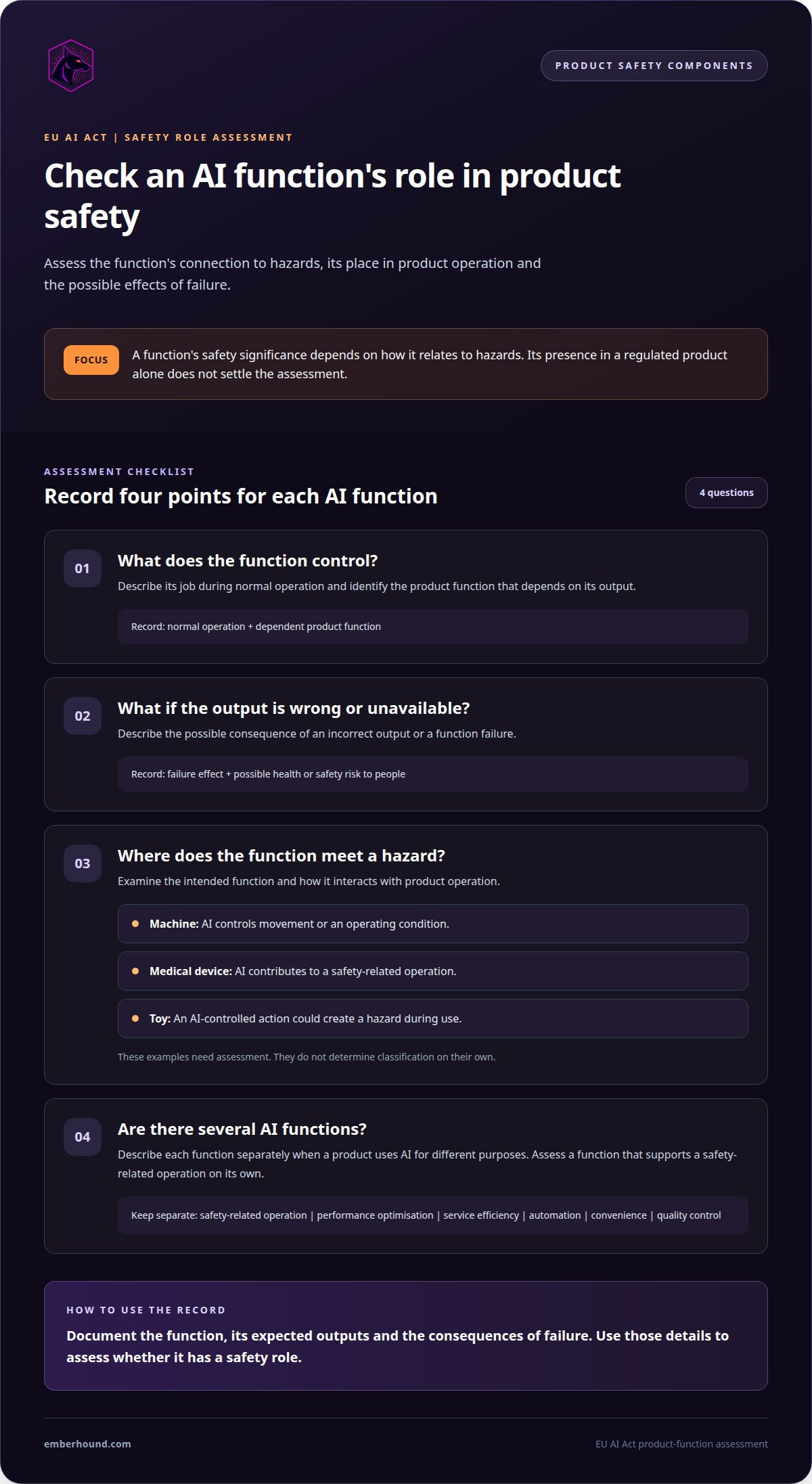
Product teams should examine what an AI function controls during normal operation and what happens when it fails. Its safety significance depends on its connection to hazards, not simply its presence in a regulated product. A function that can affect safe operation calls for a different analysis from one that only improves convenience.
Consider a machine that uses AI to control movement or an operating condition. If an incorrect output could put someone at risk, the function has a direct safety role that needs assessment. An AI feature that adjusts a display or improves service efficiency may have a different role, provided its failure does not endanger health or safety.
The same distinction applies across product types. For a medical device, examine whether an AI function contributes to a safety-related operation. For a toy, consider whether an AI-controlled action could create a hazard during use. These are examples, not automatic classifications. The system's actual design and intended function determine the analysis.
For each AI function, product and compliance teams can record:
- What the function controls during normal operation
- What could happen if its output is wrong or unavailable
- Whether people could face a health or safety risk
- Which product function depends on the AI output
This record helps distinguish safety-related functions from AI used solely for performance optimisation, service efficiency, automation, convenience or quality control. These uses do not make a function a safety component on their own. The key question is whether AI failure or malfunction could endanger health and safety.
Product boundaries matter too. A product may contain several AI functions with different purposes. Describe them separately rather than assigning one safety label to the entire product. An AI function supporting a safety-related operation needs its own analysis, even if other functions only improve usability.
For product teams, the practical question is how an AI function interacts with the product's operation and potential hazards. Document the function, its expected outputs and the consequences of failure. This gives technical and compliance teams a clear basis for deciding which functions need closer safety review.
Biometric identification and categorisation
Under Annex III point 1 of the EU AI Act, certain biometric AI uses are high-risk. The category covers remote biometric identification, biometric categorisation by protected attributes and emotion recognition. The system's purpose and operating context matter: a tool that identifies people remotely has a different function from one that checks a person's claimed identity.
Remote biometric identification systems are high-risk unless they are intended purely to verify that a person is who they claim to be. This exception has a narrow purpose. Identify what the system does in practice, who it processes and what result it produces. A product description alone does not establish whether it performs identification or verification.
Biometric categorisation can also fall within Annex III point 1 when it groups people according to protected attributes. Emotion recognition is listed in the same point. These categories concern how a system analyses or sorts people, rather than whether it makes a final decision about them. For example, an emotion-recognition tool remains within the listed category even when a person uses its output to inform a later decision.
- Identification: Does the system identify people remotely, or only verify a claimed identity?
- Categorisation: Does it sort people by protected attributes?
- Emotion recognition: Does it infer or classify emotions?
These questions help establish the system's intended purpose and actual use. Document the context, including whether outputs affect access, treatment or decisions about individuals. Testing should reflect the purpose for which the system is intended. If its use changes, revisit the classification against Annex III point 1 rather than relying on an earlier assessment.
High-risk classification does not settle whether a biometric practice is permitted. Some AI systems involving biometric data are prohibited under the EU AI Act. Article 5 identifies prohibited practices, and a prohibited system cannot become permissible through high-risk conformity assessment. The distinction matters: first determine whether the practice is prohibited, then assess the requirements that apply to a permitted high-risk system.
For a system classified as high-risk, providers need technical documentation that demonstrates compliance with the Act. The high-risk requirements include human oversight, risk management and appropriate accuracy, robustness and cybersecurity. Keep the evidence tied to the system's specific biometric function and context, such as remote identification or categorisation. Annex III high-risk provisions apply from 2 December 2027.
For UK organisations, these are EU AI Act classifications. A UK deployment with EU connections should be assessed against the Act's scope and the system's intended use. Assess each biometric function separately if one product supports identification, verification and emotion analysis.
High-risk AI use cases in sensitive areas
In sensitive settings, classification depends on an AI system's intended purpose and the decision it can influence. Annex III covers specified uses in essential services, law enforcement, immigration, justice and democratic processes. A tool supporting a consequential decision may therefore need assessment against its precise task, not just its general label.
Education systems can be high-risk. Annex III point 3 covers AI used to decide admission to education or training, evaluate learning outcomes, assess a person's education level, or monitor prohibited behaviour during tests. So yes, AI used for those decisions or exam monitoring can be considered high-risk. The use case matters: a general classroom tool does not automatically fall into the category.
Essential services bring different decisions into focus. AI used to assess eligibility for public services or benefits, or to grant, reduce, revoke or reclaim them, may be high-risk. For example, a system might recommend whether someone qualifies for a public benefit. AI that prioritises emergency service deployment is another potential high-risk use, as its output may affect how quickly people receive urgent help.
Financial decisions can also affect access to essential services. Annex III includes systems assessing the risk and pricing of life and health insurance. A model influencing an individual's insurance terms may therefore need assessment against that listed use. Ask what the system is intended to assess and how its output affects the decision.
Law enforcement uses include AI assessing recidivism risk or profiling people during the detection or investigation of offences. Annex III point 6 identifies these activities. The classification review should establish whether the system assesses a person's risk or profiles natural persons as part of an investigation. The intended purpose and actual deployment context both matter.
Justice and democratic processes include other consequential uses. Annex III point 8 covers AI assisting a judicial authority with research or interpretation, and systems that influence an election, referendum or individuals' voting behaviour. For example, an AI tool that helps a judicial authority research legal material falls within a listed area. A system influencing voter behaviour also requires careful classification.
These categories do not make every tool in a school, public body, insurer or court automatically high-risk. Compare its intended purpose with the specific Annex III task, then record your reasoning and relevant documentation. Consider what decision the output supports, whose rights or access may be affected, and whether the system profiles people. This separates a listed high-risk use from a tool serving a different function.
Which AI systems used in hiring and employment are high risk?
Annex III point 4 of the EU AI Act covers AI intended for recruitment or selection. The category includes tools that place targeted job advertisements, filter applications or evaluate candidates. The key test is the system's intended purpose. A tool used to rank applicants for a vacancy may fall within this listed use case.
Recruitment covers several stages. A system might decide which applications reach a recruiter, score candidates against selection criteria or assess their suitability for a role. Each example uses AI to support recruitment or selection. Assess the task and how its output affects candidate evaluation, rather than relying on the product name.
The category can extend beyond hiring. Annex III includes AI used to assess performance in employment. A system analysing an employee's work performance to inform management decisions may therefore need assessment against the listed use case. The key question is whether its intended purpose is employment-related performance assessment.
These examples help identify functions that need closer classification:
- Targeting job advertisements at potential applicants
- Filtering applications before recruiter review
- Evaluating candidates during selection
- Assessing performance in an employment context
Different functions within one HR platform may serve different purposes. An advertising module might target jobseekers, while another filters applications. Record what each function does, whose information it uses and how its output informs recruitment or employment decisions. This functional view makes classification more precise than treating the whole platform as one system.
For systems classified as high-risk, the EU AI Act sets provider requirements covering risk management, data governance, technical documentation, record-keeping, transparency, human oversight, accuracy, robustness and cybersecurity. These duties apply to the high-risk system. They do not mean every HR tool is automatically high-risk; its listed purpose remains central.
Employment AI can also involve rules beyond the AI Act. The General Data Protection Regulation and the Platform Work Directive may apply alongside it to AI used in human resources. For a UK organisation, identify where the system is used and what data or employment decisions it affects. The EU AI Act's Annex III provisions apply from 2 December 2027.
Keep classification tied to actual use. If a recruitment tool shifts from sorting applications to assessing employee performance, its purpose has changed and warrants a fresh review. A written account of its functions, outputs and decision context gives the provider a clearer basis for assessing its obligations.
EmberHound
EmberHound helps organisations locate sensitive information that may sit within the data environments used by AI systems. GDPR Data Discovery and PCI Card Data Discovery can help identify personal and payment card data across business files. Combined GDPR + PCI Coverage brings both discovery needs together, while a DSAR Disclosure Pack supports handling subject access requests.
EmberHound supports data visibility; it does not determine whether an AI system is high-risk under the EU AI Act or provide legal advice. Use the platform when you need to find relevant personal or card data and understand what information your organisation holds as part of wider AI governance work.
Contact EmberHound to discuss your data discovery needs.
Make the next review actionable
Turn the high-risk AI system examples in this guide into a practical review record. For each system, note its intended purpose, the decisions it informs and the team responsible for reviewing its use. Record the assumptions behind your assessment too. If the system's role changes, these details give your team a clear starting point.
Keep the review connected to the information the system processes. Knowing where personal or payment card data sits can help teams understand the data context around AI use. EmberHound's data discovery platform can support that work; it does not replace legal advice or determine an AI system's classification.
A clear record gives your team a practical basis for its next review. Take the next step at a pace that fits your organisation.
Frequently Asked Questions
Are open-source systems also regulated?
Open-source status alone does not determine whether the EU AI Act applies. The system's purpose, use and the organisation's role still matter. For example, adapting an openly available model into a tool that ranks job applicants can create responsibilities for the organisation that modifies and deploys it. Record those changes and the system's intended use; a public code licence does not settle regulatory classification.
Can a chatbot be considered high-risk?
Yes, if its intended use falls within a high-risk category or it acts as a safety component in a regulated product. A general customer-service chatbot is not automatically high-risk because it communicates with people. Article 50 transparency duties apply to AI that interacts with people or generates synthetic content, and are already in force. Treat transparency and high-risk classification as separate questions when reviewing a chatbot.
What counts as a high-risk AI system under the EU AI Act?
Look beyond the system's name and identify the specific function being placed on the market or put into service. Some Annex III systems can qualify for an exception if they meet a task-related condition and pose no significant risk of harm. A provider relying on that exception must document its assessment before market placement or use, and register the system in the EU database for high-risk AI systems.
Are biometric identification and emotion recognition systems high risk under the EU AI Act?
Some are, but the practical review should separate identification, verification, categorisation and emotion analysis as distinct functions. Record which function is active in each deployment and what result it produces. This helps avoid treating a product's biometric capability as a single, uniform use. Also assess whether the planned practice is prohibited under Article 5, since conformity assessment cannot make a prohibited practice permissible.
What requirements must providers and deployers of high-risk AI systems meet?
Responsibilities extend across the supply chain. Importers must verify that the provider completed conformity assessment, made technical documentation available, applied CE marking and appointed an authorised representative. Distributors must verify CE marking, an EU declaration of conformity and instructions. A deployer that substantially modifies a high-risk system, or changes its purpose so it becomes high-risk, can take on provider obligations under Article 25.
What are examples of high-risk AI systems in healthcare?
An AI function in a medical device may be high-risk if it contributes to a safety-related operation and its failure or malfunction could endanger health or safety, subject to the applicable product rules.
What are the risks and penalties for using high-risk AI systems without complying with the rules?
High-risk AI systems must undergo a conformity assessment before being placed on the market. Providers must demonstrate compliance on request and take corrective action if a system is no longer compliant.


