

Facial recognition does not automatically make an AI system high risk. The practical question is, “Is my AI system high risk?” Under the EU AI Act, remote biometric identification is generally classed as high risk, except when used purely to verify that someone is who they claim to be. Some biometric practices are prohibited.
It’s reasonable to want a clear answer before taking on compliance work. The Act uses four risk levels: unacceptable, high, limited and minimal. A system may be classed as high risk under product safety legislation or because it is used in a sensitive area listed in Annex III. An Annex III system may qualify for a narrow exemption, but profiling rules can rule that out.
This article explains how to assess both routes, what the product safety test means, and which Annex III exemptions may matter. If you’re asking, “Is my AI system high risk?”, the answer also depends on how the system is used. It sets out how to distinguish AI Act duties from the separate task of finding and managing personal data covered by GDPR.
Key Takeaways
- Assess whether AI is a safety component of a regulated product, and whether that product requires third-party conformity assessment.
- Check the system's intended use against the EU AI Act's high-risk categories. Its role in a decision can matter as much as the domain.
- Separate the question of whether software meets the Act's definition of an AI system from how the Act classifies its risk.
- For Annex III systems, examine the narrow exemption criteria and whether profiling rules affect eligibility.
- Distinguish EU AI Act duties from the UK laws and regulatory requirements that may also apply to your system.
AI systems that are safety components of regulated products
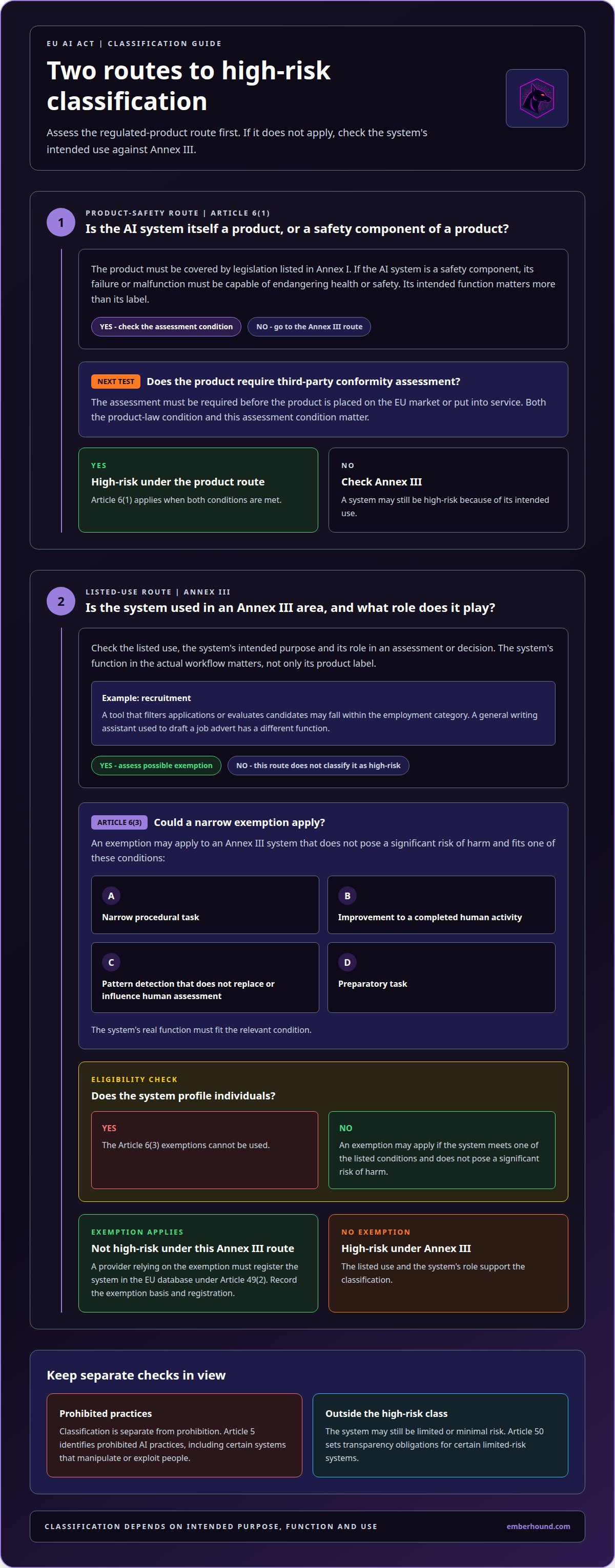
Article 6(1) of the EU AI Act sets a product-safety route to high-risk classification. It covers an AI system that is itself a product, or a safety component of a product, under legislation listed in Annex I. The product must also require a third-party conformity assessment before it is placed on the EU market or put into service. Both conditions matter.
A safety component has a direct bearing on safe operation. Under Article 3(14), the Act defines the term. An AI system can qualify where its failure or malfunction would endanger health and safety. Its intended function matters more than the label attached to the software. Calling a tool "decision support" does not settle the classification if it performs a safety function within a regulated product.
For example, Regulation (EU) 2017/745 on medical devices appears in Annex I. If an AI system is a safety component of a medical device covered by that Regulation, assess whether the device requires third-party conformity assessment. An AI system that is itself a covered product may also meet Article 6(1), subject to the same assessment criterion. The key issue is the system's relationship to the regulated product, not simply whether it uses artificial intelligence.
Use this distinction to assess the product route:
- Identify the product the AI system belongs to, or determine whether the AI system is itself the product.
- Check whether the relevant product legislation appears in Annex I.
- Establish whether that product requires third-party conformity assessment before EU market placement or service.
- Assess whether the AI system's failure or malfunction could endanger health or safety.
These points work together. A system used inside a regulated product does not automatically meet the safety-component test. Consider its function and the possible consequences of failure alongside the product legislation and assessment route.
Critical infrastructure has a separate route. Article 6(2), read with Annex III, Item 2, can classify AI systems used as safety components in critical infrastructure as high risk. Recital 55 describes components that directly protect infrastructure's physical integrity, or people's health and safety. It also says these components are not necessary for the infrastructure to function. That distinction matters: a component may protect the infrastructure without running its core operations.
So, is my AI system high risk under these rules? First identify its intended role, then test the relevant product-law or critical-infrastructure route. Consider what failure could do to people's health and safety. Fundamental rights may also matter under other high-risk categories, but they do not replace Article 6(1)'s product criteria. Facial recognition or machine intelligence alone does not establish that an AI system is a safety component.
EU AI Act high-risk classification
Article 6 of the EU AI Act sets out two routes to high-risk classification: regulated products and Annex III uses. For an Annex III system, its listed use and its role both matter.
Classification conditions and changes
Annex III covers uses where AI can affect people’s safety or fundamental rights. Appearing in a listed area does not settle classification by itself; the system’s intended purpose and role in an assessment or decision also matter. Answering “Is my AI system high risk?” means looking at what it does in the actual workflow, not just its product label.
Consider recruitment software. A tool that filters applications or evaluates candidates may fall within Annex III's employment category. A general writing assistant used to draft a job advert has a different function, even if both support recruitment. The European Commission's provision for Article 6 implementation guidance came into force on 2 August 2026. Revisit the classification if relevant rules or the system's use changes.
Exceptions to high-risk classification
Article 6(3) provides a narrow exemption for some Annex III systems that do not pose a significant risk of harm. It may apply to a narrow procedural task, an improvement to a completed human activity, pattern detection that does not replace or influence human assessment, or a preparatory task. The system's real function must fit the relevant condition.
Profiling sets a firm limit: an Annex III system that profiles individuals cannot rely on these Article 6(3) exemptions. A provider relying on an exemption must register the system in the EU database under Article 49(2). Annex VIII, Section B, point 7 refers to the public summary for that registration. Record the exemption basis and registration as part of the classification evidence.
Classification is separate from prohibition. Article 5 identifies prohibited AI practices, including certain systems that manipulate or exploit people. Other systems may be limited or minimal risk. Article 50 sets transparency obligations for certain limited-risk systems, so falling outside the high-risk class does not necessarily end the analysis.
For a practical assessment, record the system's intended purpose, function and effect on people. Identify the relevant Annex III entry, test any Article 6(3) condition, and establish whether profiling prevents an exemption. If you're asking, "Is my AI system high risk?", repeat that assessment when the system's purpose or deployment changes. The record should explain why the classification applies.
EU AI Act definition of an AI system
Article 3(1) of the EU AI Act contains the definition of an AI system. Apply that threshold first, then assess whether the system falls into a high-risk category.
AI system definition and scope
Article 3(1) sets the Act's definition, which determines whether a system enters its AI-specific framework. The definition matters because classification under Article 6 and Annexes I and III starts with a system within that scope. A product containing software or a machine-learning component needs assessment in its actual configuration, not from its label alone.
For a practical scope review, describe the system’s intended purpose, inputs, outputs and role in the wider product or service. Record how its components work together. For example, note whether a model only drafts text or also provides assessments used in a consequential decision. This gives the classification review a clear subject.
Defining high-risk AI systems
Being an AI system under Article 3(1) does not, by itself, make it high risk. Article 6 and Annexes I and III provide the classification routes. The system's intended use and function determine which route to assess. This distinction prevents teams from treating every artificial intelligence tool as having the same regulatory status.
Consider the same model in two settings: summarising public news and analysing a patient’s symptoms to recommend a diagnosis. The model may be unchanged, but its use and effect differ. The second example places its outputs in a health-related decision context and calls for a closer high-risk assessment.
Keep the system boundary clear. A single application may combine a model with data sources, memory or automated actions. Record these components and the tasks they perform, then identify which ones produce or shape outputs used by people. This helps distinguish the underlying model from the complete system being assessed.
Keep a short evidence record for each system. Include its intended purpose, users, operating context and the decisions its outputs may affect, along with a plain-language account of its function. For example, a recruitment tool that ranks applicants has a different role from one that corrects spelling in a job advert.
Next, compare that record with the relevant AI Act route. For product legislation, assess the Annex I connection and the conditions in Article 6(1). For listed use cases, assess the Annex III entry and the system's role. If neither route applies, record the basis for that conclusion and review it when the system's purpose or deployment changes.
The definition and risk classification answer separate questions: first, whether the Act treats the subject as an AI system; then, whether its intended use places it in a high-risk category. Keeping these decisions distinct makes the reasoning easier to explain.
Exemptions for certain Annex III systems
Annex III lists AI uses treated as high risk under the EU AI Act. Article 6(3) provides narrow exemptions for certain listed systems. The exemption concerns classification, not whether the system is artificial intelligence or whether it appears in an Annex III use case. Assess the actual purpose and function before relying on it.
Annex III includes uses in areas such as education, employment, essential services, insurance and critical infrastructure. Examples include AI that evaluates learning outcomes, filters job applications, assesses eligibility for public benefits, prices life or health insurance, or acts as a safety component in critical infrastructure. Remote biometric identification is also covered, except when used purely to verify that a person is who they claim to be.
For an exemption, Article 6(3) requires a careful assessment of the system’s role and its potential to create significant risk of harm. A listed use alone does not tell you whether the exemption applies. Consider what the system is intended to do, whether its outputs affect an assessment or decision, and what consequences could follow from an error. A tool that prepares material for a human review may operate differently from one that determines a person’s access to a service.
- Identify the specific Annex III category that matches the system’s intended use.
- Describe the task the AI performs and how people use its outputs.
- Assess whether that task creates significant risk of harm to health, safety or fundamental rights.
- Record why the Article 6(3) exemption does, or does not, fit the system.
Profiling is a firm limit. Under Article 6(3), an Annex III AI system that profiles individuals cannot rely on the listed exemptions from high-risk classification. This matters for systems that assess people individually, such as tools used in recruitment or applications for public benefits. A claimed procedural role does not remove the profiling restriction.
Registration also applies when a provider relies on an Article 6(3) exemption. Article 49(2) requires the provider to register the system in the EU database. Annex VIII, Section B, point 7 refers to the public summary for that registration. Treat these as part of the exemption process, not optional supporting material. The record should connect the system’s purpose and function to the exemption relied upon.
Recital 53 explains the narrow exemptions for certain Annex III systems. It does not make every system in a listed category exempt. A system used to generate recruitment rankings, for example, needs assessment against its actual role and any profiling it performs. The same analysis applies to an education tool that evaluates learning outcomes. Classification turns on the use and the exemption conditions together.
What UK laws and regulators apply to high-risk AI systems?
EU AI Act classification and UK regulatory questions are separate parts of an assessment. For a UK organisation, start by mapping where the system is placed on the market, where it is used, and which sector it supports. A system used in recruitment raises different regulatory questions from one built into a medical product. The term “high risk” alone does not identify every relevant UK law or regulator.
Use the system’s deployment to build a jurisdiction map. Record the product or service, its users, the decisions it supports, and the countries where it is made available. Then identify the legal framework for that product or activity. For example, an AI feature in a medical device calls for a product-safety review, while an applicant-ranking tool calls for an employment-context review. The relevant regulator depends on the legal framework and sector.
Keep the EU AI Act analysis distinct. Article 6 classifies certain systems as high risk through regulated-product legislation or Annex III uses. That classification identifies EU AI Act requirements; it does not, by itself, answer every question about UK law. If a system is used across borders, record the relevant markets and assess each legal framework separately. Avoid treating an internal “high-risk” label as a substitute for that analysis.
For systems within the EU AI Act’s high-risk requirements, the Act addresses specific controls. Article 9 covers risk management, Article 10 data quality and governance, and Article 11 with Annex IV technical documentation. Article 19 concerns operational logs. Article 43 and Annexes VI and VII address conformity assessment procedures. These references help teams map the EU requirements to system records and deployment processes.
Timing also differs by route under the Act. The rules for Annex III high-risk systems come into force on 2 December 2027. The timing for high-risk systems can differ depending on the route they fall under. A UK team assessing a system for EU use should record which route applies and the relevant date. Those dates do not identify the UK regulator or replace a UK-specific legal assessment.
For enforcement planning, serious breaches of high-risk AI obligations can result in fines of up to 6 percent of global turnover. This figure concerns the EU AI Act obligations, not a general UK penalty for every AI issue. Keep the alleged breach, applicable instrument and responsible regulator together in any enforcement analysis. The regulator’s remit depends on the law and sector involved.
A practical UK review should record the system’s markets, purpose, sector, applicable legal frameworks and relevant regulators. Separate EU AI Act classification from UK requirements, then map each requirement to the evidence and process it affects. This gives legal, product and compliance teams a shared view without assuming that one risk label resolves every jurisdictional question.
EmberHound
EmberHound helps organisations identify sensitive information connected to their AI systems. AI Act classification determines whether a system is high risk; data discovery answers a separate question: where personal or card data sits across your business. This can help when reviewing the data environment around an AI system or preparing to handle a data subject access request.
Use GDPR Data Discovery to locate personal data, PCI Card Data Discovery for payment card data, or Combined GDPR + PCI Coverage when both matter. The DSAR Disclosure Pack supports subject access request handling. These services help you understand where data is; they do not determine an AI system’s legal risk classification.
Contact EmberHound to discuss data discovery for your organisation.
Make the next review useful
If you’re still asking whether your AI system is high risk, turn the assessment into a record your team can maintain. Assign an owner and note what would trigger a fresh review, such as a change to the system’s purpose, workflow or data access. This gives product and compliance teams a practical starting point as the system changes.
Keep the data question distinct from risk classification. Knowing where personal or payment card data sits in AI-related workflows can help your team assess its data-handling responsibilities. EmberHound’s data discovery platform supports that work; it does not determine an AI system’s legal classification.
Take the next step by reviewing the data involved in your workflows.
A clear record and a better view of your data give your team a sound basis for its next decision.
Frequently Asked Questions
What Does “High-Risk AI” Mean Under the EU AI Act?
Under the EU AI Act, high-risk AI systems are those classified through regulated-product rules or specified uses in Annex III. Classification depends on the system’s intended purpose and role, not simply its technology. For example, an AI tool that ranks job applicants needs a different assessment from one that corrects spelling in a job advert. Classification determines which Act requirements apply.
What documentation is required for high-risk AI systems?
Article 11 and Annex IV address technical documentation for high-risk AI systems. Article 10 covers data quality and governance, while Article 9 requires providers to establish a risk-management system. In practice, keep these records organised around the specific system and its deployment. Link the technical description to the data controls and risk decisions it supports, so teams can explain how the system operates and how its risks are managed.
Why does it matter?
Classification matters because it determines whether specific EU AI Act controls apply to a system. A business that misclassifies an AI tool may overlook duties related to risk management, data governance or technical documentation. Classification also affects planning: product teams need to account for applicable requirements when developing or changing a system. For example, adding a ranking function to an existing recruitment tool may warrant a fresh review.
How does the EU AI Act define high-risk AI systems?
The Act identifies high-risk systems through Article 6 and Annexes I and III. One route concerns AI covered by specified product legislation; another concerns listed uses such as recruitment or access to essential services. The same model can therefore have different classifications across deployments. A text model used to draft internal notes has a different role from one that evaluates candidates for a job.
What obligations apply to high-risk AI systems under the EU AI Act?
The Act sets requirements that include risk management under Article 9, data quality and governance under Article 10, and technical documentation under Article 11 and Annex IV. Article 19 concerns logs of system operation. Article 43 and Annexes VI and VII address conformity assessment procedures. Which requirements apply depends on the system and its classification route; teams should map each relevant requirement to an owner and supporting records.
What steps should a business take to document and manage AI system risks?
Start with a system register that records each tool’s purpose, owner, deployment and the decisions it supports. Document the classification rationale, including the relevant Annex entry or product route. Then connect identified risks to controls, data governance and technical records. Set a review trigger for material changes, such as new users, new data sources or a changed decision-making role. This gives teams a useful record to update as the system changes.


