

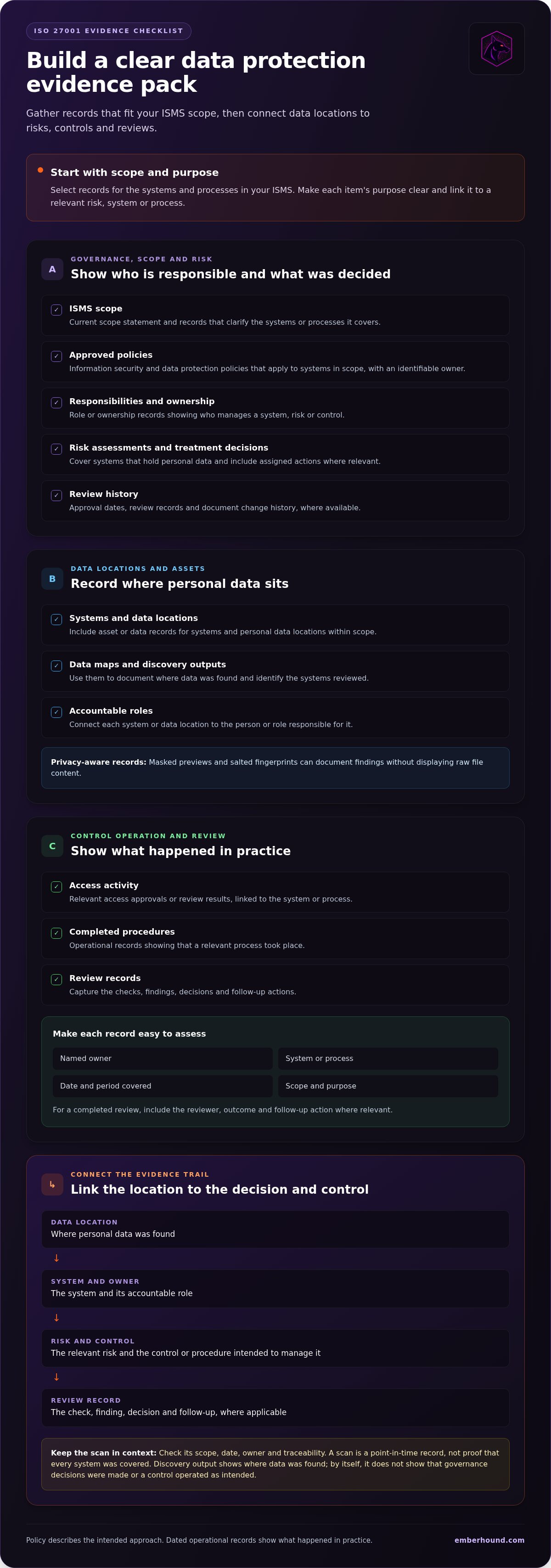
A policy folder records what your organisation intends to do. Auditors also need traceable records showing where personal data sits and how relevant controls operate. Evidence of data protection for ISO 27001 auditors should connect data locations to the risks, procedures and control records that apply to them.
That evidence can be difficult to assemble when personal data is spread across endpoints, mailboxes and files. Teams need to show which systems were reviewed, what the review found and how they handled the results, without exposing raw file contents unnecessarily. A clear evidence register helps keep discovery outputs connected to the wider ISMS records.
This checklist explains what to gather, how to organise it and how to maintain a useful audit trail. It covers discovery results alongside risk assessments, internal audit reports and control documentation. It also explains how masked previews and salted fingerprints can document findings without displaying raw file content.
Key Takeaways
- Build evidence of data protection for ISO 27001 auditors around the systems, decisions and reviews within your ISMS scope.
- Select records that fit your organisation's scope and ISMS, such as approved policies, risk assessments, assigned responsibilities and review records.
- Check discovery results for scope, date, owner and traceability. Treat each scan as a point-in-time record, not proof that every system was covered.
- Link each evidence item to a control, system, date and accountable role so its context is clear.
- Use endpoint discovery to document where sensitive data was found, alongside records showing how your ISMS is managed.
What data protection evidence do ISO 27001 auditors need?
A set of records can show what falls within the ISMS scope, which risks the organisation has considered, how relevant controls operate and how their operation is reviewed. Evidence of data protection for ISO 27001 auditors should support specific claims about your organisation's processes. The records help explain those claims, while the auditor assesses them against the audit scope and criteria.
Audit evidence is dated, attributable information that supports a specific control claim. A record is easier to assess when it names its owner, identifies the system or process it concerns and states the period it covers. A policy describes the intended approach; an operational record shows what happened in practice.
How ISO 27001 evidence relates to personal data
ISO/IEC 27001 sets requirements for an information security management system, or ISMS, covering information security within the organisation's defined scope. GDPR focuses on personal data and the rights of individuals. The frameworks overlap where risk management and security measures concern personal data, but they have different requirements. ISO 27001 certification covers the stated ISMS scope; it does not establish that every data protection obligation has been met. The ISO/IEC 27001 Wikipedia overview provides background on the standard and the purpose of an ISMS.
Keep related evidence connected, while making clear what each record demonstrates. ISMS records show how security risks are assessed and controls are managed. Personal data records help identify where personal data is held and how related risks are addressed. Choose records that reflect your organisation's scope and processes.
What a data protection evidence trail should connect
Trace each data location to the decision and control that apply to it. For example, a record of personal data on an endpoint should identify the system, its accountable owner, the relevant risk and the control or procedure intended to manage that risk. A scan output can document the location. It cannot show by itself that governance decisions were made or that a control operated as intended.
Group records by what they demonstrate:
- Policy: the approved approach and its owner.
- Risk: recorded assessments, decisions and assigned treatment actions.
- Asset or data records: systems, data locations and accountable roles within scope.
- Control operation: records showing that a relevant process took place, such as an access review or completed procedure.
- Review: records of checks, findings, decisions and follow-up actions.
Use references to connect related records. A policy can point to a procedure, which can point to a review record that identifies the systems covered. This helps reviewers follow the link between a written process and the activity carried out. Discovery outputs show where data was found; governance records explain who is responsible and how associated risks are managed.
Which data protection records should you assemble for an ISO 27001 audit?
Build an evidence pack around the systems and processes in your ISMS scope. No single document set applies to every organisation. Select records that show how personal data is governed in your environment, and make each item's purpose clear. Evidence of data protection for ISO 27001 auditors may include policies, risk assessments, ownership records, data maps, control activity and reviews. Each item should relate to a relevant risk, system or process.
A documented control describes what should happen; dated evidence shows whether and how it happened. A policy may set out an access review process. A completed review record can show its date, scope, reviewer, outcome and follow-up action. Collect records that support the controls in your ISMS, rather than adding documents without a clear purpose.
Governance, scope, and risk records
Begin with records that explain responsibilities and decisions. Check that each item has an identifiable owner and, where relevant, an approval or review date. For policies and risk records, retain enough context to connect the decision to systems that hold personal data.
- ISMS scope: the current scope statement and records that clarify the systems or processes it covers.
- Approved policies: information security and data protection policies that apply to systems in scope.
- Responsibilities: role or ownership records showing who manages a system, risk or control.
- Risk records: assessments and treatment decisions covering systems that hold personal data, with assigned actions where relevant.
- Review history: approval dates, review records and change history for these documents, where available.
Use records that reflect your actual ISMS. A policy without a clear owner or current status can be difficult to interpret. If a system or process has changed, include the relevant change or review record where one exists. In complex environments such as consumer financial services, teams navigating risk management and regulatory compliance often consult specialists such as versapien.com to help design and maintain robust governance frameworks.
Operational records and data location evidence
Next, gather records showing relevant controls in use. The right examples depend on the controls and systems in scope. Connect each record to a named system or process, a date and an accountable role. For organisations exchanging commercial documents and transactional records via platforms like 123 EDI, tracking automated transmission logs and partner access permissions provides essential proof of secure data processing. A log extract or completed review is easier to assess when its scope and purpose are clear.
- Access records: relevant access approvals or review results.
- Change and incident records: entries tied to systems and processes in scope.
- Data maps or discovery results: records of data locations, systems or devices, file types, owners and business context.
- Follow-up records: actions taken after a review, finding or identified risk.
Use a data map to connect a location, such as an employee endpoint, with its owner and business use. Discovery results can help identify locations for the map, while governance records explain how those locations are managed. For a wider preparation process, the GDPR data audit guide covers the broader data audit context.
If endpoint locations are missing from your records, a free endpoint scan can provide discovery results to review alongside your ISMS evidence.
How can you judge whether data discovery evidence is useful to an auditor?
A data discovery result is useful when its scope, source and follow-up are clear. For each record, ask: which systems were included, when was the record created, who owns it, and can it be traced to a system or process? No evidence format guarantees acceptance. The goal is to make each record clear enough to review and accurate enough to support the control claim.
Different sources answer different questions. A manual inventory can record business context and ownership, but it relies on updates from staff. System records show activity within a particular platform, but may not identify data held elsewhere. Scan outputs can help locate sensitive data in the locations scanned, but they do not show whether every system was included. Use sources together when each adds distinct information.
- Manual inventory: check its owner, last review date, stated coverage and how changes are recorded.
- System records: identify the system that produced the record, the period covered and the control activity it relates to.
- Scan output: record the locations included, scan date, method and known exclusions or errors.
A scan result describes what the scan detected within its scope at that point in time. It does not establish that every endpoint, mailbox or other storage location was covered, or that data locations have stayed the same since. Record scope limits alongside the result so readers can distinguish a partial view from a complete inventory.
Evidence quality checks: scope, provenance, and review
Before filing a discovery result, capture its source and context. List the endpoints or locations included, as well as those outside scope. Record the run date, responsible owner, method and relevant configuration details that explain what the scan could detect. Then record what happened next: who reviewed the results, how corrections were made and whether an issue was escalated. Link the review record to the scan output.
Traceability helps when two records conflict. If a manual inventory says a file store contains no personal data but a scan identifies a potential match on an endpoint, record how the owner assessed the difference. The result may need correction, investigation or a documented explanation. Keep the original finding and record any later changes.
Protecting personal data inside the evidence pack
Audit materials need enough detail to explain a finding without copying sensitive file contents unnecessarily. Use masked previews or salted SHA-256 fingerprints when they provide sufficient context. Restrict access to raw files, and record who can view evidence and any changes made to it. EmberHound Discover processes endpoint scans locally, with no file exfiltration. Its evidence can include masked previews and salted fingerprints. Details of its security practices are on the EmberHound trust page.
What is a practical checklist for preparing data protection evidence?
A repeatable process keeps evidence tied to the systems and controls it describes. Use one register to track records, owners, review status and gaps. Make each item traceable and safe to share, and record gaps plainly instead of presenting the pack as complete when it is not.
A repeatable evidence preparation sequence
Work through these steps in order. Assign an owner to each action and record progress in the evidence register. The register gives the team one place to see what is ready, what needs review and where follow-up is required.
- Confirm scope. Record the audit scope, the systems and locations included, and the period under review. Note exclusions so the evidence set has clear boundaries.
- Assign evidence owners. Name the role responsible for each system or record. Agree who will gather the evidence and who will review it.
- Map claims to records. For each control claim, identify the relevant system, supporting evidence, date and accountable role. Keep each record connected to its context.
- Gather existing material. Collect applicable policies, risk records, system inventories and operational records. Use current versions and include dates or status information where available.
- Record data locations. Add relevant data maps or discovery outputs to the register. Record the locations they cover and any known limits.
- Log gaps and follow-up. Mark missing, outdated or unclear evidence plainly. Add an owner and next action. A gap in the evidence set does not, by itself, prove that a control failed.
- Review and assign status. Check each item for accuracy, context and appropriate access. Record whether it is ready, needs clarification or is awaiting follow-up.
Keep the register concise. Useful fields include evidence reference, control or claim, system, date, owner, scope, review status and follow-up action. Mark unavailable records as unavailable instead of suggesting that another document proves the same activity.
Review the pack before sharing it
Before sharing, check that each item relates to the audit scope and identifies its source, date and owner. Remove personal data the reviewer does not need, and apply appropriate access restrictions to evidence files. For teams still mapping where personal data may sit, the GDPR data discovery guide explains discovery basics. Keep the evidence register with the pack so status and ownership remain clear.
Check whether another team member can follow the link from a control claim to its supporting record. Fix broken references, unclear dates and unexplained exclusions before sharing. Record any changes made during the review.
Where does EmberHound Discover fit in an ISO 27001 evidence workflow?
EmberHound Discover provides an endpoint-level view of sensitive data locations for your evidence workflow. Use findings to identify records that need owner review, then connect relevant results to the systems and risks documented in your ISMS. This gives your team a way to compare its data location records with findings from the endpoints in scope.
What Discover can contribute to the evidence workflow
After a scan, review the findings with the people responsible for the affected systems. They can confirm the business context, note differences from existing records and decide whether a risk or control record needs attention. In your evidence register, reference each finding alongside its review outcome and accountable role. This records the hand-off from discovery to organisational decision-making.
Discover's endpoint findings are one input to the evidence trail. Keep them with records explaining how your organisation manages related risks and controls. A scan does not establish that the full ISMS meets ISO 27001 requirements or replace organisational review, risk decisions and control ownership.
What a data discovery scan cannot establish on its own
Use results within the scan's recorded scope. They describe the endpoints assessed, not every possible location across the organisation. Your team decides whether other systems or storage locations need separate coverage and records those decisions. The pricing page explains usage-based access and the free-scan entry point for teams beginning with endpoint discovery.
Keep your evidence trail useful between audits
Make evidence maintenance part of routine security work. After a system change, scan or risk review, update the affected records and assign an owner to follow up on open questions. This keeps evidence of data protection for ISO 27001 auditors connected to current systems and decisions, rather than leaving it in a folder assembled once and forgotten.
Set an internal checkpoint to review the evidence register. Confirm that owners can still access the records, scope notes remain accurate and outstanding actions have a status. Regular updates reduce the work involved in rebuilding the trail during audit preparation.
Secure handling matters for endpoint discovery. EmberHound uses TLS 1.3 in transit and AES-256 encryption at rest. A scan gives your team endpoint findings to review and assess for the evidence workflow.
Start with a clear scope and a named owner. Build the evidence process one record at a time with an EmberHound scan.
Frequently Asked Questions
What evidence do ISO 27001 auditors usually ask to review for data protection?
Requests vary by audit scope and the processes or systems under review. Use the audit plan to prepare an index of relevant records, and retain the source material behind any extracts or summaries. This helps your team explain how an item was produced if the reviewer needs more context.
Is an ISO 27001 certificate proof that an organisation complies with GDPR?
No. A certificate should not be presented as proof of full GDPR compliance. Check the certificate's stated scope before referring to it, especially if the organisation has several legal entities, services or operating units. Describe only the ISMS covered by the certificate. Assess the organisation's wider data protection responsibilities separately.
Can a data discovery scan count as ISO 27001 audit evidence?
Yes. A scan can show that a discovery activity took place and produced particular findings. Keep the original output separate from later interpretation so a reviewer can distinguish the tool's result from the organisation's assessment. Evidence of data protection for ISO 27001 auditors is clearer when a reviewer can trace a finding to its analysis, decision and any resulting action.
What should a data protection evidence register include?
Give each item a stable reference that remains the same when the register is sorted or updated. Record where the source file is stored and whether the entry points to an original, an extract or a working copy. Use consistent status labels and define each one briefly. This helps colleagues interpret entries and locate the right version.
How can an organisation share audit evidence without exposing personal data?
Prepare a review copy and keep the source record separate. Before sharing, check the copy for hidden spreadsheet tabs, document comments, tracked changes and metadata that may contain information outside the visible page. Use an approved transfer route and check recipient permissions before granting access. Record what was shared and withdraw access when it is no longer needed under your organisation's process.
How often should data protection evidence be reviewed for an ISO 27001 audit?
Set review triggers as well as calendar reviews. For example, reassess affected records when a business unit starts a new personal data process, a supplier relationship changes or a system is retired. These events can make an accurate record outdated. Define who checks each trigger and how the outcome is recorded, so reviews form part of change decisions rather than happening only during audit preparation.


