

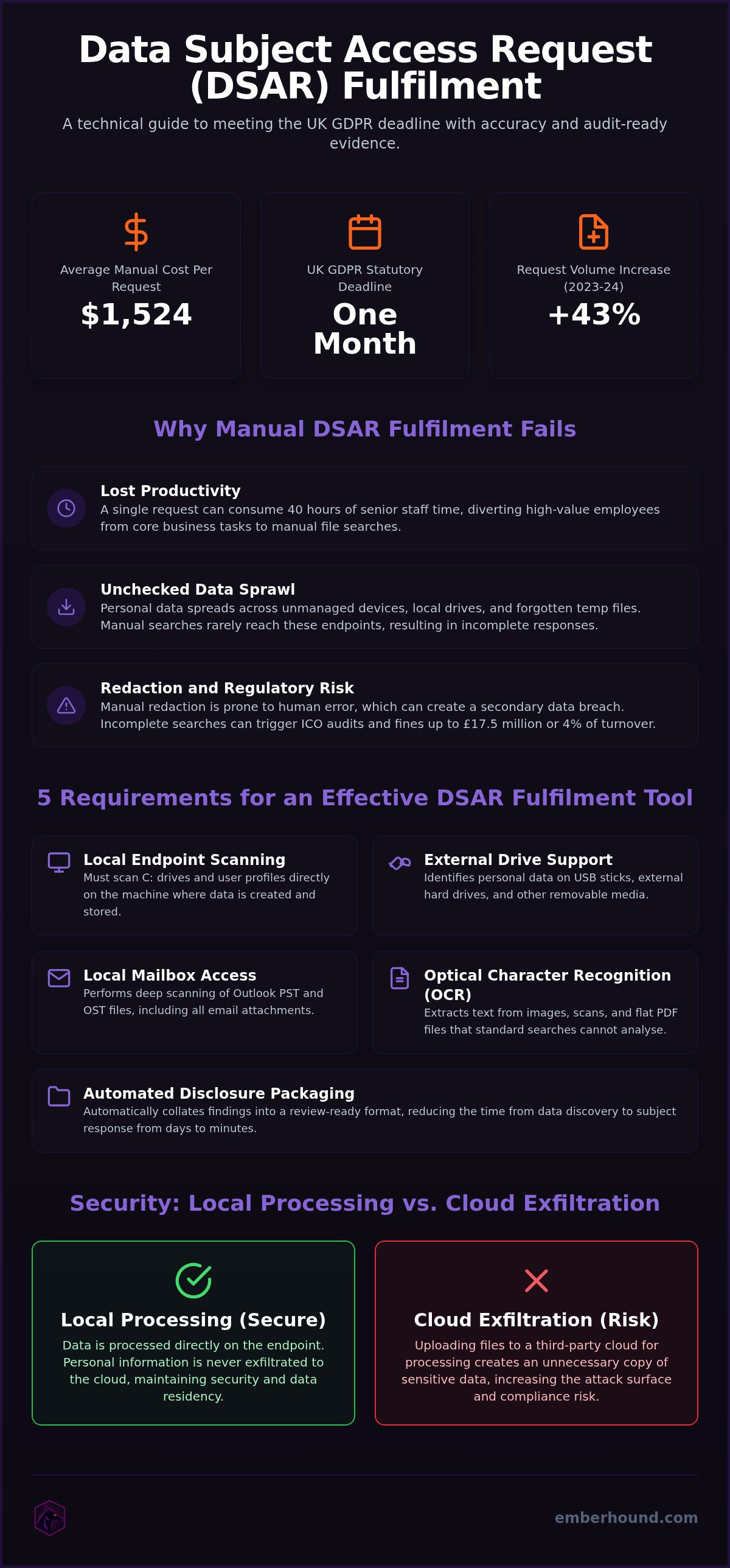
The average cost to manually fulfil a single Data Subject Access Request (DSAR) is $1,524. With request volumes increasing by 43% between 2023 and 2024, the manual approach is no longer a viable strategy for lean teams. You need a fast DSAR fulfillment tool that identifies personal data across all endpoints without the friction of enterprise bloat. The statutory deadline under UK GDPR is one calendar month. It is a hard limit that does not pause whilst you search through local mailboxes or external drives.
You understand the stress of the one-month countdown. It's a high-stakes race against regulatory expectations where manual errors lead to non-compliance. This article explains how to select a tool that provides audit-ready evidence for the Information Commissioner's Office (ICO) without the burden of long-term contracts. We provide a practical checklist to help you locate personal data quickly and meet legal deadlines with certainty. You'll learn to automate discovery and secure your process with a tool that is easy to deploy and built for speed.
Key Takeaways
- Meet the statutory one-calendar-month deadline by replacing manual folder searches with automated discovery across all network endpoints.
- Locate personal data within images and scanned documents by using a tool that includes OCR scanning as a core feature.
- Maintain security by selecting a fast DSAR fulfillment tool that processes data locally on the endpoint instead of exfiltrating files to the cloud.
- Create audit-ready evidence for the ICO by following a methodical 6-step workflow for request scoping and data identification.
- Reduce compliance overhead with a usage-based pricing model that eliminates the need for expensive, long-term enterprise contracts.
The 30-Day Countdown: Why Manual DSAR Fulfilment Fails
The UK GDPR mandates a response window of one calendar month. This is a non-negotiable deadline. Manual discovery forces your team to open every folder, document, and local mailbox across the network. It is a slow, error-prone process that drains IT and compliance resources. Relying on human memory or basic Windows search functions is a high-risk strategy. A fast DSAR fulfillment tool is necessary to move from guesswork to certainty. Missing a single file containing personal data can lead to immediate regulatory scrutiny.
The Hidden Costs of Manual Data Discovery
Staff hours are the most visible cost. A single request can consume 40 hours of senior staff time. This translates to significant lost productivity and high operational overheads. Data sprawl compounds this problem. Personal data often resides in unexpected locations, such as external hard drives or forgotten temp files. Manual searching rarely reaches these endpoints. Manual redaction is another bottleneck. It increases the likelihood of accidental disclosure. A single oversight creates a secondary data breach during the fulfilment process.
- Lost Productivity: High-value employees spend days on file discovery instead of core business tasks.
- Data Sprawl: Personal data spreads across unmanaged devices and local drives over time.
- Redaction Risk: Manual highlighting of text is prone to human fatigue and oversight.
Regulatory Risks and the ICO
The Information Commissioner's Office (ICO) requires a thorough and proportionate search for personal data. Incomplete responses lead to formal complaints. If a data subject knows you hold their data but you fail to produce it, they will escalate. "We could not find it" is not a valid legal defence in the eyes of the regulator. If the data exists on your hardware, you are legally responsible for its discovery. Using a fast DSAR fulfillment tool ensures you can prove the depth of your search with audit-ready logs.
Incomplete responses often trigger wider audits. This turns a single request into a review of your entire data governance framework. The ICO has the power to issue fines of up to £17.5 million or 4% of global turnover for serious failures. Even for smaller organisations, the administrative burden of an investigation is enough to halt operations. Efficiency is not just a preference - it is a regulatory requirement.
Checklist: 5 Requirements for an Effective DSAR Fulfilment Tool
Selecting a fast DSAR fulfillment tool requires more than looking at a price tag. You need a technical solution that addresses where data actually lives. Most enterprise platforms focus on cloud storage, but significant personal data remains on local hardware. To ensure your search is thorough, your tool must meet five specific technical standards. These requirements ensure that your response is both accurate and legally defensible if challenged by the ICO.
- Local Endpoint Scanning: The ability to scan C: drives and user profiles directly on the machine.
- External Drive Support: Identification of personal data on USB sticks and external hard drives.
- Local Mailbox Access: Deep scanning of Outlook PST and OST files, including their attachments.
- Optical Character Recognition: Extraction of text from images and flat PDF files that standard searches miss.
- Disclosure Packaging: Automatic collation of findings into a review-ready format for the data subject.
OCR and Image-Based Data Discovery
Personal data is frequently trapped in non-text formats. Think of scanned driver's licences, passport copies, or screenshots of customer chats. Standard file search tools only look at filenames or metadata. They are blind to the content inside a JPG or a flat PDF. An effective tool uses OCR to "read" these images. Without this capability, your DSAR response is incomplete. You risk a formal complaint because you failed to identify data that was physically present on your network. A thorough search must include every image file on the device.
Automated Disclosure Packs
Once you find the data, the clock is still ticking. Organising hundreds of files into a readable format for the requestor is a slow, manual process. A fast DSAR fulfillment tool should generate a disclosure pack automatically. This pack should include masked previews. This allows your compliance team to review the findings without exposing raw file content prematurely. It reduces the time to response from days to minutes. You can start a free scan to see how these disclosure packs are formatted before you commit to a full search.
Efficiency comes from reducing the number of steps between receiving a request and sending the data. If your tool requires you to manually move files or re-type information, it isn't truly fast. It's just another administrative burden. Look for a solution that handles the heavy lifting of discovery and collation in one motion. This ensures you meet the one-month deadline without pulling your IT team away from their primary responsibilities.
Data Privacy and Local Processing: The Security Question
Many compliance tools exfiltrate data to the cloud for analysis. This creates a new security risk. You are moving sensitive personal data out of your protected network to a third-party server. It is a counter-intuitive approach to privacy. A fast DSAR fulfillment tool should prioritise local processing. Scanning data at the source is faster than uploading terabytes of files to a remote dashboard. It eliminates the latency of large transfers. It also ensures you maintain total control over the data subject's information during the entire discovery phase.
Local Scanning vs Cloud Exfiltration
Local scanning minimises the attack surface of your business. If data never leaves the endpoint, it cannot be intercepted in transit or compromised in a cloud breach. EmberHound performs all processing locally on the endpoint. This design choice removes the need for complex data processing agreements with cloud providers. Security is baked into the architecture through TLS 1.3 and AES-256 encryption at rest. These are non-negotiable standards for any modern IT environment. You get the visibility you need without the liability of external storage.
Processing at the source is about velocity. Whilst cloud tools struggle with large volumes, a fast DSAR fulfillment tool starts discovery instantly. It uses the device's own hardware to index and identify personal data. This allows you to scale your response across hundreds of machines simultaneously without bottlenecking your internet bandwidth.
Maintaining an Audit Trail
Regulators require proof of a thorough search. You need more than just a list of files. You need a defensible record of what was scanned and when. Salted SHA-256 fingerprints provide this proof of discovery. They create a unique digital signature for every file without revealing the actual data content. This allows you to present a verifiable log to the ICO while keeping the raw data private. It is a pragmatic way to demonstrate compliance.
Comprehensive audit logging is essential for a defensible response. These logs must be immutable. They provide a chronological history of the discovery process that cannot be altered after the fact. If a data subject challenges your response, these logs are your primary defence. They show you followed a methodical process. They prove you checked the local mailboxes and external drives mentioned in earlier sections. Reliable evidence is the difference between a closed case and a formal audit.
6 Steps to Speed Up Your DSAR Workflow
Speed depends on your process as much as your software. A fast DSAR fulfillment tool only works if you have a clear operational path. You must move from the initial request to the final disclosure without second-guessing your data locations. This 6-step workflow eliminates bottlenecks and keeps you within the statutory one-month window. It turns a reactive crisis into a repeatable technical procedure.
First, define the scope. Identify the data subject using all known identifiers, such as personal email addresses or employee numbers. Second, deploy your discovery scan. This should cover all relevant endpoints, including local drives and external hardware. Third, ensure OCR is active to capture personal data hidden in scanned IDs or screenshots. Fourth, review the findings. Use masked previews to verify the data's relevance without unnecessary exposure. Fifth, generate your disclosure pack. This collates all findings into a structured format. Finally, document the process. Log every step to ensure your response is audit-ready.
Mapping Your Data Landscape
Identifying where data resides is the most difficult part of any request. You must look beyond the central server. Personal data often sits in local mailboxes, desktop folders, and forgotten backups. Prioritise your scanning based on where the subject likely interacted with your business. For example, an ex-employee's data is likely on their specific laptop and in HR mailboxes. You can use the EmberHound GDPR guide to help map your internal data landscape more effectively. This ensures you aren't scanning irrelevant machines whilst the clock is ticking.
Review and Redaction
A fast DSAR fulfillment tool highlights the exact location of personal data within a file. This drastically reduces the time spent on manual redaction. Instead of reading every line, you jump straight to the relevant sections. However, a final human check is essential before disclosure. No tool should replace the final decision-maker. The software finds the data; you confirm its relevance. This dual approach ensures accuracy whilst maintaining the speed required to meet legal deadlines. It protects your business from accidentally disclosing third-party information.
Documentation is your safety net. If a subject claims your response was incomplete, your compliance log proves otherwise. It should record the search parameters, the devices scanned, and the timestamps for each action. This level of detail turns a stressful request into a routine administrative task. It provides the confidence you need to handle increasing request volumes without expanding your team. You move from fear of the ICO to a position of documented readiness.
EmberHound: Fast DSAR Fulfilment Without Manual Labour
EmberHound is a data discovery platform built for lean IT and compliance teams. It locates personal data across all endpoints. No manual folder searching. No opening every document. It is a fast DSAR fulfillment tool that delivers results immediately. We built it for professionals who are tired of enterprise bloat. You get technical accuracy without the administrative weight.
Forget mandatory annual commitments. We use usage-based pricing. You only pay for what you scan. There are no mandatory long-term contracts. Many enterprise platforms demand five-figure annual fees before you run your first discovery scan. EmberHound removes that barrier. It is a pay-as-you-go model that respects your budget and your time. You can start finding personal data today without a board-level procurement battle.
Pragmatic Compliance for UK SMEs
Avoid the deployment drama. Many platforms take months to configure. They require complex integrations and heavy consulting fees. EmberHound is different. It is an accessible solution that provides technical accuracy without the friction. You can deploy it across your network and start finding personal data in minutes. Check our pricing options to see how the platform scales with your specific request volume. It is compliance that fits your business - not the other way around.
Ready to Start Your Scan?
The best way to understand your exposure is to see the data. A free GDPR scan identifies personal data on your network without any upfront cost. It reveals what manual searching misses. You can also book a video demo to see the DSAR disclosure pack in action. See how the platform collates findings and prepares them for the data subject. It is a transparent, high-velocity approach to compliance. This fast DSAR fulfillment tool removes the guesswork from your workflow. Stop searching through folders. Start scanning today.
Secure Your 30-Day Window
Manual data discovery is a liability you can't afford. The one-month statutory deadline is a hard limit. Human searching is simply unsustainable for lean teams when the average cost per request reaches $1,524. You need a fast DSAR fulfillment tool that prioritises local scanning to keep sensitive data within your network. By automating the discovery of personal data across all endpoints and local mailboxes, you eliminate the risk of oversight and the burden of manual redaction.
Local-only processing ensures maximum security whilst salted SHA-256 fingerprints provide the audit-ready evidence the ICO expects. You don't need expensive enterprise contracts or months of configuration to achieve this level of technical accuracy. Pragmatic compliance is about using the right tools at the right time. Our usage-based pricing ensures you only pay for the scans you actually run. It's a no-nonsense approach to a high-stakes requirement.
Take control of your data landscape before the next request arrives. It's time to replace manual labour with technical certainty.
Frequently Asked Questions
What is the deadline for a DSAR in the UK?
Organisations must respond to a subject access request without undue delay and at most within one calendar month of receipt. This is a hard deadline under the UK GDPR. You can extend this by a further two months if the request is complex or you receive numerous requests from the same individual. You must inform the data subject of the extension within the first month. Clear documentation of your reasoning is required to satisfy the ICO.
Can I charge a fee for a subject access request?
You cannot charge a fee for fulfilling a DSAR in most circumstances. The UK GDPR mandates that information must be provided free of charge. You may only apply a reasonable fee to cover administrative costs if a request is manifestly unfounded or excessive. This applies mostly to repetitive requests for the same data. If you choose to charge, you must be prepared to justify the cost to the regulator based on actual administrative labour.
How do I find personal data in scanned images?
Finding personal data in images requires Optical Character Recognition (OCR) technology. Standard search tools only index filenames or metadata, leaving scanned IDs and screenshots invisible. A fast DSAR fulfillment tool uses OCR to read the text within these flat files. This ensures you capture data that would otherwise be missed. It turns unsearchable images into readable evidence, which is essential for a thorough and legally compliant discovery process.
What is a DSAR disclosure pack?
A DSAR disclosure pack is the final collection of personal data prepared for the requestor. It must be easy to understand and well-structured. The pack includes the actual data records along with details on why the data is held and which third parties have accessed it. Preparing this manually is slow. Automated tools collate these findings into a review-ready format, allowing your team to verify the contents before final disclosure to the individual.
Does DSAR automation software exfiltrate my files?
Many cloud-based tools upload your files to external servers for analysis. This creates a secondary security risk for sensitive information. EmberHound operates as a local-only scanner, ensuring all data processing stays on your endpoints. No raw files ever leave your network or upload to the cloud. This design maintains your security posture whilst providing the visibility needed for compliance. It is a safer approach for businesses handling high-risk personal data.
How do I handle employee DSARs vs customer DSARs?
Employee requests are typically more complex than customer queries. They involve internal emails, local files, and chat logs that often reside on specific hardware. A fast DSAR fulfillment tool must be able to scan local mailboxes and hard drives to capture these internal communications. Customer data is often centralised in a CRM, but employee data is scattered. You need a tool that reaches every endpoint to ensure your search is truly exhaustive.


