

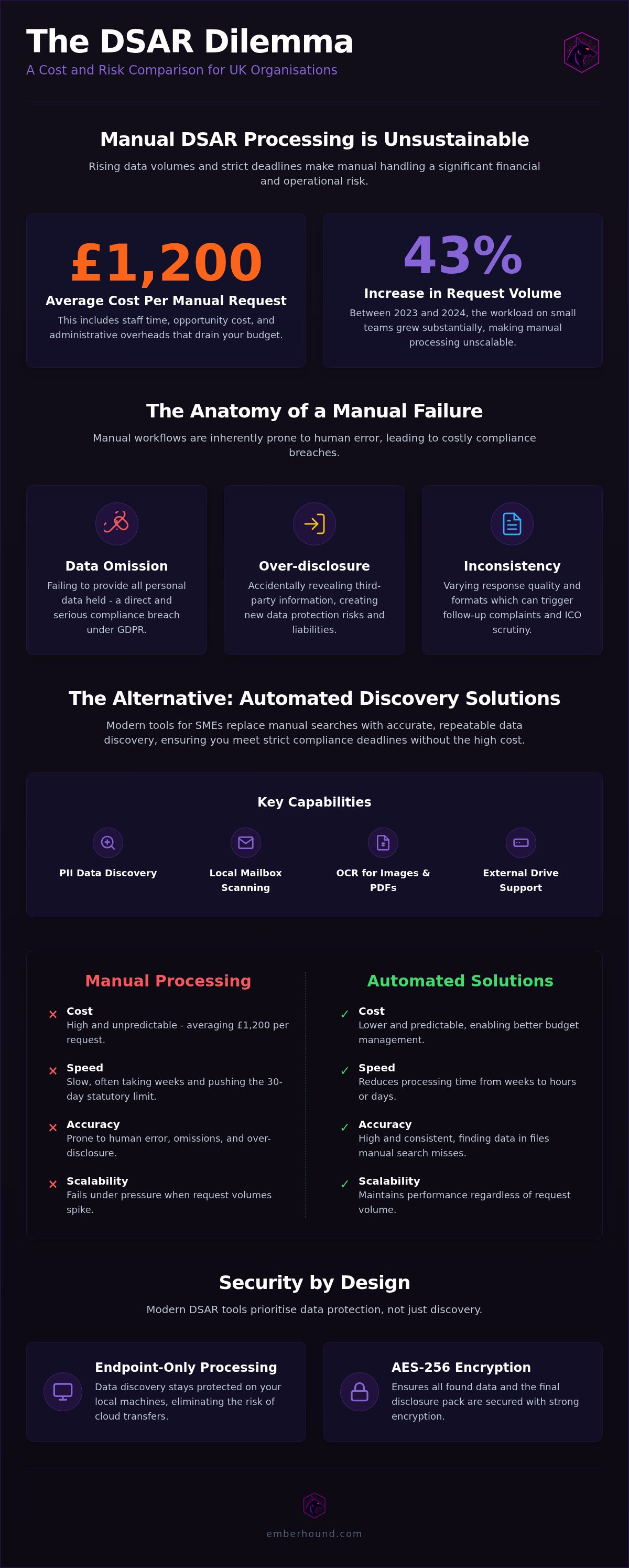
UK businesses now spend an average of £1,200 to process a single data subject access request. With request volumes increasing by 43% between 2023 and 2024, the financial burden of manual handling is no longer a sustainable line item. You know the pressure. Your team spends hours scouring mailboxes and external drives, yet the risk of a missed deadline or a compliance oversight remains high. It's an expensive, high-stakes grind that drains your budget and your staff's time.
You need a better way to handle these requests without the constant fear of regulatory fines. We provide a direct comparison of the leading alternatives to manual DSAR processing available in 2026. You'll learn how to move away from spreadsheet-based tracking and toward automated systems that lower costs and ensure you meet strict GDPR deadlines. We examine automated PII data discovery, OCR scanning, and dedicated disclosure packs to help you choose the right fit for your organisation. It's time to stop overpaying for compliance and start protecting your bottom line.
Key Takeaways
- Manual DSAR processing costs UK organisations an average of £1,200 per request. Understand why rising data volumes make this manual approach a significant financial and operational risk.
- Compare the most effective alternatives to manual DSAR processing for 2026. We examine how automated PII discovery and OCR tools replace slow, error-prone mailbox searches.
- Follow a structured guide to transition your team from spreadsheets to automation. Learn how to identify current bottlenecks and select a tool that integrates with your existing data environment.
- Review quantifiable results from SMEs that switched to automated compliance. These case studies show how to reduce processing time whilst maintaining strict GDPR alignment.
- Discover the security advantages of endpoint-only processing and AES-256 encryption. These features ensure data discovery stays protected without the need for risky cloud transfers.
Why Manual DSAR Processing Isn't Sustainable Anymore
Manual DSAR processing is a drain on your resources. It's slow. It's expensive. It's prone to failure. In 2026, relying on human effort to find, redact, and package data is a strategy for burnout. Regulatory pressure is mounting. GDPR response times remain strict. You have exactly one month to respond to a request. One month to find every scrap of personal data across mailboxes, local drives, and servers. If you miss that window, the Information Commissioner's Office (ICO) doesn't care how hard your team worked. They care about the breach.
The volume of requests is climbing. Between 2023 and 2024, DSAR volume increased by 43%. Small teams are feeling the weight. You can't hire your way out of this problem without destroying your margins. Seeking alternatives to manual DSAR processing is no longer a luxury for the enterprise - it's a survival requirement for SMEs.
The Financial and Time Costs of Manual DSARs
The numbers are stark. UK businesses spend between £70,000 and £330,000 annually on compliance according to industry data. A single manual request averages £1,200. This isn't just about the salary of the person doing the work. It's about the opportunity cost. It's about pulling your IT lead away from critical security projects to search for an ex-employee's emails. You can find more detail on these requirements in our GDPR guide. The time taken to fulfil requests manually often stretches to the limit of the statutory deadline, leaving zero room for error. If a request is complex, your team is already underwater.
Common Errors in Manual Processing
Humans make mistakes. They miss attachments. They forget to check external hard drives. They overlook data buried in image files or scanned PDFs. These aren't just minor oversights; they are compliance breaches that invite regulatory scrutiny. Inconsistent response times and data omission risks are inherent to manual workflows. Common failures include:
- Data omission - failing to provide all personal data held.
- Over-disclosure - accidentally revealing third-party information.
- Inconsistency - varying response quality that triggers follow-up complaints.
Searching for alternatives to manual DSAR processing isn't just about speed. It's about accuracy. Manual workflows can't scale. When request volumes spike, manual systems break. You need a process that remains predictable regardless of how many requests land in your inbox.
Exploring Automated DSAR Processing Solutions
The market for alternatives to manual DSAR processing has split into two distinct paths. On one side, you have enterprise-grade legacy platforms designed for multinational corporations with thousands of data streams. These tools often require six-figure annual budgets and months of configuration. On the other side, agile solutions focus on the specific needs of SMEs. These tools prioritise speed, ease of deployment, and immediate visibility into local data stores. For a small team, the choice is clear. You don't need a platform that takes more time to manage than the DSAR itself.
Categorising the Solution Landscape
Enterprise legacy platforms offer extensive features, but their complexity is often a barrier for leaner organisations. They are built for extreme scale, not necessarily for speed of response in a small IT environment. Often, these large systems require dedicated personnel just to maintain the software. In contrast, agile discovery tools focus on the practical realities of finding data where it actually lives. Key capabilities to look for include:
- PII Data Discovery: Automatically identifying personal information across diverse file types.
- Local Mailbox Scanning: Directly searching Outlook and other email clients without complex server-side integrations.
- OCR Scanning: Reading text within images and PDFs, a common blind spot in manual searches.
- External Drive Support: The ability to scan external hard drives and local storage where data often hides.
These features ensure you aren't just moving the manual work into a different interface. You are removing the human element from the search process entirely.
Choosing the Right Tool for Your Organisation
Don't buy more software than you can use. High-cost bloatware often sits idle because the implementation is too taxing for overworked IT staff. When evaluating alternatives, consider your specific data footprint. Do you store most data in the cloud, or is it scattered across employee laptops and local servers? If your data is decentralised, you need a tool that performs endpoint-only processing. This keeps data on the machine, using AES-256 encryption to maintain security whilst you work.
Integration is the second hurdle. A tool that requires a complete overhaul of your file system is a liability. Look for solutions that plug into your existing behaviour. If you're ready to see how automation fits your workflow, you can test a free configuration to see the speed for yourself. The goal is to move beyond the slow, error-prone habits of the past whilst guaranteeing you never miss a GDPR deadline again.
Step-by-Step Guide to Transitioning from Manual to Automated DSARs
Transitioning from manual workflows to automation isn't just a software upgrade. It's a fundamental shift in how your organisation handles risk. You've seen the costs. You've felt the pressure of the 30-day clock. Now, you need a plan to stop the manual grind. This isn't about adding another layer of bureaucracy. It's about stripping it away. The goal is a process that is predictable, repeatable, and fast.
Evaluating Your Current DSAR Process
Start with an honest audit. Track every minute your team spends on a single request. Don't just count the time spent writing the final response. Include the hours spent searching mailboxes, scanning external hard drives, and manually redacting third-party names. Most SMEs discover that data discovery is their biggest bottleneck. Identify where the process stalls. Is it the volume of files? Is it the difficulty of searching legacy systems? You need to know exactly where the friction lives before you can remove it.
Once you've mapped the friction, set concrete targets. Aim to reduce your processing time by 70% or more. This clarity helps you filter through alternatives to manual DSAR processing. You aren't looking for a complex platform to manage your problems. You're looking for a specific tool to solve them. You can see how this looks in practice with a video demo of automated discovery. Setting a goal to lower that £1,200 average cost per request gives your team a clear metric for success.
Implementing Automated Solutions
Selection is critical. Pick a tool that handles PII data discovery and OCR scanning out of the box. Avoid solutions that require months of professional services to install. A phased roll-out is the safest path. Start with one department or one specific data source, such as local mailboxes. This allows you to verify the accuracy of the automated results against your old manual checks without overwhelming your staff.
Training should be brief and functional. Your team doesn't need to be experts in the underlying code. They need to know how to trigger a scan, review the findings, and generate a disclosure pack. Focus on the results. Show them how a task that took two days now takes twenty minutes. Monitor the first five requests closely. Adjust your search parameters to ensure you're capturing everything whilst avoiding over-disclosure. This methodical approach builds confidence. It turns compliance from a dreaded manual chore into a repeatable, high-speed process. Seeking alternatives to manual DSAR handling is the only way to stay ahead of the 43% year-on-year increase in request volumes.
Real-World Examples of DSAR Automation Success
Theory doesn't stop ICO fines. Results do. Moving from manual workflows to automated systems is the only way to handle the 43% increase in request volumes seen between 2023 and 2024. Organisations that continue to gamble on human memory and manual searches are essentially waiting for a compliance failure. By examining alternatives to manual DSAR processing in practice, the financial and operational benefits become clear.
SME Success Stories
A UK-based professional services firm with 60 employees found itself overwhelmed by requests from former staff. Their manual process was a disaster. Two senior managers were spending 20 hours per request searching through Outlook and local file shares. At an average manual cost of £1,200 per DSAR, the firm was losing thousands in billable time every month. They replaced this grind with automated PII data discovery and local mailbox scanning. The result was immediate. Their response time dropped from 22 days to just under three hours. They moved from a state of constant panic to a predictable, repeatable workflow.
Enterprise-Level Implementations
In larger organisations, the primary friction point is data fragmentation. A regional logistics group struggled with personal data scattered across hundreds of endpoints and external hard drives. Manual searches were incomplete, leaving the organisation vulnerable to "right to access" complaints. They transitioned to an automated system that utilised OCR scanning to identify data within legacy PDFs and image files. This shift reduced engineering involvement in routine fulfilment by 70% whilst ensuring that nothing was missed. The implementation proved that alternatives to manual DSAR handling aren't just about speed; they are about technical precision that humans cannot match at scale.
The lesson from these implementations is simple. Integration with existing IT infrastructure does not have to be a months-long project. By focusing on endpoint-only processing and local scanning, these businesses avoided the "bloatware" typical of enterprise platforms. They gained visibility into their data without disrupting their daily operations. You can find more about why this approach works for lean teams on our why us page. Efficiency is the best defence against regulatory pressure.
EmberHound's DSAR Automation: Offering a Competitive Edge
Manual DSAR processing is a liability. It's an expensive, slow, and error-prone distraction for your IT and compliance teams. EmberHound provides practical alternatives to manual DSAR handling by focusing on the technical reality of where your data lives. We don't offer bloated enterprise dashboards or vague legal consulting. We provide a direct, high-speed solution for GDPR Data Discovery and PII Data Discovery that works on your terms.
Features and Benefits of EmberHound's Solution
Our approach is built on speed and security. Unlike cloud-heavy platforms that require you to move sensitive information, EmberHound utilises endpoint-only processing. Your data stays on your local machines. We protect every scan with AES-256 encryption to ensure your compliance efforts don't create new security risks. Key features include:
- Local Mailbox Scanning: Directly search Outlook and local email stores without complex server integrations.
- OCR Scanning: Identify personal data within images and scanned PDFs that manual searches consistently miss.
- Scan External Hard Drives: Locate PII on peripheral storage and local drives to ensure a complete disclosure pack.
- Combined GDPR + PCI Coverage: Manage both data privacy and payment card compliance within a single, unified workflow.
This technical precision removes the friction from DSAR fulfilment. You stop digging through folders and start generating results. By automating the search for PII, you reduce the time your staff spends on repetitive tasks. It's a cost-effective way to scale your compliance without increasing your headcount.
Customer Success with EmberHound
SMEs are the primary targets for DSAR "fishing expeditions" because they often lack the resources to respond quickly. One UK-based technology provider was spending over 15 hours on every request. They were drowning in manual mailbox searches. After switching to EmberHound, their processing time dropped to under two hours. They used our DSAR Disclosure Pack to automate the redaction and packaging of results, ensuring they never missed a GDPR deadline again.
The feedback is consistent: it's about regaining control. Our clients report that the ability to scan local drives and mailboxes instantly provides a level of visibility that manual processes can't match. You can see these capabilities in action by viewing the EmberHound demo. We provide the tools you need to move from a defensive, panicked posture to a state of calm, professional readiness. Stop overpaying for manual effort and start using a system designed for the realities of 2026. Efficiency isn't just a goal; it's your best defence against regulatory oversight.
Secure Your Compliance Future
The £1,200 average cost of manual DSAR processing is a burden you don't have to carry. We've explored how transitioning to automation protects your budget and your team's time. By moving away from spreadsheets and toward technical alternatives to manual DSAR, you eliminate the human errors that lead to ICO scrutiny. You've seen how SMEs are already dropping their response times from weeks to hours.
Efficiency doesn't mean sacrificing security. Our solution ensures GDPR compliance alignment through endpoint-only processing. Your sensitive data never leaves your control. We use AES-256 encryption to keep your discovery process protected whilst you work. It's a no-nonsense approach to a complex regulatory requirement.
Take the first step toward a faster, more reliable compliance workflow today. You've seen the results others have achieved. It's time to make your process predictable and stress-free.
Frequently Asked Questions
What are DSARs and why are they important?
Data Subject Access Requests (DSARs) are legal requests under GDPR that allow individuals to see what personal data an organisation holds about them. They are critical because non-compliance leads to heavy ICO fines. UK organisations have exactly one month to respond. Failure to provide a full disclosure pack can trigger regulatory audits and reputational damage. It's a fundamental right that requires a precise, timely response every time.
How can automation improve DSAR processing?
Automation replaces manual mailbox searches and file-by-file reviews with high-speed PII data discovery. It removes human error, such as missing an attachment or failing to check a local hard drive. By using alternatives to manual DSAR processing, you reduce the time spent on a single request from days to hours. This efficiency allows your IT team to focus on critical security projects rather than administrative data retrieval and manual redaction.
What features should I look for in a DSAR tool?
Prioritise tools that offer local mailbox scanning and OCR scanning for images and PDFs. You need a solution that handles endpoint-only processing to keep sensitive data on your machines. Look for the ability to scan external hard drives and generate a ready-to-send disclosure pack. Avoid "bloatware" that requires extensive server-side integration. The tool should be lightweight, fast, and easy for your existing compliance staff to operate without constant IT support.
How do automated DSAR tools ensure compliance?
These tools provide a repeatable, audited process that aligns with GDPR standards. They use systematic PII discovery to ensure no personal data is missed across your environment. By automating redaction, they prevent over-disclosure of third-party information. Features like AES-256 encryption protect the data during the search process. This creates a defensible audit trail that demonstrates your organisation's commitment to data privacy and regulatory deadlines whilst reducing total risk.
Is DSAR automation cost-effective for small businesses?
Automation is highly cost-effective because it reduces the time-intensive labour required for every request. Small businesses often lack the headcount to handle the 43% increase in request volumes seen between 2023 and 2024. Automation prevents you from hiring additional compliance staff or pulling senior engineers away from their core work. By choosing cost-effective alternatives to manual DSAR workflows, you turn a variable, high-risk expense into a predictable, low-cost operational task that protects your business margins.
What challenges might I face when automating DSAR processes?
The main challenge is data fragmentation across employee laptops and legacy file shares. Some tools struggle to access data that isn't stored in the cloud. You might also face initial resistance from staff who are used to manual spreadsheets. Choosing a tool with endpoint-only processing solves the access issue. A phased roll-out ensures your team understands the new workflow without disrupting their daily operations or compromising existing security protocols.
How does EmberHound's DSAR solution compare to competitors?
EmberHound focuses on the practical needs of SMEs rather than the complex requirements of massive enterprises. We prioritise endpoint-only processing, which keeps your data secure and local. Unlike competitors who require complex dashboard hosting, our tool is designed for immediate deployment and ease of use. We offer combined GDPR and PCI coverage, local mailbox scanning, and OCR capabilities. It's a faster, leaner solution than traditional, high-cost privacy platforms.


