

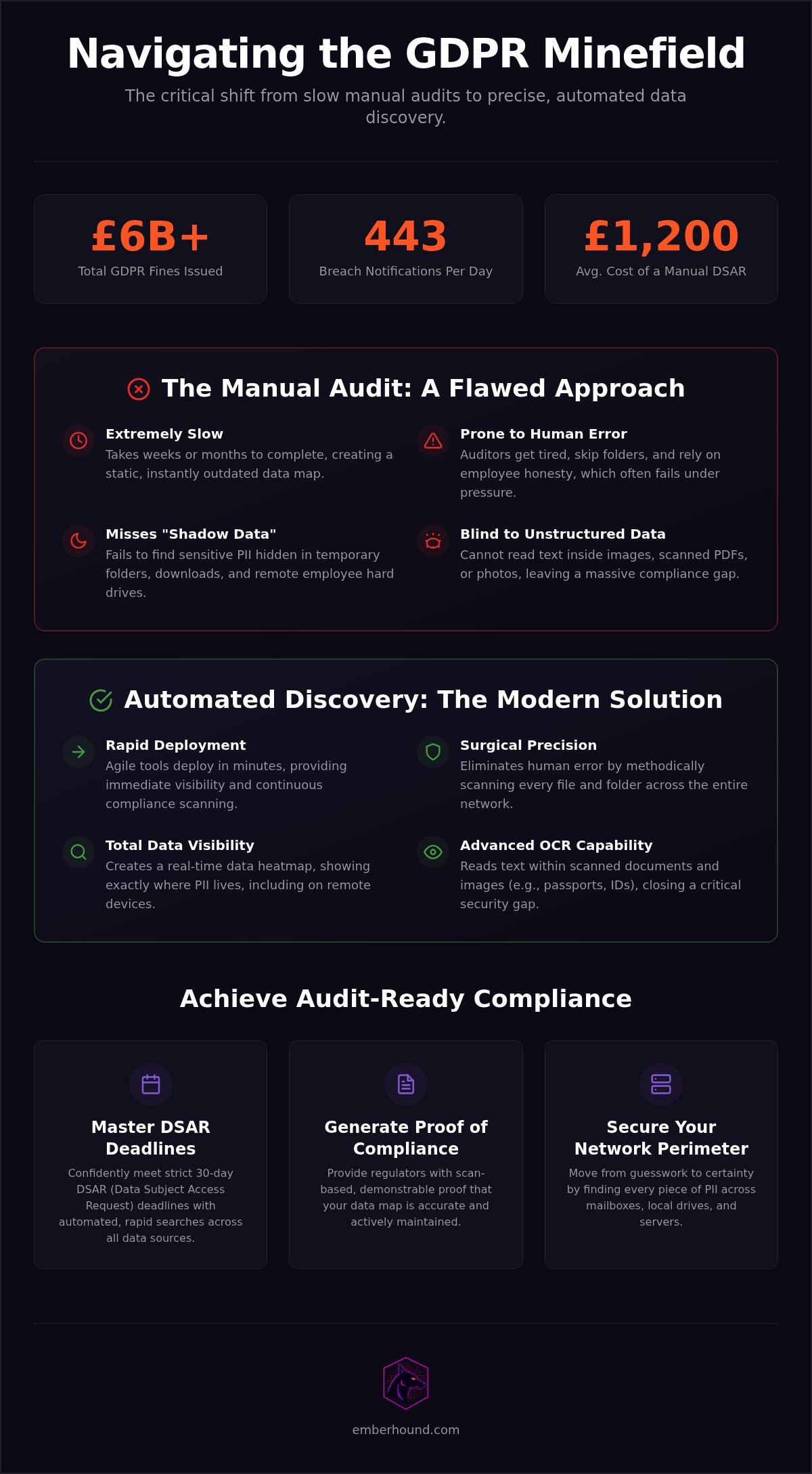
Total GDPR fines have now surpassed £6 billion. With breach notifications hitting a record 443 per day in early 2026, the margin for error has effectively vanished. Most UK businesses are still relying on manual audits that take weeks. It's a slow, expensive process; especially when handling a single DSAR manually can cost roughly £1,200 in staff time. You need a faster way to secure your perimeter. Implementing the right GDPR data discovery software is the only way to move from guesswork to absolute certainty.
We know the pressure you're under. You're likely facing impossible DSAR deadlines and the constant fear of a failed audit. It's an exhausting cycle. This article promises to show you how to locate every scrap of sensitive data across your network without the burden of enterprise bloat. You'll learn how to gain total visibility of PII and meet compliance standards with surgical precision. We'll explore the mechanics of automated scanning, the secrets to rapid DSAR fulfilment, and the path to audit-ready compliance.
Key Takeaways
- Identify "shadow data" hidden on remote employee hard drives that manual audits inevitably overlook.
- Understand why GDPR data discovery software is the only way to eliminate human error and secure your network perimeter.
- Avoid the trap of "enterprise bloat" by selecting agile tools that deploy in minutes rather than months.
- Meet strict 30-day DSAR deadlines with confidence by automating searches across mailboxes and local files.
- Generate scan-based proof of compliance to satisfy auditors and protect your business from heavy regulatory fines.
What is GDPR Data Discovery Software?
You can't protect what you can't see. In the current regulatory climate, guessing is a high-stakes gamble. GDPR data discovery software is the technical solution to a human problem. Most businesses believe they have a firm grip on their data locations. They're usually wrong. This software doesn't just list files; it scans the actual content of every document, image, and email across your entire network. It acts as a digital search party, hunting for Personal Identifiable Information (PII) in places your IT team wouldn't think to look.
The core mission of these tools is to eradicate "shadow data." This refers to the sensitive files sitting in "Temporary" folders, forgotten downloads, or unencrypted backups that manual audits inevitably miss. Manual audits rely on memory and staff honesty. Both fail under pressure. Automated scanning doesn't get tired. It doesn't skip "boring" folders. It provides a definitive, live record of your data footprint rather than a static, outdated spreadsheet.
By 2026, the data landscape has become too fragmented for traditional methods. With 443 breach notifications occurring daily across Europe, the margin for error has vanished. Static inventories are a lie from the moment they're saved. Active discovery is the truth. It offers a real-time view of your risk profile, ensuring that as data moves, your visibility moves with it.
The Regulatory Mandate for Data Visibility
Article 5 of the General Data Protection Regulation (GDPR) demands absolute accountability. The ICO expects you to know exactly where data lives at any given second. In 2026, regulators have moved away from accepting "best effort" policies. They now demand demonstrable compliance. This means you must provide scan-based proof that your data map is accurate. Wilful ignorance regarding distributed data is no longer a legal shield. If a breach occurs on a remote laptop you failed to scan, the liability rests solely with your organisation.
Identifying PII Across Distributed Networks
PII has evolved far beyond names and addresses. Today, it includes location metadata, biometric signatures, and even specific behavioural patterns. The challenge of the remote workforce has made this visibility much harder to maintain. Sensitive data now lives on local hard drives, often tucked away on home office laptops outside the reach of central servers. GDPR data discovery software maps this risk in real-time. It provides a visual heatmap of your liabilities. It tells you exactly which employee has a spreadsheet of customer details on their desktop before a security incident occurs. This level of precision allows you to move from reactive panic to proactive protection.
How Automated Scanning Eradicates the Manual Audit Burden
Manual audits are a bureaucratic siege. They're slow. They're expensive. Most importantly, they're often wrong. When a human auditor reviews a file system, they see what they expect to see. They skip the "Archive_2019" folder because it looks boring. They ignore the cluttered desktop of a busy manager. This is where the risk lives. Human error isn't just a possibility; it's a statistical certainty in manual processes.
Modern GDPR data discovery software ends this cycle of uncertainty. It doesn't get bored. It doesn't skip files because it’s nearly 5:00 PM on a Friday. It executes a surgical strike across your entire network. Whilst your team focuses on high-level security strategy, the software scans thousands of endpoints simultaneously. This shifts your business from "point-in-time" panic to a state of continuous compliance. It's about visibility that stays current, regardless of how fast your data grows.
Automating these labour-intensive tasks does more than just lower your stress levels. It slashes the actual cost of compliance. By removing the need for weeks of manual data mapping, you free up your most expensive technical assets for work that actually grows the business. Efficiency is the best defence against regulatory overreach.
Beyond Simple Text: The Power of OCR
Standard search tools are blind to unstructured data. If a customer emails a photo of their passport, a basic keyword search will miss it every time. This is a massive compliance gap. Optical Character Recognition (OCR) changes the game. It reads the text inside images and scanned PDFs as if it were a standard Word document. Think about what’s sitting in your "Downloads" folders right now. Scanned driving licences. Photos of handwritten notes from client meetings. Mobile snapshots of ID cards for onboarding. OCR technology brings these hidden liabilities into the light. It ensures your discovery process is truly comprehensive.
Mailbox and Local Drive Discovery
Mailboxes are the biggest source of unmanaged PII. We call it the "Outlook Trap." Employees treat their inbox as a filing cabinet. They send sensitive spreadsheets to themselves. They keep years of attachments that should have been deleted. Manually searching these silos to fulfil Data Subject Access Requests (DSARs) is a nightmare that drains hours of staff time. The risk isn't just in the cloud; it's on the local hard drives of your remote team. Data often migrates from secure servers to employee desktops for convenience. Effective discovery software secures this distributed edge without slowing down user performance. It finds the PII before the regulator does. If you're tired of the manual grind, EmberHound's automated scanning provides the visibility you need to stop guessing.
Enterprise Bloat vs Agile Discovery: Choosing the Right Tool
Enterprise software is often built like a tank when you only need a scout. You're sold a "comprehensive governance suite" but end up paying for fifty features you'll never touch. This isn't just a waste of budget. It's a strategic error. When GDPR data discovery software becomes too complex, it doesn't get used. It sits on the shelf whilst your data risks continue to grow. You need a tool that solves the problem, not one that creates a new department to manage it.
Implementation time is the hidden killer. A six-month rollout is a six-month window of vulnerability. If a regulator knocks tomorrow, "we're currently installing a platform" isn't a valid defence. You need visibility now, not next quarter. Effective discovery is critical for GDPR compliance because it addresses immediate liabilities, not theoretical future governance. Speed is a security feature.
Then there's the "system drag." Heavyweight agents can cripple employee laptops, leading to staff disabling the very security tools meant to protect them. You need a lightweight solution that scans quietly in the background without hogging CPU resources. Finally, consider the UK factor. A tool built with a deep understanding of local ICO expectations is always superior to a generic global platform. Localised knowledge means the software is tuned to the specific risks UK businesses face every day.
Why Heavyweight Platforms Fail SMEs
Complexity is a barrier to entry. If your team needs a week of training just to run a scan, the software has failed. SMEs don't have dedicated "Data Governance Departments." They have overworked IT managers who need answers in minutes. Targeted compliance scanning is about finding the PII and fixing the problem. It shouldn't cost the earth or require a PhD to operate. UK-based expertise ensures you get support from people who actually understand the specific nuances of our regulatory landscape. No jargon. Just results.
The Speed Factor in Compliance
Velocity is your best friend during a surprise audit. You need the ability to generate a comprehensive report in under an hour, not a week. Lightweight agents make this possible by scanning distributed networks without the system drag that kills productivity. The end result should be a clear, actionable list of files that need attention. You don't need a 500-page manual on data theory. You need to know which files to delete and which to encrypt. Right now. GDPR data discovery software should empower your team, not bury them in more work.
Mastering DSARs and Audits with Precision Discovery
The 30-day clock is a deadline, not a suggestion. If you're still manually searching through folders when a Data Subject Access Request (DSAR) hits your inbox, you've already lost the race. Manual fulfilment is a recipe for regulatory failure. It drains your staff's time. It leaves you wide open to human error. You need a system that responds with surgical speed. You need a process that turns a weeks-long search into a minutes-long scan.
GDPR data discovery software locates a specific individual's information across all digital silos in minutes. It doesn't matter if the data is buried in a five-year-old email thread or a local "Temp" folder on a remote laptop. The software finds it. This automation allows you to move directly to the redaction and disclosure phase. Manual redaction is a minefield; one missed name in a 50-page PDF can lead to a secondary breach. Automated tools highlight these risks, helping you prepare the data safely and ensuring you don't accidentally leak other subjects' information in the process.
This isn't just about speed; it's about the audit trail. The ICO doesn't just want the end result; they want to see your homework. They want proof of due diligence. An automated system logs every scan, every discovery, and every action taken. It builds a bulletproof record of your compliance efforts. It shows the regulator that you aren't just guessing. If you're struggling to keep up with the rising volume of requests, EmberHound's DSAR disclosure packs provide the structured framework you need to stay ahead.
The 48-Hour DSAR Response Framework
- Step 1: Trigger an automated scan specifically for the data subject's unique identifiers across all mailboxes and endpoints.
- Step 2: Review the results using specialised disclosure packs to categorise, redact, and organise the found data.
- Step 3: Securely deliver the disclosure pack to the requester and log the entire interaction for your compliance records.
Preparing for an ICO Audit
Auditors value control. You must be able to demonstrate exactly where your data lives and how often you scan for it. Showing a live data map is far more persuasive than showing a static spreadsheet from last year. Proactive remediation is your best tool here. Use your GDPR data discovery software to identify and delete the data you don't need before the auditor arrives. Clean environments are far easier to defend and demonstrate a commitment to privacy by design. Data minimisation is the active process of identifying and deleting redundant personal data to ensure you only retain what is strictly necessary for your business operations.
EmberHound: Your Agile Guardian for GDPR Compliance
EmberHound is the definitive antidote to the complexity we have explored. We've stripped away the corporate fluff to build a platform that prioritises your time. This is GDPR data discovery software designed for the "Efficient Specialist." It provides a surgical strike against data oversight without the baggage of traditional enterprise suites. We offer a unified approach to compliance. Our platform covers GDPR, PCI DSS, and specialised DSAR disclosure packs in one streamlined interface.
We don't believe in one-size-fits-all pricing. Your network is unique. Your scanning needs should be too. EmberHound offers flexible add-ons so you only pay for the coverage you actually use. Whether you need deep-dive OCR scanning for image-heavy archives, mailbox discovery for cluttered inboxes, or local hard drive scanning for remote teams; you can tailor your toolkit to your specific risk profile. It's about targeted protection that scales with your business.
Targeted Scanning Without the Friction
Deployment shouldn't be a project in itself. You can get your first scan running in hours, not weeks. EmberHound provides visual risk mapping that translates raw data into actionable intelligence. You'll see exactly where your highest risks are concentrated at a glance. This empowers the Data Protection Officer (DPO) to act decisively. You become the hero who secures the perimeter, not the bottleneck holding up the business. It's visibility without the system drag.
Why UK DPOs Trust EmberHound
We are a UK-based technology company. We speak your language. Our support team consists of experts who understand the specific pressures of the local regulatory environment. We don't hide behind jargon. We provide reliable, transparent, and blunt feedback on your data health. We value your time above all else. If you're ready to stop guessing and start scanning, organise your free EmberHound demo today and see the difference that agile discovery makes.
From Data Anxiety to Audit Certainty
Manual audits are a liability you can no longer afford. We have established that shadow data on local drives and buried in mailboxes is the silent killer of compliance. You have seen how automation turns weeks of manual searching into minutes of precision scanning. It's time to move from point-in-time guesses to continuous, active visibility. The margin for error in 2026 is zero.
Choosing the right GDPR data discovery software is the difference between a failed audit and demonstrable proof of due diligence. You don't need enterprise bloat or six-month rollouts. You need a surgical tool that identifies PII across every endpoint instantly. EmberHound is built for this exact purpose. As UK-based compliance specialists, we provide OCR-enabled scanning and dedicated DSAR disclosure packs without the corporate fluff.
Take control of your network perimeter. You can't protect what you don't know exists. Start scanning today and turn your data liabilities into a compliant, manageable asset. Your team deserves the clarity that only automated discovery can provide.
Master your data visibility with EmberHound
Frequently Asked Questions
What is the best GDPR data discovery software for UK SMEs?
EmberHound is the definitive choice for UK SMEs who value time over bureaucracy. It provides targeted visibility without the enterprise bloat typical of global platforms. You get UK-based support and a tool built specifically for the local regulatory landscape. It's about speed, accuracy, and actionable results rather than endless configurations.
Can GDPR discovery tools find data in scanned images and PDFs?
Yes, provided the software includes Optical Character Recognition (OCR) technology. OCR reads the text within scanned PDFs and mobile photos of documents. It identifies PII in passport scans or handwritten notes that standard search tools miss. This is vital for uncovering unstructured data liabilities hidden in "Downloads" folders.
How long does it take to implement data discovery software?
You can get your first scan running in hours, not weeks. Agile tools avoid the six-month rollout period typical of heavyweight platforms. Rapid deployment is a security feature. It ensures you have visibility before a regulator knocks on your door. Speed is essential when you're facing an immediate audit or a backlog of requests.
Does data discovery software work for remote employees on home Wi-Fi?
It does. Effective software uses lightweight agents to scan local hard drives regardless of the network connection. This is critical for securing the distributed perimeter of a modern workforce. It finds sensitive files saved to desktops even when employees are working from home and away from central servers.
Is automated discovery better than manual data mapping for GDPR?
Automated discovery is objectively superior. Manual mapping is a static, point-in-time guess that relies on staff memory and honesty. Implementing GDPR data discovery software provides a live, content-based record of your actual data footprint. It eliminates human error and finds the shadow data that manual audits inevitably overlook.
What is a DSAR disclosure pack and why do I need one?
A DSAR disclosure pack is a specialised toolset for redacting and organising personal data for a requester. It turns a mountain of raw scan results into a safe, deliverable package. You need one to meet strict 30-day deadlines without accidentally leaking other people's information in the process.
Can I use discovery software to scan for PCI DSS compliance as well?
Yes. Many businesses use the same discovery engine to hunt for cardholder data alongside personal information. You can combine GDPR and PCI coverage to secure your network against multiple regulatory risks at once. This includes identifying Primary Account Numbers (PANs) across your entire infrastructure.
How much does GDPR data discovery software typically cost?
Costs are typically based on the number of endpoints and specific add-ons like mailboxes or OCR scanning. Whilst specific pricing varies, it's a fraction of the cost of manual compliance. Consider that handling just one DSAR manually can cost roughly £1,200 in staff time. Investing in GDPR data discovery software pays for itself by automating these labour-intensive tasks.


