

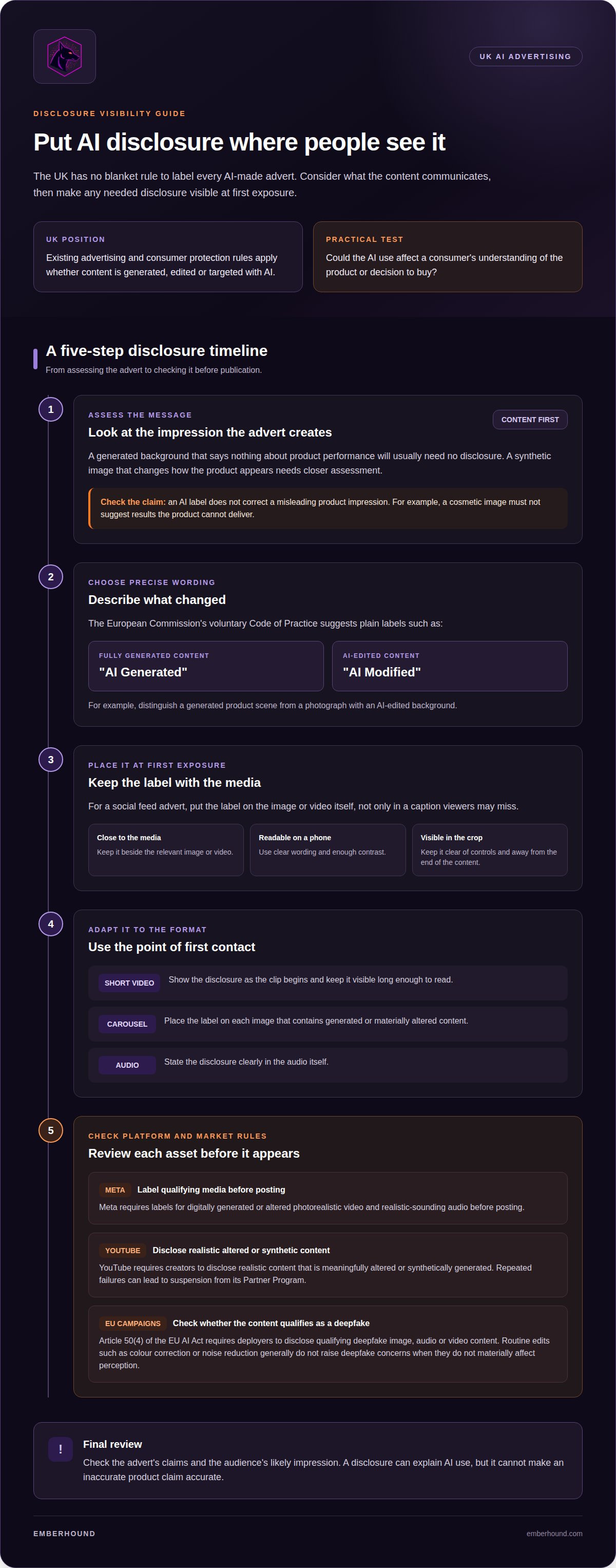
A blanket AI label is not the UK rule. UK businesses do not have to disclose every use of generative AI in marketing content. Existing advertising and consumer protection rules still apply, and AI use may need to be disclosed when it is material to a consumer's understanding of a product or decision to buy.
That distinction matters. A routine background image may need no label, while a synthetic person or product image that changes the impression an advert creates may raise a different issue. Adding an AI label will not fix a misleading product claim. The same tool can produce content with different disclosure needs, depending on its role and the message around it.
This guide explains when UK rules may call for disclosure and how to make a label visible to consumers. It also covers how to set a workable policy for AI-generated and AI-edited marketing, including realistic people, images and platform requirements. You'll have a clearer basis for deciding what to disclose, where a label should appear and what your team should review before publication.
Key Takeaways
- The UK has no blanket legal requirement to label every AI-generated advert. Disclosure may matter when AI use affects a consumer's understanding or buying decision.
- Assess what the content communicates, not only how it was made. A label does not correct a misleading product impression.
- Place any disclosure where people can see it when they first encounter the content, and account for the platform's own labelling rules.
- Set a policy that distinguishes routine edits from realistic synthetic people or product imagery, then assign clear review responsibilities before publication.
- AI marketing can also involve personal data. Understand what data is used and where it is held, particularly when handling a subject access request.
UK requirements for disclosing AI in advertising
The UK has no blanket legal requirement to label every advertisement made with AI. The decision depends on the advert's claims, content and placement.
UK advertising disclosure rules
The CAP and BCAP Codes contain no AI-specific rules, but their existing advertising requirements apply whether content is generated, edited or targeted with AI. For UK advertisers, the practical test is whether AI use is material to a consumer's understanding or decision. A generated background image that says nothing about product performance will usually need no disclosure. A synthetic image that changes the impression of a product needs closer assessment.
Transparency does not replace accuracy. If an AI-generated cosmetic image suggests results the product cannot deliver, adding an AI label will not correct that misleading impression. Assess the message the advert communicates, including any performance claims, before deciding whether disclosure addresses the issue.
EU AI Act deepfake rules
For an EU-facing campaign, Article 50(4) of the EU AI Act is relevant when AI generates or manipulates image, audio or video content that constitutes a deepfake. Deployers must disclose that qualifying content has been artificially generated or manipulated. The European Commission's Guidelines say product imagery may count as a deepfake if it changes how consumers perceive the product's appearance, characteristics, quality, function or use.
The European Commission's Guidelines assess deepfakes by how the relevant audience may perceive the content, whether or not the creator intended to deceive. A realistic AI-generated product demonstration could therefore require disclosure if it changes the apparent product experience. Routine edits such as colour correction or noise reduction generally do not raise deepfake concerns when they do not materially affect perception.
EU AI-content labelling requirement
The EU AI Act also requires providers to tell users when they are interacting with an AI system. For marketing content, distinguish this provider duty from the deployer's duty to disclose qualifying deepfakes. The European Commission's voluntary Code of Practice on Transparency of AI-generated Content proposes labels such as "AI Generated" and "AI Modified", with clear disclosure at first exposure. The Code is voluntary.
Providers of generative AI systems placed on the EU market before 2 August 2026 have until 2 December 2026 to meet marking and detection obligations. Article 50(2)'s watermark-detection interoperability duty applies from 2 February 2027.
Platform rules and regional differences
Rules vary by jurisdiction and platform: the UK has no general AI advertising labelling rule, while EU law sets duties for defined content and providers. In the US, California's AI Transparency Act sets duties for covered AI providers. These differences matter when a campaign runs across several markets.
YouTube requires creators to disclose realistic content that is meaningfully altered or synthetically generated. Repeated failures to disclose can lead to suspension from its Partner Program. Meta also requires labels for digitally generated or altered photorealistic video and realistic-sounding audio before posting.
California provider duties
Since 2 August 2026, California's AI Transparency Act requires covered providers to make a free public detection tool available. It also requires them to offer users an option to add a visible disclosure and to embed a latent, machine-readable disclosure in AI-generated image, video and audio content.
The Act covers publicly accessible generative AI systems with more than one million monthly visitors or users in California. Its duties concern covered providers, so marketers should distinguish those requirements from the rules governing their own advertisements. A text-only chatbot's text output is outside the Act's content duties; a product that generates images, video or speech is covered.
Disclosure labels and visibility at first exposure
A disclosure works only if the audience can see it while viewing the content. For an advert in a social media feed, place the label on the image or video itself, not only in a caption viewers may miss.
Make the label visible in the content
The European Commission's voluntary Code of Practice proposes clear disclosure at first exposure, with suggested wording such as "AI Generated" and "AI Modified". Use a plain label that describes the change. For example, distinguish a fully generated product scene from a photograph with an AI-edited background.
Place the wording where it remains legible on a phone screen. Keep it close to the relevant image or video, with enough contrast against the background. A label hidden behind interface controls, cut off in a crop or shown only at the end may arrive too late.
Match the label to the media format. For a short video, show it as the clip begins and keep it visible long enough to read. For a carousel advert, place it on each image containing generated or materially altered content. For an audio advert, state the disclosure clearly in the audio itself.
Account for Meta's posting requirements
Meta requires users to label digitally generated or altered photorealistic video and realistic-sounding audio before posting. Add the platform label during publishing when the content meets that description. A small caption added afterwards may not meet the requirement to label the media before it appears.
Check each asset separately. A campaign might pair an ordinary product photograph with a synthetic presenter and generated voiceover. The presenter and audio need closer review under Meta's rule, even if the product photograph does not. Keep the label attached to the relevant media when adapting the campaign to another format.
Keep labels intact across placements
A disclosure can disappear when an advert is cropped, compressed or reposted. Review the final version in each placement, including a mobile feed, full-screen story and video preview. Check that the wording remains readable and that platform controls do not cover it.
For each asset, record the AI change, the label used and where it appears. This helps the social media team apply the same decision when resizing or reposting content. It also gives reviewers a clear point to revisit if an edit changes the content's meaning.
Use a publishing check that tests the actual file, not just the design mock-up. A team preparing repeated campaigns can organise its data discovery process alongside its records for disclosure decisions.
Realistic synthetic people and influencers in advertising
A realistic AI-generated presenter can change how an audience interprets an advert. The European Commission's Guidelines say synthetic influencers, presenters, executives and avatars may fall within the EU AI Act's deepfake disclosure rules, even when they depict no real person.
Assess the impression a synthetic person creates
For an EU-facing campaign, assess whether viewers could perceive a realistic synthetic person as genuine. The European Commission's Guidelines focus on audience perception, not an intention to deceive. A fabricated influencer presenting a product as a satisfied customer could create a different impression from an obviously animated mascot.
That distinction affects disclosure decisions. If a synthetic presenter appears to give a real testimonial, viewers may take the endorsement as evidence of personal experience. A clear disclosure can identify the person as AI-generated, but it cannot make an unsupported testimonial or product claim accurate.
Check the advert's claims, not only its label
UK advertising and consumer protection rules still apply to AI-generated content. The key question is whether the content gives consumers a misleading impression or omits material information that could affect their understanding or decision. For example, an AI-generated fitness influencer demonstrating a product must not imply results the product cannot deliver.
A disclosure can help explain that the presenter is synthetic. It does not correct a false claim about product performance. Review the spoken script, visual demonstration and surrounding copy together. The same synthetic person can communicate different claims in separate adverts.
Commercial advertising has no automatic creative exception
The EU AI Act's lighter disclosure regime for evidently artistic, creative, satirical, fictional or analogous works does not automatically apply to commercial advertising. A polished fictional style alone does not remove an advert from assessment. For example, a fictional AI character promoting a real product remains part of a commercial message.
Classify the content by its purpose and context. If a campaign sells a product, assess its marketing function before relying on an artistic presentation. Tie the disclosure decision to the specific asset and audience.
Apply industry principles and market checks
ISBA and the IPA produced guiding principles for generative AI advertising in 2023. They recommend transparency when AI features prominently and consumers are unlikely to recognise its use. A realistic virtual influencer shown in a natural setting may meet that test more readily than an unmistakably animated character.
Political advertising needs a separate market review. Laws requiring disclosures for AI-generated content in political advertisements or communications have passed in California, New York and other US states, including Oregon and Washington. These are US rules, not UK requirements. A campaign adapted for a US platform needs review against the rules in each intended market.
Disclosure policies for generative AI marketing content
A written policy makes disclosure decisions repeatable. It should define which AI changes matter, who approves labels and how teams handle different markets and platforms.
Set a content-based disclosure test
Start with the audience's likely impression, not the tool used to create the asset. Record whether AI generated or changed a person, product feature, demonstration or claim. A synthetic spokesperson delivering a product testimonial needs closer review than an AI edit that removes an irrelevant background object.
For UK campaigns, assess whether AI use is material to consumers' understanding or decisions. Check the whole advert, including its imagery, script and surrounding copy. A label cannot fix a fundamentally misleading message, so the policy should require a separate check of the underlying product claim.
Define labels and approval responsibilities
Set approved wording for distinct cases, such as "AI Generated" for fully synthetic material and "AI Modified" for material edits. The European Commission's voluntary Code of Practice on Transparency of AI-generated Content proposes these labels and disclosure at first exposure. It was published on 10 June 2026; participation in the Code is voluntary.
Assign an owner for each decision. For example, the campaign lead can record the AI changes, while an advertising reviewer assesses the claims and label. Require approval again if an editor changes a product image, voiceover or synthetic presenter after sign-off.
Make the policy work across platforms
Keep a record for each asset: its AI-generated or edited elements, the disclosure decision, approved wording and intended placements. Before publication, compare the final social media post with that record. A label embedded in a video may be cropped from a vertical version, so review each finished format.
Include platform rules as a separate check. TikTok requires disclosure when realistic images, video or audio use AI. It also strongly encourages disclosure for fully AI-generated or significantly AI-edited content, beyond filters or minor retouching. Record platform labelling steps separately from any visible label required by your policy.
Review vendors and regional versions
Ask AI vendors whether generated-content marks remain detectable after compression and editing. Test a marked image after the actual export process. If the mark disappears, the campaign still needs a clear disclosure method that survives its planned placements.
For campaigns reaching EU audiences, assess the EU AI Act's deepfake rules alongside UK advertising standards. For US political advertising, account for state-specific disclosure laws. Record market decisions with the asset, so a UK-approved version is not automatically reused in another jurisdiction.
How UK GDPR applies to AI marketing content
AI disclosure and data protection are separate checks. For a UK campaign, map personal information across the workflow, from prompts and source files to generated assets and audience targeting. A generated image may contain no personal data, while a prompt copied from a customer record may include identifying details. Using the tool does not remove the need to examine the information involved.
Map personal data through the content workflow
Start with the material entered into each AI tool. A prompt containing a customer's name, purchase history or support message includes personal information that needs careful handling. Record the source, purpose and destination of those details. Marketing staff should use fictional examples or remove identifying fields when the task does not require them.
Review the output too. An AI-generated spokesperson might resemble a recognisable person, even if the prompt did not name them. Check whether the image, voice or text identifies someone directly or through context. A face, job title and named workplace together may point to a real individual.
Review tools, access and retention
For each AI vendor, document what data the team submits and how the service handles it. Identify whether prompts or uploaded files are stored, who can access them and whether they are reused. Do not assume a public-facing campaign asset contains no personal information simply because its final image looks synthetic.
Limit access to source files containing customer details. Keep campaign materials separate from raw customer records, and remove information staff do not need. If a marketer uses a support transcript to draft a testimonial, replace identifying details before submission and keep the source out of the prompt.
Keep a record for requests and corrections
Link each campaign asset to its inputs, tool and internal owner. This gives the team a practical trail if someone asks how their information was used. For example, a person who recognises their wording in a generated email can be directed to the relevant campaign record, rather than prompting an unstructured search across team accounts.
Set a route for raising concerns about personal information in marketing outputs. Record the request, identify the relevant asset and preserve the associated prompt history where appropriate. If an image or text needs correction, update the published asset and review versions scheduled for other channels.
Separate privacy review from disclosure review
A visible AI label explains how content was made. It does not explain what personal information entered the workflow. Keep these checks distinct in the approval record. A campaign using a synthetic presenter may need a disclosure decision, while a prompt built from customer data needs a separate privacy assessment.
Use data discovery to locate personal information before teams reuse files for AI-assisted campaigns. Review your data discovery requirements
EmberHound: DSAR Disclosure Pack
EmberHound's DSAR Disclosure Pack supports teams handling subject access requests. Use it when a request requires you to find and prepare personal information held across business files. GDPR Data Discovery can help locate personal data relevant to the search.
AI marketing workflows can add another place to consider: prompts or source files containing personal information. Identifying where that information sits can help your team assess what may be relevant to a disclosure. The DSAR Disclosure Pack supports disclosure work; it does not decide whether an advert needs an AI label or assess whether a marketing claim is misleading.
If you need support with subject access request disclosure, contact EmberHound.
Make your policy part of campaign planning
Give each campaign a record that can keep pace with changes to its content and audience. A policy for generative AI marketing content disclosure works best when teams can connect an approval decision to the asset, its data sources and the version actually published. Build that record into your normal campaign workflow, so a late edit triggers a fresh review instead of relying on someone to remember.
Data visibility is a separate part of this work. EmberHound provides GDPR Data Discovery, PCI Card Data Discovery and Combined GDPR + PCI Coverage. These offerings help organisations locate sensitive information across their data environment. Teams can review where information used in marketing workflows is held.
Set a clear owner for the policy and give campaign teams a straightforward route to raise uncertain cases. With decisions recorded and data discovery in view, your process can adapt as campaigns change.
Start with one campaign. Make the decision process clear, then build from there.
Frequently Asked Questions
To disclose or not to disclose?
Disclose when leaving AI use unmentioned could give people a materially different understanding of the content. For example, a fabricated customer story presented as a real review may affect how a buyer weighs the product. Make the decision for each asset, since a campaign can combine genuine photography, AI-edited visuals and synthetic copy. Keep a brief rationale with the approved version, so later edits can be assessed in the same context.
What UK laws require disclosure of generative AI in marketing content?
No general UK law requires a label on every AI-assisted marketing asset. Other duties can still apply to the campaign's content and use of personal information. A business running an advert for UK and EU audiences should record which version appears in each market, then assess any separate rules that apply there. A single UK approval should not automatically approve an asset for every territory.
Do UK advertising rules require marketers to disclose AI-generated content?
There is no UK-wide requirement to disclose every AI-generated advert. Marketers should assess whether the content gives a false impression or withholds information that could affect a consumer's decision. For example, if generated copy presents a fictional feature as available, review and correct the claim before publication. Keep evidence for factual product statements with the campaign record, so reviewers can trace what supports each claim.
What does the UK Advertising Standards Authority say about AI-generated ads and transparency?
The ASA applies the CAP and BCAP Codes to advertising, and those codes contain no AI-specific rules. The review therefore concerns the advert's claims and overall presentation. For a campaign using generated copy, keep the approved brief and substantiation with the final text. This helps the marketing team identify which statements need evidence when copy changes during approval or adaptation for another audience.
When should a business label marketing content as AI-generated or AI-assisted?
Consider a label when people could reasonably mistake a generated element for a real person, event, product feature or customer experience. For an AI-written email, the deciding issue may be the message's effect rather than the drafting method alone. Record whether AI changed the asset's meaning or evidence. This gives reviewers a consistent basis for later revisions by copywriters, designers or agencies.
Are there UK disclosure requirements for AI-generated images, videos, influencers or synthetic endorsements?
The UK has no blanket labelling rule covering every AI-generated image, video or synthetic influencer. A synthetic endorsement can still cause a problem if it appears to come from a genuine customer with first-hand experience. Separate the character's fictional identity from any factual claim about product use. For EU campaigns, realistic synthetic people may also fall within the AI Act's deepfake disclosure rules.
What are the penalties or risks for failing to disclose AI-generated marketing content in the UK?
The UK does not set a single penalty for omitting an AI label from every advert. Risk depends on whether the content breaches existing rules or a platform's own requirements. A misleading endorsement could prompt a complaint and require the campaign to be reviewed or changed. Keep source material and approval records for each claim, so the business can respond clearly if a consumer challenges an advert.
What are the best practices for disclosing AI use in marketing content?
Give campaign reviewers a short decision record for each asset: what AI changed, whether that change affects the audience's understanding and who approved publication. Retain the final version alongside evidence for product claims. Reopen the review whenever an edit changes a testimonial, demonstration or product detail. For campaigns across borders, record intended markets separately, since versions may face different rules.


