

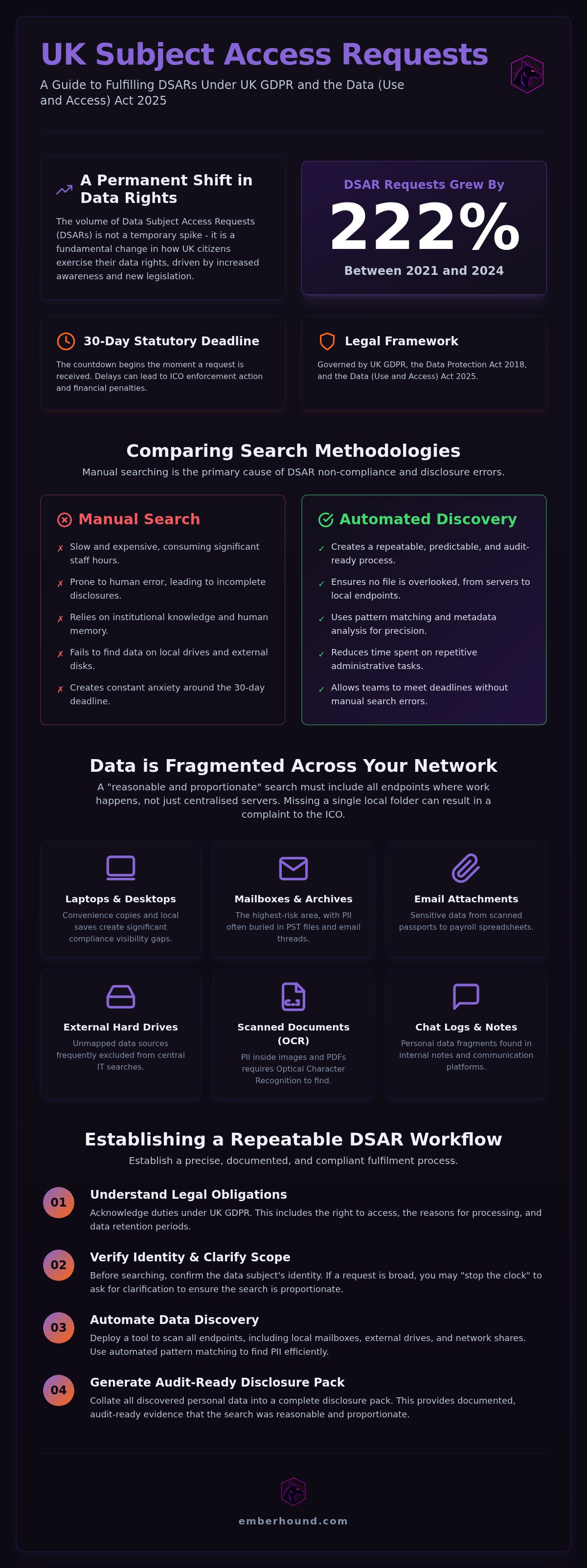
GDPR-related DSAR requests grew by 222% between 2021 and 2024. This isn't just a temporary spike. It is a permanent shift in how UK citizens exercise their data rights. If your team still relies on manual searches through local drives and email attachments, the 30-day statutory deadline is a constant source of anxiety. You know the cost of missing a single file. It's not just the administrative burden - it's the risk of regulatory friction under the Data (Use and Access) Act 2025.
A dedicated subject access request tool UK removes this uncertainty. You deserve a repeatable process that finds personal data wherever it hides, from local mailboxes to external hard drives. This guide explains how to identify data across your entire network to meet deadlines without manual search errors. We will examine the transition from enterprise bloatware to agile endpoint scanning. This ensures your disclosure packs are complete and audit-ready. Learn how to satisfy the new reasonable and proportionate search standards whilst reducing the time spent on repetitive administrative tasks.
Key Takeaways
- Understand your legal obligations under the UK GDPR and the Data (Use and Access) Act 2025 to manage the rising volume of data requests.
- Locate personal data across all company endpoints, including local mailboxes and external hard drives where information often hides.
- Implement a subject access request tool UK to replace slow manual searches with automated pattern matching and metadata analysis.
- Build a repeatable fulfilment workflow that prioritises identity verification and scope clarification to ensure every disclosure pack is complete.
- Adopt local endpoint scanning to find PII and generate audit-ready evidence without exfiltrating files from your secure network.
The Statutory Burden of Subject Access Requests in the UK
A Subject Access Request (DSAR) is a legal right under the UK GDPR and the Data Protection Act 2018. It isn't a suggestion. It's a statutory obligation. Individuals can demand a copy of every piece of personal data you hold. They can also ask why you have it and who you share it with. This right to transparency is a cornerstone of Freedom of Information in the UK, ensuring that organisations remain accountable to the people whose data they process. Failure to comply doesn't just result in a stern letter. It leads to enforcement action or heavy fines from the Information Commissioner's Office (ICO).
Defining the Rights of the Data Subject
Data subjects have a broad remit. They can request confirmation that their data is being processed. They are entitled to a full copy of that data. This includes obvious entries in centralised databases. It also includes hidden fragments in emails, chat logs, and internal notes. You must also provide supplementary information, such as your data retention periods and the logic behind any automated decision-making. If you miss a single email attachment or a local file, your disclosure is incomplete. Under the Data (Use and Access) Act 2025, you must conduct a search that is reasonable and proportionate. If your search process is documented and thorough, you protect the organisation from claims of negligence.
Statutory Deadlines and Penalties for Non-compliance
The clock is loud. You have exactly one month to respond. The 30-day countdown begins the moment the request hits any part of your organisation. You can't ignore it because it landed in the wrong inbox. While the 2025 Act allows you to "stop the clock" to ask for clarification, the pressure remains. Penalties for delay include reputational damage and financial sanctions. The ICO continues to receive a high volume of complaints regarding the right of access. A public enforcement notice can damage trust with clients and partners permanently. Most organisations fail because they lack visibility. They don't know where the data lives, so they can't retrieve it in time.
Manual searching is the primary culprit for these failures. Staff opening folders one by one is a recipe for error. It is slow. It is expensive. It is prone to oversight. Relying on human memory to find data hidden on local drives or external disks is a high-stakes gamble. Deploying a subject access request tool UK allows teams to automate the discovery phase, moving from panic to precision. It creates a repeatable process that ensures no file is overlooked. This shift from manual labour to automated discovery is the only way to handle the 222% growth in DSAR volume seen in recent years. You need a system that works as fast as the statutory clock.
Locating Personal Data Across Endpoints and Mailboxes
Personal data is rarely confined to a single database or file server. It fragmented across the network years ago. Laptops, mobile devices, and external drives contain fragments of personal information that your central IT systems often cannot see. If your discovery process stops at the server room door, your disclosure pack is incomplete. You must account for unmapped data sources to ensure the disclosure is complete. Missing a single local folder can lead to a formal complaint to the ICO.
Why Local Storage and Laptops Create Visibility Gaps
Employees often save documents to their desktop or local folders for convenience. It is a human habit that creates massive visibility gaps for compliance officers. Remote working has increased the volume of data stored outside the central network, often on devices that only connect to the corporate VPN occasionally. A search that is "reasonable and proportionate" must still include the endpoints where the work actually happens. If a subject access request tool UK cannot scan these "dark" endpoints locally, you are simply guessing at compliance. You need a system that identifies PII on the physical disk, reaching into the hidden corners of the fleet without requiring files to be moved to a central server first.
Scanning Mailboxes and Attachments for Personal Information
Mailboxes represent the highest risk area for most UK firms. Sensitive data is frequently shared in attachments, from scanned passports to payroll spreadsheets. Emails provide a detailed chronological record of interactions containing personal data, but this information is often buried in PST files or deep within attachment threads. A dedicated subject access request tool UK must scan live mailboxes and archive files with high precision. It also requires Optical Character Recognition (OCR) technology to detect data within scanned document images. Without OCR, a photograph of a driving licence or a scanned contract remains invisible to your search. Identifying these fragments is the only way to ensure your disclosure is legally sound.
Following the UK Government's SAR Procedure provides a clear baseline for a compliant workflow, but the technical execution remains your responsibility. You can begin by identifying where your data actually lives with a local discovery scan. This ensures that when the 30-day clock starts, you aren't wasting time searching in the dark or relying on staff to manually check their own folders.
Comparing Manual Search Against Automated Discovery Tools
Manual searching is a legacy approach that no longer fits the modern data landscape. It involves staff opening every folder, document, and spreadsheet to find specific keywords. This process is inherently slow. It is also prohibitively expensive. Most importantly, it is unreliable. Human error is a certainty when scanning thousands of files across multiple devices. An incomplete disclosure leads directly to regulatory friction and potential fines. By deploying a subject access request tool UK, you replace manual guesswork with automated precision. Automated tools use pattern matching and metadata analysis to find data in seconds. This allows your compliance team to stop acting as file hunters. They can focus on redaction and legal review instead of the administrative grind of data gathering.
The Hidden Costs of Manual File Searching
Staff time is your most expensive asset. Consider the hourly cost of a senior IT or compliance officer. If a single request requires 20 hours of manual searching, the internal cost per DSAR quickly climbs above £1,000. This doesn't account for the opportunity cost of delayed projects. Manual processes are impossible to scale as your business grows or as the volume of requests increases. You cannot simply hire more people every time a new request arrives. Refer to this UK GDPR compliance guide to understand how to manage these operational costs effectively. A repeatable, automated process is the only way to keep costs predictable whilst ensuring you meet the 30-day statutory deadline. It turns a chaotic search into a structured workflow.
Enterprise Platforms vs Agile Discovery Tools
Enterprise platforms are often the default choice for large corporations. They frequently require months of deployment and demand high annual fees. These systems are often "bloatware" that require dedicated consultants just to operate. For leaner, more efficient teams, this complexity is a liability. Agile discovery tools offer a smarter alternative. They focus on rapid installation and immediate results. Choosing the right subject access request tool UK means finding a balance between power and speed. EmberHound provides a privacy-first approach for organisations that value privacy-first data discovery. Our software scans endpoints locally. Files never leave your system. You get the visibility of an enterprise tool without the high stakes of data exfiltration or the friction of a multi-month rollout. It is about achieving compliance through technical efficiency, not through administrative bloat.
Establishing a Reliable Process for DSAR Fulfilment
Process is your best defence against the 30-day statutory clock. Without a structured workflow, you are simply reacting to chaos. Start with verification. You cannot risk handing over personal data to the wrong person. That is a self-inflicted data breach. Verify the requester's identity immediately to prevent unauthorised disclosure. Ask for a passport or driving licence if you have any doubt about the identity of the person making the request. Keep a strict record of all correspondence to demonstrate an audit-ready response to the ICO if required.
Verifying Identity and Scoping the Request
The 30-day deadline is tight, but it isn't always absolute. Under the Data (Use and Access) Act 2025, you can pause the clock whilst waiting for identity verification or necessary clarification. This is a critical window. Use it. If an individual has a long history with your firm, the volume of data could be immense. Clarify the scope of the request early. Ask if they need specific records or data from a particular timeframe. A well-scoped request is easier to manage and fits the "reasonable and proportionate" search standard now codified in UK law. It prevents your team from drowning in irrelevant files.
Once the scope is defined, run a comprehensive scan across all endpoints and mailboxes using a subject access request tool UK. Don't rely on employees to search their own local folders. They will miss data hidden in attachments or unmapped drives. The tool does the heavy lifting, locating every instance of the requester's PII across the entire fleet. You then move to the review phase. You must redact any information relating to third parties. Your legal obligation is to provide the requester's data, not the personal details of their colleagues or other clients.
Generating Audit-ready Evidence for Disclosure
The final disclosure pack must be easy for the requester to navigate. It shouldn't be a disorganised dump of files. High-quality output reduces the likelihood of follow-up complaints or secondary requests. Use masked previews to confirm the data before including it in the final pack. This ensures you only disclose what is necessary. For deeper insights into automating these steps, reference this guide on GDPR data discovery software UK. Using salted fingerprints and masked previews provides the audit trail you need to prove your search was thorough and compliant.
Fulfil DSARs Faster with EmberHound Data Discovery
EmberHound is a UK-based platform. It is built for efficient personal data discovery. Most enterprise tools are heavy. They require months of deployment and expensive custom consulting. We don't. We focus on speed and visibility. Our subject access request tool UK allows you to start scanning in minutes. There is no deployment drama. No complex integration. You get a clear path to compliance without the friction of traditional software. We are the agile alternative for professionals who value time above all else.
Local Processing with No File Exfiltration
Security is our priority. Our software performs all scanning locally on the endpoint. Files never leave your system. This eliminates the risk of data breaches during the discovery phase. Many platforms exfiltrate data to a central cloud. We don't. We use TLS 1.3 for communication. Data at rest is secured with AES-256 encryption. You maintain total control. We provide proof of compliance through salted SHA-256 fingerprints. This ensures your audit trail is immutable. It is a protective, no-nonsense approach to security. You get the evidence you need without the risk of moving sensitive files across the internet. This local-first architecture is why IT teams trust our process.
Usage-based Pricing for UK SMEs
Enterprise platforms often demand high annual fees. Some cloud instances cost between £18,090 and £48,222 a year. This is prohibitive for UK SMEs. We reject that model. EmberHound offers usage-based pricing. You pay only for what you use. There are no mandatory annual contracts. It is built for lean IT and compliance teams who need results quickly. You shouldn't be trapped in a long-term commitment just to meet a statutory deadline. Our DSAR disclosure pack organises found data into an audit-ready format instantly. It is the smarter, faster alternative to enterprise bloatware. You can start your compliance journey today. Our platform provides the visibility you need to satisfy the ICO without the enterprise price tag.
Secure Your Compliance Future
The burden of DSAR fulfilment isn't going away. Manual searching is a liability you can't afford. Visibility is the only way to meet the 30-day deadline and maintain accuracy. By moving discovery to the endpoint, you eliminate the risk of file exfiltration. This process accounts for every local drive and mailbox in your fleet. Implementing a subject access request tool UK turns a high-stakes crisis into a routine administrative task. You gain total control over your data landscape. No more guessing. No more missed attachments.
EmberHound is registered in England & Wales. We provide endpoint-only scanning for total privacy. There are no long-term contracts or mandatory annual fees. You get audit-ready evidence and masked previews instantly. It is time to stop the administrative grind. Move toward a simplified, automated future where compliance is a guarantee, not a gamble. You have the tools to protect your organisation and respect data rights simultaneously.
Take the first step towards a stress-free disclosure process today.
Frequently Asked Questions
What is a subject access request in the UK?
A DSAR is a legal right under the UK GDPR and Data Protection Act 2018. It allows individuals to request a copy of their personal data held by an organisation. This includes emails, database entries, and internal notes. You must also explain why you hold the data and who you share it with. It is a fundamental right of transparency for every UK citizen.
How long does a business have to respond to a DSAR?
You have exactly one month from the day you receive the request to respond. This deadline can be extended by a further two months if the request is complex or if the individual has made multiple requests. However, you must notify the requester of the extension and the reasons for the delay within the first month. The clock starts the moment the request is received.
Can a UK business charge a fee for a subject access request?
You generally cannot charge a fee for complying with a DSAR. Following the Data (Use and Access) Act 2025, a "reasonable fee" is only permitted if a request is "manifestly unfounded or excessive". You may also charge for additional copies of information already provided. Charging a fee remains the exception, not the rule, and must be based on actual administrative costs.
What personal data is exempt from a DSAR disclosure?
Several exemptions apply, including data protected by legal professional privilege or information that would reveal the personal data of third parties. You don't have to disclose data used for crime prevention or certain management forecasts. Each exemption requires careful justification. You must document why you are withholding specific files to avoid regulatory friction with the ICO during a potential audit.
How do I find personal data on employee laptops for a DSAR?
Use a subject access request tool UK to scan endpoints locally and identify data where it lives. Manual searches are slow and prone to oversight. An automated tool identifies PII across local drives and mailboxes without moving files to a central server. This ensures you find hidden fragments in desktop folders and email attachments quickly. It creates an audit trail that manual searching cannot match.
Is a subject access request tool necessary for small businesses?
Yes, because manual data gathering is prohibitively expensive for lean teams. Small businesses often lack the administrative capacity to handle the 222% growth in DSAR volume recorded between 2021 and 2024. A dedicated subject access request tool UK provides a repeatable process that reduces search time from days to minutes. It allows small teams to compete with the compliance capabilities of much larger organisations.
What happens if I miss the 30-day DSAR deadline?
Missing the deadline results in enforcement action or financial penalties from the ICO. It also causes significant reputational damage. Individuals have the right to complain to the regulator if you fail to respond on time. Under the 2026 guidance, organisations must have a formal internal process to handle these complaints directly. Responding late is often seen as a failure of basic data governance.
Do I have to provide emails sent by the requester in the disclosure?
You must provide all personal data held by the controller, including the content of emails sent by the individual. Whilst they have the "sent" copy, your organisation's copy may contain metadata or internal notes added during processing. Your disclosure pack should include these records to ensure the response is legally complete. This ensures you satisfy the requirement to provide all data relating to the subject.


