

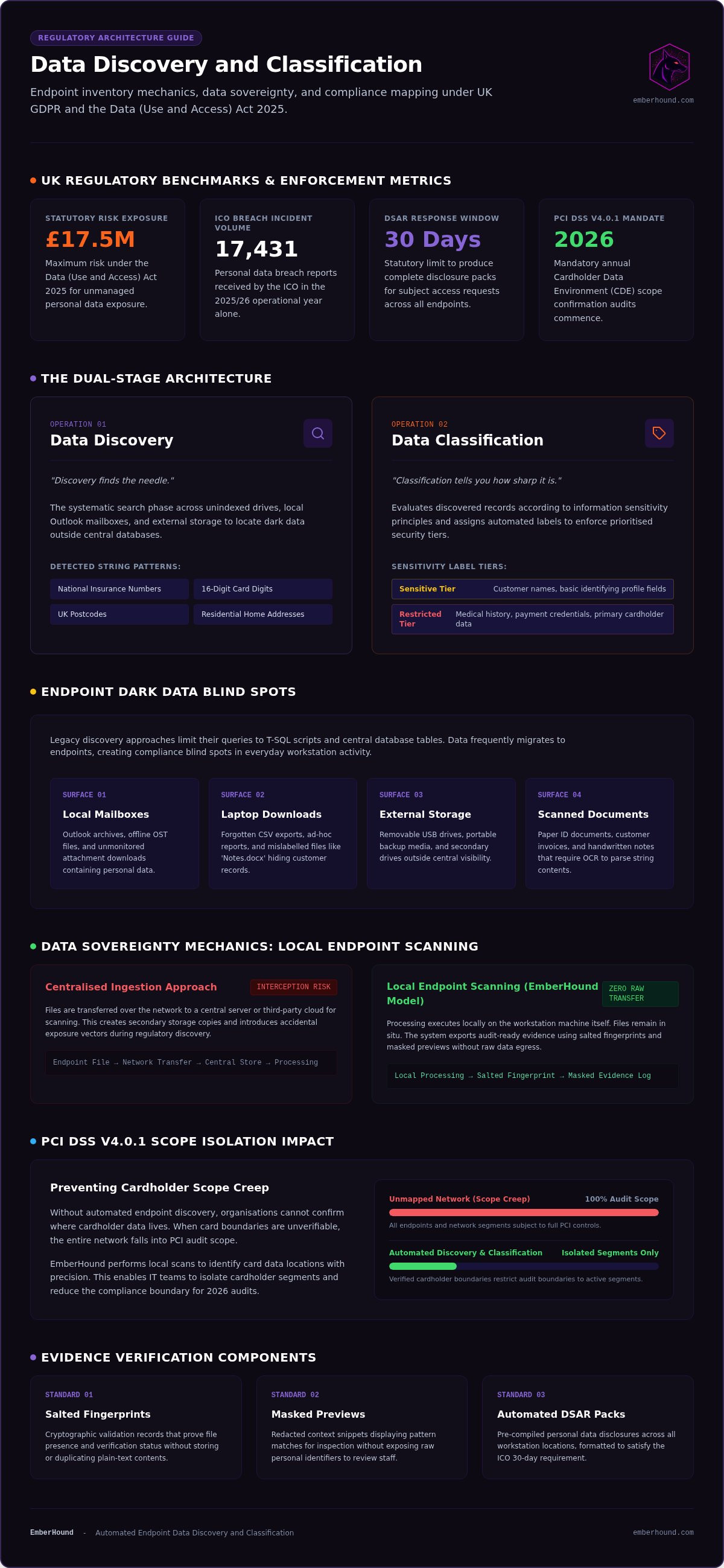
How many sensitive files are hiding in local mailboxes or forgotten downloads on your team's laptops? For many UK IT managers, the answer is an educated guess that carries a £17.5 million risk under the Data (Use and Access) Act 2025. Understanding what is data discovery and classification is the first step to closing that gap. It is the systematic process of locating personal data across your network and labelling it according to its sensitivity. Without this visibility, your GDPR and PCI DSS v4.0.1 compliance is a matter of luck.
Manual data searching is slow and prone to error. You shouldn't have to endure weeks of software deployment drama just to see your own files. This guide explains how to identify and categorise sensitive data to meet strict UK standards without unnecessary technical complexity. We will map out an automated workflow that provides audit - ready evidence and a clear map of where your data lives. This approach uses local endpoint scanning and salted fingerprints to secure your environment. It requires zero legal consulting to get started.
Key Takeaways
- Define what is data discovery and classification to identify sensitive data and categorise files by risk level across your network.
- Scan endpoints locally to maintain data sovereignty - files never leave your environment during the discovery process.
- Meet the mandatory inventory requirements of UK GDPR and PCI DSS v4.0.1 with automated classification labels.
- Address the 30 - day DSAR deadline with automated disclosure packs that find personal data in local mailboxes.
- Export audit - ready evidence with salted fingerprints and masked previews to satisfy regulatory inspections without exposing raw files.
Defining Data Discovery and Classification in a Regulatory Context
Compliance is a technical requirement. It is not a guessing game. UK businesses must account for every byte of personal data they store. This starts with a clear answer to what is data discovery and classification. These are two distinct but linked operations. Discovery maps your environment to find hidden records. Classification evaluates those records based on risk. EmberHound is a data discovery platform that automates both processes. It removes the manual burden from IT teams and keeps your inventory accurate whilst you maintain full visibility of your compliance status.
Regulatory frameworks like the UK GDPR and PCI DSS v4.0.1 require organisations to know exactly what data they hold. The Data (Use and Access) Act 2025 reinforces this duty. Failing to maintain a data inventory leads to regulatory friction. The ICO received 17,431 personal data breach reports in the 2025/26 operational year. Most incidents involve data that the organisation didn't know existed in that location. Precise identification prevents you from becoming a statistic.
The Difference Between Discovery and Classification
Discovery is the search phase. It scans local drives, mailboxes, and external storage for specific patterns. These include National Insurance numbers, credit card digits, or home addresses. It uncovers 'dark data' that lives outside of central databases. This process is the foundation of any GDPR compliance strategy. If you haven't found the data, you cannot protect it.
Labels assigned during classification help your team prioritise security resources based on information sensitivity principles. A file containing a customer's name is sensitive. Records containing medical history or payment details are restricted. Discovery finds the needle. Classification tells you how sharp it is. Together, they create a functional map of your digital estate.
Why UK Businesses Prioritise Sensitive Data Identification
The ICO expects businesses to maintain a complete data inventory. You cannot fulfil a Subject Access Request (DSAR) if you are blind to half your files. You have a 30 - day window to respond to these requests. Manual effort leads to error. Automation provides an instant view of all personal data tied to an individual.
Mandatory annual cardholder data environment (CDE) scope confirmation is a core part of PCI DSS v4.0.1 for 2026 audits. If you cannot prove where card data lives, your entire network falls into scope. This increases the complexity and cost of your audit. Automated discovery prevents 'scope creep'. It identifies card data locations with precision and allows you to isolate sensitive segments to reduce your compliance burden. Efficient identification is a financial necessity.
The Mechanics of Local Endpoint Discovery
Data doesn't stay inside databases. It travels to local machines, sits in downloads folders, and hides in email attachments. Understanding what is data discovery and classification requires a focus on these endpoints. Centralised scanning often requires moving files to a central server or the cloud. This movement creates a risk of interception or accidental exposure. Local endpoint discovery eliminates this risk. The files stay exactly where they are. Processing happens on the machine itself.
Automated tools search for specific strings of information. These include 16 - digit credit card numbers, UK postcodes, and National Insurance numbers. By performing these checks locally, you maintain a credible security posture. This approach aligns with ICO guidance on documenting processing activities. You can inventory your data without increasing the threat of a breach during the audit itself. EmberHound performs all scans locally to ensure that sensitive files never leave your controlled environment.
Scanning Beyond Databases - Mailboxes and Hard Drives
Many legacy tools focus on T - SQL and database column scanning. This leaves a massive gap in your compliance map. Sensitive data is frequently hidden in local Outlook mailboxes or on external hard drives used for backups. Discovery tools must analyse the actual content of these files. They cannot rely on file names alone. A file named 'Notes.docx' could contain a full list of customer contact details. EmberHound uses specific add - ons to scan these often - ignored locations. It gives you a complete view of your data estate. You can start identifying your dark data today with a local scan that respects your privacy.
Using OCR to Identify Data in Scanned Documents
Scanned invoices, ID documents, and handwritten notes are common sources of 'dark data'. Standard text search tools cannot read these files. Optical Character Recognition (OCR) technology is the solution. It identifies text within images and PDFs. This is a requirement for modern compliance. If your discovery process skips images, you are missing a significant portion of your sensitive data. OCR scanning brings these hidden records into your classification workflow. It ensures that no personal data remains invisible to your team. This level of visibility is necessary for a complete and accurate data inventory.
Data Classification Tiers and Sensitivity Labels
Classification is the filter that prevents IT teams from drowning in noise. It is the second half of the answer to what is data discovery and classification. Once discovery locates a file, classification assigns a label that dictates its security level. This process reduces the volume of data that requires high - intensity monitoring. It allows teams to focus their resources where the risk is highest. Labels are the foundation of a functional security policy. They must be clear and consistent across the entire organisation. Vague categories lead to security gaps and audit failures.
Effective classification is a requirement for modern UK businesses. The Information Commissioner's Office (ICO) expects organisations to understand the risk profile of their data. By categorising files, you can apply appropriate controls, such as encryption or restricted access, only where they are needed. This pragmatism saves time and budget. It also ensures that your most sensitive records receive the strongest protection available. Understanding what is data discovery and classification helps you move from reactive fire - fighting to proactive risk management.
Standard Classification Frameworks - Public to Highly Confidential
Many commercial UK businesses align their internal tiers with the UK Government Security Classifications Policy to maintain consistency with public sector partners. This framework operates across tiers like OFFICIAL, SECRET, and TOP SECRET. In a commercial context, these are often adapted into four distinct categories:
- Public: Information intended for external use, such as marketing materials or public pricing.
- Internal: Non - sensitive data used for daily operations that would not cause damage if leaked.
- Confidential: Sensitive records like internal strategy documents, employee names, or business contracts.
- Restricted / Highly Confidential: High - risk data such as cardholder information, medical records, or login credentials.
Mapping Data to GDPR and PCI DSS Requirements
Regulatory compliance requires specific pattern mapping. The UK GDPR focuses on 'personal data' that can identify a living individual. This includes names, email addresses, and location data. PCI DSS v4.0.1 targets Primary Account Numbers (PAN) and cardholder data. Discovery software maps these specific patterns to relevant regulatory labels automatically. This eliminates the human error associated with manual tagging. It also ensures that your data inventory is always audit - ready.
EmberHound is a platform that generates evidence for these audits without exfiltrating your files. It uses salted SHA - 256 fingerprints to verify findings. These fingerprints are unique identifiers that prove you have identified a specific record without storing the raw sensitive content. This method provides a clear audit trail for regulators. It proves your compliance status whilst maintaining the privacy of the original data. This approach is the standard for businesses that value both security and speed.
Implementing an Automated Discovery Workflow
Manual data mapping is a liability. It is slow and prone to error. If you are still using spreadsheets to track personal data, you are falling behind. Human error is the primary cause of missed files in hidden locations. Understanding what is data discovery and classification in a modern context means moving away from manual effort. Automation is the only way to maintain an accurate inventory across your entire network. It removes the guesswork. It provides a repeatable process for your compliance team.
A structured workflow is essential for meeting the 30 - day DSAR deadline. Under the UK GDPR, individuals have the right to access their data quickly. Searching through local mailboxes and external drives one by one is not a viable strategy. Automated discovery scans these locations simultaneously. It identifies relevant records in minutes. No deployment drama. Immediate utility. This speed allows your team to review and disclose data without the anxiety of missing a regulatory deadline.
Step 1 - Setting Your Search Parameters
Success starts with clear definitions. You must define the types of sensitive data you need to locate. This includes credit card numbers, home addresses, or specific customer IDs. Once your parameters are set, you select the endpoints and mailboxes that require scanning. Selecting specific endpoints prevents unnecessary scanning of non - sensitive areas. This efficiency reduces the load on your local machines. You should also identify the regulatory frameworks that apply to your audit. Whether you are prioritising PCI DSS v4.0.1 or the UK GDPR, your software should allow you to toggle these patterns easily. This precision ensures that your scan is focused and relevant.
Step 2 - Reviewing Masked Previews and Fingerprints
Verification must not compromise security. Masked previews are the standard for verifying findings without exposing raw file content to the administrator. This feature protects your privacy by design. If a scan identifies a sensitive file, you see enough to confirm its status whilst the actual data remains protected on the endpoint. Salted fingerprints are a permanent, cryptographic record of the file for audit purposes. They are unique identifiers generated locally. This ensures that even if your audit logs are compromised, the original sensitive data cannot be reconstructed from the hash. These SHA - 256 fingerprints prove you found the data without requiring you to exfiltrate the file itself. This method allows your organisation to demonstrate compliance and protect individual privacy at the same time.
Securing Your Audit Trail with EmberHound
EmberHound is a data discovery platform built specifically for UK compliance teams. It provides a practical answer to what is data discovery and classification by automating the entire inventory process. Audit - ready evidence is generated automatically during every scan. This removes the burden of manual reporting and prevents human error. Usage - based pricing ensures you only pay for the scanning you actually perform. This model respects the budgets of lean IT teams whilst providing enterprise - grade visibility.
The platform includes dedicated DSAR disclosure packs for efficient request handling. These packs aggregate all identified personal data tied to a specific individual into a single, reviewable format. This feature is essential for meeting the strict 30 - day response window set by the ICO. By automating the collection and masking of data, you can respond to requests with confidence. It turns a complex legal obligation into a routine technical task.
Generating Evidence Without Exposing Raw Content
Security professionals often worry about the risk of the discovery tool itself. Masked previews show enough data to confirm a match without creating a new risk. You verify the presence of sensitive data whilst the original file remains untouched on the endpoint. Comprehensive audit logging tracks every access attempt or mutation. This level of transparency is a cornerstone of our trust and security posture. It provides the evidence regulators demand without compromising your internal privacy standards.
Moving From Manual Discovery to Continuous Monitoring
Manual discovery is a snapshot. It becomes outdated almost immediately as users create new files and downloads. Continuous scanning ensures that new sensitive data is identified as it is created. This proactive approach is the only way to maintain a true data inventory in a fast - moving environment. Understanding what is data discovery and classification is only the start. You must also maintain that visibility over time. Start your journey with a free GDPR scan to see your exposure today. This transition transforms compliance from a stressful annual event into a quiet, background process that works for you.
Secure Your Compliance Roadmap
Understanding what is data discovery and classification is the foundation of a secure data estate. It is the difference between guessing your risk and proving your compliance. Local scanning ensures that sensitive files stay exactly where they belong. All processing occurs on the machine. This removes the threat of file exfiltration during an audit. You now have the tools to generate audit - ready evidence for GDPR and PCI DSS v4.0.1 without the burden of manual searches.
EmberHound focuses on immediate utility. Usage - based pricing provides flexibility for lean teams. You only pay for the scanning you perform. There are no mandatory contracts to sign. This approach delivers clear visibility of your personal data and respects your operational constraints. You can move from reactive fire - fighting to a structured, continuous monitoring workflow. It is time to simplify your regulatory obligations.
Take control of your data map. A more efficient compliance future is ready when you are.
Frequently Asked Questions
What is the difference between data discovery and data mapping?
Data discovery is the technical act of searching for files, whilst data mapping is the process of documenting how that data flows through your organisation. Discovery provides the raw evidence needed to make your data map accurate. Without discovery, your map is just a guess based on policy rather than reality. Automated tools find the actual files on endpoints, allowing you to build a map that satisfies UK GDPR Article 30 requirements.
How does OCR help in finding sensitive data?
OCR technology identifies text within images, scanned PDFs, and photos of documents. This is essential for finding sensitive data in scanned invoices or ID documents that standard search tools would miss. By converting pixels into searchable text, OCR ensures that no 'dark data' remains hidden from your compliance team. It bridges the gap between physical paper trails and digital inventories, making your data classification process truly comprehensive across all file types.
Is data discovery a requirement for GDPR compliance?
Yes, data discovery is a practical necessity for meeting UK GDPR accountability standards. Article 30 requires you to maintain a record of processing activities, which is impossible without knowing exactly where personal data resides. Understanding what is data discovery and classification helps you identify the records you hold and apply the correct security controls. Failing to locate personal data makes it impossible to protect it or respond to subject access requests within the legal timeframe.
Can data discovery software find credit card numbers in emails?
Yes, modern discovery software can scan local mailboxes to find credit card numbers and other payment details. EmberHound uses specific add - ons to analyse Outlook storage files and identify patterns that match Primary Account Numbers (PAN). This is a requirement for PCI DSS v4.0.1 compliance. Many organisations forget that sensitive data often hides in email attachments or message bodies, but automated scanning brings these hidden risks to the surface for immediate classification.
What happens to my files during a scan with EmberHound?
Your files stay exactly where they are. EmberHound performs all processing locally on the endpoint, so no raw data is ever exfiltrated to the cloud. The platform identifies sensitive data and generates audit - ready evidence using masked previews and salted SHA - 256 fingerprints. Data at rest is protected by AES - 256 encryption, and all communication uses TLS 1.3. Your file system is never directly mounted or modified during the scanning process.
How long does it take to complete a data discovery scan?
The duration of a scan depends on the volume of data and the number of endpoints being analysed. Local scanning is generally faster than network - based alternatives because it doesn't suffer from bandwidth bottlenecks. Most organisations can complete an initial discovery scan across their primary endpoints in a single session. Because EmberHound is designed for no deployment drama, you can start identifying sensitive data almost immediately after installation without waiting for complex server configurations.
Do I need a legal consultant to use discovery software?
You don't need a legal consultant to operate data discovery software. These tools are designed for IT and compliance teams to use as part of their standard technical workflow. Automation removes the need for expensive legal oversight during the data gathering phase. Whilst a consultant can help with high - level policy, the software handles the heavy lifting of finding and categorising the actual files. It provides the technical evidence you need to prove your own compliance status.
What is a DSAR disclosure pack?
A DSAR disclosure pack is a curated collection of all personal data identified for a specific individual. It is designed to help you meet the 30 - day deadline for Subject Access Requests without manual searching. The pack aggregates findings from across your endpoints and mailboxes into a single, reviewable format. This automation reduces the risk of missing data and ensures that your response to the Information Commissioner's Office is both thorough and accurate.


