

Your compliance software shouldn't require a dedicated department just to keep the lights on. For many UK firms, searching for a viable OneTrust alternative for data discovery isn't about finding more features - it's about finding freedom from them. You're likely tired of paying for enterprise modules you'll never touch. You're frustrated by waiting months for a deployment that should take minutes. Worse, you're still anxious about the personal data hiding in an employee's downloads folder or an old external drive.
We understand the pressure on lean teams. You need to meet GDPR and PCI DSS v4.0.1 requirements without the "bloatware" tax. This article shows you how to swap complex, multi-module platforms for precise, local-only scanning that delivers audit-ready evidence instantly. You'll discover how to secure your endpoints in minutes, not months, using a tool designed for speed and transparency. We'll break down why usage-based pricing and endpoint-focused discovery are the smarter choice for professionals who value their time as much as their data security.
Key Takeaways
- Learn why lean compliance teams are prioritising data location over complex administrative workflows to reduce software bloat.
- Understand the security advantages of local endpoint scanning, which ensures personal data stays on the device rather than being sent to the cloud.
- Discover how to deploy a OneTrust alternative for data discovery in minutes, bypassing the need for long implementation cycles or professional services.
- See how to generate audit-ready evidence for GDPR and PCI DSS v4.0.1 using masked previews and salted fingerprints.
- Explore the benefits of usage-based pricing that removes the burden of restrictive annual contracts and allows you to scale as needed.
What is an Agile OneTrust Alternative for Data Discovery?
An agile OneTrust alternative for data discovery isn't just a cheaper version of a legacy platform. It's a fundamental shift in strategy. Traditional enterprise suites often treat data discovery as a massive administrative project. They focus on questionnaires, workflow automation, and complex vendor assessments. An agile alternative flips the script. It prioritises the technical reality of where your data sits right now. For lean UK compliance teams, this means moving away from administrative "management" and toward active, technical discovery.
Choosing a OneTrust alternative for data discovery allows you to reclaim your time. Instead of managing a software ecosystem, you focus on finding and securing files. Precise discovery software identifies sensitive data across laptops, servers, and remote devices without the need for cloud exfiltration. It's about getting immediate visibility into your data footprint without the overhead of a multi-module governance suite. EmberHound is built for this specific need, providing a dedicated platform for organisations that require facts over theoretical data maps.
The Problem with Enterprise Privacy Bloat
Most enterprise tools are designed for Fortune 500 companies with massive budgets and dedicated privacy departments. They come packed with features that smaller teams simply don't require. You're often forced into expensive annual contracts for a dozen modules whilst you only need one or two. This leads to "deployment drama" where compliance projects stall before they even begin. You spend months configuring the software before you've found a single sensitive file. Lean teams can't afford that bureaucracy. They need a tool that works immediately - without the weight of enterprise bloat.
Why Precise Discovery Matters for GDPR
Under GDPR, you can't protect what you haven't found. Identifying personal data is the non-negotiable first step of any compliance programme. Many organisations still rely on manual data mapping, which is slow, inaccurate, and out of date the moment it's finished. Automated scanning provides a factual inventory of where data actually resides. Unlike traditional data loss prevention software that might require complex network rules, agile discovery focuses on local visibility. This approach ensures you meet the strict requirements of GDPR Article 30 and Article 32 by knowing exactly where your personal data is stored.
EmberHound provides this visibility by scanning endpoints locally. Files stay where they are, and the processing happens on the device. This provides a clear path to a GDPR-ready environment without the risk of moving raw data across the network. You get results in minutes, not months. No complex setups. No hidden fees. Just clear, actionable evidence of your data posture.
Local Endpoint Scanning vs Cloud-Based Data Mapping
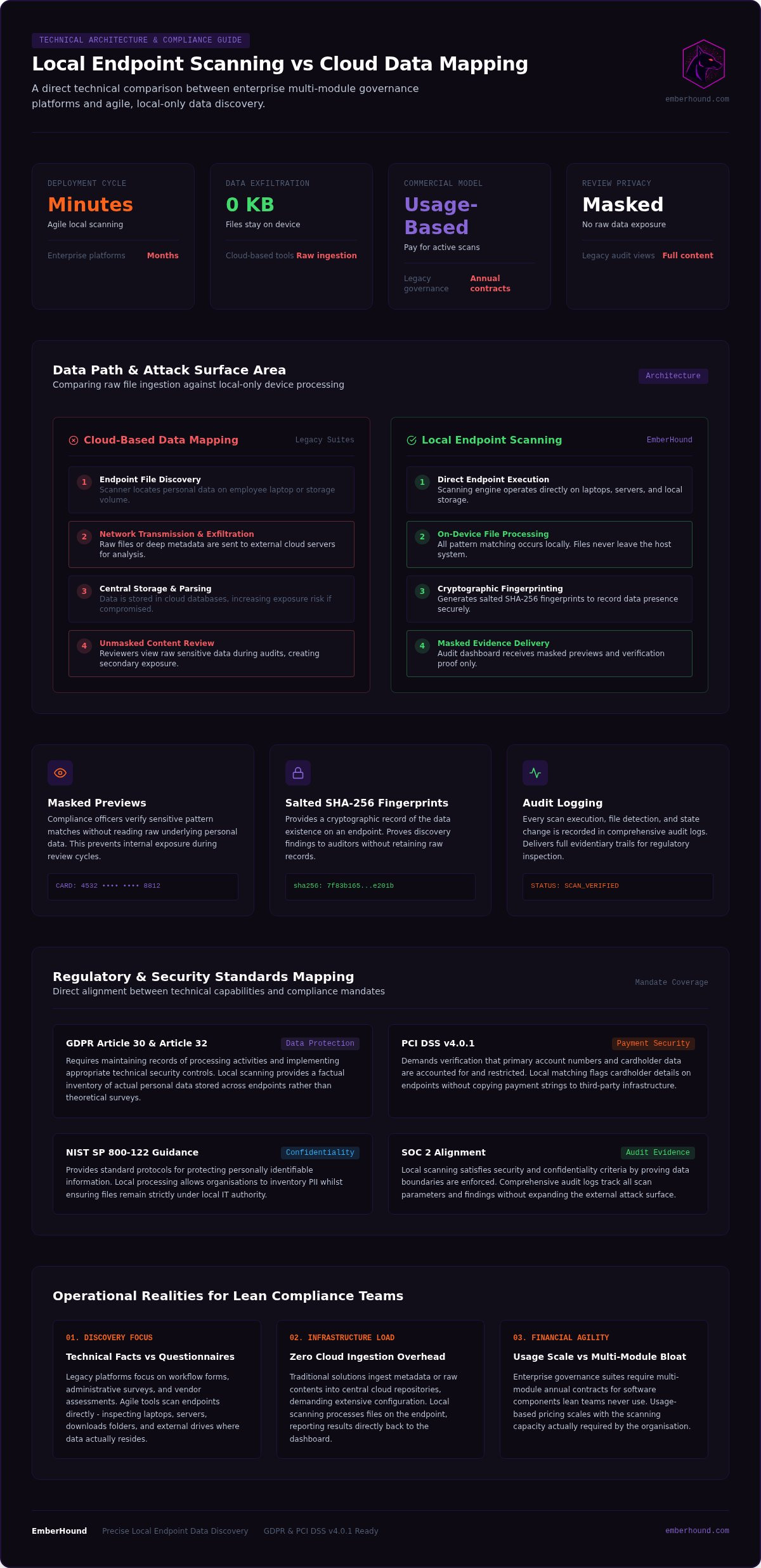
Enterprise platforms often rely on cloud-based data mapping. They ingest metadata or, in some cases, exfiltrate raw files to a central server for analysis. This creates a massive security surface area. For lean teams seeking a OneTrust alternative for data discovery, this cloud-first approach introduces unnecessary risk. If the scanning engine is compromised, your sensitive files are exposed. Local endpoint scanning eliminates this vulnerability by ensuring that files never leave the device. The discovery happens where the data lives. It's a cleaner, safer way to maintain visibility across a distributed workforce.
The Security Advantage of Local Processing
Local processing removes the need for file exfiltration. Your IT team maintains absolute control over the file system throughout the scan. This isn't just a preference; it's a security requirement for organisations adhering to strict standards like SOC 2 or PCI DSS v4.0.1. By following NIST SP 800-122 guidance, teams can inventory sensitive information without increasing their attack surface. EmberHound performs all processing on the device. Only the results - not the files - are communicated back to your dashboard.
Generating Audit-Ready Evidence Safely
Proof shouldn't require exposure. Traditional tools often show you the full content of a file to prove it contains sensitive data. This creates a secondary privacy breach for the person reviewing the findings. We use masked previews to allow compliance officers to verify matches without seeing the raw data. Salted SHA-256 fingerprints provide a cryptographic record of the data's existence. It's definitive. It's audit-ready. Every mutation and scan is tracked in comprehensive audit logs for regulatory reporting. This ensures you're ready for any GDPR enquiry or PCI assessment.
Endpoint visibility is vital for the modern UK workforce. With remote employees using various laptops and external drives, a cloud-only view is incomplete. EmberHound uses TLS 1.3 for data in transit and AES-256 encryption at rest to protect your scan results. You get a complete picture of your exposure without moving a single file. If you want to see how this works on your own network, you can start a free scan today to identify hidden risks.
Comparing Deployment Speed and Resource Requirements
Deployment shouldn't be a project in itself. For many UK organisations, the primary hurdle with legacy platforms is the sheer time required to see a result. Research indicates that enterprise rollouts for heavy governance suites typically span 4 to 12 weeks before reaching operational maturity. Lean IT groups don't have that luxury. If you are looking for a OneTrust alternative for data discovery, you likely need visibility today, not next quarter. EmberHound is designed for immediate action. You can start a scan in minutes, identifying hidden risks across your network without a single hour of professional services.
OneTrust vs EmberHound: A Comparison of Scale
OneTrust is a comprehensive management platform. It's built for global enterprises with sprawling legal departments and dozens of full-time staff dedicated to privacy. It is a 'programme'. EmberHound is a 'product'. It's a precise tool for security teams who need to find personal data across distributed endpoints now. This distinction is vital. As noted in the FTC Start with Security guidance, taking inventory of your sensitive assets is a foundational step that shouldn't be buried under layers of bureaucracy. Our usage-based model ensures you only pay for the discovery you actually perform, making it a sustainable choice as your organisation grows.
Automating DSAR Fulfilment for UK Businesses
The 30-day statutory deadline for Data Subject Access Requests (DSARs) is a constant source of anxiety for small teams. Manual processing is a significant burden that often leads to errors or missed files. Automated discovery finds personal data in local mailboxes and hard drives that manual keyword searches simply miss. By using dedicated disclosure packs, you can fulfil requests with technical evidence in a fraction of the time. This automation removes the guesswork and ensures your response is accurate and complete. It turns a high-stress compliance event into a routine, manageable task. No more hunting through folders. No more deployment drama. Just results.
Resource requirements for monolithic GRC suites often include dedicated engineers just to maintain data connectors. Lean teams need a tool that runs itself. By prioritising speed and endpoint visibility, you can focus on remediation rather than software maintenance. It's a more efficient way to manage your data footprint whilst keeping your team agile and responsive to new regulations.
How to Transition to an Agile Data Discovery Tool
Transitioning to a leaner compliance model shouldn't feel like open-heart surgery. It starts with a simple goal: clarity. You must first identify the specific frameworks your organisation is bound by, whether that's GDPR or PCI DSS v4.0.1. Once your requirements are set, the next step is mapping your physical and digital endpoints. This isn't restricted to your central database. You need visibility into remote laptops, on-premise servers, and even those forgotten external hard drives. Choosing a OneTrust alternative for data discovery allows you to bypass the complex "onboarding" phase and move straight to technical validation.
Establishing a baseline is the most critical part of the transition. You need to know your starting point. Run an initial scan to see where your sensitive data actually resides. You will find personal data in places you didn't expect. Once the scan is complete, you can export audit-ready evidence. This provides your stakeholders with definitive proof of compliance without the need for manual spreadsheets or guesswork. A OneTrust alternative for data discovery gives you this technical evidence in minutes, not months.
Scrutinising Your Current Data Footprint
Modern data risks are often visual. We use OCR technology to find personal data hidden within scanned documents, ID cards, and images that traditional text searches ignore. These are often the biggest blind spots for lean teams. Once discovered, you should organise your findings by severity. This helps you prioritise remediation efforts where the risk is highest. For those handling payments, checking for unencrypted card data is essential to reduce your PCI DSS audit scope and avoid unnecessary liability.
Building a Sustainable Compliance Workflow
Compliance isn't a one-time event. It's a habit. You should schedule regular scans to ensure new files don't create hidden risks as your team grows. This data should link directly to your internal risk register or public trust page to demonstrate transparency to your clients. If you're focusing on the legal requirements of data mapping, you can read our GDPR guide to learn more about identifying personal data across your organisation. This approach turns a complex project into a repeatable, automated process that runs in the background whilst you focus on your core business.
Why EmberHound is the Effective Choice for Modern Teams
Modern compliance shouldn't feel like a hostage situation. If you've been searching for a OneTrust alternative for data discovery, you likely value clarity over complexity. Many legacy platforms enforce high annual contract floors, often starting at £8,000 or more, whilst requiring significant upfront investment. EmberHound is a UK-based platform built for the "Efficient Specialist". It is for the professional who values their time and has a low tolerance for bureaucracy. We've removed the barriers to entry by offering a solution that understands the specific pressures of local organisations and the need for immediate, technical results.
Our usage-based pricing model is designed to address the common frustration with enterprise "bloatware". You shouldn't have to pay for a dozen modules to access the one feature you actually need. With EmberHound, you only pay for what you use. There are no mandatory contracts or long-term commitments required to start scanning your environment. This flexibility allows lean teams to scale their discovery efforts as they grow, without being locked into restrictive annual cycles. It is a pragmatic approach to data management that puts control back in your hands.
A Focus on Precise Messaging and Technical Accuracy
We believe in direct communication. Our platform is a technical solution for teams that value facts over vague superlatives. We avoid the dense, jargon-heavy language typical of large-scale software providers. Instead, we focus on what our software actually does: it finds data. It provides visibility. It secures your footprint. You won't find empty promises here, just a reliable partner in your compliance journey. To experience this no-nonsense approach, you can start a free GDPR scan to see the technical results for yourself.
Support for GDPR and PCI DSS Standards
Regulatory frameworks shouldn't be a guessing game. EmberHound provides comprehensive coverage for both GDPR and PCI DSS v4.0.1. Our software identifies Primary Account Number (PAN) data and personal data across your entire network, including endpoints that traditional scans often miss. This dual coverage ensures you're meeting your data minimisation and protection obligations simultaneously. By automating the discovery of sensitive assets, you reduce your audit scope and your liability. You can view a video demo to see our endpoint scanning in action and understand how we deliver audit-ready evidence without the deployment drama.
Choosing a OneTrust alternative for data discovery is about more than just saving money. It's about choosing a tool that respects your resources. Lean teams need a partner that provides exactly what is necessary without any distracting extras. EmberHound is that partner. We provide the technical evidence you need to satisfy regulators and stakeholders, allowing you to move from anxiety to confidence in your data posture.
Reclaim Your Time and Secure Your Data Footprint
Compliance shouldn't be a burden of bureaucracy. For lean UK teams, the path to security is through technical clarity rather than administrative bloat. You've seen how local endpoint scanning removes the risk of data exfiltration whilst providing audit-ready evidence for GDPR and PCI DSS v4.0.1. By prioritising speed and visibility, you can secure your distributed network without the "deployment drama" of legacy enterprise platforms.
EmberHound is the definitive OneTrust alternative for data discovery for organisations that value their time. Our UK-based support and usage-based pricing model ensure you only pay for what you actually use. No mandatory contracts. No hidden fees. Just precise scanning that starts in minutes to identify personal data across your laptops, servers, and external drives. It's time to move from anxiety to action with a tool built for the modern, agile professional.
Take the first step toward a simpler, more effective compliance strategy and gain immediate visibility into your data posture.
Frequently Asked Questions
Is EmberHound a suitable alternative to OneTrust for small businesses?
Yes, EmberHound is a dedicated OneTrust alternative for data discovery designed specifically for lean IT and compliance teams. Unlike enterprise platforms that bundle complex modules, our software focuses on immediate visibility into your data footprint. It is ideal for organisations that require a technical solution without the high annual floor or professional service fees. You get the precise scanning you need without the administrative overhead of a massive governance suite.
Does EmberHound scan local mailboxes for personal data?
Yes, we provide local mailbox scanning to identify personal data hiding in employee communications. This capability ensures that sensitive information stored in email archives doesn't become a compliance blind spot. It is a vital part of fulfilling Data Subject Access Requests (DSARs) accurately. By scanning mailboxes alongside your file systems, you gain a complete inventory of your data exposure without moving raw files to a central cloud server for analysis.
How does local endpoint scanning differ from cloud-based discovery?
Local endpoint scanning ensures that your files never leave the device during the discovery process. Traditional cloud-based tools often exfiltrate raw data or metadata to a central server, which increases your attack surface. EmberHound performs all processing locally on the endpoint. This approach maintains a superior security posture by keeping your sensitive information under your own control. Results are communicated via encrypted channels, but the raw file system remains private and untouched.
Can EmberHound find credit card data for PCI DSS compliance?
Yes, EmberHound includes dedicated PCI card data discovery to help you identify Primary Account Numbers (PAN) across your network. The software scans local drives, external hard drives, and mailboxes to locate unencrypted card data that could increase your audit scope. This technical validation is essential for meeting PCI DSS v4.0.1 requirements. By finding this data early, you can remediate risks and ensure your payment environment remains secure and compliant.
Is there a free version of EmberHound available for testing?
Yes, you can start a free scan to establish a baseline of your data exposure. We believe in a "pay for what you use" model that allows you to test the platform's capabilities before making a commitment. This entry point lets you see exactly how the local endpoint scanning works on your own network. It's a risk-free way to identify hidden personal data and understand the immediate value of a leaner discovery strategy.
How does the DSAR disclosure pack help with subject access requests?
The DSAR disclosure pack automates the identification and collection of personal data related to a specific request. This helps your team meet the 30-day statutory deadline without the stress of manual folder searches. It compiles findings into an organised package, providing technical evidence that your search was comprehensive. This reduces the administrative burden on lean teams whilst ensuring your responses are accurate, complete, and ready for regulatory scrutiny if required.
What encryption standards does EmberHound use for data security?
We prioritise a credible security posture by using TLS 1.3 for all data in transit and AES-256 encryption for data at rest. These industry-standard protocols ensure that your scan results and audit logs are protected from unauthorised access. Because all file processing occurs locally on the endpoint, your raw data is never exposed during transit. This combination of local processing and strong encryption provides a secure environment for managing sensitive compliance information.
Do I need to sign a long-term contract to use EmberHound?
No, EmberHound operates on a usage-based model with no mandatory long-term contracts. We reject the restrictive annual commitments common amongst enterprise providers. You have the flexibility to scale your scanning as your organisation grows or as specific projects arise. This "pay for what you use" approach ensures you aren't stuck paying for software you don't need. It is a fair, transparent way to manage your compliance budget whilst staying agile.


