

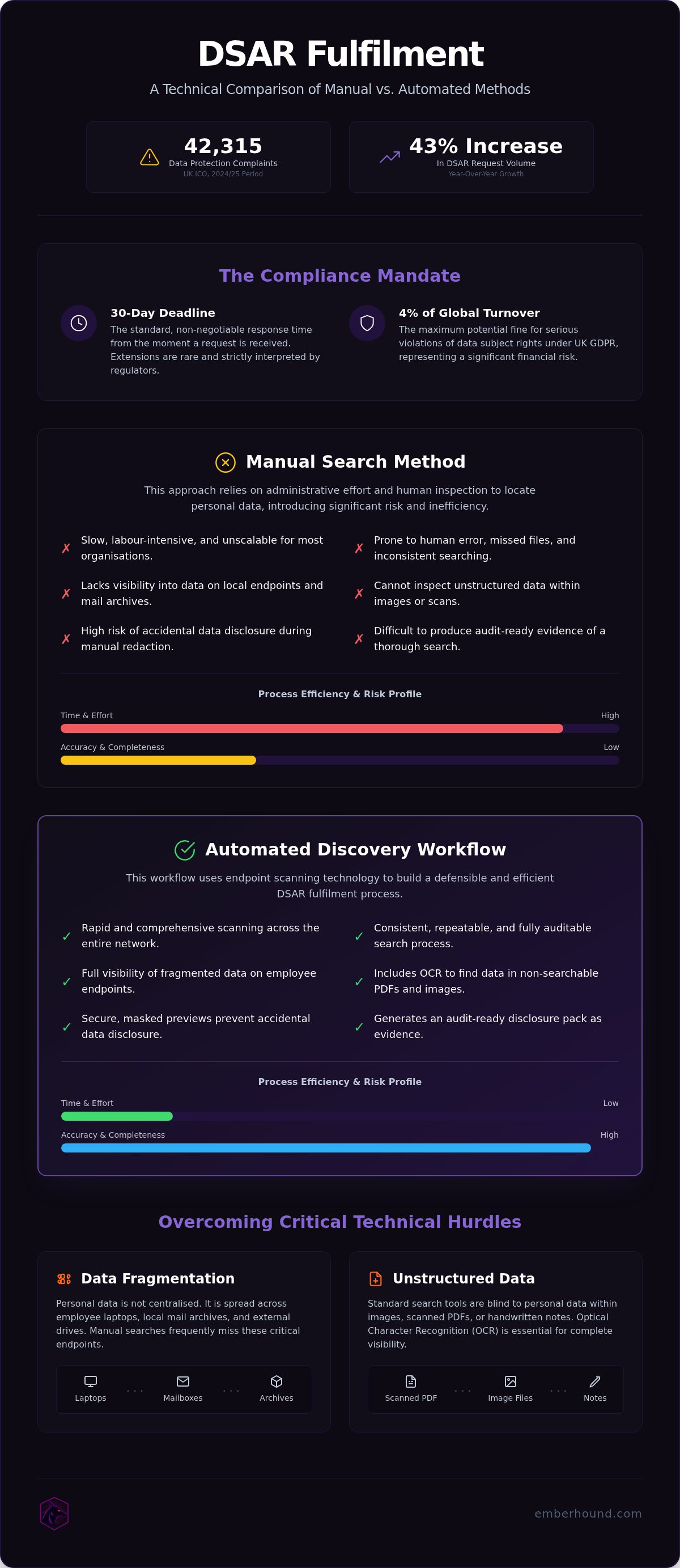
The UK Information Commissioner's Office (ICO) recorded 42,315 data protection complaints in the 2024/25 period. That is a sharp increase. For IT teams, it is a warning - one you cannot ignore. The volume of dsar requests jumped by 43% in a single year. Now, organisations are buried under unsearched mailboxes and local drives. The data is everywhere. The risk is even larger.
You feel the weight of the 30-day deadline. It is a constant race against human error and the threat of fines reaching 4% of global turnover. Manual discovery is slow and unreliable. It is a waste of your technical talent. You shouldn't spend your week digging through folders to find a single name. This guide changes the process. You will learn how to identify and organise personal data for DSAR fulfilment without the administrative burden of manual searching.
We provide a clear technical process for data discovery. This ensures you have audit-ready evidence. By focusing on local endpoint visibility, you can meet your obligations with confidence. No more guesswork. Just results.
Key Takeaways
- Identify why data fragmentation across mailboxes and hard drives creates a compliance risk.
- Establish a technical workflow to manage dsar fulfilment within the one-month deadline.
- Compare the risks of manual file inspection against the speed of automated endpoint scanning.
- Find personal data in non-searchable formats like scanned PDFs using OCR scanning.
- Secure the review process with masked previews to ensure raw data stays on the endpoint.
What is a DSAR and why does it cause anxiety?
A Data Subject Access Request (DSAR) is a formal instruction to provide a copy of all personal data held about an individual. It is not an informal enquiry. It is a legal obligation. This right of access is a core pillar of the General Data Protection Regulation (GDPR) and its UK equivalent. For most organisations, a dsar is the most frequent and most disruptive compliance event they face.
The anxiety surrounding these requests is real. It stems from the total lack of control over when or how a request arrives. An individual can make a request verbally or in writing to any part of your business. Your marketing intern, your sales head, or your support team could receive a valid request at any time. They don't need to mention specific laws for the request to be legally binding. If they ask for their data, the 30-day countdown begins immediately.
The legal right of access in the UK
Under UK law, individuals have the right to know what data you hold and the specific reasons for processing it. You must provide this information in a concise, accessible format. This is not just about finding a name in a database. It involves identifying every instance where personal data exists, including:
- Email threads and local mailbox archives.
- Spreadsheets on local hard drives.
- Scanned documents and images.
- Internal chat logs and notes.
The request is valid even if the user does not use the term "DSAR". If the intent is clear, the organisation must act. This puts a heavy burden on teams to recognise and log requests across every communication channel. You cannot ignore a request because it arrived via a social media direct message rather than a formal email.
The 30-day deadline pressure
The standard response time is one calendar month from the date of receipt. This is a non-negotiable window for most requests. Whilst you can extend this by up to two further months for complex or numerous requests, the criteria for "complex" are strictly interpreted by the Information Commissioner's Office (ICO). You must inform the individual of the extension within the first month and explain why it is necessary.
The stakes are high. Failure to meet these deadlines or providing an incomplete response can lead to formal ICO investigations. In 2026, regulatory scrutiny is higher than ever. Fines for serious violations of data subject rights can reach up to £17.5 million or 4% of global annual turnover. The pressure is not just about the fine; it is about providing audit-ready evidence of a thorough search. If you can't prove you looked everywhere, you haven't complied.
Common technical hurdles in DSAR fulfilment
Identifying personal data is a technical problem that organisations often try to solve with manual administration. It doesn't work. The average dsar involves searching through thousands of files spread across a disconnected infrastructure. When data sits in unmanaged pockets of the network, the risk of an incomplete response sky-rockets. You cannot disclose what you cannot find.
Data fragmentation across the network
Personal data is rarely confined to a single, centralised database. It lives on employee laptops, forgotten external hard drives, and within local mailbox archives. Standard network discovery tools often overlook these endpoints. They focus instead on centralised file servers that only tell half the story. This creates a dangerous visibility gap.
Shadow IT - the use of unauthorised software or personal devices for business tasks - compounds the issue. If a staff member saves a client spreadsheet to a personal desktop or a local 'temp' folder, that data is invisible to traditional IT audits. Without endpoint-level visibility, your search is fundamentally flawed. You can start a free scan to identify these hidden data pockets before they become a compliance liability.
The challenge of unstructured data
Unstructured data is the primary cause of dsar delays. Standard search functions are designed for text-heavy documents like Word files or indexed PDFs. They are blind to personal data trapped inside image files, handwritten notes, or low-quality scans. Email attachments are another frequent blind spot where sensitive information remains unindexed and unsearchable.
To capture this information, you need a technical solution that goes beyond basic keyword matching. Optical Character Recognition (OCR) technology identifies and extracts text from images and non-searchable document formats to ensure every instance of personal data is visible for compliance. Relying on manual inspection for these files is slow and prone to human error.
The final hurdle is the risk of accidental disclosure. A thorough search often unearths documents containing data belonging to multiple individuals. Redacting this third-party information manually is a high-stakes task. If you miss one name or one email address, you have traded one compliance failure for another. Following the ICO guidance on Right of Access is essential to ensure your redaction process meets regulatory standards. Manual searching is an expensive use of technical and legal resources that should be dedicated to high-value projects, not digital archaeology.
Manual search vs automated data discovery
Manual search is a liability. It relies on keyword guesses and individual file inspection. You search for a name. You hope you found every file. You probably didn't. This isn't a strategy; it's a gamble. A manual dsar process is slow, inconsistent, and legally fragile. It turns your IT department into a team of digital archaeologists.
The hidden costs of manual processing
Think about your senior IT lead. They earn a high salary. Now they are spending eight hours digging through archived mailboxes for one complex request. That is a massive waste of technical talent. Manual processes also lack the audit logging required to prove a thorough search. If the regulator asks how you searched, "we looked in the obvious places" is not an acceptable answer.
Human oversight leads to inconsistent redaction. You might miss a sensitive email address in a 50-page thread. One mistake is a privacy breach. These errors don't just cost time; they invite fines. Manual searching is a high-risk approach that provides no evidence of compliance when the 30-day deadline expires.
Why automated scanning is the technical standard
Automated scanning is the technical standard for a reason. It doesn't guess. It identifies personal data patterns like National Insurance numbers, physical addresses, and salted SHA-256 fingerprints. This provides a repeatable, audit-ready process across all endpoints. You can see why automated discovery is necessary for lean teams that cannot afford to hire dedicated compliance staff.
Automation allows for a wider search scope in a fraction of the time. You aren't just searching filenames. You are searching the actual content of files on local drives and external devices. Automation reduces the risk of human error and prevents accidental data deletion during the discovery phase. It ensures that your response is based on facts, not assumptions.
For smaller organisations, usage-based automated tools allow you to scale costs with your actual request volume. You don't need a massive enterprise contract for five requests a year. You just need a tool that works when the clock is ticking. Following the ICO guidance on the right of access requires a level of thoroughness that manual searches cannot guarantee. Automated discovery is the only way to provide a clear technical process for data discovery without the administrative burden of manual searching.
Laying the technical foundation for a thorough search
Confirming identity is not a suggestion. It is a requirement. Before you initiate a dsar search, ensure you have verified the data subject. Releasing information to an unauthorised person is a significant security incident. Once verified, define the search parameters. Vague requests are common. You are permitted to ask for clarification if a request is broad or appears "manifestly unfounded".
Identity verification and scope
Documentation is your protection. Record every step of the scope definition process. If you exclude certain data types or timeframes, you must justify those decisions. This log becomes critical evidence during an ICO audit. It demonstrates a methodical, technical approach rather than a reactive scramble. Every interaction regarding the scope of the dsar must be tracked to ensure the 30-day clock is managed correctly.
Scanning mailboxes and hard drives
Data fragmentation is your biggest enemy. Personal data often hides in local Outlook archives (.pst files) or legacy backups stored on external hard drives. These are the blind spots of centralised IT management. Your search must reach every endpoint where a staff member might have exported or saved a file. Our guide to data mapping provides a deeper technical breakdown of these environments.
Use endpoint-only scanning to identify personal data where it sits. This method is safer. It avoids the need to exfiltrate files to a central server for analysis. For non-text files, OCR scanning is essential. It "reads" scanned documents and images to find keywords that standard tools miss. This is the difference between a surface-level search and a thorough discovery that identifies every scrap of personal data.
The assembly phase is where many teams fail. You must organise the findings into a structured disclosure pack. This pack should categorise data by source and type. It must include masked previews. This allows your compliance team to review the data safely. They can confirm relevance without handling raw, unencrypted files. A structured pack simplifies the final redaction and ensures the output is audit-ready.
How EmberHound simplifies the DSAR disclosure pack
The final stage of a dsar is often the most high-risk. You have identified the data. Now you must review it without triggering a secondary security incident. Many legacy platforms force you to move your entire data set to a central server or a cloud dashboard. This creates a massive, unnecessary attack surface. It moves your most sensitive files into a third-party environment you don't control.
Privacy-first endpoint scanning
EmberHound changes the discovery model. It scans endpoints locally. The platform identifies personal data where it resides on the user's machine. It never exfiltrates your files. This ensures your data exposure risk stays at zero. We use TLS 1.3 and AES-256 encryption to protect metadata, but the raw files never leave your network.
Because the processing is local, the platform never accesses your underlying file system. You aren't handing over the keys to your kingdom. This is a technical safeguard designed for IT professionals who understand that centralisation is often a vulnerability. It's a calm, factual alternative to bloatware platforms that prioritise their own data collection over your security.
Audit-ready evidence without the drama
Meeting the 30-day deadline is only half the battle. You must also provide evidence of a thorough search. The ICO requires a repeatable, documented process. EmberHound generates salted SHA-256 fingerprints for every file it touches. This provides an immutable record of your compliance efforts. It proves exactly what was scanned and when. This creates a transparent audit trail that stands up to regulatory scrutiny.
The DSAR disclosure pack organises these findings into a structured, audit-ready format. It includes masked previews. These allow your compliance team to verify the data safely. They can confirm a file contains personal data without ever opening the raw, unmasked document. This separation of duties is a core security principle. It prevents the disclosure process itself from becoming a source of data leaks. We use AES-256 encryption at rest to ensure that even the metadata remains secure.
You don't have to worry about complex, mandatory contracts. Our usage-based pricing means you pay for what you use. If you have one request this month, you pay for one. If you have fifty, you scale up. This flexibility is essential for lean teams whilst you handle every dsar with total regulatory readiness. It's about providing exactly what you need to close the request. No drama. No bloat. Just compliance.
Automate your path to compliance
The 30-day clock doesn't stop for technical friction. You've seen why manual searching fails to meet the standard required for a modern dsar. It's slow. It's prone to error. It leaves you exposed. By switching to a technical discovery process, you eliminate the visibility gaps in your mailboxes and local drives. You can now move from a reactive scramble to a methodical, repeatable workflow that satisfies regulatory requirements without the administrative burden.
EmberHound ensures your files stay exactly where they belong. All scanning is local. There is no file exfiltration. You get audit-ready evidence with masked previews, all protected by TLS 1.3 and AES-256 encryption. This ensures a verifiable, secure response every time. The anxiety of the deadline fades when you have the tools to identify personal data instantly. You protect your team's time and your organisation's reputation.
Take control of your data discovery and close your next request with confidence.
Frequently asked questions
How long do I have to respond to a DSAR in the UK?
You have exactly one calendar month from the day you receive the request to provide a response. This is the standard timeframe required under UK GDPR. If the dsar is particularly complex or you have received multiple requests from the same individual, you can extend this by a further two months. You must notify the individual about the extension within the first month to remain compliant.
Can I charge a fee for fulfilling a subject access request?
In most circumstances, you cannot charge a fee for fulfilling a subject access request. This is a free right for the individual under UK law. You are only permitted to charge a reasonable fee to cover administrative costs if the request is clearly "manifestly unfounded or excessive". You may also charge if the individual asks for further copies of information you have already provided during a previous search.
Do I have to provide every single email that mentions the data subject?
No, you only provide information that constitutes the individual's personal data. A mention of their name in a business thread does not always mean the entire email is disclosable. You must review the content to see if it relates to them as an individual. Any information that identifies other people or contains sensitive commercial secrets must be redacted or excluded before you finalise the disclosure pack.
What happens if I miss the 30-day DSAR deadline?
Missing the deadline puts your organisation at risk of an investigation by the Information Commissioner's Office (ICO). The ICO recorded 42,315 data protection complaints in the 2024/25 period, showing that individuals are increasingly willing to report delays. Failure to comply can lead to significant financial penalties. For serious violations, fines can reach up to £17.5 million or 4% of your global annual turnover, whichever is higher.
Can I refuse to respond to a DSAR if it is too complex?
You cannot refuse a request simply because the data is difficult to locate or the volume is high. Complexity is a valid reason for a deadline extension, not a rejection. You can only refuse to act on a request if you can prove it is "manifestly unfounded or excessive". This requires a high threshold of proof. Instead of refusing, you should use automated scanning to manage the volume safely.
How do I verify the identity of someone making a DSAR?
You should use reasonable means to verify the identity of the person making the request. This might involve asking for a copy of a utility bill or a photo ID if you have genuine doubts. You shouldn't ask for more information than is necessary to confirm who they are. If the person is an existing employee or a regular client, you likely have enough information to proceed without further checks.
What is the difference between personal data and PII under UK GDPR?
Under UK GDPR, the correct legal term is "personal data". This refers to any information relating to an identified or identifiable living individual. Whilst the term "PII" is common in North America, it is not a defined term in the UK framework. Personal data has a broader scope, covering everything from IP addresses and salted SHA-256 fingerprints to physical home addresses and National Insurance numbers found during a technical search.
Does my DSAR search need to include backups and archives?
Yes, your search must include backups and archives if the personal data is still "held" by your organisation. If the data is readily available and searchable, it falls within the scope of the request. This is why manual discovery is often insufficient. Automated tools can scan legacy exports and external hard drives to ensure you don't leave pockets of data unsearched, providing audit-ready evidence of a thorough discovery process.


