

Your legacy folders are a ticking time bomb. Most IT teams are sitting on mountains of digital landfill - old spreadsheets, duplicate PDFs, and "temp" files from 2014. You know it is there. You know it costs a fortune in storage and makes every Data Subject Access Request (DSAR) a manual nightmare. More importantly, you know that hidden within those folders is sensitive personal data that could trigger a £17.5 million fine under the UK GDPR. Identifying redundant, obsolete, and trivial (ROT) data isn't just about tidying up. It is about closing the gaps before an auditor or a threat actor finds them first.
You can reclaim your infrastructure without the friction of a massive migration. This guide explains how to eliminate the noise and meet UK compliance standards without moving a single file from its original location. We provide a clear framework to categorise your information, lower your security risk, and speed up your response times. You will learn how to isolate the personal data and card data that matters whilst purging the rest with total confidence. It is time to stop managing bloat and start prioritising visibility.
Key Takeaways
- Stop wasting resources on digital landfill. Understand how redundant, obsolete, and trivial data inflates storage costs and security risks for UK organisations.
- Develop a systematic approach for identifying redundant, obsolete, and trivial (ROT) data across endpoints to meet UK GDPR storage limitation requirements.
- Protect your information during the discovery process. Learn why local-only scanning is the safest method for identifying sensitive files without the risk of exfiltration.
- Categorise personal data hidden within legacy folders. This prioritisation improves DSAR response times and reduces your overall data footprint.
- Detect sensitive information within scanned documents and images. OCR technology finds the risks that manual processes often overlook.
What is ROT data and why is it a security risk?
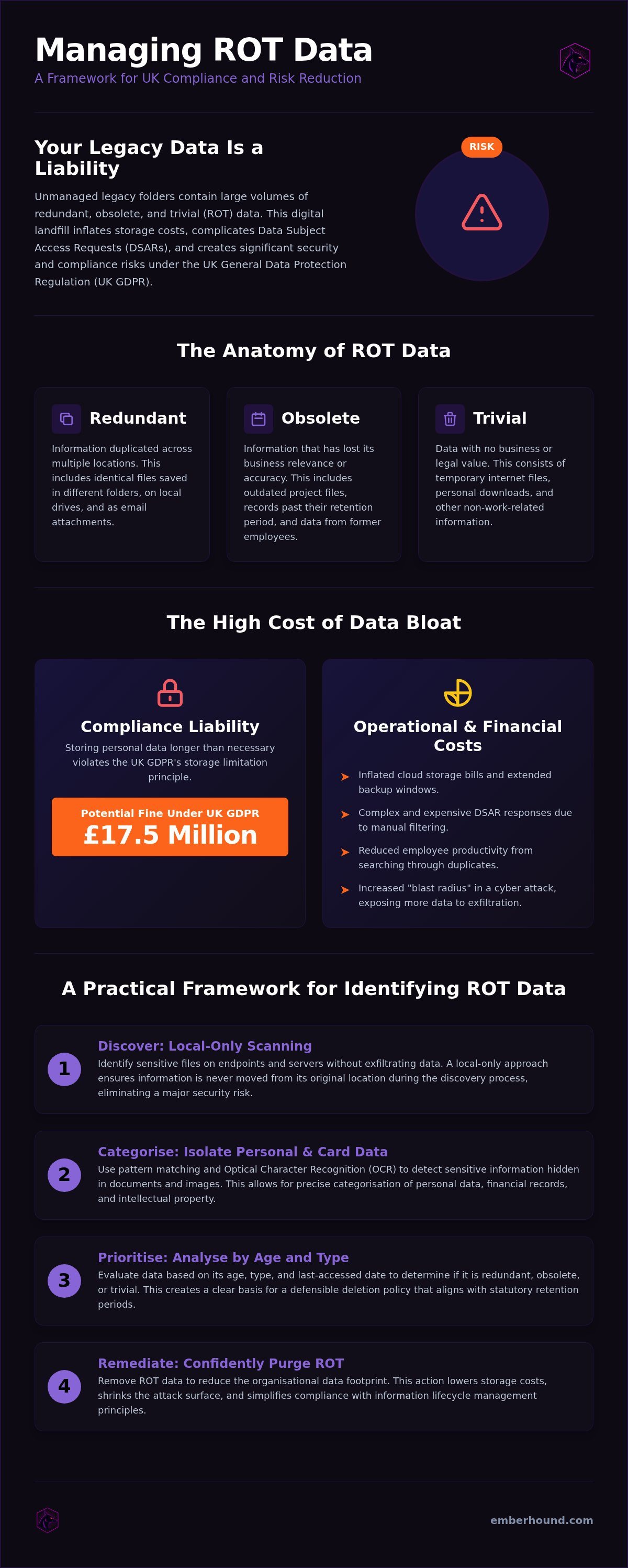
ROT is the digital sediment that accumulates across every server and endpoint in your organisation. It stands for redundant, obsolete, and trivial data. This information takes up space, drains budgets, and hides significant legal risks. To manage it, you must first understand exactly what sits in your legacy folders.
- Redundant data is any information duplicated across multiple locations. This includes the same 50MB PDF saved in five different project folders or mirrored across three separate backup volumes.
- Obsolete data is information that has lost its accuracy or business relevance. It includes legacy software files, records from employees who left years ago, or outdated draft versions of contracts.
- Trivial data has zero business or legal value. It consists of non-work files like personal photos, expired lunch menus, or temporary internet files that were never purged.
Identifying redundant, obsolete, and trivial (ROT) data is the first step in reclaiming your infrastructure and reducing your attack surface.
The high cost of data bloat in the UK
Storage is never truly cheap. Even with falling hardware prices, the operational costs of managing "dark data" are substantial. Every gigabyte of ROT data extends your backup windows and inflates your cloud storage bills. It strains server performance; when file systems are clogged with millions of useless objects, indexing slows down. Employee productivity drops whilst they hunt for the correct version of a document amongst a dozen duplicates. Maintaining servers to host data that provides no value also increases your organisation's digital carbon footprint. Effective information lifecycle management requires a rigorous process for disposing of data that has outlived its purpose.
Why ROT data is a compliance liability
Under the UK GDPR, the storage limitation principle is a legal mandate. It requires that personal data is kept for no longer than is necessary for the purposes it was collected. Storing customer records indefinitely is a direct breach. ROT data also makes Subject Access Requests (DSARs) complex and expensive. If your environment is full of "noise," your team will spend hours manually filtering through obsolete files to find relevant records. This increases the risk of missing sensitive information or failing to meet the statutory deadline. Finally, consider the "blast radius" of a cyber attack. By identifying redundant, obsolete, and trivial (ROT) data and removing it, you reduce the volume of personal data available for exfiltration. A smaller footprint equals a smaller target.
The anatomy of redundant, obsolete, and trivial data
Data doesn't just appear. It accumulates through habit and a lack of clear disposal protocols. Identifying redundant, obsolete, and trivial (ROT) data requires a granular look at how your team actually works. Most organisations treat their storage like an infinite attic. They store everything because they fear deleting something useful. This "just in case" mentality creates a massive compliance blind spot. Categorising these files is the first step toward a defensible deletion policy.
Identifying redundant data across the network
Redundant data is the most common form of digital waste. It starts with a single spreadsheet. One team member saves a copy to their desktop to work offline. Another attaches it to an email for feedback. Suddenly, five versions of the same sensitive document exist across your network. These "temporary" copies for project collaboration quickly become permanent fixtures.
Email attachments are a primary culprit. Every time a file is sent to a distribution list, it is replicated in dozens of mailboxes. Whilst central servers often have deduplication tools, local hard drives are often ignored. These endpoints contain more duplicates than your core infrastructure. They are also harder to monitor. This makes scanning local devices for redundant files a critical security priority.
Spotting obsolete and trivial information
Obsolete data is a legal liability. It includes files from former employees who left years ago or data from defunct software systems. If information is older than your statutory retention period, it shouldn't be there. The National Archives' guidance on information management provides a framework for these disposal schedules. Following these standards ensures your deletion policy is defensible during an audit. It prevents you from keeping data that no longer serves a business purpose.
Trivial data is simply non-business noise. Think holiday photos, personal music collections, or grocery lists. These files take up space and clutter search results. More dangerously, they can hide personal data. You might think an old archive folder is just "junk," but it could contain thousands of customer records. Using GDPR data discovery allows you to find the personal data buried within these obsolete archives. Identifying redundant, obsolete, and trivial (ROT) data is the only way to separate the noise from the risk.
Methods for identifying ROT data without increasing risk
Identifying redundant, obsolete, and trivial (ROT) data shouldn't create a new security vulnerability. Many organisations make the mistake of moving or copying their files to a central server or a cloud environment for analysis. This process creates a "shadow" copy of your most sensitive information, effectively doubling your attack surface during the very audit meant to reduce it. To maintain a defensible position under UK GDPR, the discovery process must be as secure as the data it targets.
The problem with manual data discovery
Asking employees to self-audit their folders rarely works. Most staff lack the legal training to distinguish between a "trivial" file and a "critical" business record. This leads to two outcomes: they either delete nothing to be safe, or they accidentally delete something vital. Manual discovery is also incredibly slow. The cost of manual labour for a single department can quickly exceed the price of automated tools. Beyond the cost, manual processes are prone to human error and lack the consistent audit trail required for compliance. You cannot prove to a regulator that your data lifecycle is under control if your primary evidence is a collection of "I think I deleted it" emails from staff.
Why local processing is safer for UK businesses
The safest way to scan for risk is to keep the data where it lives. Local processing ensures that raw file content never leaves the endpoint. Instead of exfiltrating files to a central server, modern discovery tools perform the analysis on the device itself. This is a fundamental shift from traditional network scanners that drain bandwidth and create central data repositories that attract threat actors.
By using salted SHA-256 fingerprints, you can identify duplicate files across your network without ever "seeing" the raw content. These fingerprints allow you to match redundant files whilst maintaining total privacy. This technical approach aligns with PCI DSS card data scanning standards. It ensures that sensitive cardholder data or personal data isn't being copied or moved during the identification phase.
For UK businesses, this local-only method provides three distinct advantages:
- Reduced Scope: Sensitive data stays within its authorised environment.
- Zero Exfiltration: No files are sent to the cloud, eliminating the risk of interception.
- Audit-Ready Evidence: Salted fingerprints and masked previews provide proof of compliance without exposing the underlying data.
Maintaining a clear audit log is essential for identifying redundant, obsolete, and trivial (ROT) data. This log should record what was scanned and when, providing the "how and why" behind your deletion decisions. This transparency is what turns a simple clean-up project into a robust, defensible compliance framework.
A practical framework for identifying ROT data
Establishing a defensible deletion process starts with a clear policy. Purging files requires a legal benchmark. UK organisations must align their data retention with the UK GDPR storage limitation principle. This means defining exactly how long you need to keep specific types of records. Once your policy is set, identifying redundant, obsolete, and trivial (ROT) data becomes a methodical exercise in mapping and categorisation.
Mapping your data infrastructure
Modern infrastructure is fragmented. Data no longer resides exclusively on a central file server. It is scattered across remote worker laptops, personal mailboxes, and forgotten external hard drives. Identifying personal data on these endpoints is often the hardest part of the process. Remote workers frequently save local copies of sensitive documents for speed or offline access. These files often bypass central backup and retention rules.
Email inboxes also store significant bloat. Obsolete attachments and trivial threads from years ago consume storage and increase search times during audits. A comprehensive discovery scan must include these mailboxes to find hidden risks. You must also account for data that isn't in plain text. Scanned PDF documents, such as invoices or ID copies, often contain sensitive information that standard keyword searches miss. Using OCR technology to scan these images is the only way to ensure your ROT identification is complete.
Categorising and reviewing scan results
Once the scan is complete, you need a way to filter the noise. Identifying redundant, obsolete, and trivial (ROT) data effectively requires grouping files by their utility and age. Grouping data by 'Last Accessed' date is the most effective way to find obsolete files that no longer serve a business purpose. If a document hasn't been opened or modified in seven years, it is likely a candidate for deletion. You should also identify large trivial files, such as personal video files or old software installers, that consume excessive storage without adding value. These files often hide in deep directory structures where manual audits never reach.
Reviewing these findings allows you to apply remediation with confidence. You can choose to delete, archive, or mask data based on its risk level. For a deeper look at setting these benchmarks, see our GDPR guide for retention best practices. This framework turns a chaotic storage environment into an organised, compliant asset. It replaces guesswork with technical certainty. This ensures that your data footprint remains lean and defensible.
How EmberHound simplifies the ROT data lifecycle
Identifying redundant, obsolete, and trivial (ROT) data is a liability if the discovery process itself is insecure. EmberHound is a data discovery platform built for lean compliance and security teams. It identifies personal data and card data buried within ROT categories without the risk of exfiltrating files to a central server. By processing data locally on the endpoint, the platform ensures that sensitive information remains within your authorised environment whilst you clean up the noise.
Secure discovery for lean IT teams
Most discovery tools require complex server configurations and extensive deployment schedules. EmberHound removes this friction. There is no deployment drama; the tool is designed for speed and immediate visibility. All file analysis occurs on the local machine. This means your raw data is never uploaded to the cloud or moved across the network during the identification phase. This local-only approach eliminates the risk of a secondary data breach during the audit itself.
Security is baked into the architecture. The platform uses TLS 1.3 for secure communication and AES-256 encryption to protect data at rest. Salted SHA-256 fingerprints allow for precise duplicate detection without exposing the underlying content. This approach is ideal for organisations with limited resources who need to act quickly. You can start a free scan to identify your risks and see exactly what is hiding in your legacy folders.
Meeting UK compliance standards
Compliance is about evidence. EmberHound generates reports that prove you have identified and managed sensitive data according to UK legal requirements. The platform aligns with the following frameworks:
- UK GDPR: Implements the storage limitation principle by identifying data that has outlived its purpose.
- PCI DSS v4.0.1: Locates unencrypted card data to reduce your audit scope and meet the latest mandatory requirements.
- SOC 2 and CIS Controls: Provides the continuous visibility and evidence generation required for modern security audits.
The platform provides masked previews and salted fingerprints. This allows your team to verify findings and generate audit-ready evidence without creating new privacy risks. Usage-based pricing ensures that you only pay for the data you scan, making it a cost-effective solution for one-off ROT clean-up projects or regular compliance health checks. For a deeper look at our security posture and how we protect your information, see our why us page.
Reclaim your infrastructure and reduce legal risk
Managing digital landfill is no longer a choice for UK organisations. The storage limitation principle under UK GDPR requires a proactive approach to data disposal. By now, you understand that identifying redundant, obsolete, and trivial (ROT) data is the only way to separate actual business assets from high-risk noise. You have the framework to categorise your files and the technical path to scan endpoints without the danger of exfiltration.
EmberHound provides the visibility you need without the deployment drama. All processing happens locally on the endpoint, ensuring no files leave your control. You get audit-ready evidence with masked previews and a usage-based pricing model that fits your specific project needs. There are no long-term contracts to sign or complex servers to configure. You can start cleaning up your legacy folders in minutes rather than months.
Visibility is the best defence against regulatory oversight. Take the first step toward a leaner, more secure environment today.
Frequently Asked Questions
What is the difference between redundant and obsolete data?
Redundant data consists of exact copies or duplicates of information found elsewhere, such as multiple versions of a report in different folders. Obsolete data is information that was once accurate but is no longer required for business or legal purposes, like files from employees who left years ago. Whilst redundant data wastes space, obsolete data often represents a higher legal risk because it usually exceeds the statutory retention periods required by UK law.
How much ROT data does the average UK business hold?
Whilst exact percentages vary by industry, professionals often find that a significant portion of corporate storage is comprised of "dark data" or useless files. Managing this digital landfill is essential for controlling infrastructure costs. Identifying redundant, obsolete, and trivial (ROT) data allows organisations to reclaim storage capacity and reduce the time spent on server maintenance. Without a clear discovery process, this bloat continues to grow, inflating cloud storage budgets and extending backup windows unnecessarily.
Is identifying ROT data a requirement for UK GDPR compliance?
Yes, it is a direct implementation of the UK GDPR storage limitation principle. This principle mandates that personal data must not be kept for longer than is necessary for the purposes for which it was processed. If your organisation stores obsolete files containing customer information, you are in breach of this requirement. Regular audits ensure that you only retain data that has a valid business or legal justification, reducing your exposure to potential fines.
Can I use automated tools to delete ROT data safely?
Automated discovery tools are the most reliable way to categorise data before disposal. Manual deletion is slow and often leads to the accidental removal of critical records. Tools like EmberHound use local-only scanning to find personal data and card data within legacy folders without moving files. This provides the visibility needed to apply automated remediation or deletion policies with total confidence, ensuring that your data lifecycle management is both efficient and defensible.
How does ROT data identification help with Subject Access Requests (DSARs)?
Removing ROT data significantly reduces the "noise" your team must filter through during a Subject Access Request. When you receive a DSAR, you have a statutory deadline to locate and disclose all relevant personal data. If your environment is cluttered with redundant copies and obsolete drafts, the discovery phase takes longer and carries a higher risk of error. A lean data footprint allows for faster, more accurate DSAR disclosure packs and lower administrative costs.
Does scanning for ROT data involve moving my files to the cloud?
No, scanning for risk should not involve creating more risk. Traditional network scanners often exfiltrate file content to a central server, but EmberHound performs all processing locally on the endpoint. This means your raw files never leave your control and are never moved to the cloud during the audit. This approach uses TLS 1.3 and salted SHA-256 fingerprints to identify files securely, maintaining a high level of privacy whilst identifying redundant, obsolete, and trivial (ROT) data.
What are the common signs that my organisation has a ROT data problem?
High storage costs and slow server performance are the most obvious technical indicators. You may also notice that employees struggle to find the "single source of truth" amongst multiple versions of the same document. If your IT team spends excessive time manually searching legacy folders to fulfil DSARs, you likely have a ROT problem. Another sign is the presence of non-business files, such as personal photos or outdated software installers, taking up corporate drive space.
How often should we perform a ROT data audit?
You should perform a ROT data audit at least annually, though continuous monitoring is the modern standard. Frameworks like PCI DSS 4.0 are moving towards a model of continuous, risk-based security assessment rather than point-in-time validation. Regular scanning ensures that digital bloat doesn't accumulate and that your organisation remains compliant with evolving UK data laws. A usage-based model allows you to run these audits whenever your infrastructure or compliance needs change without long-term contracts.


