

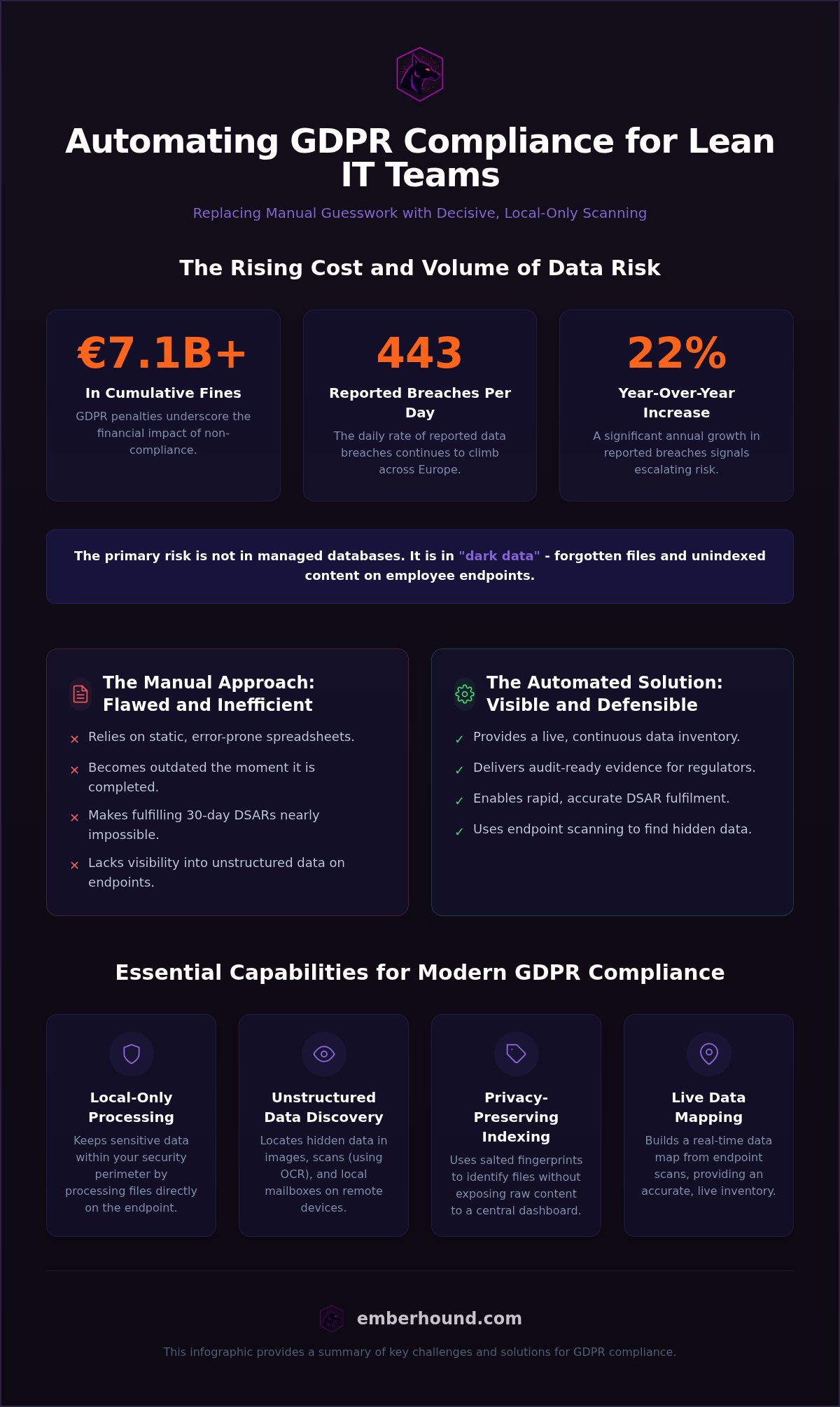
Cumulative GDPR fines have now surpassed €7.1 billion. Reported data breaches in Europe reached an average of 443 per day - a 22% year-over-year increase. Most of this risk does not sit in your primary database. It hides in forgotten spreadsheets on employee laptops or unindexed images in local folders. Finding this information manually is impossible. Relying on luck is dangerous. You need GDPR compliance tools that actually work for a lean IT team.
Manual DSAR fulfilment takes too much time. You are right to worry about hidden personal data on remote devices. However, you don't have months to configure complex enterprise software that requires a dedicated team just to keep it running. You need visibility and speed, not more bureaucracy or bloatware.
This guide identifies the most effective tools to locate personal data and maintain regulatory compliance without unnecessary complexity. We will show you how automated discovery provides audit-ready evidence for regulators and reduces your risk of a data breach. You can find what you need without the friction of traditional, slow-moving platforms. It is time to replace manual guesswork with decisive, local-only scanning.
Key Takeaways
- Replace manual spreadsheets with automated scanning to identify and organise personal data across your network.
- Select GDPR compliance tools that use local endpoint processing to keep sensitive data within your security perimeter.
- Locate hidden risks in unmanaged locations by using OCR and mailbox scanning for remote employee devices.
- Build a live data map from focused endpoint scans to provide audit-ready evidence for regulators without the burden of complex enterprise software.
- Utilise salted fingerprints and local-only processing to ensure that sensitive files never leave the endpoint during discovery.
What is a GDPR compliance tool?
A GDPR compliance tool is software designed to identify, organise, and protect personal data held by an organisation. It is a technical safeguard against the chaos of unmanaged information. Many companies still rely on manual spreadsheets to track their data assets. This approach is flawed. Spreadsheets are static and prone to error. Effective GDPR compliance tools replace these manual logs with automated scanning and reporting. They provide a live inventory of your data landscape.
The primary goal is risk reduction. By knowing exactly where personal data resides, you can apply appropriate security controls. This reduces the likelihood of regulatory fines and data breaches. It isn't about general security; it is about specific, regulatory-driven visibility. If you don't know a file exists, you can't protect it. These tools turn dark data into actionable insights.
The role of data discovery in compliance
Data discovery is the technical process of scanning your entire network to find personal data. It identifies information in structured databases and unstructured files like PDFs, spreadsheets, or images. Most sensitive data hides in the latter. An employee might save a customer list to their desktop or scan a passport into a shared folder. Data discovery is the foundation of any General Data Protection Regulation (GDPR) strategy. It provides the evidence you need to prove you are in control of your data.
Why automation is necessary for UK businesses
Manual data mapping is a losing game. It becomes outdated the moment it's finished. Automated tools provide continuous visibility into data movements across your organisation. This is particularly vital for lean IT teams who cannot afford to spend weeks on manual audits. Automation handles the heavy lifting of identifying sensitive files across hundreds of endpoints.
Consider the pressure of a Data Subject Access Request (DSAR). You have a 30-day legal limit to provide a full disclosure pack. Searching through local mailboxes and external hard drives manually is a recipe for failure. Automation allows your team to fulfil these requests within the legal timeframe. It removes the friction from compliance tasks, allowing you to focus on core operations. For more information on how this works in practice, you can view our GDPR guide.
Essential categories of GDPR software
Selecting GDPR compliance tools is not a matter of finding a single "all-in-one" solution. Instead, you must choose software that matches your specific data risks. A company with a remote workforce faces different challenges than one with a centralised on-site server. Your software stack should address the functional gaps in your current security posture. These categories typically include:
- Data subject rights management: These tools simplify the fulfilment of access and deletion requests.
- Risk assessment: Software in this category identifies vulnerabilities in how data is stored or processed.
- Encryption and anonymisation: These tools protect personal data if a breach occurs by making it unreadable to unauthorised actors.
Focusing on these areas ensures that you aren't paying for "bloatware" that adds no value to your compliance strategy. You need tools that provide immediate visibility and actionable results. Every organisation handles data differently, so your choice should reflect your actual data footprint.
Data discovery and inventory tools
Data discovery tools are the most critical category for maintaining a live inventory of personal data. These tools scan endpoints, servers, and cloud storage to find sensitive information that has drifted from managed systems. They categorise data based on regulatory requirements such as GDPR or PCI DSS. A high-quality tool provides audit-ready evidence without exposing raw file content to a central dashboard. This is a vital distinction. You should look for tools that use local processing to prevent sensitive files from leaving your network. You can start a free GDPR scan to identify where your data currently hides.
Subject Access Request (DSAR) management
Managing subject rights is an operational burden that can quickly overwhelm a lean IT team. DSAR tools help locate every scrap of data related to a specific individual across your entire infrastructure. This includes data in mailboxes and on external hard drives. Automated disclosure packs reduce the time spent on manual redaction and file gathering. Efficient DSAR handling is critical to avoid complaints to the Information Commissioner's Office (ICO). Following the official ICO guidance on GDPR is the best way to ensure your response processes are legally sound. Failure to meet the 30-day deadline increases the risk of formal investigations and significant fines.
How to evaluate GDPR compliance software
Evaluating GDPR compliance tools requires looking past the user interface. You must scrutinise the technical architecture and data handling policies of any potential solution. A tool that finds sensitive data but creates new security risks is a liability. Focus on how the software interacts with your files. It should provide visibility without compromising the integrity of your network. Prioritise tools that offer local processing to ensure that sensitive personal data never leaves your secure perimeter.
Local processing vs cloud-based scanning
Many cloud-based scanners require file exfiltration to a third-party server to perform analysis. This increases your attack surface by creating a new destination for sensitive data. Local processing keeps the data on the endpoint, which is a far more secure approach. You should identify if the platform accesses the file system directly from a central cloud hub or if it performs scanning locally on the device. This architectural choice is explored in research regarding the GDPRValidator tool for cloud services, which highlights the necessity of rigorous validation in distributed environments. Keeping the processing local ensures that your compliance activities do not become a source of data leakage.
Technical evidence and audit logs
A compliance tool is only as good as the proof it provides. You need audit-ready evidence that satisfies regulators during a review. Look for features like salted SHA-256 fingerprints. These allow you to demonstrate that you have located a file without revealing its raw content to the central dashboard. Masked previews provide enough context for your team to act without exposing sensitive personal data to unauthorised eyes. Ensure the software uses high-level encryption standards, specifically TLS 1.3 for data in transit and AES-256 for data at rest. Comprehensive audit logging is also essential. It must track every mutation and access event to ensure a transparent record for regulatory review.
Ease of deployment for lean teams
Lean IT groups cannot afford software that requires months of configuration or expensive consultants. Avoid "bloatware" that demands deep integration into every server or complex enterprise middleware. You need a solution that is fast to deploy and easy to manage on a day-to-day basis. Usage-based pricing models are often better than flat enterprise fees because they allow you to scale as your data volume grows. Choosing a tool designed for speed ensures you stay ahead of compliance deadlines without draining your personnel resources. Discover why EmberHound is suitable for lean teams looking for a pragmatic approach to data discovery.
Addressing hidden data risks on endpoints
Your primary database is rarely the source of your biggest compliance headache. Personal data often hides in unmanaged locations like employee mailboxes and external hard drives. These are the blind spots that standard GDPR compliance tools often overlook. Remote work has increased the volume of sensitive data stored on local endpoints. Every laptop in your fleet is a potential liability. If you aren't scanning these devices, you don't have a complete view of your data posture.
Ignoring these locations creates a significant risk. A single spreadsheet saved to a desktop or a customer passport scan left in a downloads folder can lead to a breach. You need a solution that reaches beyond the server room. Effective discovery must account for the reality of modern work patterns where data moves fluidly between cloud apps and local storage. Luck is not a strategy. You need visibility.
Mailbox and attachment scanning
Email remains a primary source of data leaks for UK businesses. Sensitive information is frequently shared via internal messages or sent to external partners without proper encryption. To be effective, tools must be able to scan both the body of the email and any attachments. Simply checking the file name isn't enough. You need deep inspection to identify personal data buried within long threads or archived folders. For more detail, read about scanning mailboxes for sensitive data. This visibility is essential for responding to DSARs accurately and meeting the 30 - day deadline.
OCR for scanned images and PDFs
Many organisations store scanned passports, ID cards, or contracts as image files. These are often forgotten in "Scans" folders or attached to emails. Standard text search tools cannot identify data within these files because they lack Optical Character Recognition (OCR). OCR technology for data discovery converts these images into searchable text. This allows you to identify hidden risks that would otherwise remain invisible to your audit process. Without OCR, your compliance report is incomplete. It leaves a gap that regulators will eventually find.
A comprehensive approach requires scanning every file type, including those that aren't text - based. By integrating OCR into your discovery workflow, you ensure that no image - based personal data remains unmanaged. This level of detail is what separates a tick - box exercise from a professional security strategy. It's about finding what others miss.
Getting started with automated GDPR discovery
Don't wait for a regulatory inquiry to test your defences. Effective GDPR compliance tools allow you to start small and move fast. You don't need to scan your entire network on day one. Instead, begin with a focused scan of your most critical endpoints. This approach provides immediate visibility without overwhelming your IT resources. Use these initial results to build an accurate data map and identify high-risk areas that require urgent remediation.
Implement a usage-based model to manage your costs. This ensures you pay for the protection you need as you improve your compliance posture. Review your status regularly. Data moves constantly. A one-time scan is a snapshot, not a strategy. You must ensure new data is captured as employee behaviour and storage habits change over time. It is about maintaining a state of readiness rather than performing a yearly tick-box exercise.
The 48-hour data discovery plan
Identify the departments most likely to handle sensitive personal data. HR and Finance are typically the highest priority targets for any discovery project. Deploy a local scanner to these specific endpoints to get immediate visibility. This bypasses the need for complex server configurations or months of planning. You can get results in hours, not weeks.
Once the scan is complete, generate a report of all identified personal data. This allows you to prioritise remediation efforts based on actual risk. You can see which files are unencrypted or stored in unmanaged locations. It turns an abstract compliance problem into a list of specific, fixable tasks. You can view the EmberHound video demo to see how this reporting works in practice. This rapid feedback loop is essential for lean teams who need to show progress to stakeholders quickly.
Scaling your compliance efforts
After securing your most critical endpoints, expand your scanning to include external hard drives and cloud backups. These locations often house legacy data that hasn't been accessed in years. It is still your responsibility under the law. If your business handles payment information, integrate PCI card data discovery into your workflow. This provides a unified view of your regulatory risks across both GDPR and PCI DSS frameworks.
Scaling doesn't have to mean adding complexity or "bloatware." By using tools designed for local processing, you maintain control without adding new attack surfaces. Every new device added to your network should be brought into your discovery cycle. This ensures that your data map remains accurate and your audit evidence stays fresh. It is about building a sustainable, repeatable process that protects your organisation and your customers - without the friction of traditional enterprise software.
Secure your data perimeter
Compliance is no longer about ticking boxes on a static spreadsheet. It is about technical visibility across every endpoint in your organisation. You've seen how hidden personal data in mailboxes and scanned images creates silent risks that manual audits miss. Effective GDPR compliance tools eliminate these blind spots by finding data where it actually lives.
You don't need to sacrifice security for visibility. Local-only scanning ensures no file exfiltration occurs during the discovery process. This keeps sensitive information on the device where it belongs. Your data remains protected by TLS 1.3 and AES-256 encryption at rest. When a regulator asks for proof, you can provide audit-ready evidence with masked previews that protect privacy whilst you demonstrate total control.
Replacing manual guesswork with automated precision is the fastest way to reduce your breach risk and handle DSARs with confidence. You can protect your team from the burden of complex configuration and start seeing results immediately. It's time to move from regulatory uncertainty to decisive, professional action.
Frequently Asked Questions
What are the most important GDPR compliance tools for a small business?
Data discovery is the most critical starting point for any small business. You need software that identifies where personal data resides across all endpoints. DSAR management tools are also vital for handling access requests within the 30 - day limit. Small teams should prioritise friction - reduced tools that offer automated scanning and clear reporting without requiring months of configuration or complex enterprise middleware.
Can GDPR tools find personal data in scanned PDF documents?
Yes, advanced GDPR compliance tools use Optical Character Recognition (OCR) to identify personal data within scanned PDFs and image files. Standard text search cannot read these files. OCR converts the visual information into searchable text, allowing you to locate sensitive documents like scanned passports or contracts. This capability is essential for closing the gap in your data discovery process and ensuring no unmanaged data remains.
Is it safe to use a cloud-based tool for GDPR data discovery?
Cloud - based tools often require file exfiltration to a third - party server, which increases your attack surface. A more secure alternative is local endpoint processing. This method keeps your files on your own hardware whilst the tool performs the scan. It ensures that sensitive personal data never leaves your secure perimeter. This approach, backed by TLS 1.3 and AES - 256 encryption, reduces the risk of a breach.
How long does it take to run a full GDPR data scan on a network?
The time required depends on the volume of data and the number of endpoints. However, local scanning is designed for speed. A focused scan of high - risk departments like HR or Finance can often be completed within hours. For a typical small - to - medium business, you can build a meaningful data map and identify critical risks within a 48 - hour window using automated discovery tools.
What is the difference between data mapping and data discovery software?
Data mapping is the process of documenting how personal data flows through your organisation. Data discovery software is the technical tool that actually finds the files. Mapping is often a high - level exercise, whilst discovery provides the ground - truth evidence of where data actually sits. You need discovery to verify that your data map is accurate and reflects the reality of your network and file storage habits.
Do I need a separate tool for PCI DSS and GDPR compliance?
You don't necessarily need separate tools. Some platforms provide combined coverage for both GDPR and PCI DSS frameworks. This allows you to identify personal data and credit card information in a single scan. Centralising your discovery efforts reduces software bloat and simplifies your audit preparation. It is a more efficient approach for lean IT teams managing multiple regulatory requirements without adding unnecessary technical complexity.
How much do GDPR compliance tools typically cost in the UK?
Costs vary based on the scale of your operation and the depth of scanning required. Many modern solutions use a usage - based model where you pay for what you use. This allows businesses to start with a free scan and scale their investment as they grow. You should avoid long - term contracts and seek transparent pricing that aligns with the number of endpoints or the volume of data processed.
Can a GDPR tool help me respond to a Subject Access Request (DSAR)?
Yes, a specialised tool can significantly reduce the time spent on manual file gathering. It locates every scrap of personal data related to an individual across mailboxes, hard drives, and servers. Automated DSAR disclosure packs then compile this information into a structured format for review. This ensures you meet your legal obligations within the 30 - day limit whilst maintaining an accurate, salted audit trail for regulatory evidence.


