

Centralised scanning infrastructure creates the exact data exposure risks you are trying to eliminate. Selecting the right enterprise data discovery solution often feels like choosing between blind spots across remote laptops and spending months deploying heavy server clusters. Most security teams can't afford either compromise.
Subject access requests and compliance audits consume weeks when sensitive personal data and payment records remain scattered across local drives. You shouldn't have to exfiltrate raw files to third-party cloud servers or sign mandatory annual service contracts just to see your actual exposure.
This technical guide evaluates discovery architectures that execute directly on endpoints without infrastructure bloat. We examine the core criteria needed to verify compliance under GDPR and PCI DSS v4.0, keep processing local, and generate salted SHA-256 audit logs without disrupting daily operations.
Key Takeaways
- Analyse why an endpoint-focused enterprise data discovery solution eliminates network bandwidth bottlenecks and removes the need for centralised storage clusters.
- Detect uncatalogued personal data and payment card details hidden within local mailboxes, external storage drives, and scanned image files.
- Produce audit logs with salted SHA-256 hashes and masked previews to satisfy GDPR and PCI DSS v4.0 audits without exposing raw file content.
- Execute a phased workstation deployment plan that avoids complex server configurations and replaces costly consultancy retainers.
Understanding Enterprise Data Discovery: Architecture and Requirements
Enterprise data discovery identifies and catalogues sensitive records distributed across corporate systems. Traditional governance suites treat discovery as a theoretical metadata exercise managed by external consultants. That approach ignores operational reality. Files do not stay in structured corporate databases. They leak into downloads folders, shared drives, and unmanaged endpoints. In any technical data discovery process, locating unstructured data is the primary operational hurdle. An effective enterprise data discovery solution inspects these distributed file repositories directly, establishing an accurate inventory for compliance reporting without requiring massive network overhauls.
The Scope of Unstructured Data in Corporate Environments
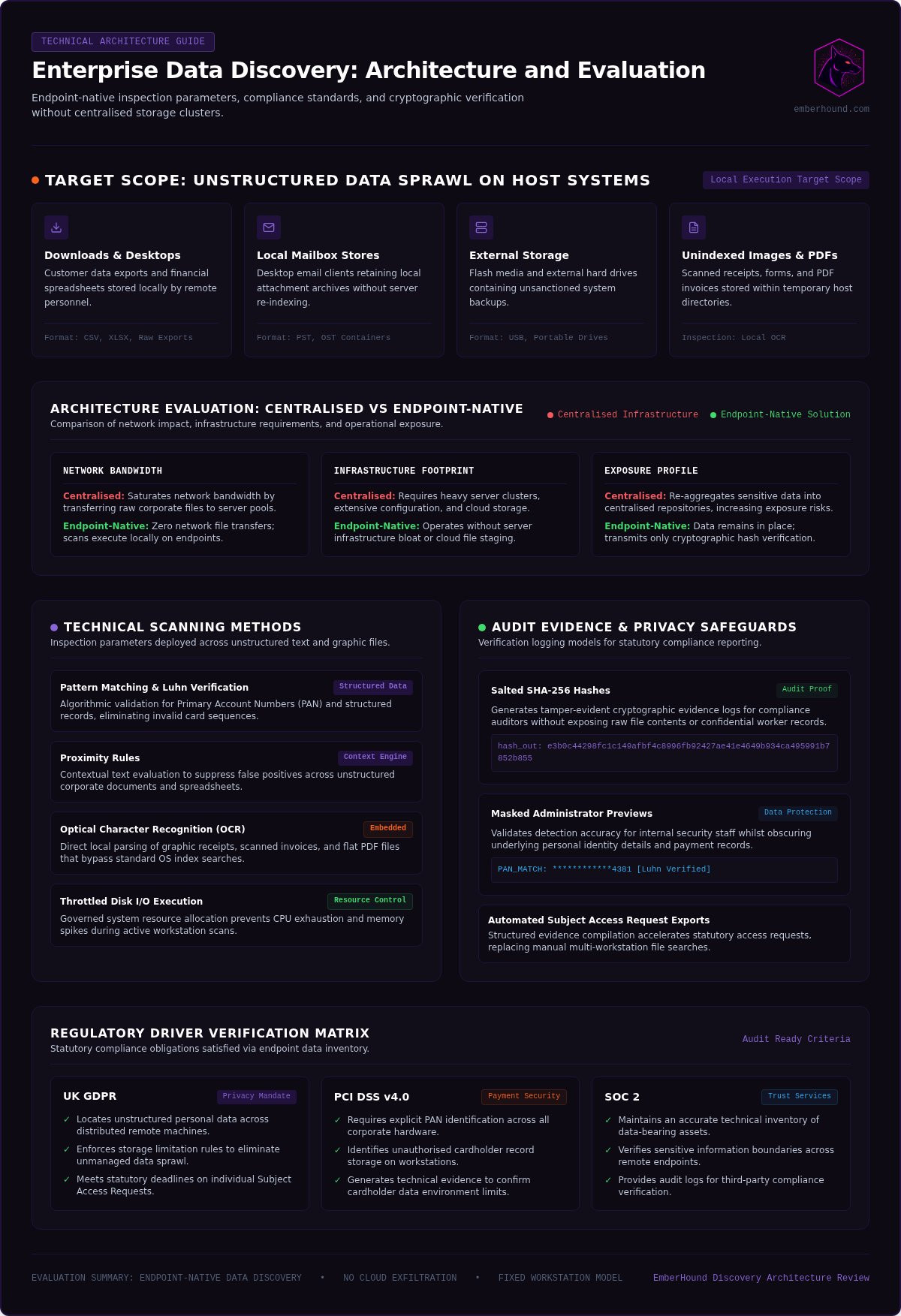
Corporate data sprawl happens during routine operations. Remote workers download customer exports to their desktop to run quick calculations. Staff save spreadsheets containing financial records to local folders. Desktop email clients compound the issue by retaining local archives of email attachments inside PST or OST files. External hard drives and flash media hold unsanctioned system backups created during routine machine migrations. Scanned receipts, PDF invoices, and customer forms sit in temporary directories, hiding unindexed text that standard operating system searches miss entirely. Without local file scanning and optical character recognition, these files remain hidden from security teams.
Regulatory Drivers: UK GDPR, PCI DSS, and SOC 2
Strict compliance mandates force visibility into this unstructured sprawl. The UK GDPR requires businesses to know precisely where personal data lives to satisfy strict storage limitation rules and individual access rights. Missing a statutory deadline on a Subject Access Request creates immediate regulatory exposure. Meanwhile, PCI DSS v4.0 requires explicit identification and monitoring of all Primary Account Numbers across company hardware. Storing cardholder records on unmanaged workstations directly breaches core standards. SOC 2 Trust Services Criteria require an accurate inventory of all assets holding sensitive information. An enterprise data discovery solution generates the technical evidence required to verify these boundaries. For a detailed breakdown of regulatory mapping, read our GDPR data discovery guide.
Evaluation Criteria for Enterprise Data Discovery Software
Selecting software requires balancing discovery depth against practical operational overhead. Many tools promise total visibility but stall during deployment due to network saturation or prohibitive server prerequisites. An enterprise data discovery solution must operate directly on endpoints, isolating compliance exposures before they trigger regulatory scrutiny.
Scanning Methods: Pattern Matching vs Optical Character Recognition
Structured records such as payment cards require algorithmic pattern matching, including Luhn verification. Unstructured text files demand proximity rules to suppress false positives. In addition, flat image scans, PDF invoices, and graphic receipts hold unindexed text that standard expression checks miss. Embedded optical character recognition inspects this text directly on the host machine. The scanner also analyses local Outlook archives without forcing IT staff to re-index corporate mail servers. In modern data discovery and classification workflows, local parsing ensures uncatalogued endpoints surface during audits.
Audit Evidence and Reporting Functionality
Locating sensitive records solves only half the challenge. Teams must prove their findings to external assessors without compromising worker confidentiality. Masked previews confirm matches whilst concealing raw personal details from administrators. Audit logs rely on salted SHA-256 fingerprints to create verifiable, tamper-evident proof for compliance reviews. These structured records also accelerate Subject Access Requests through automated exports, eliminating weeks of manual file hunting. You can start testing endpoint discovery workflows to review evidence exports in your own environment.
Deployment Overhead and System Resource Usage
Scanners must operate quietly in the background. When an agent spikes CPU usage or exhausts system memory, users notice and complain. Effective designs use throttled disk input and output to scan local storage and external drives without interrupting daily tasks. Fixed pricing structures based on active workstations prevent budget shocks as corporate operations grow. Review why modern architecture matters when replacing complex server stacks with lightweight endpoint software.
Architectural Comparison: Endpoint-Only vs Centralised Discovery
Traditional discovery software relies on centralised ingestion. These platforms pull files across the corporate network to a dedicated cluster for extraction, indexing, and pattern matching. Moving gigabytes of unstructured records creates substantial operational drag. In contrast, an endpoint-only enterprise data discovery solution shifts this compute workload directly to the client machine. Analysis occurs where the data lives, eliminating unnecessary data movement.
Security and Privacy Implications of Centralised Ingestion
Centralised ingestion expands your corporate attack surface. When an indexing engine pulls unencrypted documents from remote laptops, intermediate network paths and central staging pools become high-value targets. That repository stores cleartext extracts, temporary caches, and database indexes that contain sensitive customer information. If that staging server suffers a breach, all consolidated records are exposed at once. Endpoint execution avoids this hazard. The scanner inspects files locally on the workstation. Raw contents never leave the local drive. Only cryptographic verification tokens and masked previews transfer to the management console over TLS 1.3 channels. Security teams inspect the technical security architecture to verify how local execution keeps personal data isolated.
Network Bandwidth and Infrastructure Overhead
Centralised scanners struggle in modern hybrid work environments. Remote employees connect through variable home broadband connections and corporate VPN tunnels. Forcing multi-gigabyte mailbox archives, disc images, and uncompressed exports across those tunnels causes severe network latency and dropped connections. Endpoint processing eliminates transit bottlenecks entirely. The agent inspects internal storage and attached media using throttled system threads. It pauses during intensive user tasks and resumes when hardware resources sit idle. System administrators avoid provisioning dedicated virtual machines, high-throughput network interfaces, or secondary storage arrays just to index files. Choosing an endpoint-driven enterprise data discovery solution removes infrastructure costs and keeps network performance stable.
How to Implement an Enterprise Data Discovery Programme
A structured rollout maintains consistency across corporate workstations without bringing daily IT operations to a halt. Traditional consultancy frameworks drag discovery projects out across multiple quarters with endless stakeholder interviews. Direct software deployment replaces that administrative delay. A practical enterprise data discovery solution allows internal teams to take direct ownership, moving systematically from small pilot tests to complete estate coverage.
Step 1: Define Target Data Classes and Scope
Begin by defining exact detection targets. High-risk data categories include payment card numbers, bank details, and customer identity records. Map these criteria to vulnerable locations across corporate hardware, including downloads directories, external storage drives, and local email archive databases. Reviewing our detailed GDPR guide assists teams with establishing clear classification parameters before launching the first scan.
Step 2: Deploy Agents and Execute Baseline Scans
Deploy the lightweight agent to a targeted pilot cohort, such as finance, human resources, or customer service teams. These business units handle large volumes of sensitive exports. Execute baseline scans during scheduled low-usage windows to establish an accurate inventory of existing machine exposure. The local scanning engine inspects files, parses local email folders, and reads image documents via optical character recognition. IT administrators verify detection accuracy against the initial finding summaries to ensure pattern rules operate cleanly without unnecessary noise.
Step 3: Remediate Findings and Establish Governance
Review masked finding records to locate unauthorised data caches across remote laptops. Remediation follows clear internal procedures: delete redundant spreadsheets, relocate misplaced documents into approved cloud stores, or purge orphaned mailbox exports. Once teams resolve these baseline exposures, establish recurring scanning schedules to prevent new sprawl from accumulating unnoticed. Maintaining this cadence with an enterprise data discovery solution produces verifiable audit logs month after month.
EmberHound: Purpose-Built Data Discovery for Modern Teams
Legacy software vendors push complex contracts that require long-term commitments and expensive integration retainers. EmberHound is an enterprise data discovery solution built for teams that need immediate results without operational bloat. The platform automates file scanning across distributed workstations without requiring centralised database servers or external compliance consultants. IT administrators gain direct oversight of sensitive payment details and personal records whilst keeping scan execution entirely local.
Local Endpoint Processing and Cryptographic Evidence
Processing files on host endpoints keeps sensitive records safe from transit vulnerabilities. Scans execute directly on endpoints using AES-256 encryption at rest and TLS 1.3 for console communication. Raw file contents never leave the user workstation. Findings generate salted SHA-256 fingerprints to create verifiable audit evidence for internal reviews and external regulatory checks. Masked finding previews confirm match accuracy without displaying raw personal data to console operators. Watch the interactive product demo to see local endpoint scanning and evidence exports in action.
Flexible Adoption and Transparent Pricing
Security software should scale alongside your infrastructure without punitive billing models or multi-year contracts. EmberHound allows organisations to deploy scanning agents across priority workstations and pay only for active machines. You avoid the recurring consultancy retainers that traditional governance suites demand. Review licensing options on the EmberHound pricing page to choose an allocation that matches your fleet size.
Deploying this enterprise data discovery solution gives your team direct visibility into hidden file stores, local mailbox archives, and connected drives. You can start free scan configuration now to locate exposure across endpoints without delay.
Take Control of Endpoint Compliance Exposure
Managing data risks across remote machines requires immediate technical clarity, not server bloat. Selecting an endpoint-focused enterprise data discovery solution keeps personal data and payment records isolated on local hardware. Endpoint-only scanning ensures no file exfiltration occurs across your corporate network. Systems protect records using AES-256 encryption at rest and TLS 1.3 in transit.
Audit records rely on salted SHA-256 fingerprints. These hashes provide verifiable compliance evidence for GDPR and PCI DSS v4.0 reviews without exposing raw file content. You don't need heavy server clusters or recurring consultancy retainers to verify compliance across your workstation fleet.
Isolate hidden compliance risks today and secure your endpoints with direct, actionable visibility.
Frequently Asked Questions
How does an enterprise data discovery solution detect sensitive data in image files?
Local Optical Character Recognition engines process image files directly on the host workstation. The scanner converts raster graphics, scanned PDF documents, and image-based receipts into readable text before executing pattern-matching algorithms. This process identifies isolated payment card details or personal records embedded within graphic attachments without transferring files across network segments. Everything runs locally, protecting confidential documents from external exposure during scanning.
What is the operational difference between network scanning and endpoint-only scanning?
Network scanning pulls files from remote machines across corporate subnets to a central indexing server, consuming substantial bandwidth and saturating VPN connections. Endpoint-only scanning executes pattern recognition directly on local host hardware using background system threads. Rather than transferring gigabytes of raw files, an endpoint enterprise data discovery solution evaluates data locally and returns only cryptographic hashes and masked previews to the administration console.
Can data discovery tools scan local email stores like Outlook PST and OST files?
Dedicated discovery software parses local email database files directly on the workstation drive. The engine inspects individual messages, conversation threads, and attached documents stored inside Outlook PST and OST archives without mounting the database or forcing mail server re-indexing. This inspection isolates historical email records, finding misplaced payment card numbers or personal records that staff downloaded months prior during routine administrative work.
How do cryptographic fingerprints assist with regulatory compliance audits?
Cryptographic fingerprints generate verifiable audit evidence without exposing sensitive document content to external assessors. Scanners calculate salted SHA-256 hashes for discovered files alongside masked data previews. During GDPR or PCI DSS reviews, auditors inspect these unique records to confirm scan coverage, verify file integrity, and validate remediation timelines without viewing the underlying personal data or customer records.
What system resources are required to run background endpoint data discovery?
Modern endpoint agents operate with minimal resource overhead by design. The software regulates file reading through throttled disk queues and restricts processing to low-priority CPU threads. Memory allocation remains low during active inspection. When a user executes hardware-intensive tasks, the agent pauses active file inspection automatically, ensuring routine workstation performance remains completely unaffected throughout the compliance review.
How does automated data discovery accelerate subject access request fulfilment?
Automated scanning locates target personal records across dispersed endpoints in minutes rather than weeks. Instead of manually coordinating with department heads to search individual laptops, compliance teams query the discovery inventory for specific subject identifiers. The software compiles verified file locations and timestamps into structured disclosure packs, allowing organisations to meet statutory UK GDPR response deadlines without engaging costly legal retainers.


