

Enterprise data discovery tools demand far too much infrastructure before they inspect a single file. Finding a reliable Ground Labs alternative UK organisations can deploy quickly is now an urgent priority for lean compliance teams. You already know that locating cardholder records and personal data across endpoints is non-negotiable. Maximum UK GDPR fines sit at £17.5 million, and PCI DSS v4.0.1 is mandatory across all merchant environments. Unmapped data creates immediate regulatory exposure. Yet spending weeks setting up central master servers and filtering false positives exhausts small IT departments.
This guide evaluates modern UK data discovery platforms to help you achieve compliance without multi-tier server setups or opaque annual contracts. You will learn how to identify personal data across distributed endpoints, eliminate file exfiltration during scans, and produce clear audit logs for regulators. We compare local endpoint scanning mechanisms and licensing models so you can select the right solution for your environment.
Key Takeaways
- Discover how moving away from dedicated Master Server architectures eliminates weeks of server provisioning and administrative overhead.
- Evaluate the primary ground labs alternative UK organisations deploy to replace rigid enterprise contracts with transparent, usage-based pricing.
- Verify that your discovery software identifies UK GDPR personal data and PCI DSS payment card records without generating unmanageable false positives.
- Protect sensitive files during scans by keeping data inspection local to the endpoint rather than pulling unencrypted documents across corporate subnets.
- Learn how to structure a proof of concept across workstations, local mailboxes, and external storage to generate audit-ready evidence quickly.
Why UK Organisations Seek Alternatives to Ground Labs
Legacy discovery platforms were built for dedicated security operations centres. They assume you have spare infrastructure, specialised database administrators, and months to run deployment pilots. Most IT teams have none of those things. When compliance audits approach, small engineering groups get trapped under server provisioning tasks instead of locating sensitive files. This friction drives security leaders to seek a practical ground labs alternative UK teams can roll out without delays.
Modern compliance demands rapid action. The Information Commissioner's Office enforces maximum UK GDPR penalties up to £17.5 million or 4% of worldwide turnover. At the same time, the UK Data (Use and Access) Act 2025 aligned Privacy and Electronic Communications Regulations penalties directly with UK GDPR levels. Lean teams cannot afford shelfware that takes weeks to configure. They need discovery tools that map directly to statutory duties without operational bottlenecks.
The Burden of Heavyweight Infrastructure
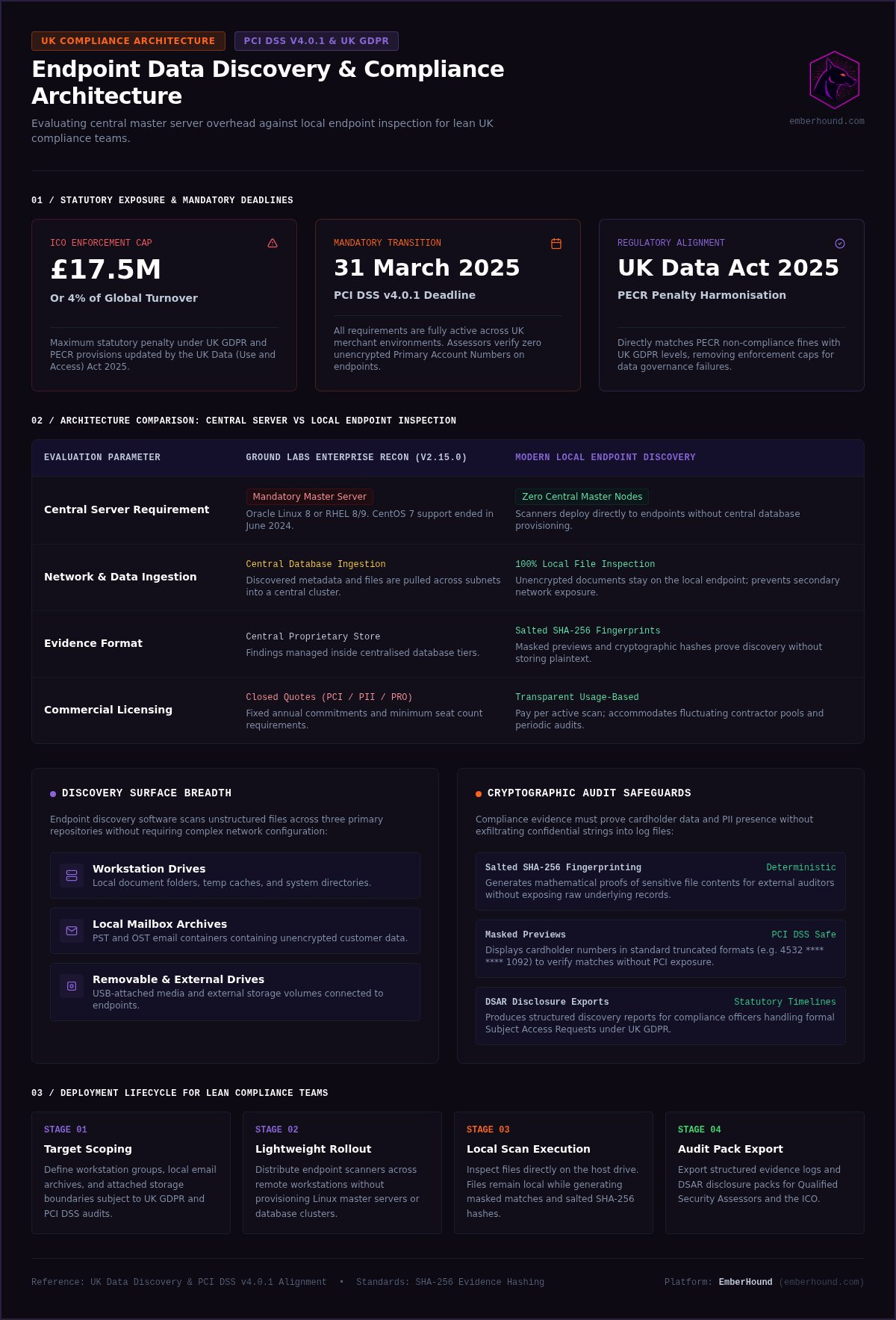
Ground Labs Enterprise Recon 2.15.0 requires a centralised Master Server deployed on Oracle Linux 8 or Red Hat Enterprise Linux 8 or 9. CentOS 7 support ended in June 2024, which forced many teams into unplanned operating system migrations. Maintaining these central servers pulls system engineers away from core responsibilities.
Traditional data loss prevention software architectures introduce predictable hurdles:
- Server maintenance overhead: Operating dedicated Linux nodes demands regular OS patching, kernel updates, and continuous disk provisioning.
- Slow agent distribution: Deploying complex agents tied to proprietary management clusters stalls workstation rollouts across remote staff.
- Central database exposure: Storing discovery metadata in a centralised database creates an attractive target that requires its own security isolation.
Commercial Rigidity and Licensing Friction
Legacy vendors sell software through closed-quote tiers such as PCI, PII, and PRO packages. These agreements mandate annual commitments, high minimum seat counts, and prolonged sales calls. Organisations with fluctuating contractor pools or single-audit mandates end up paying for idle licenses throughout the year.
Procurement teams waste valuable remediation time negotiating multi-year enterprise contracts. That model fails fast-moving businesses. A viable ground labs alternative UK teams adopt must replace quote-wall gatekeeping with transparent usage models. You can review how modern commercial terms remove this friction on our pricing breakdown. You pay only for active scans, removing financial penalties for simply maintaining scheduled audit readiness.
Core Criteria for Evaluating UK Data Discovery Tools
Selecting a ground labs alternative UK security teams can trust requires looking past surface-level interface tours. Evaluating software comes down to verification: does the engine catch what matters without putting your infrastructure at risk? You need exact coverage for domestic mandates, verification that files never leave local storage, and cryptographic evidence for your assessors.
When you evaluate tools, assess these operational capabilities:
- Targeted detection breadth: Locate unstructured personal data across local drives, PST or OST mailboxes, and external hard drives.
- Cryptographic evidence: Generate salted SHA-256 fingerprints and masked previews to prove exposure without logging plaintext records.
- Frictionless deployment: Distribute lightweight scanners to remote endpoints without configuring firewall rules or database drivers.
Regulatory Coverage for UK Frameworks
Your discovery scanner must parse both UK GDPR identifiers and payment card numbers accurately. Following the 31 March 2025 deadline, all PCI DSS v4.0.1 requirements are mandatory. Assessors check strictly for unencrypted Primary Account Numbers across endpoint storage. Tools must also supply dedicated DSAR disclosure packs so compliance officers can respond to subject access requests inside statutory deadlines. Check our gdpr-guide for step-by-step discovery strategies.
Data Security and Local Processing Standards
How a discovery tool inspects content determines your legal liability. Scanning software that copies files to a central server creates secondary exposure points. Under ICO guidance on data security, organisations must implement technical measures that prevent accidental exposure during routine operations. Endpoint-only processing inspects the data in place. No raw personal data leaves the machine.
A capable ground labs alternative UK organisations use protects discovery records from end to end. The platform must use TLS 1.3 for telemetry in transit and AES-256 encryption for all findings at rest. When compliance reviewers inspect findings, masked previews obscure account numbers and national insurance figures to preserve privacy. To test your environment with zero file exfiltration, Start free scan on a single endpoint today.
Comparing Leading Ground Labs Alternatives in the UK
Most comparison guides evaluate legacy giants against other legacy giants. They examine Spirion, Varonis, and Ground Labs side by side. This misses the actual requirement for agile UK security teams. If you manage a compact IT group, swapping one complex multi-server system for another solves nothing. A practical ground labs alternative UK businesses adopt must remove architectural friction altogether.
Three platforms represent the primary approaches to sensitive data discovery in the UK:
- Ground Labs Enterprise Recon: Offers broad multi-platform coverage across 300+ data types. It demands a dedicated Linux Master Server, client-agent infrastructure, and quote-gated enterprise tiers.
- Spirion: Delivers deep data classification for massive corporate footprints. It requires extensive consulting cycles, database clusters, and dedicated staff to tune policies.
- EmberHound Discover: Built as a lightweight endpoint engine for lean teams. It deploys quickly to locate UK GDPR personal data and payment card records without server setup.
Enterprise Scanners vs Lightweight Platforms
The core difference lies in deployment architecture. Enterprise scanners depend on central orchestration engines. You must provision database servers, open firewall ports across subnets, and configure dedicated storage for scans. That architecture adds unnecessary complexity under the NIST SP 800-53 security controls governing system boundaries and component inventory.
Modern platforms like EmberHound Discover run scans locally on the endpoint. Installation happens in minutes rather than weeks. The scan engine inspects local drives, PST archives, and external disks while preserving system performance during working hours. Learn more about this operational approach on our why-us overview.
Licensing Models and Total Cost of Ownership
Legacy software vendors enforce opaque sales funnels. You sit through product demonstrations, speak with account representatives, and negotiate multi-year contractMinimums. If you simply need to audit 50 workstations ahead of a PCI assessment, you still pay for full enterprise commitments.
Modern platforms eliminate that gatekeeping. A modern ground labs alternative UK organisations deploy provides transparent, usage-based pricing. Teams inspect endpoints as required without paying for unused capacity. You can examine the transparent tier structure on the EmberHound pricing page to match your exact scanning schedule.
Architecture Matters: Endpoint Scanning vs Centralised Ingestion
Most legacy discovery tools operate by pulling data back to a central scanning server. When you run an agentless crawl or configure centralized datastores, the system pulls files across your local area network to inspect their contents. This mechanism turns discovery scans into bandwidth-heavy transfer tasks. It also moves unencrypted files across internal switches, which creates new data transit risks during audit preparation.
A modern ground labs alternative UK engineering teams select relies on endpoint-only scanning. Instead of moving files across the network, the inspection engine operates directly on the device hosting the data. The application inspects text locally, registers matches, and leaves the original file undisturbed in its source folder.
Minimising Network Impact and Security Exposure
Endpoint processing keeps scanning traffic local to the machine. You avoid saturating internal subnets or choking remote VPN tunnels when staff work outside the office. The scanner operates in the background without pulling gigabytes of PDFs and spreadsheets across company routers.
Zero file exfiltration means sensitive files never travel to an administrative dashboard. Telemetry leaving the endpoint is limited to encrypted metadata and finding coordinates. The platform uses TLS 1.3 protocol connections for that outbound telemetry, and all stored finding records use AES-256 encryption. You can review the full technical boundaries on the EmberHound trust page.
Audit-Ready Evidence Without Privacy Breaches
Compliance reporting often creates accidental privacy violations when security dashboards log raw personal records. If your compliance officer reviews an unmasked National Insurance number or primary account number on a management screen, that console becomes a high-risk repository. Discovery platforms must prove findings exist without displaying unredacted records.
EmberHound Discover solves this verification dilemma through two cryptographic mechanisms:
- Masked previews: Reviewers see partial characters alongside context markers, confirming true positives without logging full payment card numbers.
- Salted SHA-256 fingerprints: Each finding generates a irreversible mathematical hash, allowing external Qualified Security Assessors to confirm remediation without storing raw cardholder data.
These controls give assessors the exact verification they demand while keeping cardholder records isolated. If your organisation needs a ground labs alternative UK compliance officers can use without moving raw files, run an assessment on your fleet today.
Selecting and Deploying the Right Alternative for Your Team
Replacing legacy scanning infrastructure starts with an honest inventory of your endpoints. Personal data rarely stays neatly compartmentalised in databases. It scatters across local desktop folders, exported CSV reports, detached external drives, and Outlook message stores. Selecting the right ground labs alternative UK organisations need comes down to verifying how effectively a scanner discovers data across these neglected locations.
Before committing your compliance schedule to new software, structure a practical deployment trial across these operational steps:
- Target peripheral media: Configure scans across attached backup disks and thumb drives where staff frequently dump records.
- Scan local mailbox archives: Direct the engine to search .pst and .ost containers on local drives without routing mail data across third-party cloud relays.
- Map findings directly to accountability mandates: Confirm exported reports provide the structured documentation required under UK GDPR Article 30 records of processing activities.
Conducting a Low-Friction Discovery Trial
Do not waste time setting up enterprise lab environments. Choose five to ten operational workstations across finance, customer service, and human resources teams. These departments handle the highest volumes of payment cards and employee records. Installing a lightweight client on these endpoints tests actual scan duration under normal daily workloads.
Evaluate true positive accuracy quickly. Check how the engine flags Primary Account Numbers alongside context clues to eliminate false alarms. Modern platforms give your administrators immediate visibility without heavy configuration overhead. You can review how this workflow simplifies compliance verification on the EmberHound why choose us page.
Transitioning to Ongoing Discovery
Audit readiness deteriorates the moment discovery scans stop. Staff create new spreadsheets daily. Payment forms get downloaded to local folders by mistake. Organisations must establish recurring, automated scanning cadences rather than scrambling weeks before a scheduled compliance review.
Discovery telemetry should feed directly into your Data Protection Impact Assessments (DPIAs) and internal risk registers. Regular automated scans prove accountability to regulators. They document active governance over sensitive data stores. If you need a lightweight ground labs alternative UK IT teams can deploy immediately, visit our homepage to start free scan and evaluate your first endpoints today.
Modernise Your Endpoint Discovery Today
Enterprise data discovery does not require dedicated Linux master servers or opaque multi-year contract commitments. Adopting an agile ground labs alternative UK organisations can trust gives your security team immediate visibility across distributed workstations. Endpoint-only scanning keeps file content local during scans. This prevents network congestion and eliminates secondary data transfer risks during audits.
Cryptographic evidence generation solves reporting hurdles for lean IT and compliance teams. Masked previews and salted SHA-256 fingerprints provide clear evidence for UK GDPR and PCI DSS v4.0.1 assessments. Assessors receive verifiable proof without viewing raw records on console screens. Backed by UK-based support and usage-based licensing, your team can run scans on demand without administrative delays.
Audits do not need to interrupt daily business operations. You can verify compliance across remote staff, local mailboxes, and external drives before your next audit deadline arrives.
Frequently Asked Questions
How does an endpoint data discovery scanner differ from Ground Labs Enterprise Recon?
Ground Labs Enterprise Recon relies on a central Master Server running on Oracle Linux or Red Hat Enterprise Linux to orchestrate scans. An agile ground labs alternative UK organisations use executes discovery locally on each workstation. The engine runs searches directly on the host machine. You avoid building dedicated database servers, opening complex firewall paths, and managing client-server cluster overhead. Setup finishes in minutes.
Can an alternative discovery tool find both UK GDPR personal data and payment card data?
Yes. EmberHound Discover scans for both data categories within a single automated engine. It detects names, National Insurance numbers, and contact details alongside Primary Account Numbers for PCI DSS v4.0.1 compliance. Combining UK GDPR personal data discovery with payment card detection eliminates the operational headache of running separate scanning tools. Teams evaluate their entire risk exposure from one unified reporting interface.
Does data discovery software need to copy files to a central server to scan them?
No. Legacy architectures often pull files across internal subnets to a central indexing server, but endpoint-only tools inspect files in place. The scanning engine opens documents locally on the endpoint, reads the text, and checks for sensitive data patterns. File content never leaves the machine. Telemetry sent back to the console contains only encrypted metadata and location coordinates. This keeps internal network consumption minimal.
What evidence does a data discovery platform produce for an ICO audit?
The software generates comprehensive audit logs, masked previews, and salted SHA-256 cryptographic fingerprints. These artifacts verify that you located and remediated sensitive records without exposing the underlying personal data to console administrators or external assessors. The generated reports map findings directly to Article 30 records of processing activities. This gives Information Commissioner's Office caseworkers clear proof of technical compliance without creating secondary data leaks.
How does optical character recognition assist in sensitive data discovery?
Optical character recognition (OCR) extracts text embedded inside images, scanned PDF forms, and photo receipts. Plain file scanners miss these graphics because standard search routines cannot read pixels. OCR scanning identifies personal data and payment cards stored in scanned passports, identity documents, and customer invoices. This capability prevents hidden sensitive information from bypassing your compliance discovery sweeps across endpoint image repositories.
How long does it take to deploy a lightweight discovery scanner across UK endpoints?
Deployment takes minutes. Because an agile ground labs alternative UK teams deploy requires no dedicated Master Server or database provisioning, you simply distribute the lightweight client to target laptops and desktops. The software installs silently via your existing endpoint management tools. It begins scanning local storage immediately. IT teams can generate actionable compliance reports on the same day.
Can data discovery tools scan local email archives and connected external hard drives?
Yes. Discovery software inspects local message storage, including Outlook .pst and .ost files, directly on the user's hard drive. It also scans connected external storage, such as USB thumb drives and portable backup disks, as soon as staff mount them. The scan engine processes text within these containers locally. This reveals detached archives that standard network or cloud-only crawlers routinely miss.


