

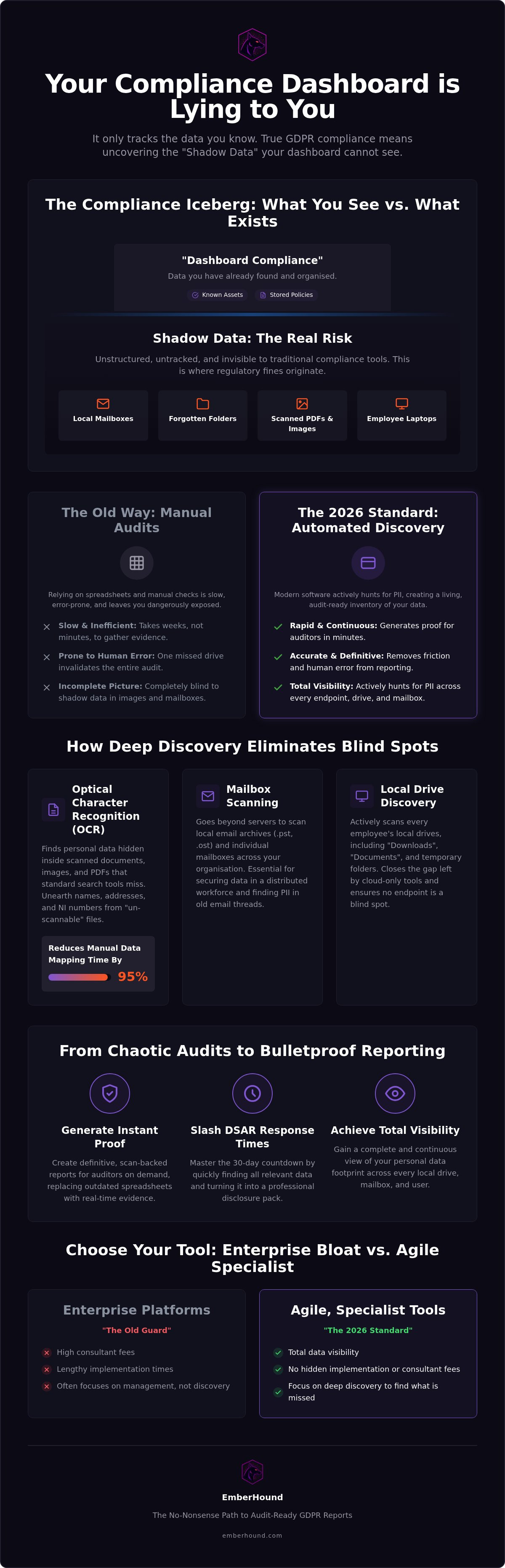
Your compliance dashboard is likely lying to you. It tracks the data you've already found; but it's blind to the "shadow data" hiding in local mailboxes and forgotten folders. You know the stress of manual mapping. It's slow. It's prone to error. One missed file during a DSAR can lead to massive regulatory headaches and a loss of trust. You're working with a framework that demands precision, yet your current tools are leaving you exposed.
It's time to move beyond manual spreadsheets and enterprise bloat. You can achieve bulletproof reporting through automated data discovery that leaves no stone unturned. We'll show you how the right GDPR compliance reporting software turns a chaotic audit into a streamlined, automated process. We'll cover how to generate instant proof for auditors, slash your DSAR response times, and gain total visibility across every local drive and mailbox in your organisation. You'll learn how to find the data your dashboard misses before the regulator does.
Key Takeaways
- Stop relying on "dashboard compliance" that ignores shadow data; true visibility requires deep discovery across local drives and mailboxes to find what spreadsheets miss.
- Shift from manual audits to automated GDPR compliance reporting software that provides bulletproof proof for auditors in minutes rather than weeks.
- Leverage OCR technology to unearth personal data hidden in scanned PDFs and image files, eliminating the blind spots that often lead to regulatory fines.
- Master the 30-day DSAR countdown by converting raw search results into clean, professional disclosure packs that reduce stress and ensure legal accuracy.
- Choose agile, specialist tools over bloated enterprise platforms to achieve total data visibility without the high consultant fees or lengthy implementation times.
The Reporting Trap: Why GDPR Compliance Reporting Software Starts with Discovery
Most businesses treat compliance as a filing exercise. They buy software to store policies and list assets. But a list is only as good as the search that created it. True GDPR compliance reporting software isn't a digital filing cabinet. It's a lens. It provides visibility into the dark corners of your network where personal data actually lives. Without active discovery, your reports are just guesswork. They tell a story of what you think you have, rather than what's actually there.
The General Data Protection Regulation (GDPR) requires more than just good intentions. It requires proof. Pretty charts won't save you in an audit. A green light on a dashboard means nothing if there's a spreadsheet full of customer names sitting on a former employee's laptop. This is "Dashboard Compliance". It's a false sense of security. Regulators look past the interface. They want to see your methodology for finding data, not just how you've organised the data you already knew about.
Manual data mapping fails the moment your business grows. You can't track every new folder or mailbox by hand whilst your team scales. Automated scanning is now essential for fulfilling Article 30 requirements. It turns your Records of Processing Activities (RoPA) from a static, decaying document into a living inventory. It moves the burden of proof from your memory to your technology. This is how you build a report that actually holds up under scrutiny.
Management vs. Discovery: Know the Difference
Management tools organise what you tell them. Discovery tools find what you missed. For most UK SMEs, the biggest threat is "Shadow Data". This is information stored on local drives, in downloads folders, or buried in old email archives. If you can't see it, you can't report on it. To prove to an auditor that your data inventory is complete, you need a tool that actively hunts for PII across every endpoint. You need to show that you've looked where most businesses forget to check.
The 2026 Standard for Audit-Ready Reports
The days of the annual compliance checkbox are over. In 2026, regulators expect continuous evidence. They want real-time visibility into your data footprint. Manual spreadsheets are too slow and too prone to human error. One mistyped cell or forgotten drive can invalidate a year's worth of work. Modern GDPR compliance reporting software removes that friction. It collects evidence automatically. It ensures that when a regulator asks for proof, you aren't scrambling to update a six-month-old Excel sheet. You're handing over a definitive, scan-backed report that reflects your current reality.
Deep Discovery: How OCR and Mailbox Scanning Eliminate Shadow Data
Your compliance dashboard probably sees the cloud. It might even see your primary database. But it's likely blind to the "Downloads" folder on an employee's laptop or a scanned contract sitting on a workstation across your organisation. This is shadow data. It's the unencrypted PDF of a customer's passport or the Excel sheet with 500 National Insurance numbers hidden in a marketing executive's "Temporary" files. If your GDPR compliance reporting software can't find these files, your audit trail is broken.
Standard search tools are blind to images. This is why Optical Character Recognition (OCR) is now a non-negotiable requirement for 2026. Without it, you're ignoring a massive volume of "un-scannable" PII. Scanned IDs, handwritten notes, and image-based invoices are common hiding places for sensitive information. By 2026, automated OCR discovery has become the gold standard for efficiency, reducing the time spent on manual data mapping by up to 95% compared to traditional human-led audits. It's the only way to ensure your reporting is actually comprehensive.
The Power of OCR in Data Privacy
OCR technology doesn't just look at file names. It reads the content inside the image. It identifies names, addresses, and NI numbers buried in old project folders. This eliminates the risk of "forgotten" scans that often lead to data breaches. Under current data protection legislation, individuals have a clear right to erasure. You can't delete what you can't see. OCR ensures that every scanned document is indexed, searchable, and ready for redaction or deletion.
Securing the Distributed Workforce
The UK's shift to remote and hybrid work has scattered sensitive data across thousands of local drives. Outlook has become a graveyard for sensitive information. CVs, contracts, and even unencrypted payment details sit in "Sent Items" for years. You need visibility across these mailboxes without the network lag of traditional enterprise tools. Using a "Hard Drive Add on" allows you to scan local workstations directly. It's fast. It's accurate. It provides total visibility without disrupting the user's workflow. If you're struggling to manage this complexity, EmberHound's automated discovery offers a streamlined way to regain control.
Don't ignore the crossover between privacy and payments. If you find a credit card number whilst searching for an email address, you need to know immediately. Combined GDPR + PCI Coverage ensures you aren't running two separate, clunky programmes to solve one visibility problem. You get a single, clean report that satisfies both sets of regulations. This is how you move from "Dashboard Compliance" to actual, bulletproof security.
Enterprise Bloat vs. Agile Tools: A 2026 Comparison Framework
Enterprise software is often a trap. It promises a "single pane of glass" but delivers a lead weight. Implementation takes months. Consultant fees spiral into the thousands. By the time the platform is fully configured, your data landscape has already shifted. For UK SMEs, these massive compliance suites are often "shelfware"; expensive tools that are too complex for a lean team to actually use. You don't need a platform that manages your entire legal department. You need a tool that finds your data.
Speed is a critical compliance feature. Under GDPR's accountability principle, you are responsible for demonstrating exactly how you handle personal information. If you cannot find a specific piece of PII within minutes, you aren't in control. Large platforms often focus on the "centre", scanning cloud storage and central databases whilst ignoring the "edge". But the edge is where your employees work. It is where they download sensitive files and save them to local drives. Lightweight, specialised GDPR compliance reporting software prioritises these high-risk areas.
Evaluating Your Compliance Tech Stack
Does your current tool scan the edge or just the cloud? If it can't see a laptop in Manchester or a workstation in London, your visibility is incomplete. You need frictionless deployment. You should be able to start scanning in minutes, not weeks. Look for tools that offer UK-based support and a specific focus on local regulations. A tool built for the global enterprise often misses the nuances of the UK's data protection environment. It adds layers of bureaucracy where you need immediate, actionable clarity.
Cost-Benefit Analysis for SMEs
Justifying the ROI of automated discovery to your board is simple: compare the cost of software against the cost of a data breach or a failed audit. "All-in-one" platforms often provide "none-in-depth" discovery. They tick boxes but miss files. To achieve true protection, you must balance features like OCR and mailbox scanning against your specific risk profile. Specialised GDPR compliance reporting software allows you to target your budget where it matters most. It provides the depth of discovery required for bulletproof reporting without the enterprise bloat. You get total visibility, faster response times, and a cleaner audit trail for a fraction of the implementation cost.
Fulfilling DSARs: Turning Discovery into Professional Disclosure Packs
The 30-day clock is ticking. For many UK businesses, a Subject Access Request (DSAR) feels like a fire drill. You have one month to find, review, and redact every scrap of personal data you hold on an individual. It's the ultimate stress test for your internal processes. If your GDPR compliance reporting software only points to folders rather than specific files, you're already behind. You need to move from raw search results to a professional, legally sound disclosure pack without losing a week to manual labour.
Redaction fatigue is a significant risk. Manually scanning hundreds of emails and documents for third-party names or sensitive business info is soul-crushing. It's also where mistakes happen. Specialised tools identify PII automatically. They highlight what needs to stay and what must go. This creates a defensible audit trail. If the ICO ever questions your response, you can prove exactly what you searched, what you found, and why you redacted specific elements. You aren't just guessing; you're providing evidence.
The DSAR Workflow: A Step-by-Step Guide
The process must be methodical. Speed without accuracy is a liability. Follow these steps to ensure a clean response:
- Step 1: Broad Discovery. Run a comprehensive search across all local drives and mailboxes. Don't just check the cloud. Use a Mailbox Add on to scan the "Sent Items" and "Archives" where data often hides.
- Step 2: OCR Validation. Ensure no PII is buried in scanned attachments or image-based PDFs. As established, OCR is your only defence against "un-scannable" data.
- Step 3: Pack Compilation. Gather the results into a clean, professional Disclosure Pack. This shouldn't be a messy ZIP file of raw data. It should be an organised, redacted response that satisfies the data subject's rights.
Avoiding the Common DSAR Pitfalls
Missing a single file is enough to trigger an ICO complaint. It signals a lack of control over your data estate. Conversely, over-disclosing is just as dangerous. If you accidentally send a document containing someone else's personal details, you've just created a brand new data breach. Specialist GDPR compliance reporting software ensures you only send what is legally required. It protects third-party privacy whilst fulfilling your obligations to the requester. Efficiency is your best protection. You can handle complex requests with confidence by using a dedicated DSAR Disclosure Pack tool. It turns a chaotic search into a repeatable, professional process.
EmberHound: The No-Nonsense Path to Audit-Ready GDPR Reports
EmberHound is the definitive answer to the data discovery gap. It isn't just another dashboard for your documentation. It's an active, agile guardian that hunts for PII where other tools fail to look. Whilst enterprise giants bury you in configuration menus and consultant fees, EmberHound focuses on the result: a bulletproof audit trail. It is the GDPR compliance reporting software built for teams that value time over bureaucracy. We don't just manage your compliance; we find the evidence to prove it.
Total peace of mind comes from comprehensive visibility. We don't just scan the cloud. With our Mailbox Add on and Hard Drive Add on, you gain access to the real-world storage used by your employees every day. From local "Downloads" folders to the depths of Outlook archives, EmberHound ensures your inventory is complete. For organisations handling payments, our Combined GDPR + PCI Coverage provides a single, unified report. You satisfy two major regulatory frameworks with one streamlined scan. It's the most efficient way to secure your data estate.
Your Agile Guardian for Compliance
Forget the months of implementation. There are no consultants required and no enterprise bloat to navigate. EmberHound is powerful scanning that simply works. You can get your first compliance report ready by the end of the day. Because we are registered in England & Wales, our tool is designed specifically for the UK regulatory landscape. We understand the pressure of Article 30 and the precision required for a UK GDPR audit. We provide the professional clarity you need to face any auditor with confidence.
Start Your Discovery Journey Today
The path to compliance is simple: find, scan, and report. Stop guessing where your sensitive information lives. Stop worrying about the "shadow data" hiding on a laptop in Leeds or an image file in London. It's time to start knowing. You deserve a tool that provides professional clarity without the headache of legacy software. Every minute spent on manual spreadsheets is a minute of unnecessary risk. Secure your data with EmberHound discovery software today.
Secure Your Audit Trail with Decisive Discovery
Compliance is no longer a static checkbox. It's a continuous search for the truth. You've seen how pretty dashboards fail when they ignore the shadow data on local drives and buried in mailboxes. Relying on manual spreadsheets in a high-stakes regulatory environment is a gamble you don't need to take. By prioritising automated discovery and OCR-powered image scanning, you eliminate the blind spots that lead to ICO complaints and lost trust. You move from a reactive state of anxiety to a proactive position of strength.
EmberHound provides the UK-based expertise and specialised DSAR Disclosure Packs required to handle the toughest requests with ease. It's about professional clarity and speed. Implementing the right GDPR compliance reporting software ensures you are always audit-ready without the friction of enterprise bloat. You can find, redact, and report on sensitive data in minutes rather than weeks. The tools are ready. The methodology is clear. It's time to stop guessing and start knowing exactly where your data lives.
Master your data discovery with EmberHound. Take control of your data estate today.
Frequently Asked Questions
What is the best GDPR compliance reporting software for UK SMEs?
EmberHound is the definitive GDPR compliance reporting software for UK SMEs because it prioritises deep data discovery over administrative bloat. Unlike enterprise platforms that require months of configuration; it provides instant visibility into local drives and mailboxes. It's built for speed and pragmatic results. It gives small teams the authoritative evidence they need to satisfy auditors without the high consultant fees of legacy suites.
Can GDPR software automatically find PII on employee laptops?
Yes; specialist tools use a "Hard Drive Add on" to scan local workstations directly. This is essential for securing a distributed workforce across the UK. Cloud-only tools often miss "shadow data" stored in local downloads or temporary folders. Automated scanning ensures that personal data on remote laptops is identified; indexed; and included in your central compliance reports before it becomes a liability.
How does OCR help with GDPR compliance reporting?
OCR technology scans the "un-scannable" by identifying PII within image files and scanned PDFs. It's a non-negotiable feature for 2026. Without OCR; your compliance reports are blind to scanned contracts; handwritten notes; and passport copies. It reads the text inside these images to ensure your data inventory is truly comprehensive and your reporting is based on every file you own.
Is automated data discovery required for a DSAR?
Legally; the law doesn't specify your search method; but practically; automation is essential. You have a strict 30-day deadline to respond to a Subject Access Request. Finding PII manually across thousands of emails and local folders is slow and prone to error. Automated discovery ensures you find every relevant file quickly; allowing you to compile a professional disclosure pack with confidence.
What is the difference between data management and data discovery software?
Data management tools are digital filing cabinets for the data you already know about. They organise policies and list assets based on your input. Data discovery software is a searchlight. It actively hunts for hidden or forgotten files across your entire network. To prove compliance; you need discovery tools to verify that your management lists are actually accurate and complete.
Can I use one tool for both GDPR and PCI DSS compliance reporting?
You can if you choose a tool that offers "Combined GDPR + PCI Coverage". This allows you to scan for both personal data and unencrypted payment card information simultaneously. It simplifies your tech stack and provides a unified report. You'll save time by running one comprehensive scan instead of managing two separate; clunky programmes to satisfy different regulations.
How long does it take to implement GDPR scanning software?
Agile tools can be deployed and start scanning in minutes. There's no need for lengthy configuration phases or expensive implementation consultants. You can have your first deep-discovery report ready by the end of the day. This speed is a critical feature for lean teams who need to address compliance gaps immediately rather than waiting for a months-long enterprise rollout.
Does GDPR software help with Article 30 RoPA documentation?
Yes; it provides the physical evidence required to prove your Records of Processing Activities (RoPA) are accurate. Article 30 demands a living inventory of how you handle data. Automated GDPR compliance reporting software turns your RoPA from a static spreadsheet into a verified list. It ensures your documentation reflects the real-time state of your data estate during an audit.


