

How many unencrypted credit card numbers are sitting in your company's "Screenshots" folder right now? It is a blind spot that keeps security teams awake at night. You know the risk is real. A single misplaced JPEG containing sensitive payment information can lead to a devastating data breach and a massive fine from the Information Commissioner's Office. You need a reliable way to detect credit card data in images before it becomes a liability. Manual checks are impossible at scale. Relying on staff to follow policy is a gamble you cannot afford to take.
We understand the pressure of maintaining PCI DSS compliance whilst you manage a growing mountain of unstructured data. It is a heavy burden for any IT team. This guide shows you exactly how to identify these risks using automated tools and OCR technology. You will learn how to locate hidden data, satisfy regulatory requirements, and harden your security measures. We cover the specific methods and software needed to gain full visibility over your image libraries. This turns a complex compliance headache into a manageable, automated process.
Key Takeaways
- Unencrypted images often hide sensitive payment details that standard text scanners miss. Identifying these files is the first step toward reducing your organisation's attack surface.
- Use automated OCR scanning to detect credit card data in images across your network and endpoints. This technology extracts text from static files to identify Primary Account Numbers (PAN).
- Effective detection requires tools that scan diverse storage locations, including local mailboxes and external hard drives. Regular scanning schedules ensure that new risks are identified immediately.
- Compliance with PCI DSS and GDPR requires more than just internal policy. You must demonstrate the ability to find and secure sensitive data regardless of its file format.
Understanding Credit Card Data Detection in Images
Sensitive data doesn't just live in spreadsheets or databases. It hides in plain sight. Every day, your organisation likely handles screenshots, scanned receipts, and ID photos. These files often contain full payment details. If you don't detect credit card data in images, you are flying blind. This oversight creates a silent risk that standard antivirus or text-based search tools cannot see. You need visibility. You need to know exactly what is stored on your endpoints and mailboxes.
Components of Credit Card Data
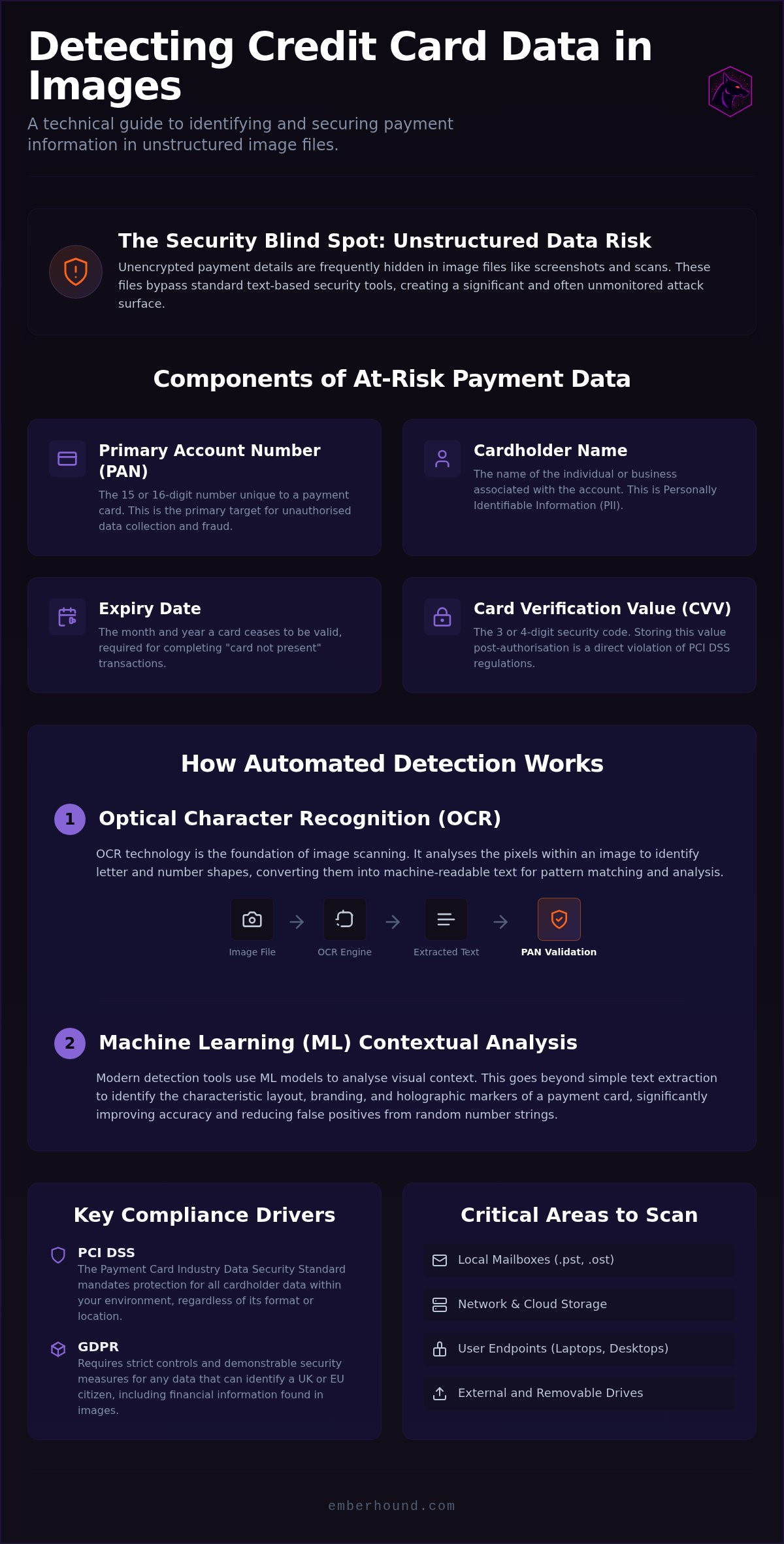
To secure data, you must understand what you are looking for. Credit card information consists of several distinct pieces of PII (Personally Identifiable Information). Each piece increases the value of the record for a fraudster. Protecting these elements is critical for any business handling payments.
- Primary Account Number (PAN): The 15 or 16-digit number unique to the card. It is the primary target for attackers.
- Cardholder Name: The individual or business name associated with the account.
- Expiry Date: The month and year the card ceases to be valid.
- Card Verification Value (CVV): The three or four-digit security code. Storing this after authorisation is a direct violation of PCI DSS.
A single leaked image containing these details can trigger a mandatory notification to the Information Commissioner's Office (ICO). The fallout includes financial penalties and reputational damage that is difficult to repair. Data is a liability if it's unmanaged. You must treat every image as a potential security hole.
Applications of Credit Card Detection
Why does this matter now? Because the way we work has changed. Remote teams frequently share screenshots to troubleshoot payment issues. Customers upload photos of cards to e-commerce portals. These habits create a sprawling data swamp that is hard to police. Using automated tools to detect credit card data in images allows your security team to find and redact this information before a breach occurs.
Compliance is the driving force here. Under the Payment Card Industry Data Security Standard (PCI DSS), you are responsible for every card number in your environment. GDPR adds another layer of responsibility. It requires strict controls over any data that identifies a UK citizen. You can learn more about these requirements in our GDPR guide. Manual audits are too slow. They are prone to human error. Specialised OCR (Optical Character Recognition) technology is the only way to scan thousands of images per hour accurately. This technology converts pixels into searchable text, identifying card patterns instantly. It turns an impossible task into a routine security check.
Methods for Detecting Credit Card Data in Images
Finding a needle in a haystack is easy compared to finding a card number in a million untagged images. You cannot rely on luck. To detect credit card data in images effectively, you need a technical stack that combines raw character recognition with intelligent pattern matching. Accuracy is the only metric that matters. A false negative is a breach waiting to happen, whilst too many false positives will bury your security team in useless alerts.
Optical Character Recognition (OCR)
OCR is the foundational tool for this task. It works by analysing the pixels in an image to identify the shapes of letters and numbers. Once identified, these characters are converted into machine-readable text. This allows your security software to run Luhn algorithm checks against the extracted strings to verify if a sequence is a valid card number. It is a fast, reliable way to process large volumes of static files. However, OCR performance depends on image quality:
- Resolution: Low-DPI scans often cause character misidentification.
- Contrast: Text that blends into the background colour is harder to extract.
- Orientation: Skewed or upside-down images require pre-processing rotation.
Using a tool with OCR scanning capabilities allows you to process local mailboxes and external drives where these risky files often reside. You can start scanning your environment to identify these hidden risks today.
Machine Learning Approaches
Machine learning (ML) takes detection beyond simple text reading. Modern models are trained on thousands of image datasets to recognise the visual context of a credit card. An ML model identifies the layout, the holographic markers, and the branding of a card. This contextual awareness helps distinguish between a genuine credit card and a random 16-digit string in a technical diagram. It provides a secondary layer of verification that reduces false positives significantly.
Modern tools that detect credit card data in images use these models to automate compliance. Evaluating their effectiveness requires measuring the "precision-recall" balance. High precision means fewer false alarms. High recall means no cards are missed. For small teams, a pre-trained solution is often better than building from scratch. It saves time and ensures you use a model that has already seen millions of variations of card designs from around the world.
Implementing Detection Solutions: A Step-by-Step Guide
Theory is useless without execution. Identifying the need to detect credit card data in images is only the start. You must now deploy a system that works across your entire infrastructure without slowing down operations. For small, lean teams, the goal is to achieve maximum coverage with minimum administrative bloat. You don't have time to manage complex server clusters or write custom scripts for every endpoint.
Integrating Detection Tools
Your first step is selecting a tool that reaches where your data actually lives. Don't just scan your central database. Most high-risk files are scattered across local mailboxes and external hard drives. Look for software that offers automated data discovery with built-in OCR scanning. This removes the friction of manual configuration.
- Identify Endpoints: Map out every device that touches customer data. This includes remote laptops and office workstations.
- Configure Permissions: Ensure the scanner has the necessary read access to scan local mailboxes and encrypted volumes.
- Set Scanning Intervals: Compliance isn't a one-time event. Schedule weekly or monthly scans to catch new files as they are created.
Integration should be direct. If you are using a solution like EmberHound, you can start with a product demo to see how the software maps to your specific network topology. The focus is on visibility. If you can't see the file, you can't secure it.
Testing and Validation
Never assume your detection tool is perfect on day one. You must validate its performance using a controlled test set. Create a folder containing a mix of valid credit card images and "noise" files, such as technical diagrams or internal memos. This allows you to measure how effectively the system can detect credit card data in images under real-world conditions.
Monitor two key metrics: the detection rate and the false positive rate. If the tool misses valid cards, you may need to adjust the OCR sensitivity or improve the image pre-processing settings. If it flags too many non-sensitive files, refine your pattern-matching rules to exclude common internal document formats. This calibration ensures your security team only spends time on genuine threats. Once validated, you can move from testing to full-scale deployment with confidence in your data protection measures.
Compliance and Security Considerations
Compliance is not a suggestion. It is a legal and financial mandate. If you store customer information, you are a target. Failing to detect credit card data in images leaves a massive gap in your perimeter. The Information Commissioner's Office (ICO) does not accept "we didn't know the data was there" as a valid defence. You are responsible for every pixel of sensitive information on your network, whether it is in a database or a forgotten screenshot.
GDPR Compliance
The UK GDPR demands that personal data is processed securely and kept only as long as necessary. Images containing credit card details are often the "dark data" that organisations miss during data audits. If a customer submits a Subject Access Request (SAR), you must identify all their data. This includes text trapped inside image files. Using specialised data discovery software is the only way to ensure your SAR responses are accurate and complete. It allows you to document your efforts, proving to regulators that you take data minimisation seriously. You can find more detail on these obligations in our GDPR guide.
PCI DSS Requirements
The Payment Card Industry Data Security Standard (PCI DSS) is even more prescriptive. Requirement 3 specifically forbids the storage of unencrypted Primary Account Numbers (PAN). If your staff are saving images of cards to troubleshoot payments, you are in direct violation. You must detect credit card data in images to ensure these files are either encrypted, masked, or deleted. Regular audits are a core part of maintaining your "Attestation of Compliance." A single failed audit can lead to increased transaction fees or the loss of your ability to process card payments entirely.
The cost of failure is high. Under the UK GDPR, the ICO can issue fines of up to £17.5 million or 4% of your annual global turnover, whichever is higher. Beyond the fines, a breach involving card data destroys customer trust instantly. You must ensure that your detection process itself is secure. Do not move sensitive images to a central "quarantine" server without encryption. Keep the data at the endpoint whilst you decide on the next action. This limits the risk of a secondary breach during the cleanup phase.
Conclusion: Enhancing Your Data Security Measures
The risk associated with unmanaged image files is no longer a theoretical concern. It is a documented vulnerability that leads to real financial penalties and lost consumer confidence in the UK market. You cannot afford to leave your compliance to chance. By choosing to detect credit card data in images, you close a significant loop in your data protection strategy. This process clarifies your digital footprint rather than adding administrative complexity. You are removing the blind spots that attackers rely on to exploit your organisation.
Manual data audits are a relic of a slower era. They are too slow to keep pace with the volume of screenshots, scans, and attachments generated by modern remote and hybrid teams. You need a solution that works at the speed of your business without requiring a massive increase in headcount. Adopting automated OCR scanning is the only practical way to maintain visibility across your endpoints. It removes the burden of oversight from your staff and places it into a reliable, repeatable system. This shift allows your security team to focus on active remediation rather than tedious discovery.
Security is not a static project with a defined end date. It is a continuous process of refinement and vigilance. As your organisation grows, so does the amount of unstructured data you produce. New devices, new mailboxes, and new external drives are added to your network every month. Each one is a potential hiding place for sensitive payment information that could trigger a PCI DSS violation. You must integrate detection into your standard operational procedures to stay ahead of the risk. Regular, automated scans ensure that your compliance remains intact even as your infrastructure evolves.
We have detailed the methods, the technology, and the regulatory stakes. Now it is time to act. Don't wait for an ICO investigation or a failed PCI audit to discover where your vulnerabilities lie. Proactive discovery is the hallmark of a mature, resilient security posture. When you use automated tools to detect credit card data in images, you are no longer reacting to crises. You can take the first step toward total visibility right now without any financial commitment. It is time to stop guessing and start knowing exactly what is on your drives. Protect your organisation and your customers by identifying the risks before they are exploited by bad actors.
Secure Your Digital Perimeter
Visibility is your strongest defence. You now understand that static image files are often the weakest link in a modern security strategy. Relying on staff to follow data policies isn't enough to prevent leaks. You need automated GDPR and PCI card data scanning to find what's hidden in screenshots, scans, and email attachments. These specialised compliance tools provide the clarity required to meet strict UK regulatory standards without increasing your team's workload.
Our advanced OCR technology makes it easy to detect credit card data in images across your entire network. This approach turns a manual compliance nightmare into a streamlined, background process. You can identify risks before they become breaches. By removing the burden of manual discovery, your team can focus on active remediation and growth. You have the power to eliminate these blind spots and harden your security posture today.
Frequently Asked Questions
What is OCR and how does it work for credit card detection?
OCR (Optical Character Recognition) is a technology that converts the visual pixels of an image into machine-encoded text. In the context of payment security, it scans the shapes of numbers and letters on a card surface. The software then applies validation rules, such as the Luhn algorithm, to the extracted text. This process allows you to detect credit card data in images that would otherwise be invisible to traditional text-based search tools.
Can I detect credit card data in low-quality images?
Yes, but the accuracy of the detection depends heavily on the pre-processing capabilities of your software. Advanced tools use filters to improve contrast and remove digital noise before scanning. Whilst extremely blurry or low-resolution files might still fail, modern algorithms can often reconstruct partially obscured digits. It is best practice to use high-accuracy OCR scanning that specifically targets common card fonts to maximise the chances of identifying sensitive data in poor-quality captures.
What are the legal implications of failing to protect credit card information?
Failing to secure card data can result in severe financial penalties under the UK GDPR and PCI DSS. The Information Commissioner's Office (ICO) has the authority to issue fines reaching up to £17.5 million or 4% of global turnover. Additionally, you may face litigation from affected customers and the loss of your merchant processing agreement. These risks make it vital to find and redact card information stored in unstructured formats like screenshots or scanned documents.
How accurate are machine learning models for detecting card data?
Machine learning models offer significantly higher precision than basic pattern matching by recognising the visual context of a payment card. These models identify card layouts, holograms, and brand logos rather than just searching for 16-digit strings. This contextual awareness reduces false positives, ensuring your security team isn't overwhelmed by irrelevant alerts. When you detect credit card data in images using ML, you gain a more reliable layer of protection that adapts to diverse card designs.
What steps can I take to ensure compliance while using detection solutions?
Maintain compliance by ensuring that your detection software itself does not create new security vulnerabilities. You should always process data at the endpoint where possible to avoid moving sensitive images across your network. Keep detailed audit logs of all scans to prove due diligence to regulators. It is also essential to use tools that support both GDPR and PCI card data discovery, allowing you to manage multiple regulatory requirements through a single, unified workflow.
Are there any free tools available for detecting credit card data in images?
Some open-source libraries like Tesseract exist, but they often lack the specialised logic needed for reliable PCI compliance. General OCR tools don't typically include validation algorithms or the ability to scan local mailboxes and external drives automatically. For professional environments, a dedicated solution is usually necessary to ensure that no sensitive files are missed. You can start with a basic scan to assess your current risk level without upfront costs.
How often should I update my detection methods to align with regulations?
You should review your detection methods at least annually or whenever significant changes occur in your IT infrastructure. Compliance standards like PCI DSS undergo periodic updates to address emerging threats and new payment technologies. Regular reviews ensure that your OCR scanning tools are still effective against modern card designs and storage habits. Continuous monitoring is better than sporadic checks, as it allows you to catch new instances of sensitive data as soon as they appear on your network.


