

The global average cost of a data breach reached $4.99 million in 2026. This is a 12 per cent increase from the previous year. For many lean teams, the fear of a leak during a security audit is enough to stall compliance projects for months. Manual data mapping is too slow. It is also prone to human error. You need a reliable way to perform PII scanning for databases without moving sensitive records into a third-party cloud. The risk of data exfiltration is a valid concern. It often outweighs the benefits of visibility.
Security shouldn't feel like a trade-off. You understand that visibility is the first step toward GDPR compliance. However, the complexity of multi-database environments often leads to paralysis. This guide explains how to identify sensitive information within your databases. You will learn to maintain strict security and compliance standards whilst avoiding unnecessary complexity. We will show you how to build a clear map of where personal data lives and how to generate audit-ready reports. Local-only processing keeps your information secure and your team ready for any audit. It is time to replace manual spreadsheets with automated, local discovery.
Key Takeaways
- Map sensitive records amongst noise using automated PII scanning for databases.
- Prevent file exfiltration by keeping all data processing on the local endpoint during the discovery phase.
- Create audit-ready evidence for GDPR and PCI DSS v4.0 by identifying the precise location of personal data.
- Detect data drift across multi-database environments by integrating regular scans into your data protection impact assessments.
- Protect information at rest with AES-256 encryption and maintain local-only control over your discovery programme.
The necessity of personal data scanning for databases
Database scanning is an automated process to locate sensitive information across your structured and unstructured storage. It is the foundation of any modern security posture. Manual auditing fails to keep pace with the volume of data generated in 2026. It is a slow, error-prone method that leaves gaps in your visibility. PII scanning for databases replaces guesswork with a factual map of your exposure. It identifies personally identifiable information where it actually lives, not just where you think it should be. Relying on static spreadsheets creates a false sense of security while sensitive records sit exposed in forgotten tables.
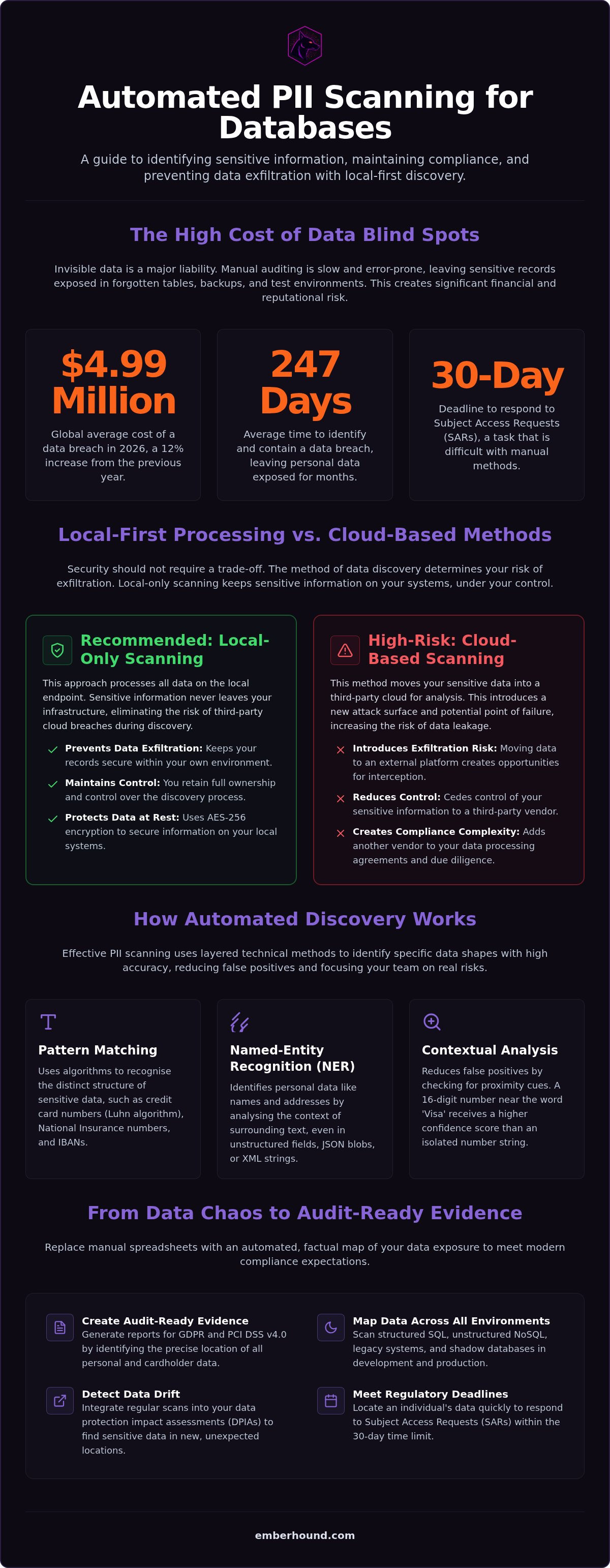
Invisible data is a major liability. Sensitive records often hide in backup tables, test environments, or misconfigured development clusters. These forgotten repositories are primary targets for attackers. According to 2026 research, the average time to identify and contain a data breach is 247 days. During that time, exposed personal data is an open door. The global average cost of a data breach is now $4.99 million. This is a 12 per cent increase from 2025. You cannot defend what you cannot see. Automated PII scanning for databases is the only way to close these visibility gaps before an auditor or an attacker finds them first.
Identifying sensitive information across different database types
Structured SQL environments are relatively simple to index. NoSQL databases are a different challenge. They often contain nested objects and unstructured strings that hide personal data amongst noise. Legacy systems are another blind spot. These older platforms frequently lack modern logging or access controls. Shadow databases created for quick tests often become permanent fixtures. They bypass official procurement and security reviews. Consistent scanning across production and development environments is essential. A leak from a staging server is just as damaging as a production breach. Your discovery programme must cover every environment without exception.
Regulatory expectations for data discovery in 2026
The Information Commissioner's Office (ICO) expects organisations to maintain a live data inventory. Static records are no longer sufficient evidence of GDPR compliance. Under PCI DSS 4.0, all 51 mandatory requirements became active on 31 March 2025. This includes the requirement to validate the location of all cardholder data. If you cannot prove where the data is, you are out of compliance. Subject access requests (SARs) also demand speed. You have a 30-day deadline to produce all data related to an individual. Automated discovery allows you to meet this deadline without pulling your engineers away from their primary work. It is a matter of operational survival.
How automated discovery locates sensitive information
Automated discovery is a precise technical operation. It goes beyond simple keyword searches. Effective PII scanning for databases uses pattern matching to identify specific data shapes. For example, credit card discovery relies on the Luhn algorithm to validate numerical strings. National Insurance numbers and IBANs follow strict structural rules that algorithms recognise instantly. This approach aligns with the NIST guide on protecting PII, which emphasises the need for accurate identification of sensitive records.
Named-entity recognition (NER) adds another layer of intelligence. It identifies names and addresses by analysing the context of the surrounding text. This is vital when personal data is buried amongst noise in unstructured fields. Modern scanners also look inside embedded objects. They can parse JSON blobs or XML strings stored within a single database cell. Layered detection logic reduces false positives by checking for proximity. If a 16-digit number is near the word Visa, the confidence score increases. This prevents your team from chasing ghosts in the data.
The mechanics of database pattern matching
Algorithms recognise the distinct structure of sensitive strings. An IBAN is not just a random sequence of characters. It has a specific country code and checksum. Distinguishing between real personal data and test fixtures is a matter of validation. Real records follow mathematical rules that sample data often ignores. Metadata also helps categorise these findings. It provides the context needed to prioritise remediation. You can start with a free scan configuration to see how these patterns appear in your own environment.
Ensuring scanning does not impact database performance
Deep data analysis should not bring your production environment to a halt. System stability is a priority during PII scanning for databases. Low-impact scanning strategies focus on off-peak hours to minimise resource contention. Agent-based scanning is often more efficient than remote connection methods. It performs the heavy lifting locally on the server. This reduces the amount of data that travels across your network. Scanners should use throttled queries to ensure they do not consume excessive CPU or memory. This methodical approach allows for thorough discovery without risking a system crash.
Local scanning vs cloud-based discovery methods
Data exfiltration is the silent threat of cloud-based discovery. Many traditional tools require you to move sensitive records into their own environment for analysis. This creates a new, unmanaged attack surface. PII scanning for databases should be a visibility exercise. It shouldn't be a data migration project. Moving data to the cloud increases the risk of unauthorised access during the discovery process. It also introduces significant costs related to cloud bandwidth. Large databases can generate terabytes of traffic during a full scan. These egress fees are often unpredictable and unnecessary.
Local scanning maintains data sovereignty. All processing happens on the local endpoint where the data resides. This keeps your records within your existing security perimeter. You use your own local hardware. This approach eliminates the need for expensive third-party cloud subscriptions and the associated data transfer fees. Usage-based pricing provides a flexible alternative to these rigid enterprise subscriptions. Local hardware utilisation is a sunk cost. You already own the infrastructure. Using it for PII scanning for databases is more efficient than paying for egress traffic. Keeping data in place is the only way to ensure it remains under your absolute control.
The risks of data ingestion in cloud-based tools
Moving personal data to a third-party cloud brings heavy compliance burdens. Under GDPR, international data transfers require strict legal frameworks. Cloud-native tools often ingest your data to train AI models. This practice violates the principle of data minimisation. You must scan files where they reside. This avoids the creation of secondary data lakes that require their own security protocols. You can find more details on this in our GDPR guide.
Maintaining an air-gapped security posture
Local processing ensures no file content ever leaves your network. This is an air-gapped posture. Your audit logs are protected using TLS 1.3 and AES-256 encryption at rest. You generate audit-ready evidence through masked previews and salted SHA-256 fingerprints. This allows you to prove compliance without exposing raw file content to external vendors. No telemetry is sent to the cloud. No file exfiltration occurs. This isolation is necessary for high-stakes environments where oversight is constant and the margin for error is zero.
Establishing a reliable data discovery programme
Reliable discovery is a continuous process. It requires a permanent commitment to visibility. Deployment drama often kills compliance projects before they start. You need a tool that avoids complex setups and invasive agents. You must integrate PII scanning for databases into your wider Data Protection Impact Assessment (DPIA). This ensures that discovery is a standard part of your risk management framework. Setting a regular schedule for automated scans is the only way to detect data drift. Developers often move data between environments for testing. Marketing teams might export records for a campaign. Without a schedule, these movements create invisible risks. Using masked previews allows you to verify findings without exposing raw personal data to the person performing the scan. This maintains privacy whilst ensuring the accuracy of your results.
Generating audit-ready evidence
Evidence is the final goal of any discovery programme. Salted SHA-256 fingerprints are the standard for proving you have found data without storing it. These fingerprints create a permanent, non-reversible record of discovery findings. You also need comprehensive audit logs of all data access and mutations. This documentation is essential for SOC 2 or CIS compliance audits. It shows that you have a methodical approach to data management. It proves that your discovery is consistent and verifiable. You can use these logs to demonstrate control to any external auditor. A clear audit trail reduces the time spent in verification meetings and speeds up the certification process.
Handling subject access requests with accuracy
A database map is your primary tool for fulfilling Subject Access Requests (DSARs). It speeds up the location of specific personal records across your entire network. You can create disclosure packs that are ready for immediate review by your Data Protection Officer (DPO). This reduces the manual burden on IT teams. You no longer need to run manual SQL queries across dozens of tables to find a single user's data. Automated PII scanning for databases turns a week-long task into a few clicks. It provides the accuracy needed to avoid fines for incomplete disclosure. It also ensures you meet the 30-day deadline without disrupting your core engineering roadmap.
Efficient data discovery with EmberHound
EmberHound is a data discovery platform designed for lean IT and compliance teams. It is the definitive solution for professionals who are tired of unnecessary complexity and deployment drama. The platform prioritises speed and visibility. Endpoint-only scanning ensures all processing occurs locally on your network. This eliminates the risk of file exfiltration. You don't have to worry about sensitive records reaching a third-party cloud. It is a no-nonsense tool for the Agile Guardian.
Usage-based pricing allows your organisation to pay for what it actually uses. This is a flexible alternative to the rigid enterprise subscriptions that drain SMB budgets. You get professional-grade PII scanning for databases without the enterprise-speak jargon. The platform automates the generation of audit-ready evidence for both GDPR and PCI DSS. This includes salted SHA-256 fingerprints and masked previews. You can move from discovery to a state of mounting confidence in your security posture quickly. It is about getting results without the bureaucracy.
Friction-reduced onboarding for small teams
You can start a scan without complex deployment or long-term contracts. Most platforms require a weeks-long onboarding process. EmberHound is different. It provides clear visibility into sensitive data exposure immediately. You have access to technical support from a UK-based team. We understand the grind of small teams. We provide exactly what is needed without distracting extras. This is a human-to-human business style that feels grounded and localised.
Advanced features for comprehensive coverage
Effective PII scanning for databases requires more than just indexing tables. EmberHound includes OCR technology to find personal data within images and scanned documents. This is vital for locating sensitive records in legacy archives or mislabelled attachments. Add-ons for local mailbox and external hard drive scanning allow you to cover your entire network from a single point of control. You can map your exposure across every endpoint. This methodical approach ensures you are always audit-ready.
Secure your database visibility for 2026
Data discovery is no longer a luxury. It's a requirement for operational survival. You've seen how manual mapping fails and how cloud-based tools create new risks. The only way to maintain control is through local-only processing. This ensures your sensitive records never leave your network during the discovery phase. PII scanning for databases provides the visibility you need without the deployment drama of enterprise legacy systems.
EmberHound protects your local audit logs with TLS 1.3 and AES-256 encryption at rest. You get audit-ready evidence through salted fingerprints and masked previews. There are no mandatory contracts or hidden egress fees. Usage-based pricing means you only pay for the discovery you actually perform. You can build a reliable compliance programme today without the burden of complex bureaucracy. It's time to stop guessing where your data lives and start proving you have it under control.
Take the first step toward a stress-free audit. Your team deserves a solution that works as hard as they do.
Frequently Asked Questions
What is the difference between personal data and sensitive data in databases?
Personal data includes any information that identifies an individual, such as names, addresses, or email accounts. Sensitive data is a specific subset under GDPR that requires higher protection, including health records, ethnicity, or religious beliefs. PII scanning for databases helps you distinguish between these categories to apply the correct security controls. Identifying the exact nature of your stored records is the first step toward meeting your legal obligations under UK data protection law.
Does database scanning impact the performance of production servers?
Modern discovery tools are designed to minimise impact on production environments. Local-only processing performs the heavy lifting on the endpoint, which reduces network traffic and avoids server strain. You should use throttled queries and schedule scans during off-peak hours to ensure system stability. This methodical approach allows for deep analysis without disrupting your core business operations. Efficient scanners avoid the resource-heavy ingestion processes used by traditional cloud-native platforms.
How often should a business scan its databases for personal data?
You should establish a regular schedule to detect data drift across your environments. Monthly scans are often sufficient for stable systems, but weekly discovery is better for active development clusters where data moves frequently. Regular PII scanning for databases ensures that temporary test tables or marketing exports don't become permanent security risks. Consistent monitoring allows your team to maintain an accurate data map and remain ready for any unexpected regulatory audit.
Can automated tools find personal data in unstructured database fields?
Automated tools use Named-Entity Recognition (NER) to find personal data buried within unstructured strings or long-form text fields. They can also parse JSON blobs and XML objects stored inside individual database cells. If your database contains scanned documents or images as attachments, OCR technology allows the scanner to read text within those files. This ensures comprehensive coverage of your environment, identifying sensitive records that would be impossible to find through manual SQL queries.
Is it possible to scan databases without moving data to the cloud?
It is entirely possible to scan your environment without moving a single file to the cloud. Local-only processing ensures that all analysis occurs within your own network perimeter. This air-gapped posture prevents file exfiltration and maintains your data sovereignty. By keeping the processing local, you also avoid the unpredictable bandwidth costs associated with cloud-based discovery tools. Your sensitive records stay exactly where they reside, keeping you in absolute control.
How does PII scanning assist with subject access requests?
Database discovery significantly reduces the manual burden of fulfilling subject access requests (DSARs). It provides a clear map of where an individual's records are stored across multiple tables and environments. You can quickly generate DSAR disclosure packs that are ready for review by your Data Protection Officer. This automation allows you to meet the 30-day deadline with total accuracy, avoiding the risk of incomplete data disclosure and the resulting regulatory fines.
What security standards should a database scanner meet?
A reliable scanner must meet modern encryption and integrity standards to protect your findings. You should look for tools that use TLS 1.3 for data in transit and AES-256 encryption for data at rest. Audit-ready evidence should be generated using salted SHA-256 fingerprints rather than storing raw file content. These standards ensure that your discovery process is secure and that your audit logs are protected from unauthorised tampering or access by external parties.
How do I handle false positives in database scan results?
False positives are managed through layered detection logic that checks for proximity and context. For example, a 16-digit number is only flagged as a credit card if it passes validation algorithms and sits near relevant keywords. You can then use masked previews to verify these findings manually without compromising the privacy of the underlying data. This approach allows your compliance team to filter out noise whilst maintaining a high level of accuracy for your reports.


