

Approximately 85-90% of UK businesses now operate in hybrid or multi-cloud environments. Most of these teams are one Subject Access Request away from a regulatory crisis because they lack reliable GDPR data discovery for cloud storage. You likely recognise the frustration of hunting for personal data across fragmented folders in OneDrive, Google Drive, and Dropbox. Manual searching is slow. It's prone to error. The risk of missing a stray spreadsheet is a constant burden for overworked IT departments.
Regaining control of your data map is the only way to satisfy the ICO. We agree that compliance must function without stalling your team's productivity. You'll learn how to identify and map personal data across every synced environment without deployment drama. This guide provides a clear path to building an inventory and gathering audit-ready evidence for the ICO. We focus on a local scanning process that keeps your data secure and your employee workflows intact. With the Data (Use and Access) Act 2025 now in force - and the ICO's power to issue higher fines - visibility is no longer optional.
Key Takeaways
- Define personal data within cloud environments to meet 2026 UK GDPR obligations.
- Use automated scanning and OCR to perform GDPR data discovery for cloud storage across synced folders and images.
- Compare native cloud search tools against specialised software to identify the best fit for multi-cloud environments.
- Map your data footprint with a 5-step framework that identifies every cloud platform used by your team.
- Maintain security with endpoint-only processing that keeps personal data inside your organisation.
GDPR data discovery for cloud storage: The 2026 definition
GDPR data discovery for cloud storage is the systematic process of identifying personal data within your cloud-connected environments. It is a technical necessity for any UK organisation handling information about citizens. The General Data Protection Regulation (GDPR) defines personal data as any information relating to an identified or identifiable person. This includes names, addresses, and digital identifiers like IP addresses. In the UK, the Data (Use and Access) Act 2025 has strengthened these requirements. Fines for breaches can now reach £17.5 million or 4% of global turnover. Visibility is your first line of defence. It allows you to prove you know exactly where your customer data resides.
Cloud storage is often a repository for unstructured data. This includes spreadsheets, PDFs, and image files that don't sit in a neat database. The Information Commissioner's Office (ICO) mandates that you maintain an accurate record of processing activities. You cannot document data that you haven't found. Discovery allows you to map where this information lives before a regulator asks to see it. It turns a chaotic file structure into an organised, audit-ready inventory. This process is essential for responding to Subject Access Requests within legal timeframes. Without a clear map, your team will spend hundreds of hours on manual searches that remain incomplete.
Why cloud storage is a compliance blind spot
Cloud folders are rarely static. Employees frequently sync these folders to their local laptops or desktops for offline work. This creates a distributed data footprint that central security tools often miss. Shadow IT adds another layer of risk. Staff might use personal cloud accounts to bypass file size limits. This places personal data in unauthorised locations. Legacy files also hide in cloud archives and often bypass standard security reviews because they are seen as low risk until a breach occurs.
The role of automated discovery in 2026
Manual searching is slow and prone to error. It cannot keep pace with the volume of data generated by modern teams. Automation provides a repeatable process for GDPR data discovery for cloud storage. This speed is vital for meeting the new 30-day complaint handling deadline introduced in June 2026. Discovery is the foundation of data protection. It ensures that your compliance posture is based on facts. It eliminates reliance on assumptions.
How automated scanning identifies personal data in cloud-synced folders
Automated scanning is the mechanical engine behind modern compliance. It replaces the slow, error-prone effort of manual file reviews with speed and precision. Scanning tools use pattern matching to recognise personal data formats across your entire file library. This includes identifying 16-digit credit card numbers, UK National Insurance numbers, and specific address structures. It is a process that operates at a scale impossible for human teams to replicate. Using these tools is the only reliable way to perform GDPR data discovery for cloud storage. You can start a free GDPR scan to see this logic in action on your own devices.
Security is maintained through salted SHA-256 fingerprints. These fingerprints provide a secure way to track data mutations without storing the actual personal data. If a file is moved, copied, or slightly altered, the system recognises the change. This ensures your data inventory remains accurate even as files circulate through your cloud storage providers. It is a method that prioritises visibility and protects the underlying information from exposure at the same time.
Endpoint-only scanning for cloud data
The most effective software scans data where it is actually used: on the employee endpoint. This approach avoids the need to grant a third party access to cloud APIs like Microsoft Graph or Google Drive. Local processing is a safer alternative to cloud-to-cloud scanning. It ensures that the contents of your files stay within your control at all times. By processing files on the laptop or desktop where they are synced, you reduce the risk of data exfiltration during the scan. The data never leaves your organisation's perimeter.
Identifying data in complex file types
Personal data is rarely found in plain text files alone. Discovery tools must look inside compressed folders like .zip files and deep into email attachments. This is where shadow data often hides. OCR technology is necessary for identifying data in scanned documents such as passport scans, driving licences, or handwritten invoices. Many organisations overlook these image-based risks during a standard audit. You can find specific details on OCR for data discovery to understand how image scanning secures your compliance posture. This capability ensures that no document - whether digital or digitised - stays hidden from your GDPR data discovery for cloud storage efforts.
Native cloud provider tools vs specialised discovery software
Native cloud tools are built for file retrieval. They are not built for regulatory scrutiny. Most UK businesses rely on the built-in search bars of OneDrive, Google Drive, or Dropbox. This is a risky strategy for GDPR data discovery for cloud storage. These native functions identify filenames and basic keywords. They do not identify the specific types of personal data that trigger a fine. A standard search tool sees a file named "Customer_List.xlsx". It does not see the 500 National Insurance numbers inside that file. You need a tool that understands the content, not just the label.
The limitations of native cloud search
Native search functions lack pattern-matching intelligence. They do not recognise the structure of sensitive identifiers like passport numbers or bank details. You must configure these tools manually for every new folder or shared drive. This creates a heavy administrative load for small teams. Reporting in these systems is also problematic. The output is usually a technical log for IT administrators. It lacks the clarity required for a compliance audit. The ICO requires evidence of what you found and how you handled it. Native logs rarely provide this context. Multi-cloud environments make this worse. Microsoft tools do not scan your Google buckets. Google tools do not scan your Dropbox folders. You end up with a fragmented view of your data footprint.
Benefits of a dedicated discovery platform
EmberHound is a data discovery platform built for specific compliance needs. It provides visibility across multiple cloud providers from a single interface. One major advantage is the use of masked previews for evidence. You can prove you found personal data without exposing the actual data to more employees. This maintains the principle of data minimisation. Specialised software also scales with your business. Usage-based pricing allows SMBs to manage their compliance costs. You only pay for what you scan. This is a pragmatic alternative to the expensive enterprise suites that require months of configuration. You can check the pricing page for usage-based options that fit your budget.
Dedicated tools focus on the specific goal of finding personal data. They are designed to produce the reports your DPO needs for an annual review. This is the difference between a general search and a targeted compliance process. Specialised software like EmberHound is designed for speed. It avoids the complex integrations that stop most compliance projects before they start. It gives you the evidence you need to satisfy the ICO without disrupting your daily operations.
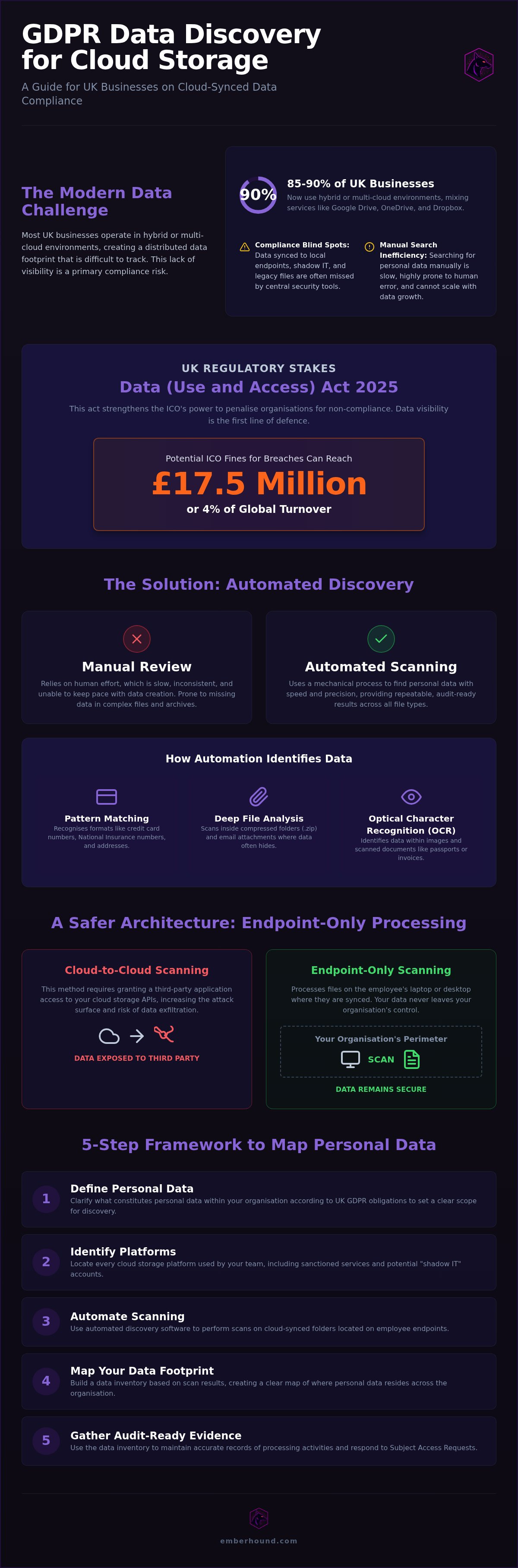
A 5-step framework to map personal data in the cloud
Compliance is a logistical challenge. It requires a repeatable method to find and document information across a distributed workforce. Relying on employee memory is a liability. You need a structured framework to perform GDPR data discovery for cloud storage. This process turns a vague understanding of your data into a defensible audit trail. It is the only way to meet the 30-day complaint response deadline mandated by the ICO as of June 2026.
Step 1 and 2: Discovery and deployment
Start by mapping where your employees actually store their work files. This goes beyond the official company OneDrive. You must identify every cloud storage platform currently in use, including shadow IT accounts. Once you have a list, deploy discovery software to the endpoints that sync with these services. You need a tool that requires no deployment drama. Traditional governance playbooks take months - often years - to implement. You can find deployment tips to help you start scanning immediately. This approach focuses on the data that is actually present on employee devices.
Step 3 to 5: Scanning and reporting
Run a comprehensive scan to locate personal data and cardholder information. Configure the scan to look for both sets of data simultaneously. This is the core of your GDPR data discovery for cloud storage effort. Use salted SHA-256 fingerprints during the scan. This allows you to prove the state of your data at a specific time without exfiltrating the sensitive content itself. It is a secure way to maintain an immutable record of your findings.
Review the findings using masked previews. This allows you to verify data types without exposing the full details to your IT team. Once verified, export an audit-ready inventory. This documents your compliance status and satisfies the ICO requirement for an accurate record of processing activities. If an individual submits a Subject Access Request, you can fulfil it quickly using a dedicated disclosure pack. This pack compiles the necessary evidence in a format ready for external review. It reduces the time spent on manual redaction and file collation.
EmberHound is a direct path to cloud data visibility
EmberHound is a data discovery platform built for the specific constraints of UK businesses. Enterprise governance suites often require months of implementation and six-figure budgets. These platforms are designed for global conglomerates with dedicated compliance departments. We prioritise the needs of lean IT groups and compliance teams. We provide specialised software that helps businesses identify personal data across distributed cloud environments. It is the fastest path to GDPR data discovery for cloud storage for teams that cannot afford deployment drama. You get the visibility you need to satisfy the ICO without the bloatware.
Security is the core of our architecture. Our platform performs all scanning locally on the employee endpoint. This ensures your data stays secure within your own network perimeter. The data never leaves your organisation. This approach eliminates the anxiety of granting third-party apps full access to your cloud file systems. You maintain total control over your information whilst the software builds your inventory. It is a no-nonsense solution for professionals who value time and security above corporate fluff. Visibility shouldn't come at the cost of a data breach during the scan itself.
Friction-reduced compliance for SMBs
We've removed the barriers that stall most security projects. There are no mandatory contracts. There are no long-term commitments required to use the platform. We use a usage-based model. This ensures you only pay for what you actually use. It is a pragmatic approach that allows smaller firms to scale their compliance efforts as they grow. Our technical style is benefit-led and accessible. We avoid the dense jargon typical of large-scale software. We focus on the immediate, actionable clarity you need to handle a Subject Access Request or a regulatory audit. You receive a clear inventory without the administrative burden of traditional enterprise tools.
Next steps for your organisation
You can download the software and start your first scan in minutes. The process is designed for speed and impact. Use our GDPR guide to understand your specific obligations under the Data (Use and Access) Act 2025. This document provides the context you need to manage your data map effectively. If you want to see the interface before you begin, you can book a video demo to see the platform in action. Start with a free scan to see exactly where your risks live. It is the most efficient way to perform GDPR data discovery for cloud storage and secure your compliance posture for 2026.
Securing your data map for 2026
Cloud compliance is no longer a matter of periodic reviews. The Data (Use and Access) Act 2025 and the June 2026 complaint handling deadline have turned visibility into a daily requirement. You've seen how manual searching fails to keep pace with fragmented cloud folders. Reliable GDPR data discovery for cloud storage requires a process that works where your data actually lives. Endpoint-only processing ensures your files stay secure whilst you build a clear inventory for the ICO.
You can move from a fragmented data map to a defensible audit trail without deployment drama. This framework provides the audit-ready evidence you need to satisfy regulators and respond to DSARs with confidence. It's time to replace guesswork with technical certainty.
Take the first step toward a stress-free compliance audit today.
Frequently Asked Questions
Does cloud storage discovery require access to our cloud admin passwords?
No, you do not need to share cloud admin passwords or grant API access to perform a scan. EmberHound operates on the endpoint level. It identifies personal data within the folders already synced to your employee laptops and desktops. This approach eliminates the need for complex integrations with cloud providers. It ensures that your administrative credentials remain secure while you perform GDPR data discovery for cloud storage across your organisation.
Can EmberHound scan data in password-protected files within the cloud?
Standard discovery tools cannot read the contents of encrypted or password-protected files without the correct decryption keys. EmberHound identifies these files as part of your inventory but flags them as inaccessible for content analysis. This is a security feature that respects existing file-level encryption. You should include these flagged files in your manual review process. It ensures that no personal data remains hidden within encrypted archives or protected documents.
How long does a typical GDPR data discovery scan take for cloud folders?
Scan duration depends on the volume of data and the performance of the local hardware. Local endpoint scanning is typically faster than cloud-to-cloud methods. It avoids API rate limits and network throttling. Small teams often complete their initial discovery in under an hour. Larger datasets take longer, but the process runs in the background. It does not disrupt employee workflows. It does not require significant system resources to maintain performance.
Is it possible to find personal data in images stored on cloud drives?
Yes, you can find personal data within images using our OCR scanning capability. This technology identifies text within passport scans, driving licences, and handwritten invoices stored in your cloud folders. Many organisations overlook image-based risks during a standard audit. Automated OCR ensures that these files are included in your GDPR data discovery for cloud storage efforts. It provides a more accurate view of your total data footprint across all file types.
What happens to the data EmberHound finds during a cloud scan?
Your data never leaves your organisation. EmberHound uses endpoint-only processing. The contents of your files are never exfiltrated to our servers. We use masked previews and salted SHA-256 fingerprints to provide evidence of your findings. This allows you to document compliance without creating new security risks. All results are encrypted at rest using AES-256 and transmitted via TLS 1.3 to ensure your privacy is maintained throughout the process.
Does the software support discovery across multiple cloud providers at once?
The software supports simultaneous discovery across any cloud provider synced to the local machine. This includes OneDrive, Google Drive, Dropbox, and iCloud. Because the scan happens at the endpoint level, the specific cloud provider does not matter. The software sees the files as they appear on the local disk. This provides a unified view of your personal data footprint across fragmented multi-cloud environments without requiring separate configurations for each individual service.
Can I use the discovery findings to respond to a Subject Access Request?
You can use the discovery findings to fulfil Subject Access Requests efficiently. Our dedicated DSAR disclosure pack compiles the necessary evidence into a structured format. This reduces the time spent on manual redaction and file collation. It allows your compliance team to meet the new 30-day response deadline introduced in June 2026. The platform provides the specific file locations and masked previews needed to verify the data before you communicate the outcome.
Is local scanning faster than API-based cloud scanning for large volumes?
Local scanning is often faster than API-based methods for large data volumes. API-based discovery is frequently slowed by the rate limits imposed by cloud providers like Microsoft or Google. Local processing avoids these bottlenecks by using the native speed of the endpoint's processor and disk. It eliminates the need to transfer large files over the internet for analysis. This efficiency makes it a pragmatic choice for UK businesses with extensive cloud storage archives.


