

In the first half of 2026, the Information Commissioner's Office (ICO) has already issued penalties exceeding £15 million. This is not a trend - it is a strategic shift toward heavier fines for systemic data failures. You likely feel the constant pressure of the 30-day DSAR deadline whilst worrying about hidden records buried in mailboxes or unindexed images. Understanding exactly what is personal data is the only way to clear the fog created by the Data (Use and Access) Act 2025. It is easy to feel overwhelmed by the fear of a simple oversight.
This guide provides a definitive reference for the UK GDPR framework as it stands in 2026. You will learn how to identify, categorise, and manage information across your entire organisation. We provide a clear checklist of data types and a roadmap to reduce your risk of regulatory fines. We move past the jargon to give you actionable clarity. This is about turning a legal abstraction into a manageable technical reality for your team.
Key Takeaways
- Learn the legal definition of what is personal data under the Data (Use and Access) Act 2025 to align your records with current UK standards.
- Distinguish between direct and indirect identifiers to uncover hidden risks within your organisation's databases and local mailboxes.
- Master the strict processing conditions required for special category data to mitigate the risk of high-impact regulatory penalties.
- Identify personal data hidden in unstructured formats like PDF scans and email attachments through targeted OCR scanning.
- Build a methodical discovery process that replaces slow manual searches with automated endpoint scanning to meet 30-day DSAR deadlines.
Defining Personal Data under UK GDPR
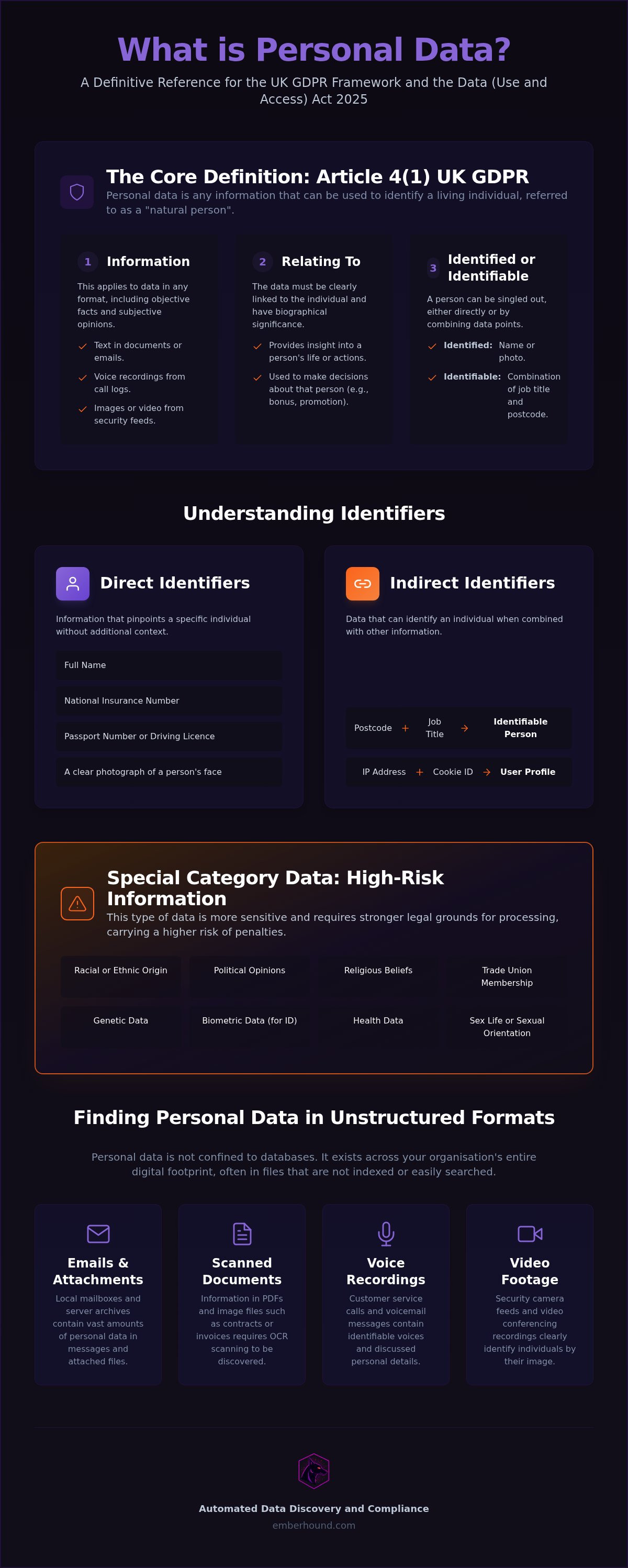
Understanding what is personal data starts with Article 4(1) of the UK GDPR. This regulation is the UK's post-Brexit adaptation of the General Data Protection Regulation (GDPR). At its core, personal data is any information that identifies a living individual. We call this individual a "natural person". Corporate entities do not have personal data rights. This distinction is critical for compliance teams. You are protecting people, not companies.
The definition is broader than many realise. It includes objective facts like a home address or a bank account number. It also includes subjective opinions. If a manager writes "this employee is underperforming" in a private email, that note is personal data. It identifies the employee and tells us something about them. This is why local mailbox scanning is a necessity. Data doesn't just sit in structured databases; it lives in sent folders and drafts. It exists in every corner of your network.
The Three Pillars of the Definition
To classify information correctly, you must apply three specific tests based on the UK GDPR framework.
- Information: This covers every format. It is text in a PDF. It is a voice recording in a customer service log. It is a face in a security camera feed.
- Relating to: The data must have a clear link to the person. This is often the most contested part of an audit.
- Identified or Identifiable: A person is "identified" if you can pick them out of a crowd immediately using a name or a photo. They are "identifiable" if you can find them by combining separate data points. For example, a job title and a postcode might not identify someone alone, but together they point to one specific employee. This is why anonymisation is difficult to achieve. Most data remains "pseudonymised", meaning it still falls under the scope of the law.
The Relates To Test
How do you know if data "relates to" someone? You look for biographical significance. In the context of UK GDPR, biographical significance is the threshold where information goes beyond a passing mention to provide meaningful insight into an individual's identity, actions, or personal circumstances. If the data provides more than a peripheral record of a person, it likely meets this test.
You must also ask if the data is used to influence actions or decisions regarding that person. If an Excel sheet determines a bonus, a promotion, or a redundancy, it relates to the individual. Identifying these links is the first step toward using a GDPR guide to map your data footprint. You cannot secure what you cannot define. Once you understand the scope of the definition, you can begin the process of discovery across your organisation's endpoints.
Identifiers and the Concept of Identifiability
Identification is more than a name on a payroll record. To understand what is personal data, you must look at how information functions in isolation and in combination. Direct identifiers allow you to pinpoint an individual without any additional context. A National Insurance number is a prime example. It is unique. It belongs to one person. There is no ambiguity. However, the law also covers indirect identifiers. These are pieces of information that, whilst seemingly anonymous, allow for identification when paired with other data points.
Modern compliance requires a shift in how you view anonymous records. Under UK data protection legislation, data is still considered personal if an individual is identifiable. This means that if a motivated intruder could reasonably link a dataset back to a living person, that dataset remains within the scope of the UK GDPR. Pseudonymised data is a common trap. You might replace names with unique IDs, but if a key exists that can relink those IDs to the original names, the data is still personal. It has not been anonymised; it has only been masked.
Direct vs Indirect Identification
Direct identification is immediate. You see a name, a photograph, or a passport number. Indirect identification is a puzzle. It involves combining factors like a physical address, a specific job title, or even a rare medical condition. If your database contains a postcode and a specific age, you might be able to identify a resident in a small village. The motivated intruder test is the standard used here. It asks if a person with no prior knowledge, but with access to public resources like social media or the electoral roll, could identify the subject. If the answer is yes, you are handling personal data.
Online Identifiers in Modern Business
The digital footprint of a user is a rich source of personal data. IP addresses and cookie IDs are now legally recognised as identifiers. They track behaviour. They link a device to a human. Metadata is equally revealing. A digital photo might look harmless, but the EXIF data often contains the exact GPS coordinates where it was taken. This location data tells you where a person lives or works. For many teams, these identifiers are the hardest to find because they are buried in system logs or image properties. You can start scanning your local drives for these identifiers to see where your hidden risks are. Managing what is personal data in a digital context requires visibility into these technical layers.
Special Category Data and Sensitive Information
Some information carries a higher risk of harm if it is exposed. Under the UK GDPR, this is known as special category data. It is a specific subset of what is personal data that requires more stringent legal protections. Processing this information is generally prohibited unless you meet one of the ten specific conditions set out in Article 9. You cannot rely on standard legitimate interests alone. You need a clear, documented reason. The stakes are high. Mismanaging this data is a fast track to the maximum fines allowed under the Data (Use and Access) Act 2025.
List of Special Categories
The law identifies information that is inherently sensitive. This includes:
- Health data: Medical records, sick notes, or disability status.
- Biometric data: Fingerprints or facial recognition patterns used for identification.
- Genetic data: Information about inherited or acquired genetic characteristics.
- Racial or ethnic origin: Often found in HR diversity monitoring forms.
- Political opinions and religious beliefs: Data that reveals a person's core values.
- Trade union membership: A common identifier in payroll or HR files.
- Sexual orientation: Private information that requires maximum protection.
Criminal offence data is not technically special category data. Instead, it is governed by a separate set of rules under Article 10 of the UK GDPR and the Data Protection Act 2018. The Data (Use and Access) Act 2025 maintains this distinction. You must handle records of convictions or alleged offences with the same level of care as health records. Don't let the technical classification fool you. The regulatory risk remains the same.
Why Categorisation Matters for Security
A breach involving special category data is a high-stakes failure. It triggers an immediate requirement for a Data Protection Impact Assessment (DPIAs). If you don't know where this data lives, you can't protect it. It often hides in plain sight. A "return to work" email in a manager's inbox is a health record. A scanned passport in a downloads folder is biometric data. These are the "hidden" files that cause the most damage during an audit.
This is where automated discovery becomes a necessity. Manual audits are too slow. They miss the sent folders and the temporary downloads. Tools that provide GDPR data discovery allow you to tag sensitive information across your network automatically. You can prioritise protection for the files that carry the highest regulatory risk. Knowing what is personal data is the first step. Knowing which data is special category is the second. It allows your team to focus limited resources on the areas of greatest vulnerability.
Personal Data in Unstructured Files and Images
Compliance often fails because it focuses on databases whilst ignoring the desktops. To understand what is personal data in a modern office, you must look at unstructured formats. These are the files that don't live in a neat table. Emails, PDFs, and image files are the vast majority of data sprawl. They are frequently forgotten, yet they carry the same regulatory weight as a structured customer record. If a file identifies a person, it is personal data. It doesn't matter if it's a spreadsheet or a screenshot of a chat log. The ICO does not distinguish between a row in SQL and a paragraph in a Word document.
The Risk of Scanned Documents
Your organisation likely handles hundreds of scanned documents. Passports, driving licences, and utility bills are often stored as images for identity verification or onboarding. Standard search tools are blind to this information. They cannot "read" the pixels in a JPEG or a flat PDF scan. This creates a massive visibility gap. Without OCR technology, these files stay hidden from your compliance audits. They sit on local hard drives and external disks, waiting for a breach or a DSAR. Endpoint scanning is the only way to find these assets where they actually live. You cannot protect what you cannot see.
Image files also contain metadata. This includes the location, date, and device ID used to capture the image. Even if the picture itself seems harmless, the metadata can indirectly identify a person. This is a common oversight in security protocols. Automated tools must look beyond the file name. They must examine the content and the hidden attributes of every image stored on your network. This ensures no sensitive identifiers are left exposed in forgotten folders. It is a necessary step for any audit in 2026.
Personal Data in Communications
Local mailboxes are a primary source of risk. They often contain years of personal details buried in long email threads. An offhand opinion about a colleague or a mention of a client's health status is personal data. These details are often duplicated across multiple sent folders and archive files. Attachments are even more dangerous. A single payroll report sent to three managers creates four distinct copies of sensitive data. You can learn why mailbox scanning is essential to stop this sprawl before it triggers an ICO investigation. Managing these communications is not a manual task. It is a technical challenge that requires automated discovery to parse through thousands of messages in minutes. It is about speed and accuracy.
Identifying Personal Data for Compliance Audits
An audit is a reality check. You cannot document what you cannot find. Understanding what is personal data is the theoretical foundation, but discovery is the technical reality. Manual searching is dead. Modern data volumes make it impossible to find every sensitive file by hand. It is slow. It is prone to human error. With the average value of ICO penalties rising by 370% since 2023, the cost of a mistake is too high. You need automated scanning to provide audit-ready evidence of compliance. This ensures your Record of Processing Activities (ROPA) reflects your actual data footprint, not just a best guess.
Steps for a Technical Data Audit
A technical audit maps data where it resides. First, locate every endpoint. This includes local mailboxes, external hard drives, and employee downloads folders. These are the dark corners where personal data hides. Once you identify these targets, apply automated scanning. This process identifies sensitive patterns like National Insurance numbers or health records in seconds. You can follow our GDPR data audit preparation checklist to structure your workflow. The goal is visibility. You need a list of files, their exact locations, and their sensitivity levels. This map is your primary defence during an ICO investigation.
Managing Data Subject Access Requests (DSARs)
The Data (Use and Access) Act 2025 has introduced a new complaint handling process. Data subjects must now contact you first. You have 30 days to acknowledge the request. If you don't know what is personal data across your endpoints, you will fail this first test. This leads directly to ICO complaints. Use disclosure packs to organise and redact information instantly. These packs ensure you only share what is necessary whilst protecting third-party privacy. You can start a free GDPR scan to find your data to see how quickly you can respond. Efficiency is the only way to manage the DSAR burden without exhausting your team.
Secure Your Data Footprint for 2026
Defining what is personal data is the first step toward operational visibility. In 2026, compliance teams must look beyond the payroll database. You must account for the identifiers hidden in sent folders, scanned images, and metadata. The Data (Use and Access) Act 2025 has increased the stakes for response times and accuracy. It is time to replace manual guesswork with technical certainty. You cannot protect information that remains invisible to your current tools.
Meeting DSAR deadlines requires a solution that delivers audit-ready evidence without the risk of file exfiltration. Endpoint-only scanning ensures your files never leave your network. You gain masked previews and salted fingerprints for your records whilst maintaining a light footprint. Our model uses usage-based pricing with no long-term contracts. This is about professional reassurance through automated precision. It is the definitive, stress-reducing solution for overworked teams.
Take control of your data sprawl today. You can reduce your regulatory risk and meet every deadline with confidence.
Frequently Asked Questions
Is an IP address considered personal data under UK GDPR?
Yes, an IP address is personal data because it is an online identifier that can link a device to a specific user. The ICO classifies these as technical identifiers that allow for tracking and profiling. Even if your organisation cannot identify the person alone, the data remains personal if a third party, like an ISP, can. This is a core part of understanding what is personal data in a modern, connected business environment.
Does personal data include information about deceased people?
No, the UK GDPR only protects the data of living individuals. Information about deceased people does not fall under the definition of personal data. However, you must still consider other legal obligations. The common law duty of confidentiality or specific rules for medical records often continue after an individual has died. Do not assume that the death of a subject removes all your legal responsibilities regarding their sensitive information.
Can business contact details be personal data?
Yes, business contact details are personal data if they identify a natural person. A generic email like [email protected] is not personal data. However, a direct email like [email protected] is. It points to a specific individual within the business. You must process these details according to the same principles as any other identifier. This includes ensuring you have a valid lawful basis for any marketing or processing activities.
Is anonymised data exempt from UK GDPR rules?
Yes, truly anonymised data is exempt from the UK GDPR. Information is only anonymised if the individual is no longer identifiable by any reasonable means. This is a permanent and irreversible process. If there is any way to relink the data to a person, it remains personal data. Many teams confuse pseudonymisation with anonymisation. If a key exists to identify the subject, you are still bound by the full weight of data protection law.
What is the difference between personal data and sensitive data?
Sensitive data is a specific subset of personal data that carries higher risks. Standard personal data includes names, addresses, and identifiers. Sensitive data, or special category data, includes health records, ethnic origin, and religious beliefs. You need a specific condition under Article 9 to process sensitive information. Knowing the difference is vital for categorising what is personal data during a technical audit to ensure you apply the correct level of security and encryption.
Are opinions about a person considered personal data?
Yes, opinions about an individual are considered personal data. If a record contains a subjective assessment of a person, it relates to them. This applies to performance reviews, interview notes, or even internal emails discussing a customer's behaviour. If the person can be identified from the record, the opinion is legally their data. You must be prepared to provide these opinions if the individual submits a Data Subject Access Request (DSAR).
Is pseudonymised data still subject to UK GDPR?
Yes, pseudonymised data is still subject to the UK GDPR. Pseudonymisation replaces direct identifiers with codes or aliases to improve security. However, because the process is reversible, the data remains personal. It is a protective measure, not a way to bypass regulation. You must still maintain a lawful basis for processing and ensure the data is stored securely. It only becomes exempt if you move to a state of full, irreversible anonymisation.
How long can an organisation keep personal data?
You can only keep personal data for as long as is necessary for the purpose you collected it. This is known as the storage limitation principle. There is no universal time limit in the UK GDPR. Instead, you must define and document your own retention periods based on legal requirements and business needs. For example, financial records often require a six-year retention period. Once the data is no longer needed, you must delete it.


