

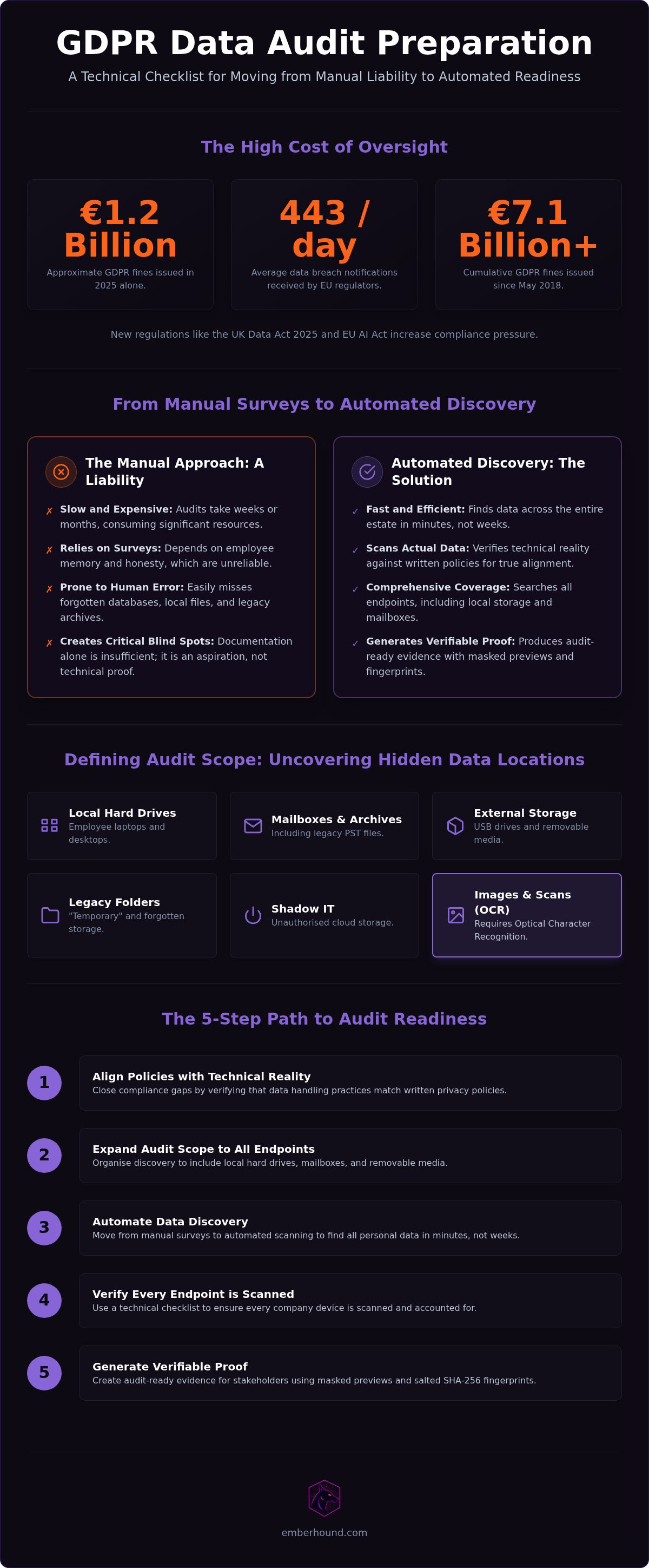
Regulators issued approximately 1.2 billion Euros in GDPR fines during 2025. With the UK Data (Use and Access) Act 2025 now in effect and EU AI Act enforcement active as of August 2026, the cost of oversight is high. You likely feel the pressure of these shifting rules. You know that a manual approach to gdpr data audit preparation is a liability. Overlooking a single forgotten database or a legacy PST file could trigger a massive fine. Manual mapping is slow, expensive, and leaves your organisation exposed.
This guide provides a structured technical checklist to help your team prepare for a formal audit. It moves beyond theory to offer a practical path toward readiness. You will learn how to identify personal data across your entire endpoint estate and generate the proof stakeholders require. We will examine automated discovery, the role of OCR in finding hidden data, and how to reduce your risk profile without a massive consulting budget. This is about moving from anxiety to visibility.
Key Takeaways
- Align technical data handling with written privacy policies. Close compliance gaps before the audit begins.
- Organise audit scope to include local hard drives and mailboxes. Don't leave personal data hidden on endpoints.
- Move from manual surveys to automated discovery. Find data in minutes rather than weeks.
- Use a technical checklist for gdpr data audit preparation. Verify that every company endpoint is scanned and accounted for.
- Generate verifiable proof for stakeholders. Use masked previews and salted SHA - 256 fingerprints for evidence.
What is GDPR Data Audit Preparation?
Preparation is the process of identifying data risks before a formal inspection. It is a proactive defensive measure. You find the gaps before the Information Commissioner's Office (ICO) finds them for you. The primary goal of gdpr data audit preparation is to align your technical data handling with your written privacy policies. If your documentation claims one thing but your hard drives reveal another, you face a significant compliance failure.
This phase involves verifying your data retention periods. You must confirm you have a valid legal justification for every piece of personal data you store. Cumulative fines for violations have exceeded 7.1 billion Euros since 2018. Regulators now receive an average of 443 data breach notifications per day across Europe. Preparation reduces the risk of joining those statistics. It ensures your organisation is ready to justify its behaviour under the General Data Protection Regulation (GDPR) and the UK Data (Use and Access) Act 2025.
The Role of the Data Protection Officer (DPO)
The DPO oversees the strategy. They act as the bridge between your technical teams and regulatory bodies. During a formal audit, the DPO is the primary contact. Their job is to ensure that your data discovery results match your Record of Processing Activities (ROPA). If the ROPA states that sensitive information is only held in a secure CRM, the DPO must verify that no copies exist in local downloads or email attachments. This requires a methodical approach to internal oversight.
Why Documentation Alone is Insufficient
Policies are aspirations. An audit is about technical reality. Regulators don't just read your handbook; they look for evidence. They need to see that data is actually stored where you claim it is. Many organisations rely on staff surveys to map data. This is a mistake. Surveys rely on memory and honesty. Neither is a substitute for a digital scan.
Effective preparation requires a search of all storage locations. This includes:
- Local hard drives on employee laptops.
- Employee mailboxes and archived PST files.
- External storage devices and removable media.
- Legacy folders and "temporary" storage areas.
Without a technical search, your documentation is just a wish list. You can find more details on how to build this technical foundation in our GDPR guide. Verify your data now so you don't have to explain its presence later. It is better to discover a vulnerability yourself than to have it pointed out during a compulsory inspection.
Identifying the Scope of Your Personal Data Audit
Defining scope is the most critical stage of gdpr data audit preparation. If your scope is too narrow, you create blind spots that auditors will exploit. Many teams rely on stakeholder interviews to map data locations. This is a flawed strategy. Employees often forget about local copies, temporary downloads, or legacy mailboxes. You must account for every device that handles personal data for UK citizens. This includes company - issued laptops, mobile devices, and any server that touches the network.
Shadow IT and unauthorised cloud storage are frequent causes of audit failure. If an employee uses a personal Dropbox account to share a spreadsheet, that data is in scope. You cannot exclude it simply because it violates company policy. A narrow scope is a liability. It's better to scan your entire infrastructure and then filter out irrelevant results. This ensures you aren't surprised by a forgotten PST file during a formal inspection. This level of visibility is a requirement under the ICO guidance on GDPR. You can start a free scan to identify these hidden risks before they become regulatory issues.
Scanning Endpoints and Local Storage
Personal data doesn't stay in your secure database. It migrates. It ends up on employee laptops and external hard drives. Audit preparation must include a technical method for searching these disconnected endpoints. Your scan should include common file types like PDF, DOCX, and XLSX. Don't assume that "local storage" is empty. Personal data often hides in browser downloads, desktop folders, and synchronised local backups. If a device connects to your network, it is part of your audit footprint.
Uncovering Data in Images and Scanned Documents
Images are a massive compliance gap. Scanned passports, ID cards, and invoices are often stored as static image files. Standard text search tools cannot see this data. You need Optical Character Recognition (OCR) technology to identify personal data within these files. Many organisations ignore images during their gdpr data audit preparation. This leaves a clear path for auditors to find unmapped data. Verify that your current tools can read text within an image file. If they can't, you have a blind spot. A passport scan sitting in a "Downloads" folder is just as much of a risk as a database leak. You must find it before the regulator does.
Choosing Between Manual Audits and Automated Discovery
Manual audits are a legacy approach to a modern problem. They rely on staff surveys and static spreadsheets. This process takes weeks to complete and is often obsolete before the final report is signed. Human error is the primary cause of inaccurate data mapping. Employees don't intentionally hide data; they simply forget where they saved it. A manual survey is only as good as the memory of your busiest staff member.
Automated discovery replaces guesswork with a technical scan. It identifies personal data across your infrastructure in minutes. This speed is essential for effective gdpr data audit preparation. You need a repeatable process that monitors compliance on an ongoing basis. An annual manual review is insufficient when data flows in and out of your organisation every hour. Automation provides a factual foundation that stands up to intense regulatory scrutiny.
The Limitations of Manual Data Mapping
Staff often forget the contents of their email attachments or old project folders. They might save a temporary copy of a customer list on their desktop and never delete it. Manual reviews cannot find these files at scale. A spreadsheet is a static snapshot of a moving target. It is out of date the moment it is saved to a shared drive. For organisations handling large volumes of files, manual mapping is an impossible task that results in incomplete records and regulatory exposure.
Benefits of Automated Technical Scanning
Scanning provides a factual inventory. It bypasses human bias by analysing the actual bits on the disk. This approach allows you to generate masked previews of the discovered data. This means auditors can see proof of the data's existence without being exposed to the raw personal information itself. This protects your privacy standards whilst it provides the technical evidence required for a formal audit.
Efficiency is also a legal requirement. Under the UK GDPR, you must respond to a Data Subject Access Request (DSAR) within 30 days. Automation is the only viable way to meet this deadline for complex requests. It allows you to locate every instance of a person's data instantly. By integrating technical scanning into your gdpr data audit preparation, you ensure your team is ready for both planned audits and unexpected regulatory demands. You can see how this works in practice by viewing our video demo.
A Technical Checklist for GDPR Audit Readiness
Execution is the final stage of gdpr data audit preparation. You have defined your scope and chosen your tools. Now you must apply them to your infrastructure. A successful audit requires proof that your technical reality aligns with your legal obligations. You cannot rely on assumptions. You must test your defences and verify your data holdings before an external auditor arrives to do it for you.
This checklist prioritises visibility and risk reduction. It focuses on the most common areas of failure: over - retention, unauthorised access, and hidden personal data. By following these steps, you build a defensible position that demonstrates proactive compliance. You move from a state of uncertainty to one of documented control.
Step 1: Data Discovery and Inventory
The foundation of your audit is a complete inventory. Use an automated GDPR scanning tool to find every instance of personal data across your company endpoints. You must categorise this data by type. Identify where you store contact details, financial information, or sensitive health data. Create a live map of these categories. If an auditor asks where you store passport scans, you should be able to provide the exact file paths instantly. This inventory must include local hard drives and mailboxes to be valid.
Step 2: Access and Security Review
Visibility without security is a liability. Verify which users have access to folders containing sensitive personal data. Apply the principle of least privilege. You must also confirm that your technical safeguards are active. Ensure TLS 1.3 is the standard for data in transit across your network. For data at rest, verify AES - 256 encryption. A critical part of gdpr data audit preparation is ensuring your scanning process is secure. Confirm that your discovery tools do not exfiltrate files to a central server. Local scanning ensures your data stays within your controlled environment.
Step 3: Verification of Retention Policies
Data has an expiry date. Compare the age of your discovered files against your official retention schedule. If a file is five years old but your policy states a three - year limit, you have a compliance gap. Flag these files for immediate deletion. You must document this deletion process. Regulators look for evidence that you actively prune your data stores. Deleting unnecessary data is the most effective way to reduce your risk of exposure during a breach.
Finally, test your response capabilities. Run a mock Data Subject Access Request (DSAR). Can you find a specific person's data across all endpoints in under an hour? If it takes days, your process is broken. Test this now so you can fix the bottlenecks before the 30 - day legal deadline starts ticking.
Generating Audit-Ready Evidence with EmberHound
Audit readiness is about proof. Policy documents are a starting point. Evidence is the finish line. EmberHound provides the technical proof required for a formal inspection. The software generates masked previews and salted SHA - 256 fingerprints. These serve as immutable evidence of your data holdings. This allows you to show an auditor exactly what you found without exposing the raw personal data. It is accountability without a secondary data breach.
Platform audit logs track every scan. They show when a scan was run and what categories of data were identified. This creates a transparent trail for stakeholders. It proves your gdpr data audit preparation is a systematic process rather than a rushed response to a letter from the ICO. You move from a defensive posture to a position of documented control. This transparency is what regulators look for during a compulsory assessment.
Local Scanning for Maximum Security
EmberHound scans endpoints locally. Your data never leaves your control. There is no file exfiltration to a central server. This is a critical differentiator for audits where data sovereignty is a concern. Many discovery tools upload files to the cloud for analysis. This creates a new attack surface and a potential compliance violation. Local scanning avoids the security risks of cloud - based processing. It ensures your gdpr data audit preparation does not create new vulnerabilities.
DSAR Disclosure Packs as Audit Proof
The ability to fulfil a Data Subject Access Request (DSAR) quickly is a key indicator of audit readiness. If you cannot find a single person's data across your network, you cannot claim to be in control of your data. EmberHound DSAR Disclosure Packs organise discovered data into a clear, formatted report. You can view a video demo to see how this evidence is gathered. This pack demonstrates to auditors that your technical systems are functional, responsive, and compliant with the 30 - day legal deadline.
Moving From Prep to Permanent Compliance
Preparation should not be a one - off event. It is a continuous requirement. New files are created every minute. Employees download attachments every hour. New risks appear every day. Regular scanning ensures that these risks are identified as they happen. It moves your organisation from a state of reactive panic to a state of permanent readiness. You can start your journey with a free GDPR scan today. Don't wait for a formal notice to find your data. Find it now and maintain that visibility every day.
Build a Defensible Audit Trail
Compliance is a technical reality, not a documentation exercise. Manual mapping is a liability. It leaves personal data hidden in local downloads and forgotten mailboxes. Effective gdpr data audit preparation requires a shift toward automated discovery. This ensures you find every file before a regulator does. By scanning endpoints locally, you maintain total control over your information. There is no file exfiltration. You generate salted SHA-256 fingerprints that serve as immutable evidence for your stakeholders.
Our UK-based support team works with professionals who are tired of regulatory complexity. We provide the tools to identify risks instantly. You can move from a state of anxiety to a position of documented readiness. Don't wait for a formal notice to start looking for your data. Secure your infrastructure today.
Frequently Asked Questions
How much does a GDPR data audit cost for a UK SME?
Cost varies based on the size of your infrastructure and whether you hire external legal consultants or use automated tools. Legal consulting fees for UK SMEs can be substantial and often scale with the complexity of your data flows. Software options provide a more predictable cost model for technical discovery. You should evaluate the volume of endpoints and the complexity of your network to determine your budget. Automated scanning reduces the billable hours required for manual mapping.
What happens if we fail a GDPR data audit?
Failure results in regulatory action from the ICO or EU authorities. Under the two - tier fine system, severe violations can reach 20 million Euros or 4% of global annual revenue. Procedural failures carry limits of 10 million Euros or 2%. As of 2026, the EU AI Act adds a new penalty layer up to 35 million Euros for serious violations. You also face a statutory right for individuals to lodge complaints directly with your organisation.
Can I use Excel to manage my GDPR data audit preparation?
You can use Excel to record findings, but it is an ineffective tool for gdpr data audit preparation. Spreadsheets are static snapshots that become obsolete as soon as they are saved. They rely on human memory and manual entry, which leads to significant mapping gaps. Excel cannot find data on a hard drive or within an encrypted image. It only records what your staff believe they have stored, which is often inaccurate.
How often should a business conduct a GDPR data audit?
You should conduct a technical audit at least annually, though continuous monitoring is the standard for high - risk environments. The UK Data (Use and Access) Act 2025 requires organisations to maintain accurate records. If your data environment changes frequently, quarterly scans are necessary. Regular audits ensure that new personal data risks are identified as they occur rather than being discovered during a formal regulatory inspection or after a data breach.
Is a GDPR data audit a legal requirement for small businesses?
Yes, the GDPR and UK GDPR apply to all organisations regardless of size. Whilst small businesses may have fewer records to manage, the legal duty to protect personal data remains absolute. You must be able to demonstrate accountability. This means having a clear inventory of the data you process and the legal basis for doing so. A lack of resources does not exempt an SME from ICO enforcement or fines for negligence.
Can automated software replace a human Data Protection Officer?
Automated software cannot replace a DPO. The software is a technical tool that provides the visibility and evidence required for compliance. The DPO provides the legal interpretation, strategy, and overall oversight. A DPO uses discovery tools to verify that the organisation's technical reality matches its written policies. Software finds the data; the DPO ensures that the processing of that data remains lawful and ethical under current regulations.
What is the difference between a GDPR gap analysis and a data audit?
A gap analysis is a high - level review of your policies against regulatory requirements. It identifies what you should be doing. A data audit is a technical verification of what you are actually doing. In your gdpr data audit preparation, the audit provides the evidence that your data on disk matches your ROPA. Gap analysis looks at the paperwork; the audit looks at the hard drives, mailboxes, and databases to confirm compliance.


