

How much personal data is currently hiding in your "miscellaneous" folders or forgotten image scans? For lean IT teams, the arrival of a 30-day DSAR deadline often triggers a sharp sense of panic. You already know that the volume of unstructured data is growing faster than your current ability to track it. Searching for the best data discovery software 2024 is no longer a luxury for enterprise giants. It is a necessity for any business that needs absolute visibility over its network before an auditor - or a data breach - exposes the gaps.
We agree that compliance shouldn't feel like a manual labour project. You can identify and protect sensitive data across your organisation whilst meeting GDPR and PCI DSS v4.0 requirements - all without the lag of cloud bloat. This guide promises a clear path to fast identification and audit-ready evidence. We'll examine how local endpoint scanning and OCR technology find hidden risks in seconds. This approach offers a friction-free deployment for teams that value speed and precision over complex jargon.
Key Takeaways
- Data discovery software identifies and maps personal data across files, emails, and local storage to help you maintain a clear data inventory.
- Finding the best data discovery software 2024 requires a focus on local endpoint processing to ensure sensitive information never leaves your network.
- Compliance-focused tools generate audit-ready evidence for GDPR and PCI DSS v4.0 whilst using secure SHA-256 fingerprints for validation.
- Integrated OCR technology ensures your team can identify personal data hidden inside scanned documents or image files that standard searches miss.
- Light, friction-free deployment models allow lean IT teams to respond to 30-day DSAR deadlines without the weight of enterprise bloatware.
What is data discovery software in 2026?
Data discovery is a technical safeguard designed to identify, categorise, and map sensitive data across your entire organisation to reduce risk and maintain regulatory compliance. Knowing what you have is only the start. You must know exactly where your liabilities live. Software in this category automates the search for personal data in files, emails, and scanned documents. It provides visibility into "dark data" - the unmanaged information that exists outside of your structured databases.
Finding the best data discovery software 2024 requires a focus on the mess of unstructured storage. You need tools that look beyond organised folders. They must find the forgotten data in the corners of your network.
The shift from intelligence to compliance
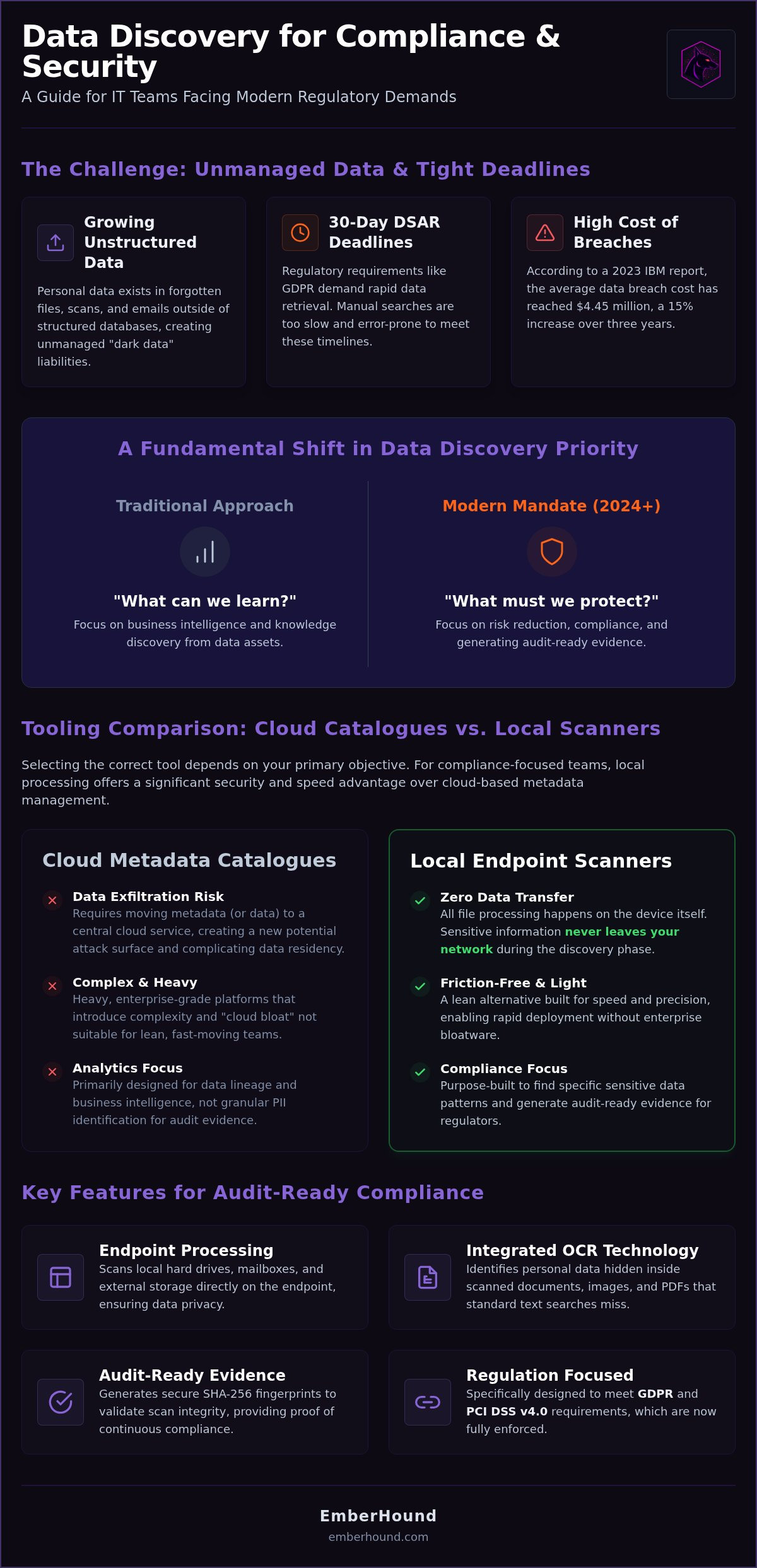
Traditional tools often treat data discovery as a branch of knowledge discovery in databases and focus on business intelligence. This approach fails the modern Data Protection Officer (DPO). In 2026, the priority has shifted from "what can we learn?" to "what must we protect?". Compliance-led discovery focuses on audit readiness and the immediate identification of personal data to satisfy GDPR and PCI DSS v4.0 requirements. It prioritises data security over analytical value. This shift is mandatory now that the future-dated requirements of PCI DSS v4.0 are fully enforced as of March 2025.
Why manual discovery is no longer viable
You can't rely on manual spreadsheets or employee honesty to track data. The scale is too large. According to a 2023 IBM report, the average cost of a data breach reached $4.45 million. This represents a 15% increase over three years. With 3,205 data compromises recorded in the US alone in 2023, the risk of missing a file is a multi-million-pound gamble.
Lean teams face specific pressures that manual processes cannot resolve:
- The 30-day DSAR deadline requires instant retrieval, not week-long manual searches.
- Unstructured data in local mailboxes and external hard drives often bypasses central IT controls.
- Scanned documents and images remain invisible to basic keyword search tools without OCR technology.
Manual efforts are slow and prone to error. They leave you exposed when an auditor asks for proof of continuous compliance. In the current regulatory climate, silence is not a defence.
Categories of sensitive data discovery tools
Selecting the best data discovery software 2024 depends on your operational objective. Generalist tools focus on data relationships and lineage. Compliance tools focus on identifying risk and generating evidence. You must choose a tool that matches your specific regulatory burden rather than one that prioritises metadata analysis. Most software in this market falls into four distinct categories:
- Enterprise data catalogues: These are built for metadata management and large-scale analysis. They help analysts understand data origins but often lack the granular scanning needed for an audit.
- Compliance scanners: These are purpose-built for GDPR and PCI DSS audit readiness. They focus on finding specific patterns like credit card numbers or passport details.
- Endpoint discovery software: These tools scan local hard drives, mailboxes, and external drives. They perform the work locally without moving data to a central cloud.
- OCR-enabled tools: These identify personal data within images and PDFs. This is a critical gap in many legacy systems that only read text-based files.
Enterprise metadata management vs endpoint scanning
Enterprise catalogues are heavy and complex. They require central dashboards and metadata exfiltration to function. This creates unnecessary cloud bloat. It adds a new layer of security risk. Endpoint scanning is a leaner alternative. It processes all files on the device itself. This ensures that sensitive data never leaves your network during the discovery phase. Following Expert Steps And Best Practices helps you distinguish between these models. You don't always need a massive catalogue to fix a compliance gap. For small, overworked teams, the speed of an endpoint scanner is more valuable than the deep analytics of a metadata platform.
Specialised tools for GDPR and PCI DSS
Audit-ready evidence is the priority for compliance teams. You need salted SHA-256 fingerprints to prove the integrity of your scans. Specialised scanners focus on technical enums and severity levels to help you prioritise remediation. They are built for high-stakes environments where a single missed file can lead to significant fines. This is especially relevant now that the transition period for PCI DSS v4.0 has ended. As of March 2025, all assessments must validate against the full set of v4.0 requirements. This includes proving that security controls are actively maintained throughout the year.
OCR technology is a necessity in this category. Many organisations have thousands of scanned receipts, photo IDs, and handwritten forms. These stay invisible to basic keyword search tools. If your scanner cannot read an image, your compliance report is incomplete. You can test your network with a free scan to see if your current tools are missing these hidden risks. Finding the best data discovery software 2024 means looking for tools that bridge the gap between text files and image-based data.
Cloud metadata catalogues vs local endpoint scanners
Selecting the best data discovery software 2024 requires a fundamental choice between centralisation and local control. Cloud platforms are often positioned as the default option for large scale visibility. However, they operate on a model of exfiltration. They require you to move your data - or its metadata - to a third party dashboard for analysis. This creates a central repository of your most sensitive liabilities. To find the best data discovery software 2024 for your organisation, you must decide if you can afford the risk of moving that information.
Local endpoint scanning is the no-nonsense alternative for lean teams. It ensures that all file processing occurs on the device itself. The software identifies personal data where it lives, whether that is on a local hard drive or an external storage device. This architecture maintains a credible security posture because your sensitive information never leaves your network. It is the definitive way to prevent data leaks during the discovery process.
The security implications of file exfiltration
Exfiltration introduces unnecessary risk. When you move metadata to the cloud, you are building a map of your vulnerabilities in an environment you don't fully control. If that central platform is breached, an attacker has a direct guide to your most sensitive data. Local scanners eliminate this threat. They use TLS 1.3 with AES-256 encryption at rest to secure the results on the endpoint. By keeping the processing local, you remove the "middleman" risk. You get the visibility you need without the anxiety of a secondary data breach.
Performance considerations for remote workforces
Remote workforces require tools that don't drain system resources. Cloud-based tools often cause "cloud bloat" because they consume high bandwidth whilst trying to upload metadata from thousands of remote endpoints. This is a friction point for employees on slow home connections. Local scanning is more efficient. It uses the endpoint's own processing power to scan local mailboxes and files. This avoids the latency associated with central uploads. Scans run in the background without affecting the user's experience. You get audit-ready evidence without the performance tax on your network or your staff.
Selection criteria for compliance and security teams
Choosing the best data discovery software 2024 requires a focus on your specific regulatory framework. GDPR and PCI DSS v4.0 have different technical requirements. You must select a tool that provides the exact evidence an auditor expects. If you operate under PCI DSS, you need to prove that security controls are active and documented. For GDPR, you need to find personal data across every device in your network before a 30-day deadline. You don't have time for a tool that creates more work than it solves.
Mapping your data landscape
Visibility is the first hurdle. You cannot protect what you cannot see. Most teams struggle with data hidden in scanned documents, PDFs, or photos. You must check for OCR capabilities to ensure you can identify personal data in files that standard text-based searches ignore. A credible map of your data landscape includes local mailboxes and external hard drives. This is where dark data usually hides. If your tool only scans central servers, it leaves a significant gap in your compliance posture.
Evaluating audit-readiness and evidence generation
Auditors don't take your word for it. They need proof. Look for features that generate audit-ready evidence automatically. This includes masked previews that allow you to verify a match without exposing the actual sensitive data. You also need salted SHA-256 fingerprints. These provide a cryptographic guarantee that your scan results haven't been tampered with. The best data discovery software 2024 should produce these reports instantly. You shouldn't have to spend hours manually compiling evidence in a spreadsheet after the scan is finished.
Handling subject access requests efficiently
The 30-day DSAR deadline is a constant source of anxiety. You need a process that is fast and repeatable. Deployment speed is a critical factor here. You should avoid software that requires lengthy deployment phases or complex on-premise hosting. Lean teams need a tool that works immediately. A friction-free onboarding process allows you to start scanning endpoints within minutes. This ensures you can find the relevant data and issue a disclosure pack before the legal deadline expires. Speed is your best defence against regulatory fines.
EmberHound: Direct data discovery for GDPR and PCI DSS
EmberHound is the technically robust answer for teams tired of enterprise bloatware. It provides direct visibility into your network risks without the complexity of traditional suites. By focusing on endpoint-only scanning, it ensures that your sensitive data never leaves your infrastructure. This is a critical distinction when searching for the best data discovery software 2024. Most platforms exfiltrate metadata to a central dashboard, but we keep the processing local to the device.
All data in transit is protected by TLS 1.3, and results are secured with AES-256 encryption at rest. Salted SHA-256 fingerprints provide a cryptographic proof that your data inventory is accurate and unchanged, allowing you to present a verifiable audit trail without exposing the underlying personal data. This allows you to provide a clean record of compliance whilst maintaining the privacy of your users. You get the certainty of a secure audit trail without the risk of a secondary data breach.
Friction-free compliance for lean IT teams
Small teams don't have time for complex deployment phases or "on-premise dashboard" hosting. EmberHound is built for speed and immediate impact. You can start scanning endpoints in minutes. The platform includes specialised DSAR disclosure packs to help you fulfil data requests within the mandatory 30-day window. It removes the manual burden of searching through thousands of files to find one individual's information. This automation turns a high-stakes panic into a methodical, repeatable process. It is a specialist tool for professionals who value their time.
OCR and mailbox scanning add-ons
Dark data is often the biggest risk to a business. EmberHound offers OCR scanning to read text inside images and PDFs. You can also scan local mailboxes and external hard drives. These features ensure that no personal data stays hidden in a forgotten attachment or a scanned ID card. It provides a level of visibility that standard keyword tools simply cannot match. You get a complete map of your unstructured data liabilities across the entire network. This covers the gaps that legacy scanners often ignore, ensuring you are ready for any regulatory inspection.
Usage-based pricing for growing organisations
We reject the traditional model of expensive, multi-year enterprise contracts. Our usage-based pricing is designed for lean IT teams who need to pay for exactly what they use. It allows you to scale your discovery efforts as your data volume grows. There is no bloatware and no hidden costs. This model makes it the best data discovery software 2024 for organisations that value efficiency over corporate fluff. It ensures you aren't paying for tools that sit idle between audit cycles. You get a high-stakes solution that fits a lean budget.
Secure your network before the next audit
Data protection is a continuous requirement rather than a one-off task. You've seen how local endpoint scanning prevents the risks of metadata exfiltration whilst identifying personal data in hidden corners like mailboxes and scanned images. Selecting the best data discovery software 2024 involves prioritising tools that provide audit-ready evidence through salted SHA-256 fingerprints. This approach avoids the weight of enterprise bloatware and ensures your sensitive information stays within your network at all times.
Lean IT teams can now meet strict 30-day DSAR deadlines and PCI DSS v4.0 standards with a usage-based model that scales with their specific needs. You don't need a complex deployment phase or mandatory long-term contracts to gain total visibility over your network liabilities. It is time to replace manual anxiety and spreadsheet tracking with technical certainty. You can secure your organisation today with a solution built for speed, precision, and absolute data sovereignty.
Frequently Asked Questions
What is the difference between data discovery and data mapping?
Data discovery is the active process of identifying and categorising sensitive data across your entire network. Data mapping is the subsequent documentation of how that data flows through your organisation and where it is stored. Discovery tools automate the search and find phase, whilst mapping provides the high-level inventory required for GDPR Article 30 records of processing activities. You need both to maintain a complete compliance posture and ensure no data stays hidden.
How does OCR help with identifying sensitive data?
OCR technology allows software to read text within image files, such as scanned passports, driver's licences, or handwritten receipts. Standard search tools often miss this hidden information because they only scan text-based documents. By using OCR, you can identify personal data in unstructured formats that would otherwise stay invisible to your compliance team. This reduces the risk of an incomplete audit or a missed file during a subject access request.
Can data discovery software scan password-protected files?
Most data discovery tools require the file to be accessible to the scanner's permissions. If a file is encrypted or password-protected at the system level, the software typically cannot read the internal content without the relevant credentials. To find the best data discovery software 2024 for your needs, you should verify how your chosen tool handles restricted permissions and encrypted archives during the initial deployment phase to avoid any gaps in your visibility.
Is local endpoint scanning more secure than cloud-based discovery?
Local endpoint scanning is generally more secure because it eliminates the need for file exfiltration. All processing occurs on the device itself, meaning sensitive information never leaves your network to be stored on a third-party cloud dashboard. This architecture reduces the attack surface and ensures that your discovery process doesn't inadvertently create a secondary data breach risk during the analysis phase. It keeps absolute control in the hands of your IT team.
How do I meet the 30-day DSAR deadline using software?
You can meet the 30-day deadline by using automated tools to locate every instance of a subject's personal data across your entire network instantly. Manual searches are too slow for modern data volumes. Software like EmberHound provides specialised DSAR disclosure packs that compile findings into a ready-to-issue format. This automation ensures you can fulfil the request accurately without the panic of a manual search or the risk of missing relevant files.
Does data discovery software help with PCI DSS 4.0 requirements?
Yes, it is a critical tool for meeting PCI DSS 4.0 standards, which now require continuous evidence that security controls are maintained. The software identifies primary account numbers (PAN) in unstructured storage and provides audit-ready evidence via salted SHA-256 fingerprints. This ensures you can prove to an assessor that cardholder data is only stored in approved, secure locations throughout the year. It is a core part of the best data discovery software 2024.
What is the risk of "dark data" in a business environment?
Dark data represents unmanaged information that exists outside of your structured databases, such as forgotten email attachments or local desktop files. The primary risk is that this data often contains sensitive personal information that your security team is unaware of. If a breach occurs, this unknown data becomes a massive liability, as you cannot protect or monitor information that you haven't identified. It is a common cause of unexpected compliance failures and fines.
How often should an organisation run a data discovery scan?
Organisations should move away from annual audits toward a model of continuous or monthly scanning. PCI DSS 4.0 specifically emphasises the importance of ongoing monitoring rather than a single point-in-time assessment. Regular scans ensure that new data created by employees is identified and secured before it becomes a compliance risk. Frequent discovery helps maintain an accurate, up-to-date map of your sensitive data landscape and keeps your team audit-ready at all times.


